
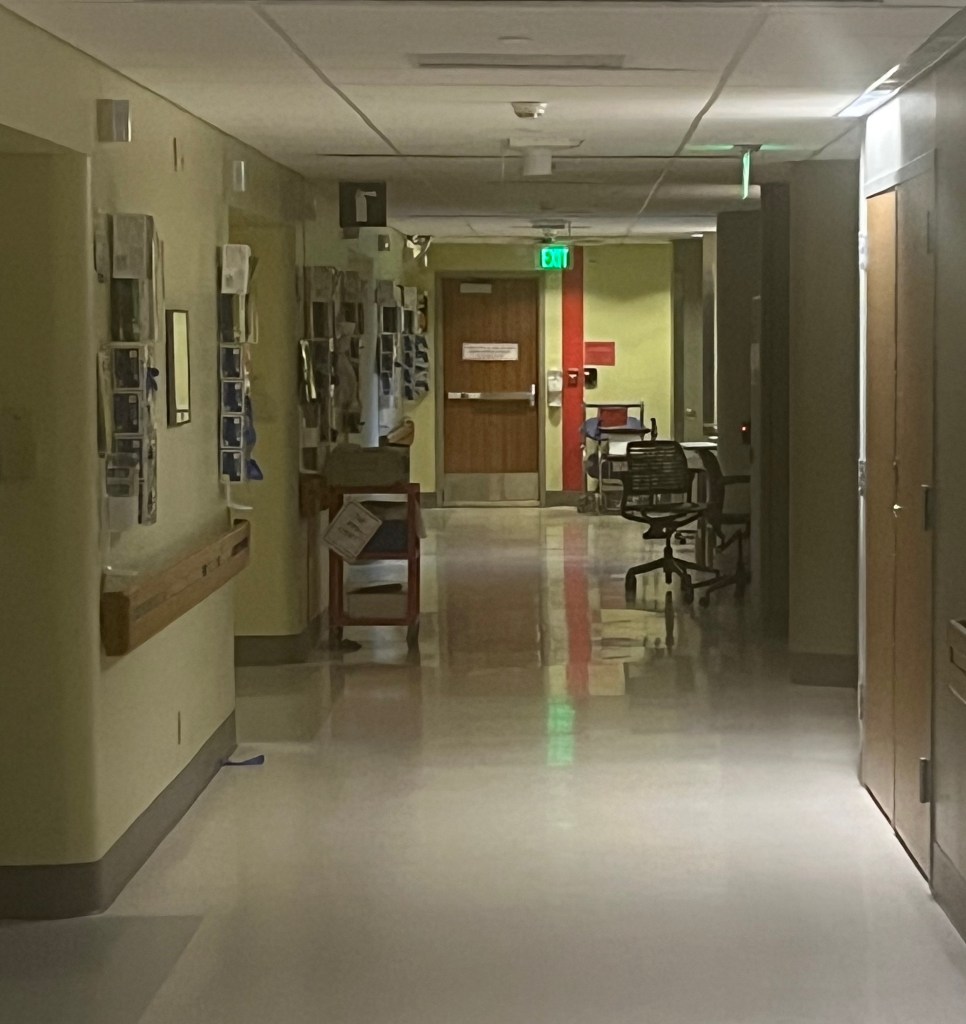
I entered a new, unfamiliar world on May 20 when I was wheeled from the surgery recovery room to an oncology section of University of Washington Hospital.
I shared Floor 7 with other cancer patients. I rarely saw them. It was a quiet, eerie existence. I can only surmise other patients were much sicker than I. They rarely left their rooms, except to be wheeled to or from surgery. On my daily walks through these lonely hallways, I only encountered nurses and visitors during my three-night stay on Floor 7.
Yet, conversations among family were overheard. During a late Friday night stroll, I encountered a family member on his cell phone delivering sad, tragic news to a loved one.
“He’s done,” the man, standing outside the loved one’s room, said to the person on the other end. “He’s done fighting. He can’t go anymore. He wants to die with dignity.”
Even though the door was closed to the room, I had seen the man in the room on previous walks. He was always sleeping, and appeared very pale. It was heartbreaking to hear he’d given up the fight.
I found the staff on Floor 7 to be hard-working, kind and patient. I don’t know how they do what they do. They all worked three, 12-hour shifts. I got to know all of them really well. Not bad for an introvert.
Rachel, the RN my first night, was a cancer survivor. Her entire stomach had been removed, and her esophagus connected directly to her small intestine. She eats only small portions, which explains why she was fit. Because of her experience, she chose to resume her nursing career in oncology. She has two young children and commutes from Snohomish.
Pauline, who grew up on Bainbridge Island, helped me on my first walk after surgery, at 3:30 a.m. Hannah, who grew up in Edmonds and is only three years removed from nursing school at Seattle U, was amazingly sweet and kind. She lives alone with her cat.
There there was Seedy, He is of African descent, and commutes to UW from Port Orchard. That’s an hour and a half drive in no traffic.
Seedy was working at Mount Sinai Hospital in New York City when the global pandemic arrived in March 2020. He shared horror stories of working on a floor where there was “COVID in every room.” Mount Sinai was the hospital where patients were dying so fast they were stored in refrigerated trucks outside.
“The hardest part was watching people die, unable to be with family,” he said in broken English. “Instead, they died in front of me, a complete stranger.” Despite being exposed to many COVID victims, Seedy said he never contracted COVID.
Seedy’s shift ended at 7 a.m., the day of my discharge. Before he left for the long drive back to Port Orchard, he stopped in to say goodbye.
“I hope to never see you again,” he told me, good-naturedly.
I’d be happy with that. A few hours later, I left Floor 7, for hopefully the last time.

Leave a Reply