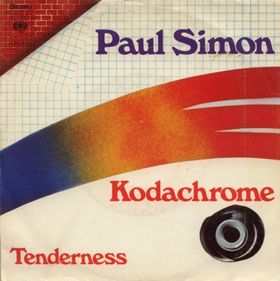
Some of you may be old enough to remember Paul Simon’s smash hit “Kodachrome” from 1973. Here’s a variation of that song, titled “Chromofobe,” the rare kidney cancer my surgeon Sarah Psutka removed.
When I think back, on all the years, that I was healthy,
It’s a wonder I was sick at all.
But as you age, and scans and x-rays look beneath the hood,
They find tumors that really aren’t so small.
Chromofobe
They said it’s a solid mass lesion,
It’s been there for many a season,
Makes me think I don’t have a clue at all, oh yeah;
It was a carcinoma,
It tried to make a permanent home-a,
My surgeon done take that Chromofobe away.
If you took all the surgeons in the Skagit Valley,
Put them all together in one club;
They couldn’t match the skills of one Sarah Psutka,
That’s why I took my kidney to U-Dub.
Chromofobe
They said it’s a solid mass lesion,
It’s been there for many a season,
Makes me think I don’t have a clue at all, oh yeah;
It was a carcinoma,
It tried to make a permanent home-a,
My surgeon done take that Chromofobe away.
My surgeon done take that Chromofobe away My surgeon done take that Chromofobe away My surgeon done take that Chromofobe away
My surgeon done take that Chromofobe My surgeon done take that Chromofobe My surgeon done take that Chromofobe away My surgeon done take that Chromofobe She sent this boy, right back home My surgeon done take that Chromofobe away My surgeon done take that Chromofobe, mm My surgeon done take that Chromofobe away Okay
Below is the song “Kodachrome” by Paul Simon that was popular so many years ago (53, to be exact). Click here to listen:
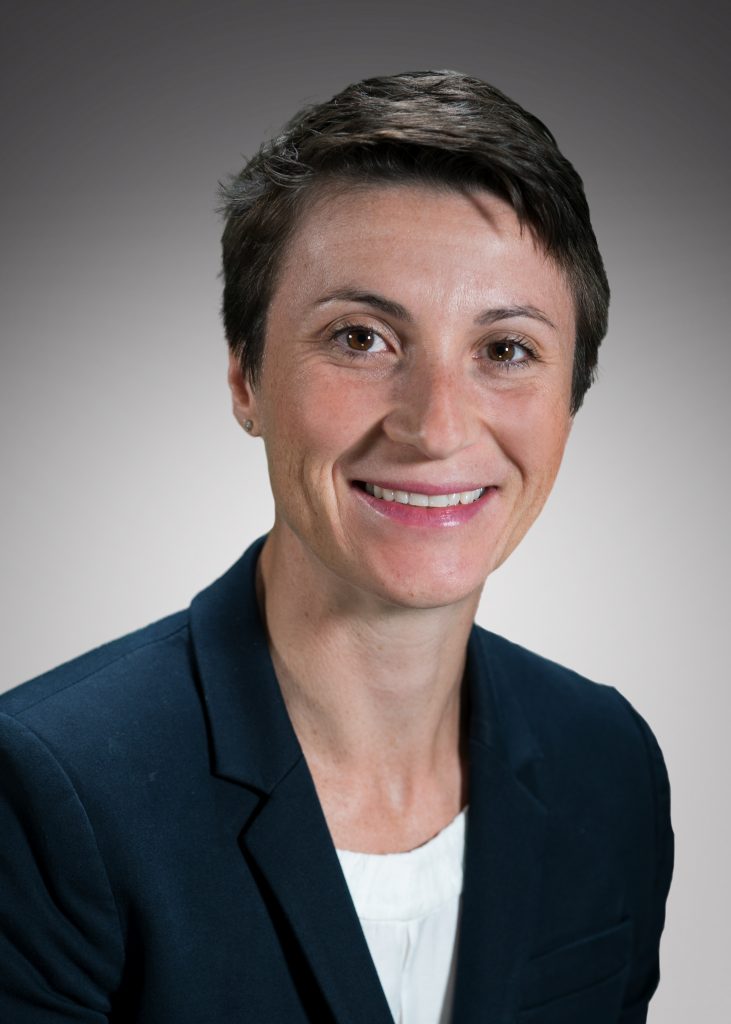
Dr. Sarah Psutka, one of the leading kidney cancer surgeons in the U.S., wouldn’t rest until my kidney was healed. She told me “I think I grew some gray hairs over this one.” She was relentless. She fought for me.
I’m healed!
I yelled those words to anyone within earshot at our lake cabin the evening of August 4. I had just gotten off a Face Time call with Dr. Sarah Psutka, my surgeon at UW Medical Center (Go Dawgs!). The proof was on Dr. Psutka’s computer, as she displayed images from a CT scan taken 24 hours earlier.
“You can see here the kidney has closed up and healing on its own,” said Dr. Psutka pointing to shades of gray and white tissue that I did not fully understand. “I viewed the images last night, and I was hopeful. But I wanted to talk to the radiologist today, and confirm what I saw before I delivered the good news.”
Good news, indeed. All three of our daughters and their families were at the lake to receive the news. But did I really believe it? (More on that later)
Anyone who has read my blog posts over the summer knows I had serious complications following my successful surgery on May 20 to remove a cancerous tumor on my right kidney. There were painful procedures (tubes hooked up to me I didn’t want to be hooked up to). There were sleepless nights. There were moments of despair. There were moments of doubt.
But something happened during the last days of July that changed everything.
Dr. Psutka is one of the leading oncology kidney surgeons in the U.S. She’s used to performing successful surgeries. She’s not used to complications. Vicki and I had a Face Time call with Dr. Psutka on July 17 on the heels of several disappointing drain fluid tests that indicated the kidney was still leaking. Up to that point, procedures designed to expedite the healing process had proven to be futile. Dr. Psutka told us my surgery was one of the more complicated – ok, insert wisecrack here – she had ever performed. Lucky me! She said in her 11 years at the UW she had only one patient that had complications like mine. She said her partner at the UW, who has been there 17 years, has only had three cases similar to mine. Clearly frustrated and searching for answers, Dr. Psutka told us she had reached out to one of her colleagues at the Mayo Clinic in Minnesota for some advice.
“My colleague thinks the drain could be doing more harm than good,” she told us, noting that the second drain put in June 8 after my first infection might be unnecessarily pulling urine from the kidney, spiking my creatinine levels . “He thinks I should pull the drain, the stent and tubes (I’ll spare you the gory details). I prefer a step-by-step approach.”
The drain was pulled on July 20 at UW. A follow-up scan to see if the leak still existed was done three days later. It indeed showed a small collection of perinephric fluid “compatible with a urine leak.”
Not good news. Dr. Psutka’s assistant, Jade Meaker, met with us to explain the next move was to install a temporary “nephrostomy tube” into my right kidney to drain into a bag attached to my leg. This procedure, it was explained, would allow the surgically-repaired kidney to heal. The left kidney would drain naturally.
Jade said the procedure was basically a ‘Hail Mary,’” or in other words a last-gasp effort before Dr. Psutka would have to remove the entire right kidney that she had operated on only two months earlier. And trust me, she did NOT want to take that kidney out.
We were devastated. Our planned trip to Europe in September that was a year in the making was now in question. My psyche, rocked by one bit of bad news after another, was also in question. The procedure, scheduled for the following Monday July 27, would be invasive.
This is when the tide began to turn. It was the “comeback after the setback” I had hoped for, and inferred in my earlier blog posts.
Dr. Psutka, after performing a surgery at Harborview Medical Center on Friday evening, July 24, had taken a red-eye flight the same night to Indianapolis. She was in Indianapolis for the weekend to speak at a medical convention. For all I know, she went off script and told the gathered group of doctors she was baffled by complications with a particular patient from a partial nephrectomy surgery.
She called me Saturday morning that weekend, asking “How are you feeling.” I replied “I’m feeling great.” Based on my CT results two days earlier, without saying as much, Dr. Psutka suspected I would get another infection. On Sunday evening, while on her flight back to Seattle, and just hours before my 10 a.m. appointment the next day for my nephrostomy tube procedure, she texted me, “How are you feeling.” Again, I replied “I feel fine.” Full disclosure here. How many doctors give their patients their private cell phone number and call them on weekends and when they’re out of state?
At this point, I had come to a crossroads. The night before, I sensed an inner voice telling me, “this kidney could heal on its own.” I debated whether to even bring that up with Dr. Psutka – would she think I was crazy? – but finally decided to do so, asking in a text if the kidney could heal without intervention. She got right back to me: “I’ve been thinking the same thing over the weekend.” She said she would call me when she landed in Seattle.
An hour or so later, while Dr. Psutka was on an Uber ride from Sea-Tac Airport to her home in Seattle, she called. She said “we have two good options here. We do the safe thing by putting in the (nephrostomy) tube, or see if it will heal on its own. There is no clear (correct) solution.”
I said, “let’s see if it will heal.”
Less than 12 hours before a team of doctors, nurses and an anesthesiologist were scheduled to install the nephrostomy tube and remove the small collection of fluid from the suspected leak, the procedure was called off. Instead, Dr. Psutka removed the stent and “tubes” the next day (Monday), as the colleague from the Mayo Clinic had recommended.
Afterward, Dr. Psutka said she wanted to speak with Vicki, who was in the waiting room, to see if she had any questions. Vicki, for whatever reason, told Dr. Psutka “that kidney is going to heal on its own. A lot of people are praying for Rick.” Vicki said Dr. Psutka looked doubtful. As we know now, the results from the CT scan the next week proved Vicki was right.
Fast forward to August 24, about three weeks after I had received the initial news from Dr. Psutka at the lake cabin that my kidney had healed. I was scheduled for two more CT scans. One was the three-month checkup to see if there was any evidence of cancer at the surgical site or nearby organs. The other was to take yet another look at the right kidney, to make sure it had healed up.
I must admit I approached the scans and subsequent follow-up appointment with Dr. Psutka with some fear and trepidation. I had experienced some PTSD over the course of the summer. I was a little skeptical. In my mind, there remained “scar tissue.”
Vicki was a little puzzled by this, telling me “your kidney has healed. Dr. Psutka already told you. Why are you nervous?”
It occurred to me I had not completely bought into the fact I had “been healed,” no matter what I yelled that day at the lake cabin.
It reminded me of a story in the Bible. In Mark 9, a desperate father asks Jesus to heal his son, crying out with both faith and doubt. The father basically tells Jesus in verse 22 “heal my son if you can.”
Jesus replies to the father “If you can? All things are possible to him who believes.”
Jesus could have said “you don’t have enough faith, so I’m just movin’ on to someone else.” But he doesn’t do that. What happens next is very moving.
Verse 24 says the boy’s father told Jesus, “I do believe; help me in my unbelief.” Jesus rebukes the unclean spirit in the boy, and heals him.
Both of my scans on August 24 came back clean. I have no cancer, thanks to Dr. Psutka, who preserved 85 percent of my right kidney. I have some collateral damage from some procedures. But my kidney has healed. I asked Dr. Psutka, “could it start leaking again?” She replied, “only if I opened you up again and starting cutting on it.” She cleared me for our trip to Europe.
How often have we prayed for something, God answers that prayer, and we attribute the favorable outcome to something else? We all know that there are times God doesn’t grant us what we’ve prayed for. But does that cloud our ability to appreciate when prayer is answered?
I know, without a doubt, God has led me through several storms in my life. I am not unique. We all go through storms. It can be a financial storm. It can be a relationship storm. It can be a career storm. It can be a medical storm. This battle with kidney cancer was a storm.
There will be more storms in the future. I will be fearful. And yes, I probably will be doubtful. But in my finiteness, in my short-sightedness, in my weakness, I will say:
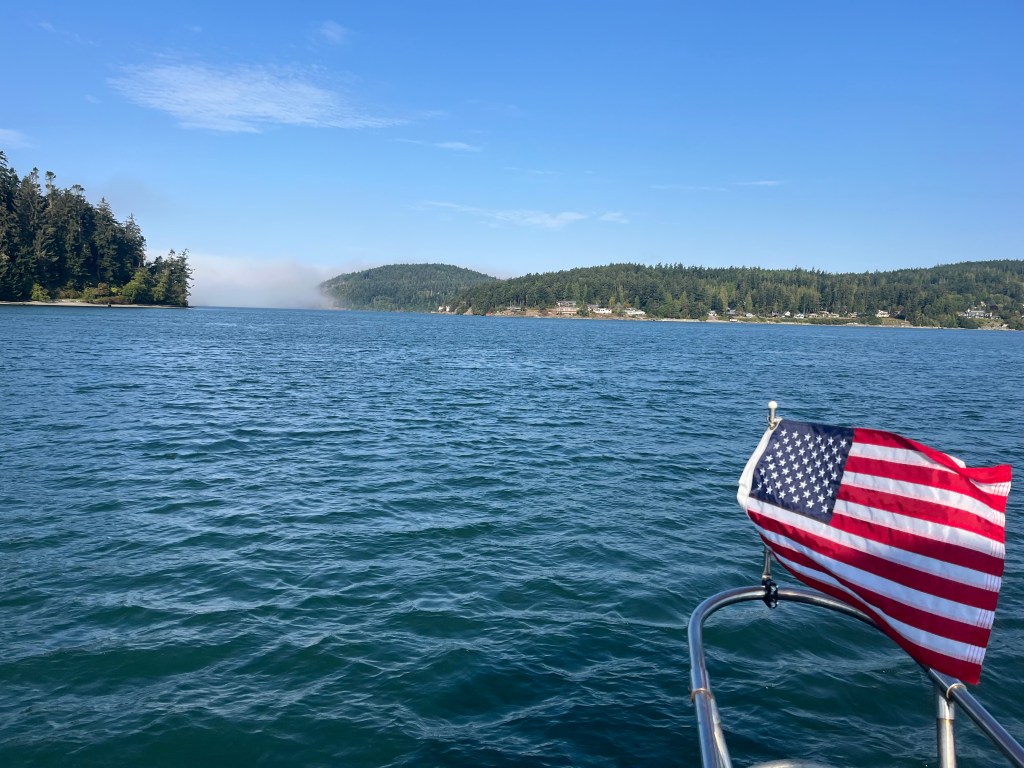
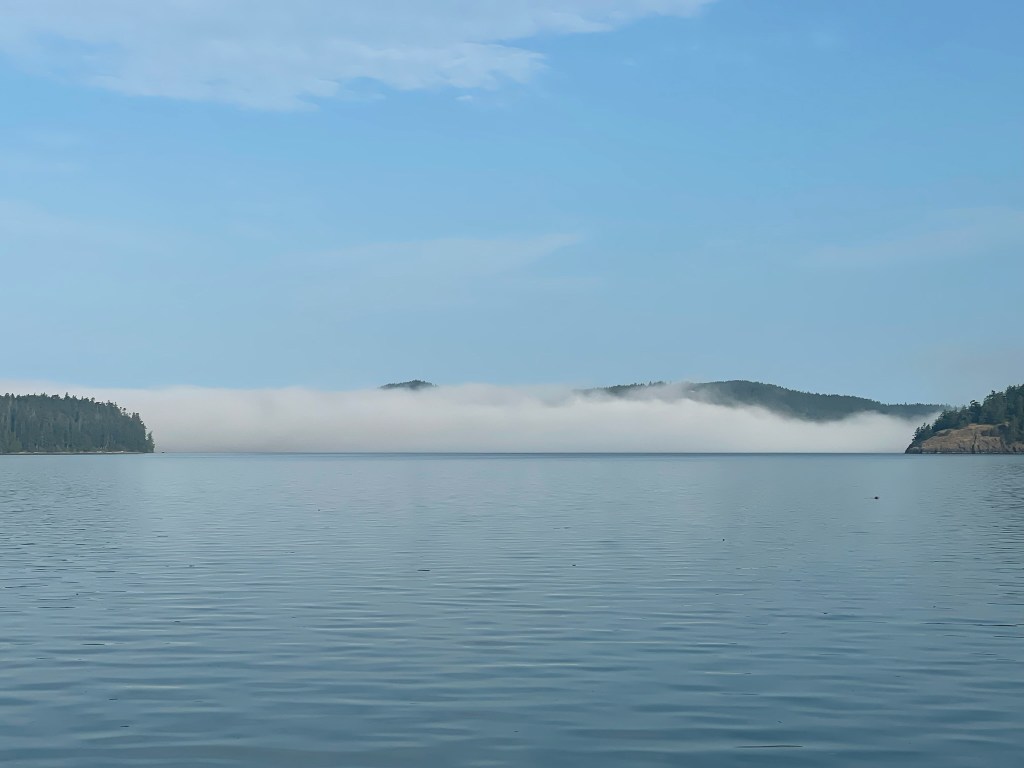
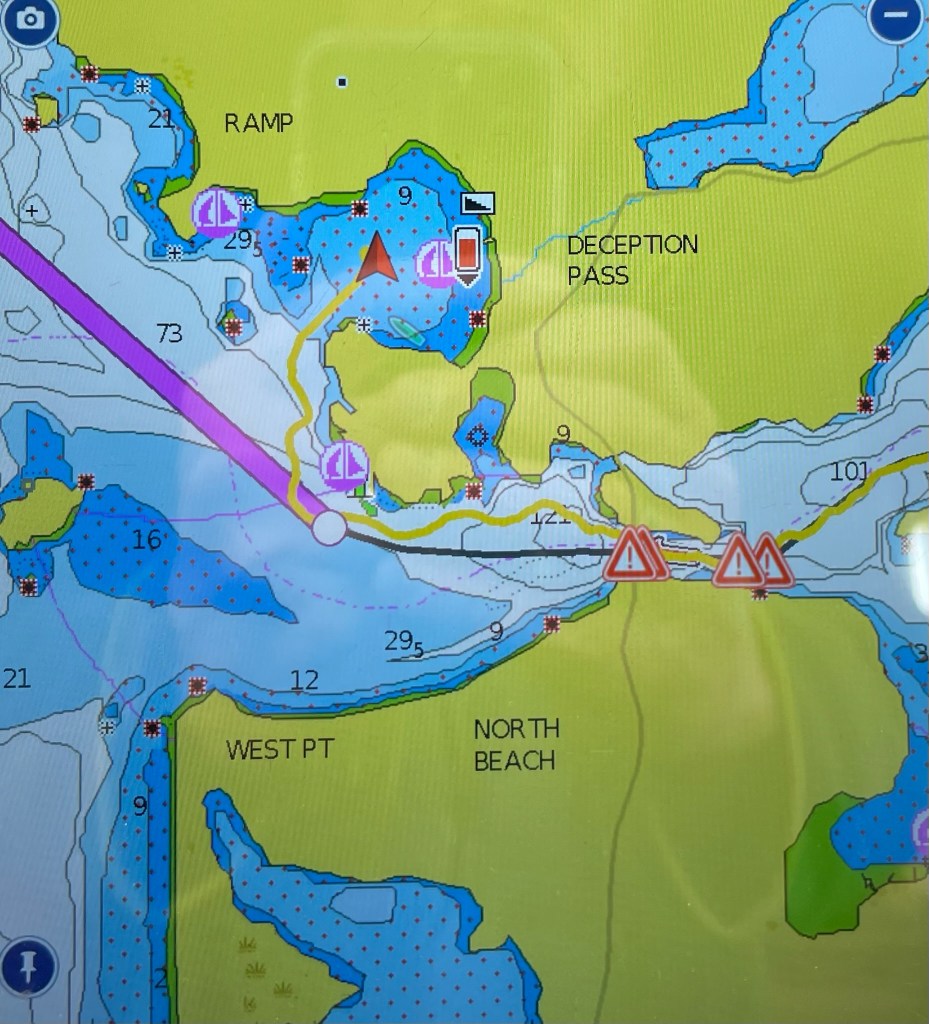
The first sighting of fog we saw as we left Hope Island for Deception Pass in the early morning of Day 2 of our boat trip. The fog bank would be a harbinger of things to come. The fog bank loomed larger as we got closer to the entrance to Deception Pass.The fog was so thick through Deception Pass we barely saw the bridge.
Our good ship and crew was a bone to be chewed when the thick fog of Whidbey comes early.
Shades of Gordon Lightfoot’s “Wreck of the Edmund Fitzgerald?” Most definitely. That song kept playing in my head in the days after my brother-in-law Kent Oldenburger, longtime friend Bob Swenson and I had a white-knuckle experience the morning of August 18 while navigating Deception Pass between Whidbey and Fidalgo islands. (For background, see my last post).
We encountered blinding fog entering the pass, and five-foot swells just west of the bridge, much to our surprise. Bob and I were on the bow deck when we were pounded by those big waves. When water came over the bow, Bob and I knew we were in trouble. Kent screamed for us to get back into the cabin.
After the trip, I sat down and wrote some lyrics to a song. Yes, I took some liberties. Kent’s wife, Kimberly, technically isn’t a part-owner of the boat. But I needed a rhyme! (she is proud of Kent!) And for the record, Kent was really worried, to a point of obsessiveness, about the lasagne, even if we ate it the previous evening!
Anyway, I digress. I emailed the lyrics to Bob. A day later, he replied with a url to this song. Bob had sent the lyrics to a website that, with the help of AI, turns text into studio-quality music. The tune doesn’t sound anything like Gord’s 1976 smash hit. But I have to admit it’s a pretty catchy melody.
Deception, it’s said, delivers fear and pure dread,
when the morning fog travels with light speed.
The boat, well cared for, weighing 1,000 pounds more
than the trawler Persistence weighed empty;
Our good ship and crew was a bone to be chewed
when the thick fog of Whidbey comes early.
The ship was the pride of Chuck, Kent and his bride,
Coming up from the locks in Seattle;
As trawlers will go, it’s a bit older we know,
with a good captain and a crew easily rattled.
Concluding some plans with a forecast in hand
when we left fully loaded for Roche Harbor;
But early that morn, when the ship was seaborne,
Could it be the fog feared on the doppler?
When lunch prep came, Kent came on deck sayin’
“Bob, will you please check on the lasagne”;
At 11 a.m., as the 5-foot swells came in, he said,
“Fellas, it’s too rough to feed ya.”
The captain exclaimed we had water comin’ in,
yelling “Bob, Rick, get back in the cabin;”
Fog so thick we could not see, our knees were wobbly,
Could it be the boat wreck we’d be fearin’?
Does anyone know, why we had to just go,
and test Deception Pass’ superpowers;
We look back and say we’d have made Bowman’s Bay,
in the p.m. well under an hour.
We might have cracked up, we might have capsized
We might have been thrown in the water;
But all we can say, we’re still alive today
We went home to our wives, sons and daughters.
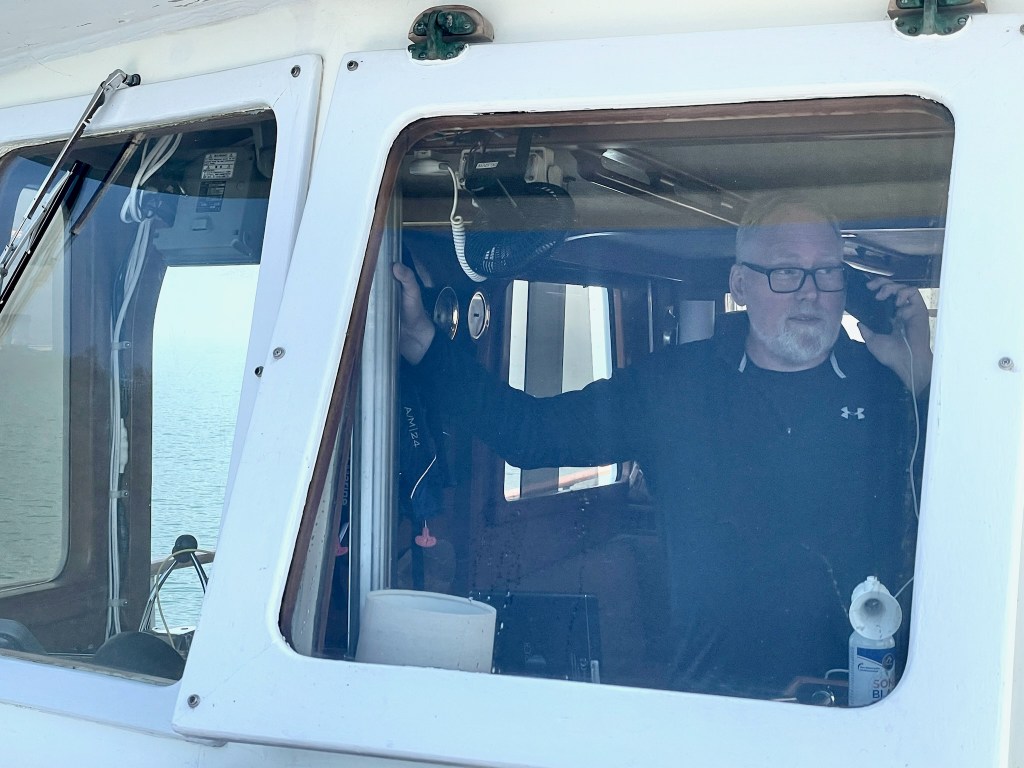
This was the display screen on the sonar Kent was looking at while trying to steer Persistence through Deception Pass. We were able to make it to the safety of Bowman’s Bay, which you can see near the top of the screen.Captain Kent in the cabin
The last video Bob shot before things really got nasty, and it was clear neither Bob nor I were safe outside the cabin of the boat.
“Lund, Sven and Ole” on the fly bridge of Kent’s trawler Persistence in Roche Harbor.
I could get used to the lifestyle of a boater. Owning a boat and cruising on the water means trading human schedules for the more laid-back rhythms of nature. Days are measured by tides, sunrises, water currents and wind instead of clocks. It offers quiet anchorages, endless horizons, and a deep sense of freedom.
In the photo above, anchored in idyllic, sun-kissed Roche Harbor on the upper deck of my brother-law Kent’s 34-foot trawler, we had just devoured a meal of barbecued steaks, rice and salad. Then we piled into the dingy and motored into Roche Harbor Resort for some ice cream, a little window-shopping and a lot of gawking at multi-million-dollar super yachts parked at the dock.
In the end, however, I would be a poor boater. I would be the one who would do something stupid, similar to what we heard on the marine scanner a night earlier while moored at Hope Island. A boat had run aground near the mouth of the La Conner Channel. Kent had warned us beforehand that the entrance to La Conner and the Swinomish Channel was dangerously shallow at low tide. The boater placed a distress call to the Coast Guard, asking for a tow. I hope he had good insurance.
Fortunately, we leave the boat driving – at least the high-level navigation portions – to our trusty captain Kent. Bob Swenson and I are merely deckhands. We follow Kent’s orders – or try to anyway – whether it be securing mooring lines or deploying fenders the moment the captain gives the orders to dock.
This was our “second annual” boat trip. Last August, we cruised central Puget Sound, with visits to Blake Island and Poulsbo. This time, we ventured north, all the way to the upper reaches of the San Juan Islands. To reach our destination of Roche Harbor on Day 2, it meant a 9 1/2-hour trip to Hope Island near La Conner. That put us in a good spot to navigate Deception Pass by 9 a.m. the next morning at “slack tide,” a brief period before the tidal current changes direction from incoming to outgoing.
The fog was so thick through Deception Pass we barely saw the bridge.
Nevertheless, “passing” Deception Pass would be a harrowing experience, largely due to blinding fog and five-foot swells that threatened to swamp our boat. Kent did well to steer our boat with the aid of sonar to the shelter of Bowman’s Bay, where we hung out for a couple hours while waiting for the fog to lift.
From there, we crossed Rosario Strait to Lopez Island, and past Center, Decatur, Blakely, Shaw and Orcas islands, and finally San Juan Island and Roche Harbor. I must say the San Juan Islands are magical this time of year. I am thankful I could take part, as there was a time during my recovery from kidney cancer surgery where the prospects looked bleak.
Below is a map of our boat trip. Hope you enjoy the photos.
Bob and “Captain Kent” on Day 1, as we approach the Mukilteo-Clinton ferry and Whidbey Island.We cruised the Saratoga Passage between familiar Camano and Whidbey islands on our way north. Here, we are about to enter Skagit Bay, where we noticed a different current. The water color also took on a aqua blue hue. As one who was raised in the Skagit Valley, it was interesting for me to see familiar landmarks from the water, as opposed to on land.Our boat joined other boats moored off the shore of Hope Island, a marine state park, near La Conner.A heron sits atop a buoy marker near the entrance to Lopez Pass.Kent and I on the bow of Persistence.I barbecued New York steaks for dinner at Roche Harbor. Microwaved jasmine rice, a green salad prepared by Bob and non-alcoholic IPA beer rounded out the meal. It was glorious.
Kent drives the dingy from our boat to Roche Harbor Resort after dinner.Historic Hotel de Haro, built in 1886, at Roche Harbor. Presidents Teddy Roosevelt and William Taft, and actor John Wayne are among its most famous guests.A “Colors” ceremony has been a sunset tradition at Roche Harbor since 1957. Resort dock staff members lower the flags of Roche Harbor, Washington state, Great Britain, Canada and the United States. Before the American flag comes down a cannon shot booms through the harbor.Roche Harbor at sunset, as we prepare to head back on the dingy to Persistence.We visited the Mausoleum at Roche Harbor where the pioneer McMillan family is entombed.Our “home on the water,” Persistence, moored in Roche Harbor.The wake behind “Persistence.”Bob and I are dropped off at Friday Harbor on Day 3 for our ferry ride back to Anacortes. Taking our place for the next adventure were boat co-owner Chuck and Kent’s friend John.
Our wedding day, August 13, 1977, at Redeemer Covenant Church in Orangevale, California.
I, take you, Vicki/Rick, to be my wedded wife/husband, to have and to hold from this day forward, for better, for worse, for richer, for poorer,in sickness and in health, to love and to cherish, till death do us part.
We recited those vows 49 years ago today, on a sweltering, late-summer California evening in a small church a few miles east of Sacramento. The “sickness and health” portion of those vows seemed so foreign at the time. We were young, vibrant and carefree.
Decades later, those words hit home. In February, I was diagnosed with kidney cancer. While the surgery in May was a success – no cancer was found in nearby organs or in the margins – complications ensued. I had an infection, followed by several weeks of procedures designed to speed up the healing process in my leaking, surgically-repaired right kidney. It was hard. It was often painful. It was tiresome.
Vicki wearing “protective gear” during my second hospitalization for an infection at University of Washington Medical Center. The day before my release, the infectious disease team at UW got involved in my care, saying I had tested positive for “MRSA.” That meant anyone who entered my room, including nurses, had to don protective clothing. My surgeon would later confide that this was an overreaction.
But the girl I married never wavered. If you know anything about Vicki, once she commits to something, she’s “all in,” whether that’s to a task, her daughters, her grandchildren, or her husband. That meant long days at the UW Hospital when I was admitted there. That meant multiple trips with me to the hospital for tests and follow-up procedures. That meant changing bandages at two different drain sites on a daily basis. That meant missing out on social events because she’d rather be at my side. Thankfully, I’ve come out the other side of this ordeal.
Of course, I was not surprised that Vicki would respond this way. I’ve known her devotion, her unwavering commitment and her tenacity for a very long time. It’s who she is.
I met Vicki in 1975. We were students at North Park College in Chicago. I was in charge of a school Valentine’s Day dance. I needed a date. Vicki and I had worked in the school cafeteria together, so we knew each other. I asked her to the dance. She said “yes.” We had a good time.
A couple weeks later was “Turnabout” on campus. “Turnabout,” at least back in the ’70s, was when normal social roles were flipped, and girls asked the guys out. Vicki took me out to dinner at a nice restaurant in downtown Chicago. We started dating.
I have to admit I was a little surprised by these developments. Vicki was absolutely gorgeous. She could have dated anyone she wanted on campus. I believe I had “outkicked my coverage.” (For those of you who have never heard that term, google it). As it turned out, the affection was mutual. It was obvious early on that there was immediately “chemistry” between us, i.e. a physical attraction.
Vicki and I met at North Park College in Chicago.
I was a sophomore. She was a freshman.The problem was, I wouldn’t be returning to North Park for my junior year. I had already made up my mind I was transferring to Western Washington University. To be honest, when she returned to California and I to Washington at the end of the ’74-’75 school year, I thought that was the end of the relationship. Boy was I wrong. She kept it alive, inviting me to Sacramento that summer to meet her family.
During that year of separation – she in Chicago, me in Mount Vernon – I learned a lot about Vicki. She was also beautiful on the inside. She was loyal. She was committed. Our relationship during that year actually grew deeper. During the few occasions we got together, we learned we shared the same values.
We both wanted to become people molded in the likeness of Jesus. We both wanted to use our gifts, not for ourselves, but to serve others and the “Body of Christ,” i.e. the Church, and bring glory to His name. We shared a Puritan work ethic that had been instilled in us by our parents, a cultural and spiritual belief that hard work, frugality and discipline are core moral duties. As husband and wife, we wanted to be a “team,” where we shared daily responsibilities and made major life and financial decisions together with mutual respect. We would learn later that we were different in many ways, but that each of us had strengths and weaknesses that complimented each other. I married a sinner. She married a bigger one. Each of us were “works in progress.” We gave each other grace.
We’re much older now, though Vicki still has her blonde hair!
Extra grace was required these past six months. But the girl I fell in love with so many years ago never blinked. Always committed. Always a steadfast partner through all of life’s changes.
Here’s to Year 50, my love. It’s going to be a good one.
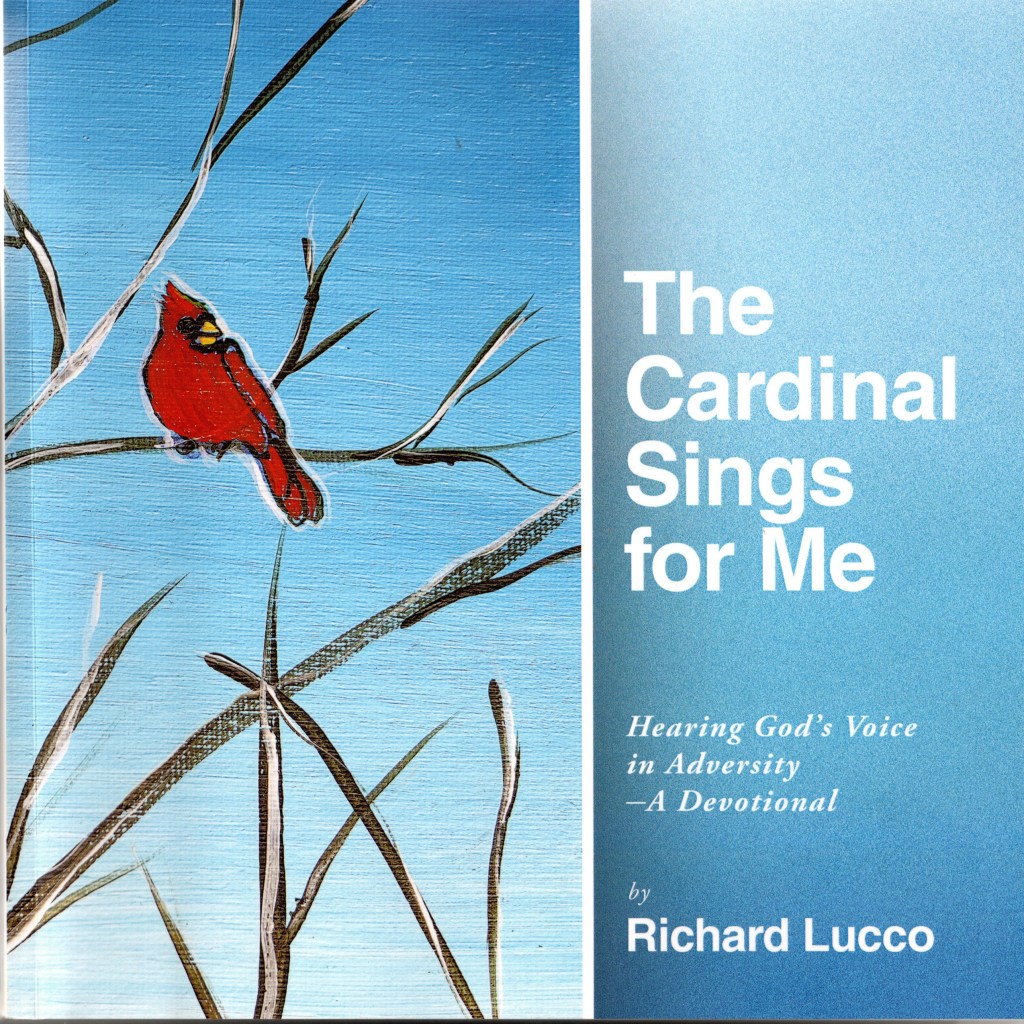
The Covenant Church put together this book of devotional writings from Dick Lucco after the former Covenant pastor died from prostate cancer in 2022.
I’ve had a lot of time on my hands while recovering from kidney cancer surgery. Vicki and I have watched a lot of World Cup soccer – too many, to be quite honest, because I’m not really a big soccer fan – and a wide assortment of Netflix movies. It’s also been an opportunity to catch up on some reading.
My favorite book has been “The Cardinal Sings for Me.” It’s a collection of devotionals by Dick Lucco, a longtime pastor and conference superintendent in the Covenant Church. The devotionals were written from March 2020 through May 2021 for the congregation he was serving, Northwest Covenant in Mount Prospect, Illinois, during the height of the COVID-19 global pandemic.
While some of the devotionals were written to help his congregation deal with the confinements of the pandemic, many of his writings were deeply personal. Dick was simultaneously dealing with the ups and downs of his own battle with prostate cancer, which he eventually succumbed to. He passed away on May 17, 2022, just one day shy of his 71st birthday.
His writings are humorous and sad, touching and deeply spiritual. He often makes light of his cancer treatment. But he’s also brutally honest about his “bad days,” writing in one devotional, “there are days – and this is one of them for me – when I can’t seem to get out of a ditch of discouragement and despair.” But it’s in those dark moments, however, that Dick says God changes his attitude to a spirit of gratitude.
That’s where the title of the book comes in. Dick was fascinated with the cardinal. The striking, vivid red of the male cardinal, though never mentioned in the Bible, is widely seen as a symbol of hope and God’s presence. In his book, Dick quotes Emily Dickinson: “Hope is the thing with feathers that perches in the soul.” Dick writes in his book there “were and are times when I desperately need hope to perch in my soul.”
I suspect that during the lockdown of the pandemic Dick spent many days staring out the window at this beautiful bird that is plentiful in the midwest. While other birds fly south for the winter – and you could say when our health and other life challenges head south – the devoted cardinal remains rooted in the dark, gray days of the midwest winter. It’s also probably no coincidence that in the Catholic Church a cardinal is a high-ranking bishop or priest.
Dick carried a miniature cardinal in his pocket and collected cardinal trinkets. It should also be noted the native of St. Louis was a big fan of the major-league baseball Cardinals. He was known to proudly wear a Cardinals baseball cap while living many years in the Chicago area, a staunch Cubs town.
I resonate with Dick’s writings. Although I am currently cleared of cancer, I too have had many fear-filled nights when my arduous and painful road to recovery from Kidney cancer surgery has seemed hopeless. It is in those moments, however, when I cry out to God, that He gives me just enough hope and peace to fall back asleep.
Perhaps I’ll one day write a book about my experience with kidney cancer. Anyone who knows me well is aware I’m a loyal, longtime fan of University of Washington athletics. In the Bible, the color purple represents royal, majesty and divine authority. The Siberian Husky is a magnificent animal.
Not to make light of Dick’s writings, but perhaps mine will be called “The Husky Barks for Me.”
If you’re like me, it’s hard to be patient. I’m in a waiting game right now. My whole journey since my kidney cancer diagnosis in February has been one delay after another.
My urologist in late February referred me to the University of Washington. But wait! The UW has to process that referral and get approval from my insurance.
My referral was approved and a surgeon was selected to cut out the cancer. But wait! She’s not available to meet with Vicki and I until March 30.
Dr. Sarah Psutka recommends a partial nephrectomy surgery at our meeting. But wait! She tells us she’s booked out and doesn’t think she can do it until the summer (as it turned out, the surgery date was set for May 20).
Dr. Psutka tells us the surgery was a success. The cancerous tumor was removed and there’s no cancer “in the margins” or surrounding tissue. But wait! The drain tube I’m sent home with fails. I begin running a fever, an infection develops, and on June 5 I’m back at UW Hospital for doses of antibiotics. A new, more sophisticated drain tube is placed. Dr. Psutka says there’s a small urinary leak in my kidney that hasn’t healed.
The new drain tube I’m sent home with is working. I feel good. I have no more fever. But wait! Weekly tests for creatinine levels from fluid in the drain tube are higher than they should be. The urinary leak isn’t closing up.
I have a second, less-invasive surgery on July 7 called a “Cystoscopy with Retrograde Pyelogram and Ureteral Stent Insertion.” They found the small leak and closed it off with a temporary stent that is supposed to divert urine away from the kidney and surgical site to let it heal. But wait! My next appointment to see if this is working isn’t until July 23.
So that’s where I am. Still in the waiting room.
As Americans who live in a fast-paced culture, we struggle mightily with waiting. Technology has made us less patient. We’ve conditioned our brains to expect instant gratification. Because high-speed internet and one-day delivery by Amazon rewards us without delay, we get frustrated when daily processes – whether it be the loading of a website or simply waiting for the traffic light to green while giving in to the urge to look at our phone – take more than a few seconds.
I’ve learned from experience that my sense of timing is vastly different than God’s. God has His own timetable. You may have heard this joke that refers to how time flies in the divine realm:
A man is speaking to God and asks, “God, now long is a million years to you?
God answers: “To Me, it’s about a second.”
The man then asks, “God, how much is a million dollars to You?”
God answers, “To Me, it’s like a single penny.”
The man thinks for a moment, gets a hopeful look in his eye, and asks, “God, could you give me one of your pennies?”
And God cheerfully replies, “Sure! Just a second.”
It’s a lighthearted take on the scripture passage 2 Peter 3:8, which says “with the Lord one day is like a thousand years, and thousand years are like one day.”
I’ve learned over the years God is not a vending machine. You don’t press a button, and get what you want right away. If that were the case, we’d probably be spoiled brats. Sometimes the answer is “yes.” Sometimes the answer is “no.” Sometimes the answer is “not yet.” A delay is not necessarily a denial.
Many people have been praying for me. I have felt those prayers. It shouldn’t be lost on me that I am cancer-free. Vicki and I, however, pray daily for complete healing. I feel like my life has been “on hold” for nearly two months. With two different sets of “plumbing for bodily fluids,” it’s difficult to go anywhere in public. We’re missing out on “summer.” I’m largely housebound – and sadly, so is Vicki, who’s been a great nurse and support by the way! I know I couldn’t do this alone.
For whatever reason, I’ve had to walk this path. This is another setback. There have been more times in the middle of the night when things have seemed hopeless. But there’s also been times when a scripture or podcast I’m listening to addresses the specific affliction I’m going through, and gives me hope. In those instances, I choose worship over worry, and praying over panic.
I’m hoping when I come out the other side, I’ll be more appreciative of my overall good health that I’ve taken for granted, have more empathy for people who are cancer-ridden and struggle daily with chronic pain and disease, and be more grateful to a God who has richly blessed me in so many ways.
I had a little setback following my surgery for kidney cancer on May 20. I had barely been declared “cancer-free” when I began to experience over the course of several days a low-grade fever and chills. It ultimately led to a trip to the emergency room at the University of Washington on June 5.
CT scans that evening revealed a 8.3-centimeter-sized abscess below my stitched-up right kidney. In other words, I had a very bad infection. During my four-night stay at UW, I received heavy doses of antibiotics, as well as a much-needed procedure to properly drain the infected site.
I have to admit I had some anxious moments, lying there in my hospital bed, wide awake at 3 in the morning. Sleep-deprived and running a fever, I felt miserable and a little discouraged. I felt like I was in a “battle.”
For the past six months, I’ve been a youth group volunteer leader at Bethany Covenant Church. I work with high-school boys, and in our small group I’ve talked to them about the physical, three-dimensional world we see, and the fourth dimension that we don’t see. The “unseen spiritual world” is beyond human perception, a realm inhabited by God, angels ,and yes, forces of evil that seek to “undo us.” There’s also a fifth dimension. But for those of you who are older, that was a rock group from the seventies!
But I digress. Back to the fourth dimension, where spiritual wars are waged. The Apostle Paul in the book of Ephesians uses the image of a Roman soldier’s armor to describe how believers can stand firm in the midst of spiritual challenges. That armor includes prayer, memorized scripture, and for me even lyrics to a Christian worship song.
One song stood out to me, and helped me during my darkest night, on June 6. It’s called “Way Maker,” by the group Leeland. We sang it almost every week at youth group. To be honest, it isn’t one of my favorite songs. It’s one of those “7-11 songs,” you know where you sing the same 7 words 11 times. But the words were so drilled into my head that they came to me in the midst of my fear that night at UW. The lyrics go like this:
And You are Way maker, miracle worker Promise keeper, light in the darkness My God, that is who You are
The words to the chorus also spoke to God’s presence, as I chose to walk by faith, and not by sight. I was not alone. He was with me “in the fire,” standing next to me. I could not see God working, but had this sense that things were going to be alright.
Even when I don’t see it, You’re workin’ Even when I don’t feel it, You’re workin’ You never stop, You never stop workin’
My surgeon, Dr. Sarah Psutka, said I had a “small leak” from my kidney following surgery. That was always considered a slight risk with a partial nephrectomy. As I write this blog, I am in Day 4 since my release from UW Hospital. I have no fever. The drain is clearing out the bacteria from the infection. I continue to heal and recover from what was a major, delicate surgery. I’m also sleeping better now.
I’ve had my share of setbacks in life, as I’m sure you have. It can be a setback at your job, your career. It can be a broken or a strained relationship. It can be a financial setback. It can be the loss of a loved one. It can be the pain of regret. In those moments, we can’t see the whole picture. But God sees the end of the story. There can be no comeback without a setback. A setback can merely be a stepping stone to success, to a place where God wants us to be.
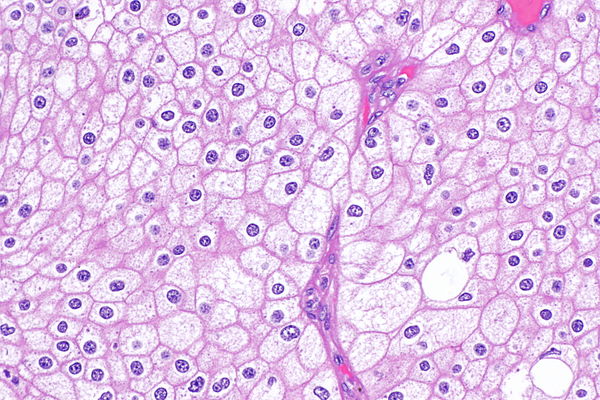
What Chromofobe Renal Cell Carcinoma looks like under the microscope. The subtype of renal cancer only appears in 3-5% of kidney cancer patients.
On the morning of May 20, I was wheeled into one of the 24 operating rooms at the University of Washington Hospital.
I was greeted at the operating table by a host of doctors, anesthesiologists and nurses. Knowing they were working for the “UW brand,” I borrowed a line from “Bow Down to Washington,” the school’s fight song, to give them a little pre-surgery pep talk. They smiled, acknowledging my nervous attempt at last-minute, gallows humor.
The words that followed – and frankly the last ones I remember before waking up seven hours later in the recovery room – were grounded in hope and the significance of the task at hand.
“Today’s going to be a good day, Rick,” said my renowned, gifted surgeon, Dr. Sarah Psutka, before I nodded off into la-la land.
It would be a good day, despite all the pain I had in my abdomen that evening and the days to follow. Dr. Psutka, and her assistant, Dr. Carson, told me they had accomplished what they set out to do. Dr. Psutka had successfully removed the cancerous tumor on my right kidney – which apparently was no small feat – while preserving 85 percent of the otherwise-healthy kidney. Because the mostly-exterior, 6-centimeter tumor was behind the kidney, Dr. Psutka said she had to “flip the kidney over” with her hands to cut the tumor.
Dr. Sarah Psutka is one of the leading kidney cancer surgeons in the U.S. She’s in demand, so it took awhile to get an opening for surgery. She was worth the wait.Fortunately, “Chromofobe” cancer was willing to wait as well.
That image didn’t ease my pain. Only a favorable pathology report would ease the discomfort emanating from the 8 1/2-inch-long incision just below my right rib cage.
Dr. Carson, in his check-in with me on day 3 of my stay at UW, hinted he and Dr. Ptsuka were expecting good news.
“We feel very good about what we did,” he told me. “And we’re expecting a good report card from pathology.”
An “A+” report card, as it turned out. No cancer was found “on the margins,” or in other words, healthy tissue beyond the tissue with cancer cells. No cancer in the surrounding “fatty tissue,” which I imagine after consuming a lot of pizza and IPA beers over the years was considerable.
The shocker in the pathology report was this: The cancer was found to be “Chromofobe Renal Cell Carcinoma,” a rare but less aggressive than the cancer that afflicts most kidneys, “Clear Renal Cell Carcinoma.”
“This is a rarer cancer of the kidney that generally has a more indolent behavior,” Dr. Psutka told me.
“Indolent” is a fancy term for “habitually lazy, or disinclined to exert oneself.” Which I found interesting. Perhaps fitting. When I was little, my parents and aunt and uncle from Minnesota would occasionally refer to my cousin and myself, in a half-kidding sort of way, as “Lazy Ole Me.” I guess we were slackers back in the day. That label must have drove me to prove them wrong, because I think I’m anything but lazy now.
“Chromofobe Renal Cell Carcinoma” was content to just sit there, not socialize with nearby organs, such as the lungs and liver, where more aggressive forms of kidney cancer tend to dangerously wander. I guess I can be an introvert and anti-social at times.
Truth is, the tumor was large enough it would eventually mix it up with nearby organs, I’m told. I am so thankful this was caught early.
Most common types of kidney cancer
Renal cancer
Percentage in patients
Clear Cell Carcinoma
70-80 percent
Papillary Cell Carcinoma
10-15 percent
Chromofobe Cell Carcinima
3-5 percent
I will not need follow-up treatment for cancer. The surgical removal of the cancerous tumor was the treatment. I will require annual screenings for at least five years going forward.
Thank you God, for knitting me together, for knowing my innermost thoughts, as well as my innermost organs. And thank you that the pesky tumor that threatened to cut my life short was actually the real “Lazy Ole Me” in this scenario.
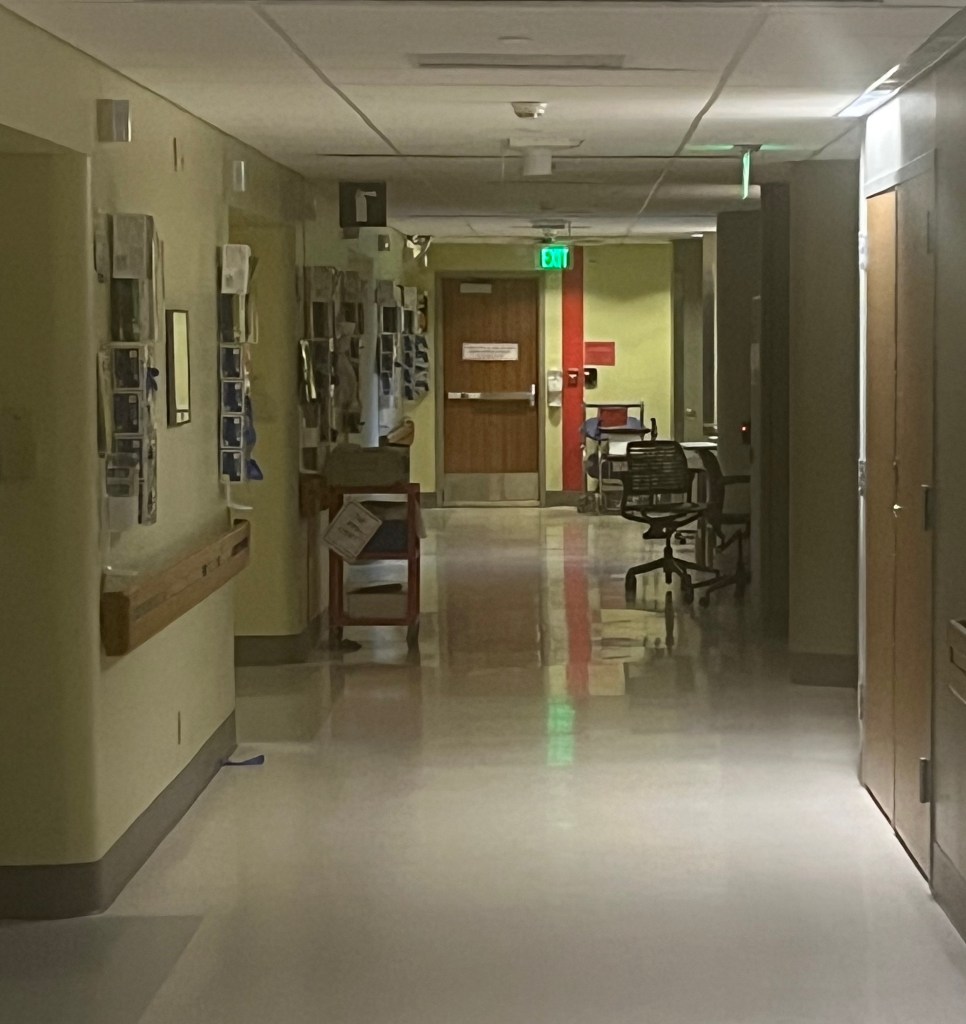
The hallways were usually quite on Floor 7 in the southeast tower of UW Hospital.
I entered a new, unfamiliar world on May 20 when I was wheeled from the surgery recovery room to an oncology section of University of Washington Hospital.
I shared Floor 7 with other cancer patients. I rarely saw them. It was a quiet, eerie existence. I can only surmise other patients were much sicker than I. They rarely left their rooms, except to be wheeled to or from surgery. On my daily walks through these lonely hallways, I only encountered nurses and visitors during my three-night stay on Floor 7.
Yet, conversations among family were overheard. During a late Friday night stroll, I encountered a family member on his cell phone delivering sad, tragic news to a loved one.
“He’s done,” the man, standing outside the loved one’s room, said to the person on the other end. “He’s done fighting. He can’t go anymore. He wants to die with dignity.”
Even though the door was closed to the room, I had seen the man in the room on previous walks. He was always sleeping, and appeared very pale. It was heartbreaking to hear he’d given up the fight.
I found the staff on Floor 7 to be hard-working, kind and patient. I don’t know how they do what they do. They all worked three, 12-hour shifts. I got to know all of them really well. Not bad for an introvert.
Rachel, the RN my first night, was a cancer survivor. Her entire stomach had been removed, and her esophagus connected directly to her small intestine. She eats only small portions, which explains why she was fit. Because of her experience, she chose to resume her nursing career in oncology. She has two young children and commutes from Snohomish.
Pauline, who grew up on Bainbridge Island, helped me on my first walk after surgery, at 3:30 a.m. Hannah, who grew up in Edmonds and is only three years removed from nursing school at Seattle U, was amazingly sweet and kind. She lives alone with her cat.
There there was Seedy, He is of African descent, and commutes to UW from Port Orchard. That’s an hour and a half drive in no traffic.
Seedy was working at Mount Sinai Hospital in New York City when the global pandemic arrived in March 2020. He shared horror stories of working on a floor where there was “COVID in every room.” Mount Sinai was the hospital where patients were dying so fast they were stored in refrigerated trucks outside.
“The hardest part was watching people die, unable to be with family,” he said in broken English. “Instead, they died in front of me, a complete stranger.” Despite being exposed to many COVID victims, Seedy said he never contracted COVID.
Seedy’s shift ended at 7 a.m., the day of my discharge. Before he left for the long drive back to Port Orchard, he stopped in to say goodbye.
“I hope to never see you again,” he told me, good-naturedly.
I’d be happy with that. A few hours later, I left Floor 7, for hopefully the last time.