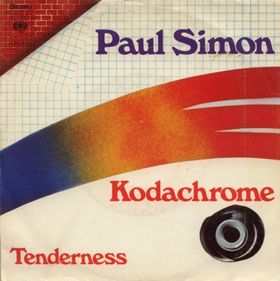
Some of you may be old enough to remember Paul Simon’s smash hit “Kodachrome” from 1973. Here’s a variation of that song, titled “Chromofobe,” the rare kidney cancer my surgeon Sarah Psutka removed.
When I think back, on all the years, that I was healthy,
It’s a wonder I was sick at all.
But as you age, and scans and x-rays look beneath the hood,
They find tumors that really aren’t so small.
Chromofobe
They said it’s a solid mass lesion,
It’s been there for many a season,
Makes me think I don’t have a clue at all, oh yeah;
It was a carcinoma,
It tried to make a permanent home-a,
My surgeon done take that Chromofobe away.
If you took all the surgeons in the Skagit Valley,
Put them all together in one club;
They couldn’t match the skills of one Sarah Psutka,
That’s why I took my kidney to U-Dub.
Chromofobe
They said it’s a solid mass lesion,
It’s been there for many a season,
Makes me think I don’t have a clue at all, oh yeah;
It was a carcinoma,
It tried to make a permanent home-a,
My surgeon done take that Chromofobe away.
My surgeon done take that Chromofobe away My surgeon done take that Chromofobe away My surgeon done take that Chromofobe away
My surgeon done take that Chromofobe My surgeon done take that Chromofobe My surgeon done take that Chromofobe away My surgeon done take that Chromofobe She sent this boy, right back home My surgeon done take that Chromofobe away My surgeon done take that Chromofobe, mm My surgeon done take that Chromofobe away Okay
Below is the song “Kodachrome” by Paul Simon that was popular so many years ago (53, to be exact). Click here to listen:
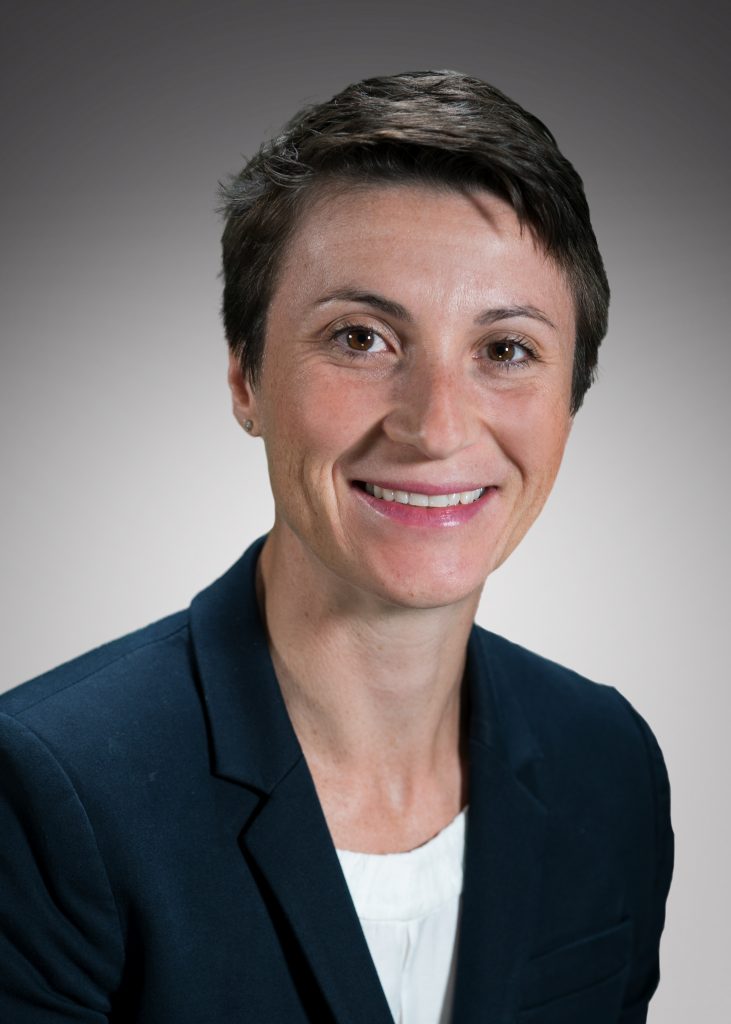
Dr. Sarah Psutka, one of the leading kidney cancer surgeons in the U.S., wouldn’t rest until my kidney was healed. She told me “I think I grew some gray hairs over this one.” She was relentless. She fought for me.
I’m healed!
I yelled those words to anyone within earshot at our lake cabin the evening of August 4. I had just gotten off a Face Time call with Dr. Sarah Psutka, my surgeon at UW Medical Center (Go Dawgs!). The proof was on Dr. Psutka’s computer, as she displayed images from a CT scan taken 24 hours earlier.
“You can see here the kidney has closed up and healing on its own,” said Dr. Psutka pointing to shades of gray and white tissue that I did not fully understand. “I viewed the images last night, and I was hopeful. But I wanted to talk to the radiologist today, and confirm what I saw before I delivered the good news.”
Good news, indeed. All three of our daughters and their families were at the lake to receive the news. But did I really believe it? (More on that later)
Anyone who has read my blog posts over the summer knows I had serious complications following my successful surgery on May 20 to remove a cancerous tumor on my right kidney. There were painful procedures (tubes hooked up to me I didn’t want to be hooked up to). There were sleepless nights. There were moments of despair. There were moments of doubt.
But something happened during the last days of July that changed everything.
Dr. Psutka is one of the leading oncology kidney surgeons in the U.S. She’s used to performing successful surgeries. She’s not used to complications. Vicki and I had a Face Time call with Dr. Psutka on July 17 on the heels of several disappointing drain fluid tests that indicated the kidney was still leaking. Up to that point, procedures designed to expedite the healing process had proven to be futile. Dr. Psutka told us my surgery was one of the more complicated – ok, insert wisecrack here – she had ever performed. Lucky me! She said in her 11 years at the UW she had only one patient that had complications like mine. She said her partner at the UW, who has been there 17 years, has only had three cases similar to mine. Clearly frustrated and searching for answers, Dr. Psutka told us she had reached out to one of her colleagues at the Mayo Clinic in Minnesota for some advice.
“My colleague thinks the drain could be doing more harm than good,” she told us, noting that the second drain put in June 8 after my first infection might be unnecessarily pulling urine from the kidney, spiking my creatinine levels . “He thinks I should pull the drain, the stent and tubes (I’ll spare you the gory details). I prefer a step-by-step approach.”
The drain was pulled on July 20 at UW. A follow-up scan to see if the leak still existed was done three days later. It indeed showed a small collection of perinephric fluid “compatible with a urine leak.”
Not good news. Dr. Psutka’s assistant, Jade Meaker, met with us to explain the next move was to install a temporary “nephrostomy tube” into my right kidney to drain into a bag attached to my leg. This procedure, it was explained, would allow the surgically-repaired kidney to heal. The left kidney would drain naturally.
Jade said the procedure was basically a ‘Hail Mary,’” or in other words a last-gasp effort before Dr. Psutka would have to remove the entire right kidney that she had operated on only two months earlier. And trust me, she did NOT want to take that kidney out.
We were devastated. Our planned trip to Europe in September that was a year in the making was now in question. My psyche, rocked by one bit of bad news after another, was also in question. The procedure, scheduled for the following Monday July 27, would be invasive.
This is when the tide began to turn. It was the “comeback after the setback” I had hoped for, and inferred in my earlier blog posts.
Dr. Psutka, after performing a surgery at Harborview Medical Center on Friday evening, July 24, had taken a red-eye flight the same night to Indianapolis. She was in Indianapolis for the weekend to speak at a medical convention. For all I know, she went off script and told the gathered group of doctors she was baffled by complications with a particular patient from a partial nephrectomy surgery.
She called me Saturday morning that weekend, asking “How are you feeling.” I replied “I’m feeling great.” Based on my CT results two days earlier, without saying as much, Dr. Psutka suspected I would get another infection. On Sunday evening, while on her flight back to Seattle, and just hours before my 10 a.m. appointment the next day for my nephrostomy tube procedure, she texted me, “How are you feeling.” Again, I replied “I feel fine.” Full disclosure here. How many doctors give their patients their private cell phone number and call them on weekends and when they’re out of state?
At this point, I had come to a crossroads. The night before, I sensed an inner voice telling me, “this kidney could heal on its own.” I debated whether to even bring that up with Dr. Psutka – would she think I was crazy? – but finally decided to do so, asking in a text if the kidney could heal without intervention. She got right back to me: “I’ve been thinking the same thing over the weekend.” She said she would call me when she landed in Seattle.
An hour or so later, while Dr. Psutka was on an Uber ride from Sea-Tac Airport to her home in Seattle, she called. She said “we have two good options here. We do the safe thing by putting in the (nephrostomy) tube, or see if it will heal on its own. There is no clear (correct) solution.”
I said, “let’s see if it will heal.”
Less than 12 hours before a team of doctors, nurses and an anesthesiologist were scheduled to install the nephrostomy tube and remove the small collection of fluid from the suspected leak, the procedure was called off. Instead, Dr. Psutka removed the stent and “tubes” the next day (Monday), as the colleague from the Mayo Clinic had recommended.
Afterward, Dr. Psutka said she wanted to speak with Vicki, who was in the waiting room, to see if she had any questions. Vicki, for whatever reason, told Dr. Psutka “that kidney is going to heal on its own. A lot of people are praying for Rick.” Vicki said Dr. Psutka looked doubtful. As we know now, the results from the CT scan the next week proved Vicki was right.
Fast forward to August 24, about three weeks after I had received the initial news from Dr. Psutka at the lake cabin that my kidney had healed. I was scheduled for two more CT scans. One was the three-month checkup to see if there was any evidence of cancer at the surgical site or nearby organs. The other was to take yet another look at the right kidney, to make sure it had healed up.
I must admit I approached the scans and subsequent follow-up appointment with Dr. Psutka with some fear and trepidation. I had experienced some PTSD over the course of the summer. I was a little skeptical. In my mind, there remained “scar tissue.”
Vicki was a little puzzled by this, telling me “your kidney has healed. Dr. Psutka already told you. Why are you nervous?”
It occurred to me I had not completely bought into the fact I had “been healed,” no matter what I yelled that day at the lake cabin.
It reminded me of a story in the Bible. In Mark 9, a desperate father asks Jesus to heal his son, crying out with both faith and doubt. The father basically tells Jesus in verse 22 “heal my son if you can.”
Jesus replies to the father “If you can? All things are possible to him who believes.”
Jesus could have said “you don’t have enough faith, so I’m just movin’ on to someone else.” But he doesn’t do that. What happens next is very moving.
Verse 24 says the boy’s father told Jesus, “I do believe; help me in my unbelief.” Jesus rebukes the unclean spirit in the boy, and heals him.
Both of my scans on August 24 came back clean. I have no cancer, thanks to Dr. Psutka, who preserved 85 percent of my right kidney. I have some collateral damage from some procedures. But my kidney has healed. I asked Dr. Psutka, “could it start leaking again?” She replied, “only if I opened you up again and starting cutting on it.” She cleared me for our trip to Europe.
How often have we prayed for something, God answers that prayer, and we attribute the favorable outcome to something else? We all know that there are times God doesn’t grant us what we’ve prayed for. But does that cloud our ability to appreciate when prayer is answered?
I know, without a doubt, God has led me through several storms in my life. I am not unique. We all go through storms. It can be a financial storm. It can be a relationship storm. It can be a career storm. It can be a medical storm. This battle with kidney cancer was a storm.
There will be more storms in the future. I will be fearful. And yes, I probably will be doubtful. But in my finiteness, in my short-sightedness, in my weakness, I will say:
If you’re like me, it’s hard to be patient. I’m in a waiting game right now. My whole journey since my kidney cancer diagnosis in February has been one delay after another.
My urologist in late February referred me to the University of Washington. But wait! The UW has to process that referral and get approval from my insurance.
My referral was approved and a surgeon was selected to cut out the cancer. But wait! She’s not available to meet with Vicki and I until March 30.
Dr. Sarah Psutka recommends a partial nephrectomy surgery at our meeting. But wait! She tells us she’s booked out and doesn’t think she can do it until the summer (as it turned out, the surgery date was set for May 20).
Dr. Psutka tells us the surgery was a success. The cancerous tumor was removed and there’s no cancer “in the margins” or surrounding tissue. But wait! The drain tube I’m sent home with fails. I begin running a fever, an infection develops, and on June 5 I’m back at UW Hospital for doses of antibiotics. A new, more sophisticated drain tube is placed. Dr. Psutka says there’s a small urinary leak in my kidney that hasn’t healed.
The new drain tube I’m sent home with is working. I feel good. I have no more fever. But wait! Weekly tests for creatinine levels from fluid in the drain tube are higher than they should be. The urinary leak isn’t closing up.
I have a second, less-invasive surgery on July 7 called a “Cystoscopy with Retrograde Pyelogram and Ureteral Stent Insertion.” They found the small leak and closed it off with a temporary stent that is supposed to divert urine away from the kidney and surgical site to let it heal. But wait! My next appointment to see if this is working isn’t until July 23.
So that’s where I am. Still in the waiting room.
As Americans who live in a fast-paced culture, we struggle mightily with waiting. Technology has made us less patient. We’ve conditioned our brains to expect instant gratification. Because high-speed internet and one-day delivery by Amazon rewards us without delay, we get frustrated when daily processes – whether it be the loading of a website or simply waiting for the traffic light to green while giving in to the urge to look at our phone – take more than a few seconds.
I’ve learned from experience that my sense of timing is vastly different than God’s. God has His own timetable. You may have heard this joke that refers to how time flies in the divine realm:
A man is speaking to God and asks, “God, now long is a million years to you?
God answers: “To Me, it’s about a second.”
The man then asks, “God, how much is a million dollars to You?”
God answers, “To Me, it’s like a single penny.”
The man thinks for a moment, gets a hopeful look in his eye, and asks, “God, could you give me one of your pennies?”
And God cheerfully replies, “Sure! Just a second.”
It’s a lighthearted take on the scripture passage 2 Peter 3:8, which says “with the Lord one day is like a thousand years, and thousand years are like one day.”
I’ve learned over the years God is not a vending machine. You don’t press a button, and get what you want right away. If that were the case, we’d probably be spoiled brats. Sometimes the answer is “yes.” Sometimes the answer is “no.” Sometimes the answer is “not yet.” A delay is not necessarily a denial.
Many people have been praying for me. I have felt those prayers. It shouldn’t be lost on me that I am cancer-free. Vicki and I, however, pray daily for complete healing. I feel like my life has been “on hold” for nearly two months. With two different sets of “plumbing for bodily fluids,” it’s difficult to go anywhere in public. We’re missing out on “summer.” I’m largely housebound – and sadly, so is Vicki, who’s been a great nurse and support by the way! I know I couldn’t do this alone.
For whatever reason, I’ve had to walk this path. This is another setback. There have been more times in the middle of the night when things have seemed hopeless. But there’s also been times when a scripture or podcast I’m listening to addresses the specific affliction I’m going through, and gives me hope. In those instances, I choose worship over worry, and praying over panic.
I’m hoping when I come out the other side, I’ll be more appreciative of my overall good health that I’ve taken for granted, have more empathy for people who are cancer-ridden and struggle daily with chronic pain and disease, and be more grateful to a God who has richly blessed me in so many ways.
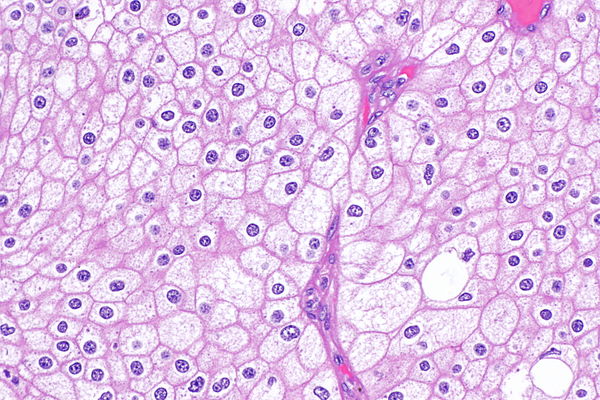
What Chromofobe Renal Cell Carcinoma looks like under the microscope. The subtype of renal cancer only appears in 3-5% of kidney cancer patients.
On the morning of May 20, I was wheeled into one of the 24 operating rooms at the University of Washington Hospital.
I was greeted at the operating table by a host of doctors, anesthesiologists and nurses. Knowing they were working for the “UW brand,” I borrowed a line from “Bow Down to Washington,” the school’s fight song, to give them a little pre-surgery pep talk. They smiled, acknowledging my nervous attempt at last-minute, gallows humor.
The words that followed – and frankly the last ones I remember before waking up seven hours later in the recovery room – were grounded in hope and the significance of the task at hand.
“Today’s going to be a good day, Rick,” said my renowned, gifted surgeon, Dr. Sarah Psutka, before I nodded off into la-la land.
It would be a good day, despite all the pain I had in my abdomen that evening and the days to follow. Dr. Psutka, and her assistant, Dr. Carson, told me they had accomplished what they set out to do. Dr. Psutka had successfully removed the cancerous tumor on my right kidney – which apparently was no small feat – while preserving 85 percent of the otherwise-healthy kidney. Because the mostly-exterior, 6-centimeter tumor was behind the kidney, Dr. Psutka said she had to “flip the kidney over” with her hands to cut the tumor.
Dr. Sarah Psutka is one of the leading kidney cancer surgeons in the U.S. She’s in demand, so it took awhile to get an opening for surgery. She was worth the wait.Fortunately, “Chromofobe” cancer was willing to wait as well.
That image didn’t ease my pain. Only a favorable pathology report would ease the discomfort emanating from the 8 1/2-inch-long incision just below my right rib cage.
Dr. Carson, in his check-in with me on day 3 of my stay at UW, hinted he and Dr. Ptsuka were expecting good news.
“We feel very good about what we did,” he told me. “And we’re expecting a good report card from pathology.”
An “A+” report card, as it turned out. No cancer was found “on the margins,” or in other words, healthy tissue beyond the tissue with cancer cells. No cancer in the surrounding “fatty tissue,” which I imagine after consuming a lot of pizza and IPA beers over the years was considerable.
The shocker in the pathology report was this: The cancer was found to be “Chromofobe Renal Cell Carcinoma,” a rare but less aggressive than the cancer that afflicts most kidneys, “Clear Renal Cell Carcinoma.”
“This is a rarer cancer of the kidney that generally has a more indolent behavior,” Dr. Psutka told me.
“Indolent” is a fancy term for “habitually lazy, or disinclined to exert oneself.” Which I found interesting. Perhaps fitting. When I was little, my parents and aunt and uncle from Minnesota would occasionally refer to my cousin and myself, in a half-kidding sort of way, as “Lazy Ole Me.” I guess we were slackers back in the day. That label must have drove me to prove them wrong, because I think I’m anything but lazy now.
“Chromofobe Renal Cell Carcinoma” was content to just sit there, not socialize with nearby organs, such as the lungs and liver, where more aggressive forms of kidney cancer tend to dangerously wander. I guess I can be an introvert and anti-social at times.
Truth is, the tumor was large enough it would eventually mix it up with nearby organs, I’m told. I am so thankful this was caught early.
Most common types of kidney cancer
Renal cancer
Percentage in patients
Clear Cell Carcinoma
70-80 percent
Papillary Cell Carcinoma
10-15 percent
Chromofobe Cell Carcinima
3-5 percent
I will not need follow-up treatment for cancer. The surgical removal of the cancerous tumor was the treatment. I will require annual screenings for at least five years going forward.
Thank you God, for knitting me together, for knowing my innermost thoughts, as well as my innermost organs. And thank you that the pesky tumor that threatened to cut my life short was actually the real “Lazy Ole Me” in this scenario.
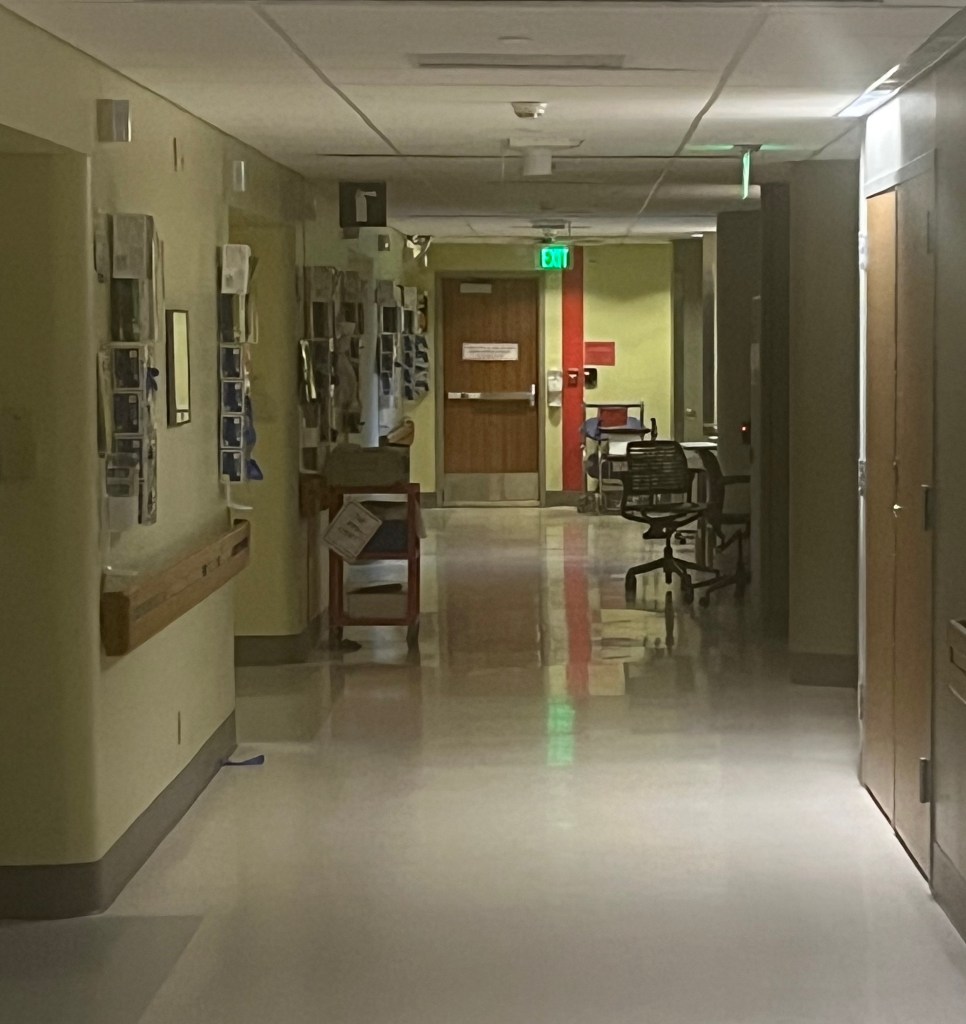
The hallways were usually quite on Floor 7 in the southeast tower of UW Hospital.
I entered a new, unfamiliar world on May 20 when I was wheeled from the surgery recovery room to an oncology section of University of Washington Hospital.
I shared Floor 7 with other cancer patients. I rarely saw them. It was a quiet, eerie existence. I can only surmise other patients were much sicker than I. They rarely left their rooms, except to be wheeled to or from surgery. On my daily walks through these lonely hallways, I only encountered nurses and visitors during my three-night stay on Floor 7.
Yet, conversations among family were overheard. During a late Friday night stroll, I encountered a family member on his cell phone delivering sad, tragic news to a loved one.
“He’s done,” the man, standing outside the loved one’s room, said to the person on the other end. “He’s done fighting. He can’t go anymore. He wants to die with dignity.”
Even though the door was closed to the room, I had seen the man in the room on previous walks. He was always sleeping, and appeared very pale. It was heartbreaking to hear he’d given up the fight.
I found the staff on Floor 7 to be hard-working, kind and patient. I don’t know how they do what they do. They all worked three, 12-hour shifts. I got to know all of them really well. Not bad for an introvert.
Rachel, the RN my first night, was a cancer survivor. Her entire stomach had been removed, and her esophagus connected directly to her small intestine. She eats only small portions, which explains why she was fit. Because of her experience, she chose to resume her nursing career in oncology. She has two young children and commutes from Snohomish.
Pauline, who grew up on Bainbridge Island, helped me on my first walk after surgery, at 3:30 a.m. Hannah, who grew up in Edmonds and is only three years removed from nursing school at Seattle U, was amazingly sweet and kind. She lives alone with her cat.
There there was Seedy, He is of African descent, and commutes to UW from Port Orchard. That’s an hour and a half drive in no traffic.
Seedy was working at Mount Sinai Hospital in New York City when the global pandemic arrived in March 2020. He shared horror stories of working on a floor where there was “COVID in every room.” Mount Sinai was the hospital where patients were dying so fast they were stored in refrigerated trucks outside.
“The hardest part was watching people die, unable to be with family,” he said in broken English. “Instead, they died in front of me, a complete stranger.” Despite being exposed to many COVID victims, Seedy said he never contracted COVID.
Seedy’s shift ended at 7 a.m., the day of my discharge. Before he left for the long drive back to Port Orchard, he stopped in to say goodbye.
“I hope to never see you again,” he told me, good-naturedly.
I’d be happy with that. A few hours later, I left Floor 7, for hopefully the last time.
I drove to Cascade Valley Hospital in Arlington on the morning of February 12 for what appeared to a routine ultrasound test. My doctor wanted a look at my bladder, and since the scan would be “in the neighborhood,” he made a last-minute decision to include pictures of my two kidneys.
When the ultrasound was finished, I asked the technician if he saw “anything interesting.” He said my bladder was functioning normal. And my kidneys? He declined to answer, saying something to the effect that he wasn’t at liberty to discuss results, which sounded ominous. That was the radiologist’s job, he said.
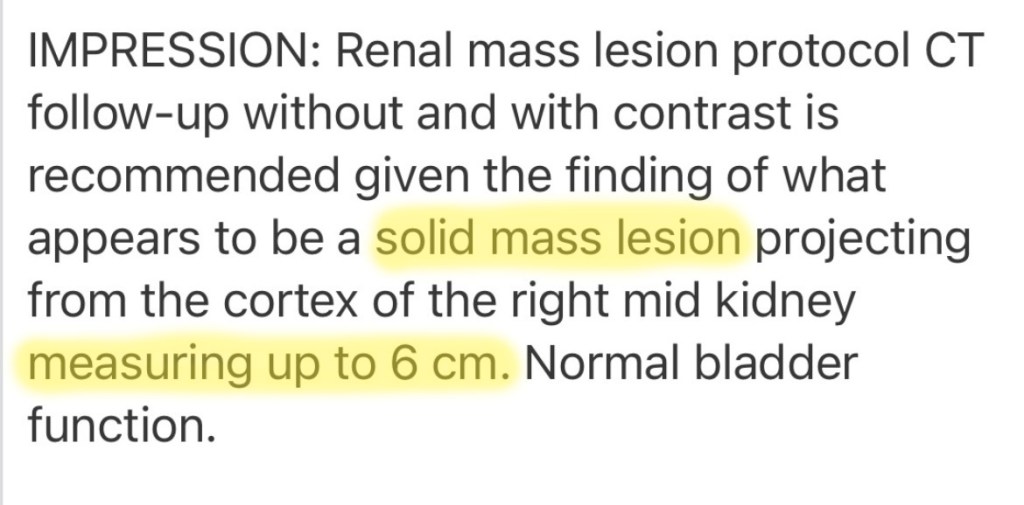
The radiologist didn’t take long to release his findings. I hadn’t even finished the 25-minute drive back home when I got a “ping” on my email that I had a new test result in “MyChart.” I was stopped at a red light on Highway 532 just west of I-5, so I instinctively opened the message. My eyes fixated on the words “solid mass lesion.”
Results from my ultrasound test at a hospital in Arlington on Feburary 12, which so happens to be our oldest daughter’s birthday.
I’m no medical expert, but those words were unsettling. I had left my home two hours earlier a healthy man – at least as far as I knew. I returned home acutely aware I had a mass half the size of my right kidney. I had no symptoms. The results, of course, also went to my primary care physician, Dr. Alden Campbell. A few days later, he called me.
“This looks concerning,” he said. “I’m ordering a CT scan.”
The CT scan would confirm or deny my doctor’s suspicions it was cancer. If it were cancer, the CT would also show if it had spread to nearby organs. The CT scan was scheduled for the following week, also at the Arlington hospital. Once again, the results came back quickly.
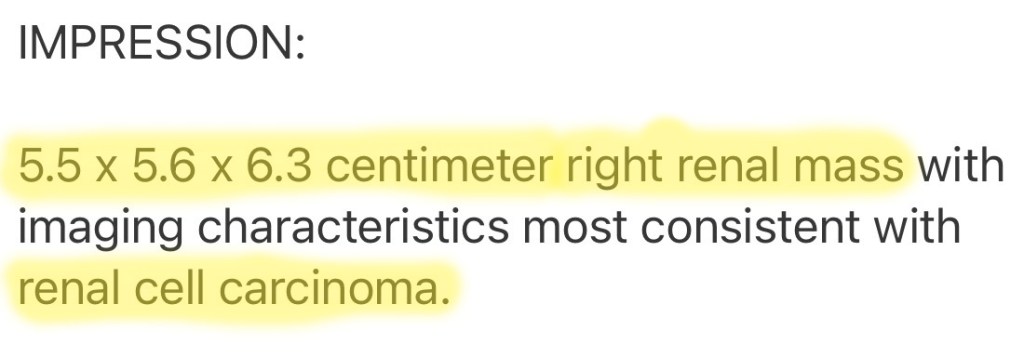
The radiologist’s report from my initial CT scan on my right kidney.
I didn’t immediately think the term “renal cell carcinoma” was cancer. I’m new to this world. I thought, or hoped, it might mean “pre-cancer.” But Dr. Campbell called me and told me it was indeed cancer. The good news, he said, is it appeared the cancer was contained to the kidney, and had not “metastasized.” That assessment would later be confirmed by my urologist and my surgeon.
“I think we caught this early,” Dr. Campbell told me. “You might have dodged a bullet.”
If I did steer clear of advanced cancer, I owe Dr. Campbell a debt of gratitude. To borrow a catch phrase from COVID, he ordered the kidney scan out of “an abundance of caution.” He had noticed my kidney function bloodwork tests were trending slightly downward.
“I just want to make sure,” he said before the ultrasound.
My good friend and retired cardiologist, Bob Swenson, thinks most doctors wouldn’t have ordered the ultrasound, electing to instead “watch the numbers” going forward. My next appointment with Dr. Campbell wouldn’t have been until September.
Over the course of my life I have occasionally wondered what it would be like to receive news you had cancer. Dr. Campbell’s words were so “matter of fact,” as if I’d been told I had the flu, or bronchitis. Not that I knew it should be dramatic, like “My God, you have cancer!” Or, “I’m very sorry to tell you that you have cancer.” I guess I just didn’t know what to expect.
A few weeks later, I spoke with a friend of mine who is currently in remission from colon cancer. In her case, it was diagnosed late. The cancer had already invaded her liver. It was termed Stage 4 cancer. She has undergone “immunotherapy.” The cancer, for the time being, has been kept at bay.
“You’re entering a new world,” she told me. “You will never be the same.”
That’s for sure. Once word spread, I received phone calls and text messages from people I hadn’t heard from in years. With my cancer diagnosis, I had crossed a line.
Dr. Campbell immediately referred me to a urologist at Skagit Valley Hospital. Dr. Kyle Schuyler showed me the images from the CT scan. It was his opinion the tumor was slow-growing, and could have been there “for years.” He said he could remove my kidney – otherwise known as a “nephrectomy” – at SV Hospital, but thought the rest of my kidney looked healthy and could be saved. He said the best option would be what is termed a “partial nephrectomy.” That procedure, he said, is more complex and would be best performed by a surgeon at University of Washington Medical Center in Seattle. He put in the referral while I was still in the room.
That surgeon would be Dr. Sarah Psutka. It took awhile for the UW and my insurance to approve the referral. But once that happened, we were told we had a “pre-op” appointment on March 30 with Dr. Psukta.
I had done a little research on Dr. Psutka beforehand. It was obvious she had impeccable credentials. She is an Associate Professor of Urology in the Department of Urology at the University of Washington and Fred Hutchinson Cancer Center. She received her undergraduate and medical degrees from Harvard University, and completed urology residency training at the Massachusetts General Hospital. She completed a Society of Urologic Oncology Fellowship in Urologic Oncology at the Mayo Clinic, and concurrently obtained her Masters’ in Clinical and Translational Science. In our one-hour sit down with her, she was as advertised. She was knowledgeable, professional and kind.
“You’ll be well cared for here,” she told me.
She noticed my UW shirt. I told her we were Husky football season ticket holders. A native of Toronto, Canada, she said she was a hockey fan, and pulled out her phone to proudly show us photos of her two girls who are members of the Seattle Kraken “junior” hockey team.
But I digress. Back to the surgery. She concurred much of the kidney looked healthy and could be saved. But because of the size of the tumor, she would have to do an “open surgery,” as opposed to the less invasive laparoscopic/robotic procedure. That meant a large incision, a minimum three-night stay in the hospital and a longer recovery. She said, if during the three-to-four-hour procedure it’s deemed unsafe to do the partial nephrectomy, she will remove the entire kidney. She termed my cancer “Stage 1B.”
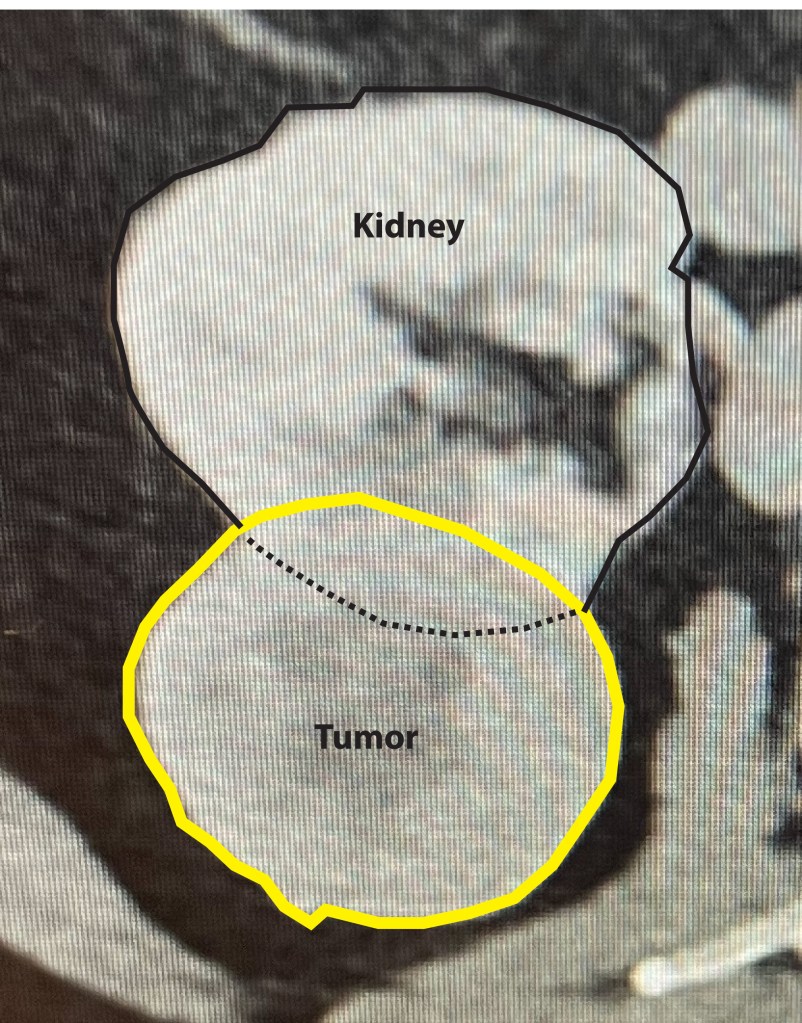
A CT scan of my right kidney and tumor, which at 6 cm (or 2 1/2 inches) in diameter is considered large. The tumor is described as “exophytic,” meaning most of it is outside the kidney.
We then found out there’s a price to pay for a world-class surgeon. She’s in demand. She told us we were likely looking at surgery in “June or July.” Fortunately, we received a call the next day that the surgery will actually be May 20.
The delay does allow us to travel on May 8 to our niece’s wedding near Santa Cruz, California. I can also attend a speaker event at my church (a former UW football player and chaplain) on April 18 that I am in charge of. I had this crazy idea surgery was imminent after our March 30 meeting with Dr. Psutka.
Funny how “life happens when you’re making plans. ” I’ll be relieved when the cancer mass is removed as I continue along this uncertain journey that began the day I heard the “C Word.” I’m hopeful for another “C Word” – the one that stands for “Cured.”