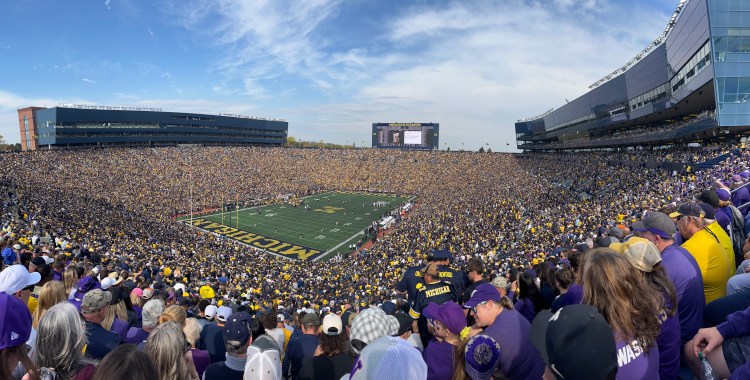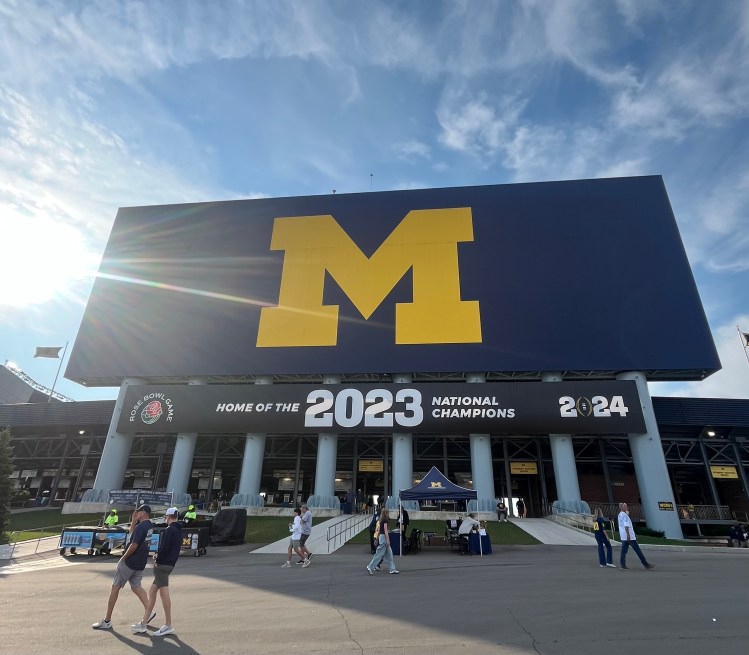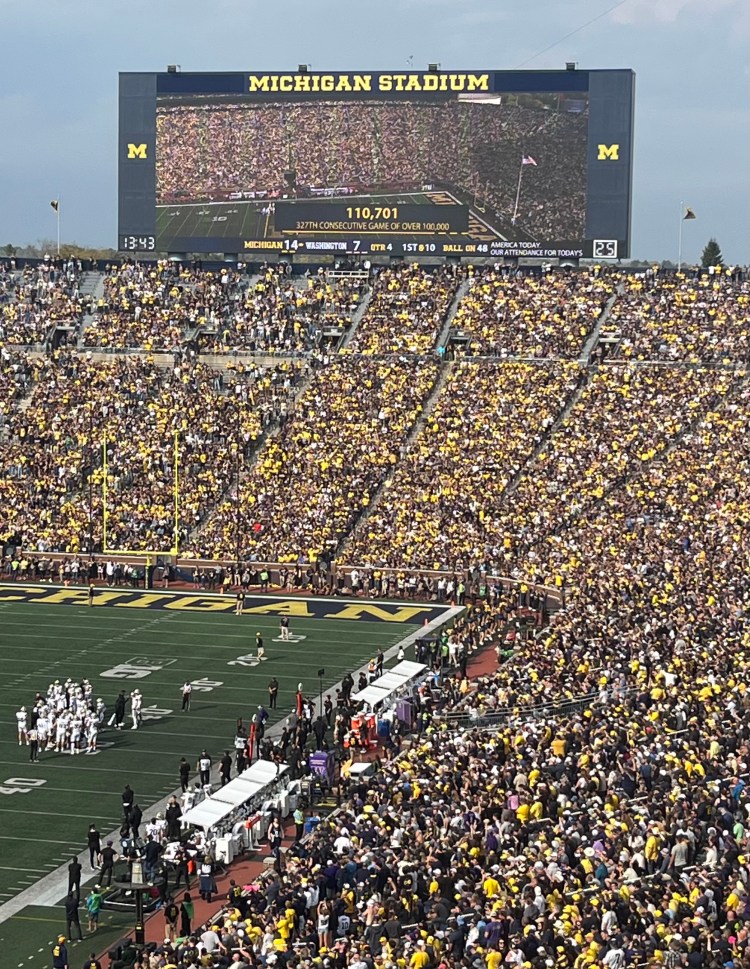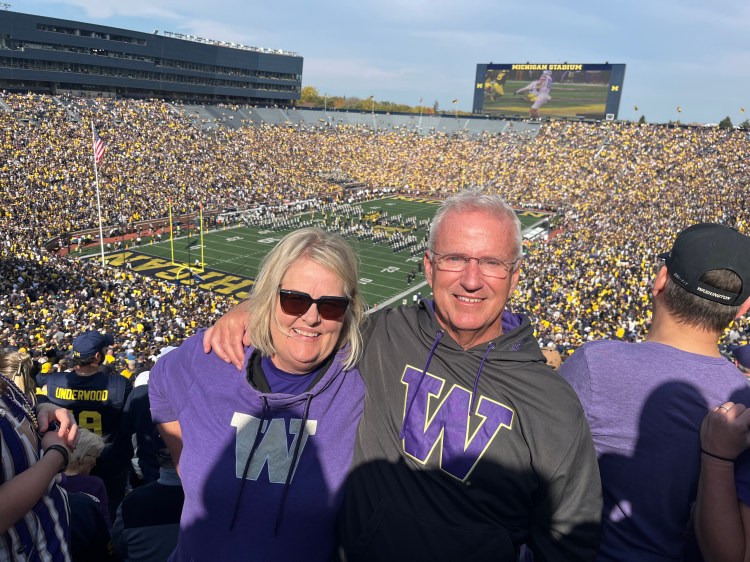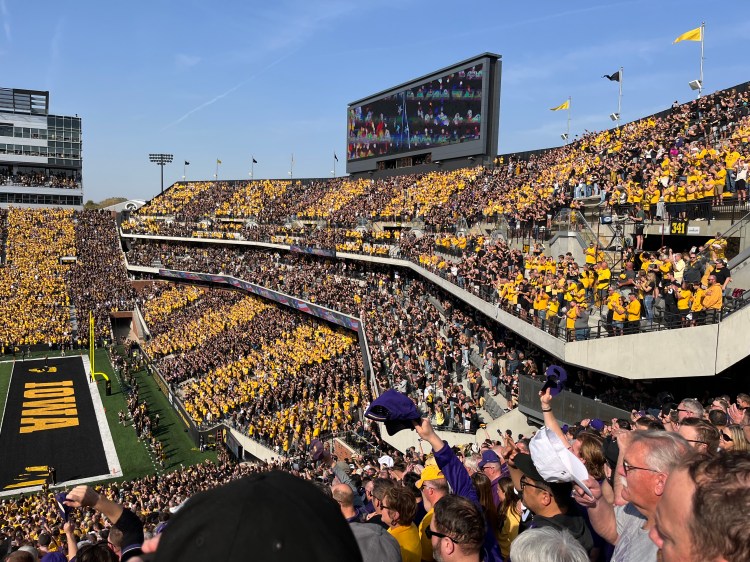
Michigan Stadium is called the “Big House” for good reason. With a seating capacity of 107,601 – and it usually exceeds that number – it is the largest stadium in the U.S., and third largest in the world. This was our view at the October 18 game in Ann Arbor between Washington and Michigan. Note the levels of luxury suites on each side of the field.
OK, I’ve done a stint in the Big House. Not time in prison, thankfully, but about five hours in the “Big House” that is Michigan Stadium.
I was overwhelmed by the size of the stadium. You could get lost here.
I was underwhelmed by the setting and architecture. It’s basically just a big concrete bowl. It sits in the middle of flatland Michigan, not the shores of Lake Washington where the “Greatest Setting in College Football” resides. For as big as the stadium is, it also didn’t feel that “loud.”
What screams here is “big-time college football.” This is a bucket list I had to check. And I’m glad I did.
Some thoughts from a warm and breezy, mid-October Saturday afternoon in Ann Arbor:
THEY SHOW UP EARLY: My daughters kid me that my sporting event philosophy is “arrive early, stay late.” Michigan fans show up early. We arrived two hours early, and half the stadium was full. Every seat – 110,701 on this day – was filled by kickoff. We encountered the same thing last year in Iowa City. It’s a late-arriving crowd at Husky Stadium, for sure. Sometimes, it’s outright embarrassing. Not Michigan. Maybe it’s a Midwest thing. Maybe I should live in the Midwest.
IN MY MIND’S EYE: It’s always a little surreal walking for the first time into a stadium you’d seen countless times on television. One of the first things I noticed was the familiar brick wall that rings the field. For whatever reason, I remembered that from a UW-Michigan game I watched on my family’s black-and-white TV in 1969. Bo Schembechler’s Wolverines took Jim Owens’ Huskies to the woodshed that day, 45-7.
BIG-TIME BRAND: Michigan’s iconic blue and maize winged helmets. A sea of maize in the stands. Two massive video scoreboards at the north and south ends of the stadium, each emblazoned on the back side with a giant, block “M.”
The back side of the giant video scoreboards on each end of Michigan Stadium.
HAIL TO THE VICTORS: The Michigan band in pregame playing “Hail to the Victors,” one of the most famous college fight songs in the land. And Michigan fans thrusting their right arms forward, in unison, with each “Hail! Hail!” The Wolverines running onto the field, but not before each player jumped to touch the giant “Go Big Blue” banner. Both teams share an entrance to the field at the 50-yard-line, unlike any other stadium I know of. Not ideal. Ask Ohio State and Michigan State.
An empty Michigan Stadium at night. The opening below the “M” on the far side is the player entrance to the field.
EVERYTHING’S BIGGER: The stadium is immense. This day’s game drew 110,701, which was the stadium’s 327th consecutive game with more than 100,000 fans. That’s 40,000 more than Husky Stadium’s capacity of 70,138. I’m told there’s not a bad seat in the house. Several levels of luxury suites tower over both sides of the field. Something tells me a lot of money is flowing into the football program’s coffers. All remaining games this season are sold out. Season tickets for 2026 are sold out.
The UW-Michigan game drew 107,601, the 327th consecutive game over 100,000. The stadium record is 115,109, which was set in 2013 in a night game with Notre Dame.Two of Michigan’s 12 national-title teams that are displayed on the outer wall of a concourse.
VICTORS HAILED: We walked around the stadium before the game. They certainly hail their victors here. The school’s 12 national championships are proudly displayed on the outer wall of a concourse. Washington claims two natties.
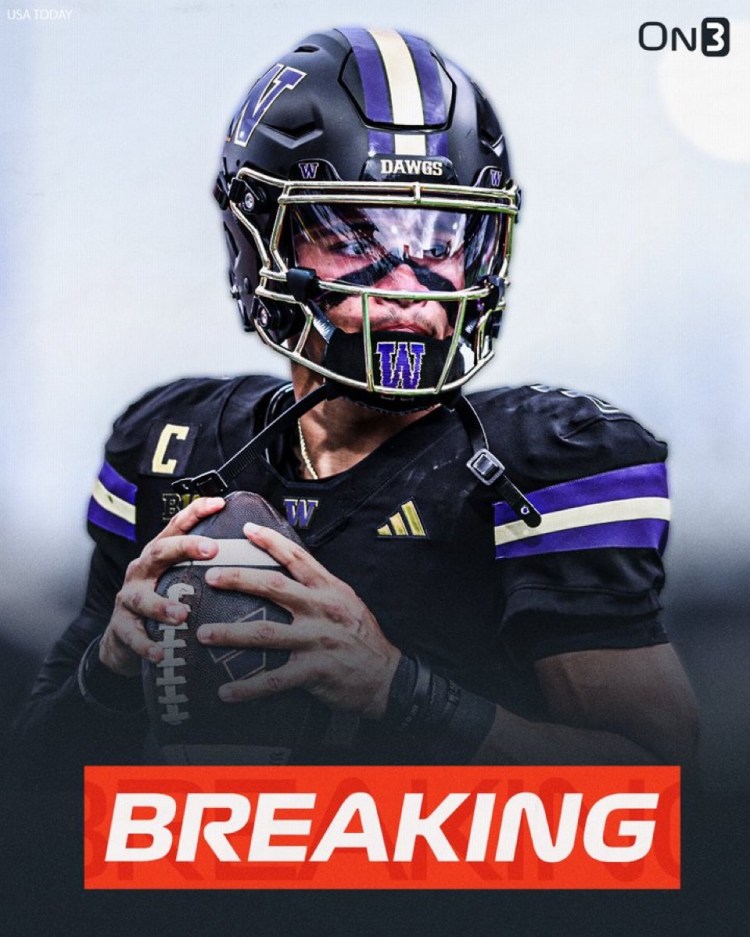
EVICTED FROM THE BIG HOUSE: As for the game, the Huskies played Michigan to a 7-7 tie at the half. Then the Wolverines, clearly the bigger and more physical team on the offensive and defensive lines, showed who owned the Big House. Demond Williams threw three interceptions. The Wolverines threw the Huskies up against the wall, roughed ’em up a little, and then kicked them out the door. Michigan 24, UW 7.
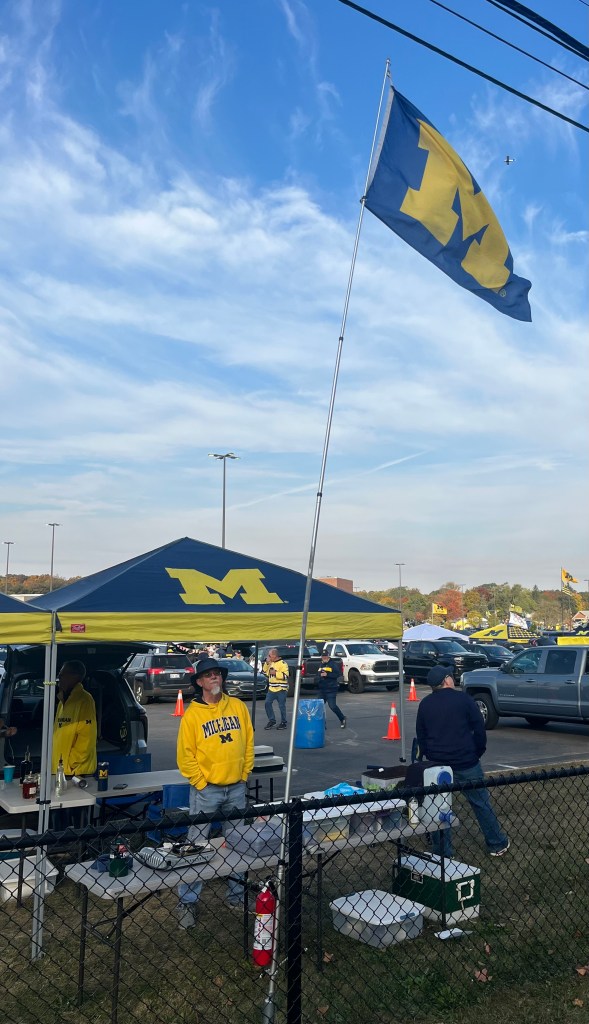
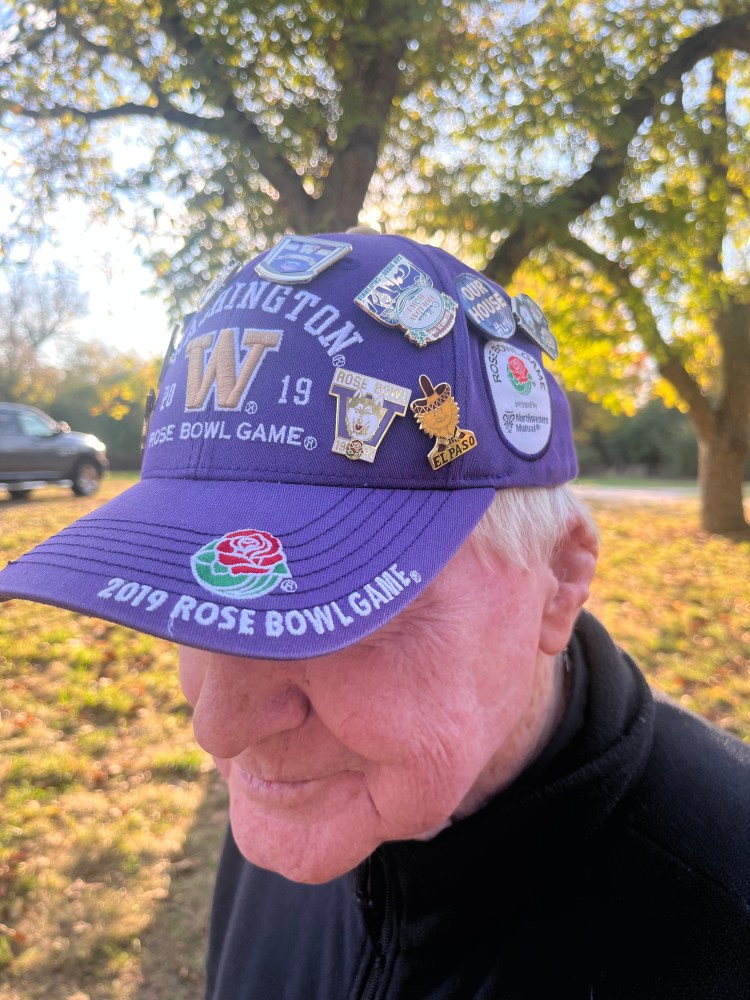
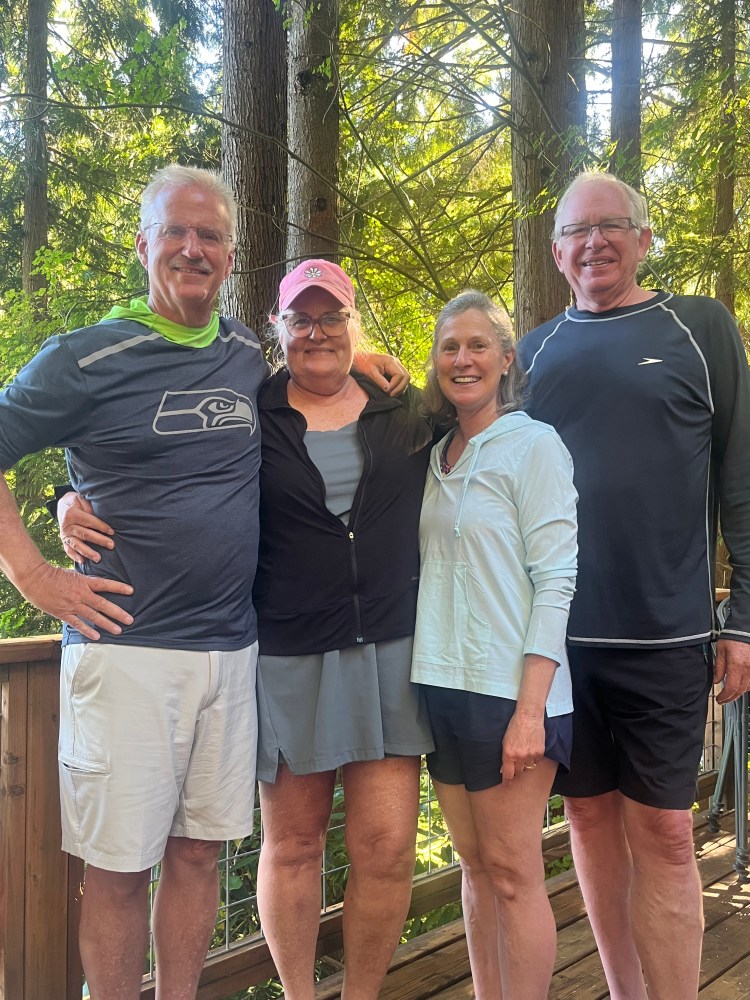
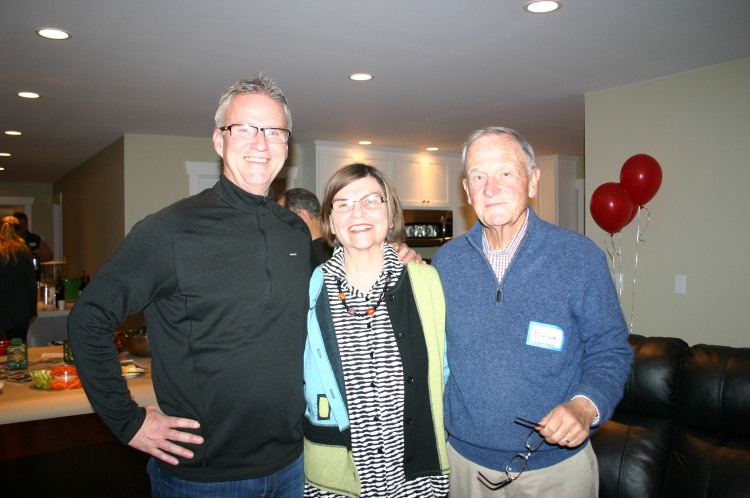
Vicki and I before during pre-game. The stadium would be full by the time the game began.Some Michigan tailgaters along our walk to the stadium. The game started at noon. Michigan fans started tailgating at 6 a.m.We met two Husky fans, brothers Dale and John Galvin, at our hotel in Dearborn the night before the game. They had already made parking reservations and invited us to ride with them. Great guys.Dale Galvin has been a Husky football season tickets for nearly 60 years. His cap is adorned with buttons from different bowl games UW has played in. He said his favorite bowl was the 1984 Orange Bowl, when UW upset heavily-favored Oklahoma. Dale has a law degree from UW, and owns a realty law firm in Mountlake Terrace.
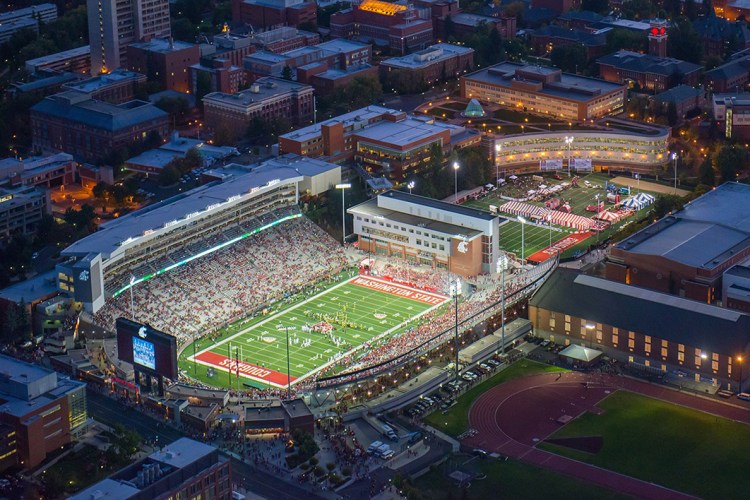
An aerial photo of cozy Martin Stadium, home of the Washington State Cougars, in Pullman. The Compton Union Building is just beyond the Cougar Football Complex behind the west end zone, and the Terrell Library behind that.
I don’t know why it took me so long. I was born in Washington, have lived all but nine of my 70-plus years in this state, yet until recently had never set foot on the campus of Washington State University in Pullman.
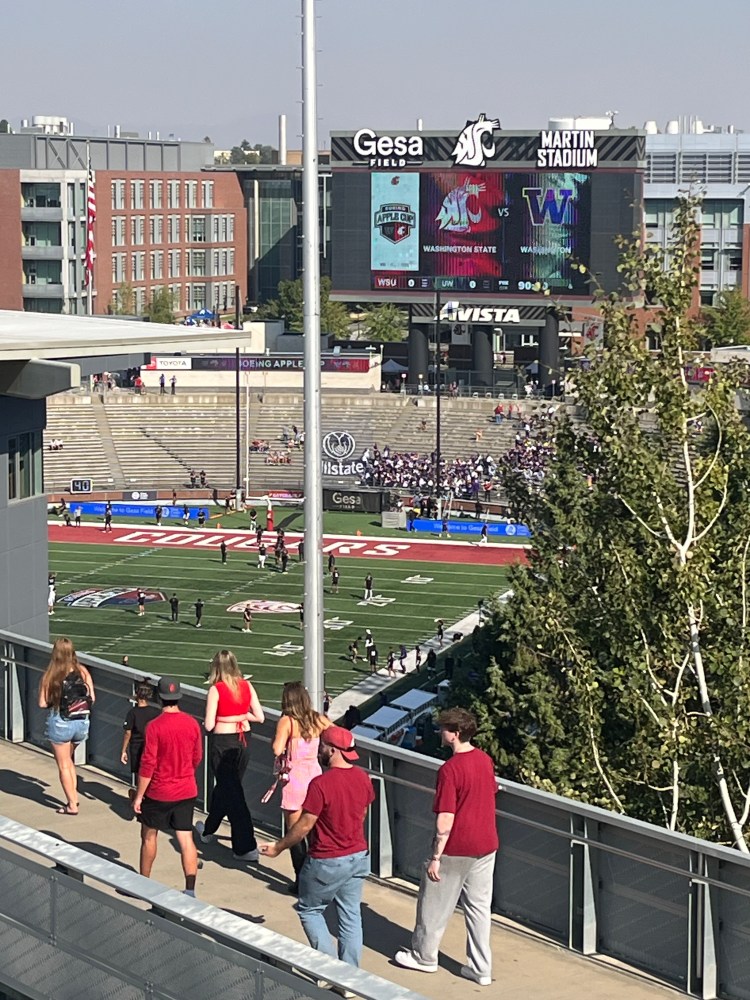
But there we were, in quaint Martin Stadium, surrounded by Cougar fans, on a sun-splashed, late September afternoon in the Palouse, to watch WSU and UW play in the Apple Cup. It was glorious.
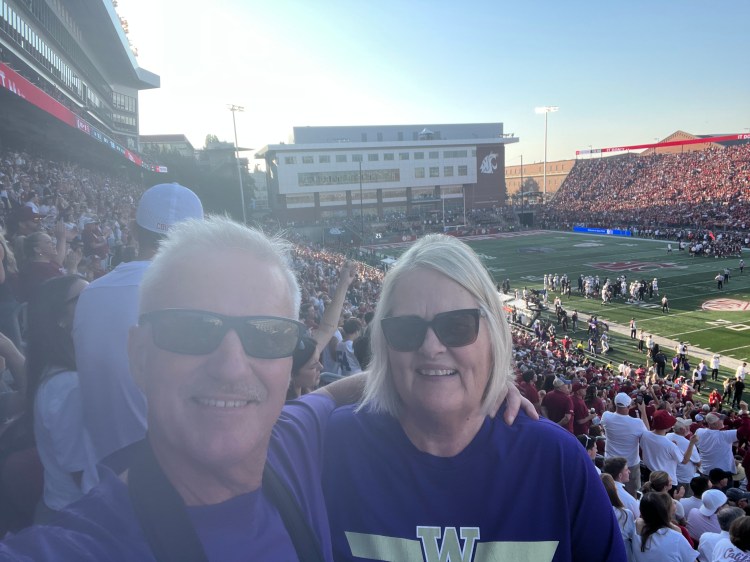
Vicki and I at the September 20 Apple Cup in Martin Stadium. That’s the Cougar Football Complex in the background. We were surrounded by Cougar fans, who were absolutely giddy that on this day beer was sold for the first time in the stadium (how ironic!). I asked the beer-drinking guy next to me if this was his first beer in the stadium. “No, it’s my fourth,” he replied. He was on beer No. 4 for the game.
I’m sorry I was late to the party. And having had many conversations with Coug alums over the years, I understand life at Wazzu was one big party!
I had always wanted to watch an Apple Cup in Pullman. But I could never summon the courage to make the trip over the mountains in late November, when the contest was traditionally played. I preferred to watch those games –usually played in sub-freezing temperatures, and occasionally in howling snow storms – from the comfort of my family-room couch.
That all changed when the Huskies left the Pac-12 for the promise of a more lucrative future in the Big Ten, leaving the Cougars to fend for themselves. The bold move – which WSU fans will never forgive UW for – relegated the Apple Cup to a non-conference matchup in September.
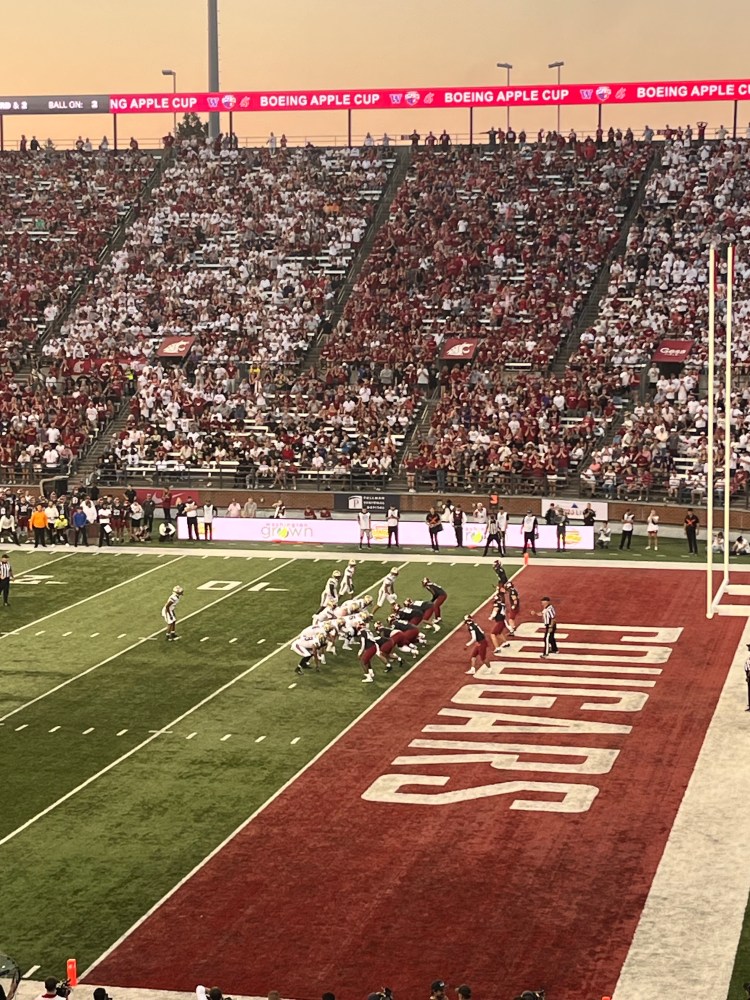
I, for one, certainly wasn’t complaining when the 117th Apple Cup kicked off at 4:40 p.m. amid 80-degree temperatures and a slight breeze. UW won the game decisively, 59-24, though for three quarters it was much closer than that. The game was okay, not great. It was the experience I won’t forget.
The Huskies drive for yet another touchdown in their 59-24 victory over the Cougars, a game that was more competitive than the final score indicated.
My perception of Pullman had always been colored by Apple Cup humor. You know, the back-and-forth jokes between the two schools in the days leading up to the rivalry game, including the one about directions to Pullman: “Go east until you smell it. Then go south until you step in it.”
Many WSU fans perceive UW fans as “arrogant,” and chafe at Huskies referring to Cougars as their “little brother.” Or, perceiving Cougars as country bumpkins, “Cousin Clem.”
Even legendary UW Coach Don James, who was usually understated and not one to take shots at an opponent, could talk some smack. Once speaking at a spring coaches tour in Portland, James referenced Pullman.
“A tornado went through there,” he said, “and did a million dollars worth of improvements.”
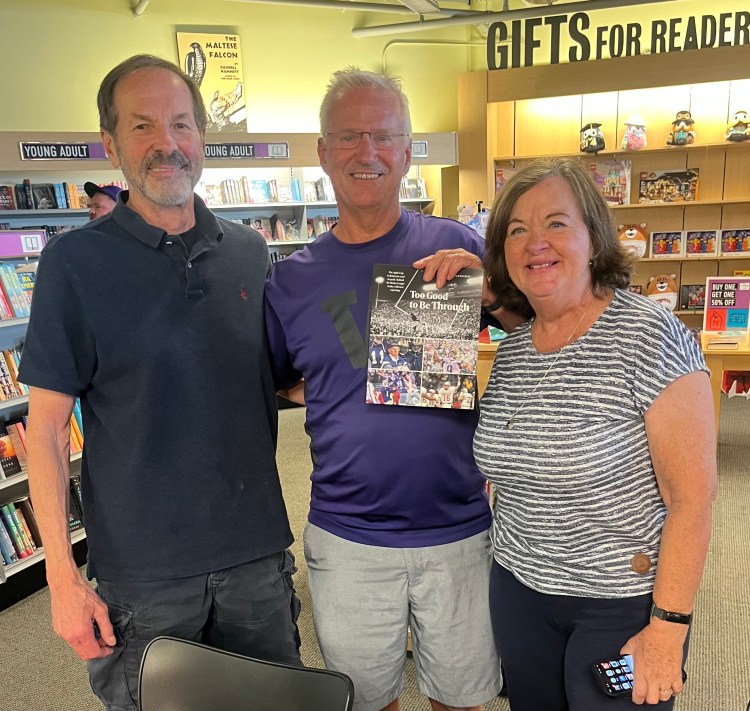
Myself with Bud Withers, and his wife, Velvet, in the WSU Bookstore before the Apple Cup. I’m holding Bud’s book “Too Good to be Through.” It’s the first book written on the Apple Cup, and one I highly recommend. Bud is an award-winning sports writer. We worked together for several years at The Seattle Times.
Husky and Cougar players were also known to talk a little trash. Before the 1987 Apple Cup in Seattle, UW quarterback Chris Chandler said this of the Cougs:
“No matter what happens, they have to go back to Pullman. And I feel sorry for them.”
Shed no tears for the Cougs. They love Pullman – and are fiercely loyal and true to their school.
The Cougar Band plays the school’s fight song before the teams take the field. That’s the student section on the left side of the grandstands across the field. Alcohol wasn’t allowed to be served there, but of course we all know alcohol has been consumed in that section for many decades, as is the case with most schools.
My friend and former colleague, Craig Smith, covered WSU football for The Seattle Times in the 1980s and 1990s. Because the team was his beat, Craig spent a lot of time in Pullman. I remember him telling me he was struck by the tight-knit, bond WSU students seem to have – the sense of family, an “us against the world” mentality while isolated together in the remote town in the northeast corner of the state. Years after graduation, Cougars are drawn “home” to the familiar haunts of ole Wazzu. Craig called this sense of community “Mother Pullman.”
Driving east from the Columbia River on Highway 26, and passing the rolling wheat fields of the Palouse, is the only way to run to the warm embrace of “Mother Pullman.” Can’t say there’s anything memorable between the river and Othello. But once you hit Washtucna, you see the familiar “quilting effect” of the rolling hills, which change from vibrant green in spring to golden brown in the summer. Giant grain elevators proudly proclaim “GO COUGS” in bold letters the closer you get to Pullman.
Finally, NW Davis Way leads you down the hill to the edge of downtown Pullman. Except there’s nothing really special about the downtown. Instead, your eyes are fixed on the big hill behind downtown, and the towering brick buildings that adorn this picturesque, 620-acre campus. Pullman IS Washington State University.
Martin Stadium is not separate from campus, as Husky Stadium is at UW, and Autzen Stadium at the University of Oregon. The stadium is carved into the campus. The Compton Union Building (bookstore) and Terrell and Holland libraries are a couple minutes walk from the stadium, as are several other classroom buildings.
Down Colorado Street, near the frat houses, is the historic “Coug” restaurant and bar, where former WSU coaches Jim Sweeney, Walden, Dennis Erickson, Mike Price and Mike Leach were known to drown their sorrows after a tough loss, or celebrate a big victory. Just east of the stadium, near the indoor practice facility is Ferdinand’s Ice Cream Shoppe and WSU Creamery, which Cougs claim serves the best ice cream on the planet. You can also purchase popular “Cougar Gold” cheese there.
It is here, on this quaint, walkable campus, where memories are made, and lifelong bonds are formed. My friend Dave Harrison, who played football for Jim Walden and remains a die-hard Coug, met his wife at Wazzu.
The terrace along Terrell Library offers great views of the stadium.
“It’s (WSU) a pretty special place for Ann and me,” he said wistfully.
Even Huskies acknowledge this. Perhaps Joe Steele, a star running back for UW in the 1970s, said it best.
“Washington State’s a beautiful place,” Steele told Bud Withers in his recently-released book “Too Good to be Through,” a historical account of the Apple Cup. “The campus, where it sits, the stadium. The Washington experience is one thing – it’s inner-city, it’s got its challenges … one thing about the Cougars, you go to Washington State, you’re Cougars for life.”
1982: When the rivalry got serious
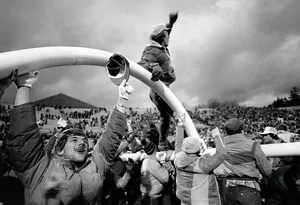
Cougar fans tear down the goal post after WSU stunned heavily-favored UW in the 1982 Apple Cup. The students eventually carried the goal post out of Martin Stadium and dumped it into the Palouse River.
I was a young sportswriter in Oregon working in the office one Saturday afternoon when the Associated Press teletype machine spit out the shocking final score: Washington State 24, Washington 20. It was one of those “I-remember-where-I-was-when-I-heard” moments.
The Huskies entered the game 10-1 and ranked No. 5 in the nation, and only needed to defeat the 2-7-1 Cougars to return to the Rose Bowl for the third consecutive year. UW was behind 21-20 in the waning minutes of the game, but seemed destined to break the hearts of the Cougar faithful when usually-reliable kicker Chuck Nelson lined up for what appeared to be a 33-yard, game-winning field goal. But the referees ruled Nelson’s kick sailed inches wide right, ending his streak of a then NCAA-record 30th consecutive made field goals. It was WSU’s first win over UW in nine years. Instead of a trip to Pasadena, the loss sent the Huskies to the Aloha Bowl.
As a follower of UW sports since my earliest memories (thanks dad!), I had always viewed the Apple Cup as a nice, intrastate rivalry. Back then, in most years neither the Huskies nor the Cougars were very good. Hence, there wasn’t much on the line. But by the late ’70s, the UW football program had become a player on the national stage under James. There was this aura of invincibility under the legendary coach. Not only had James proven he could win big games, his teams usually won when they were supposed to. How could UW lose to such an inferior opponent?
The game in 1982 was also the first Apple Cup played in Pullman in 28 years. Prior to that, WSU’s home games in the rivalry were played in Joe Albi Stadium in Spokane. Bringing the game back to Pullman gave the Cougars more of a – and frankly overdue – home-field advantage. Cougar fans were so excited to beat the Huskies they tore down a goal post, carried it out of the stadium and dumped it in the Palouse River.
My friend Dave was a backup center and special teams player on that ’82 team. He said the Cougs were still smarting from the previous year’s game, in Seattle, when the Huskies won 23-10 in a winner-to-the-Rose Bowl game.
“After watching my high-school teammate (UW receiver and future Seattle Seahawk) Paul Skansi catch a touchdown pass, and the very long bus ride back to Pullman after the 1981 game, I just remember how painful that was for all us,” recalled Dave. “After a miserable season in 1982, returning the favor was pretty big for us Cougs.”
The ’82 game would not be a fluke. The following season in Seattle, the unranked Cougs knocked the Huskies out of the Rose Bowl once again. This time, with a big, physical defensive front, they completely shut down No. 15 Washington, 17-6. Just as the ’81 game stung the Cougs, the back-to-back losses to WSU had to be galling for UW fans.
Although the Huskies have had the upper hand for the most part since, I believe that game 43 years ago was a turning point for the rivalry. That’s when the Apple Cup became more competitive – and jokes and the trash talk began.
Below are the Apple Cup scores from 1974-1985. The 1982 season marked the return of the game to Pullman, andstarted a run where WSU won three games in a four-year span.
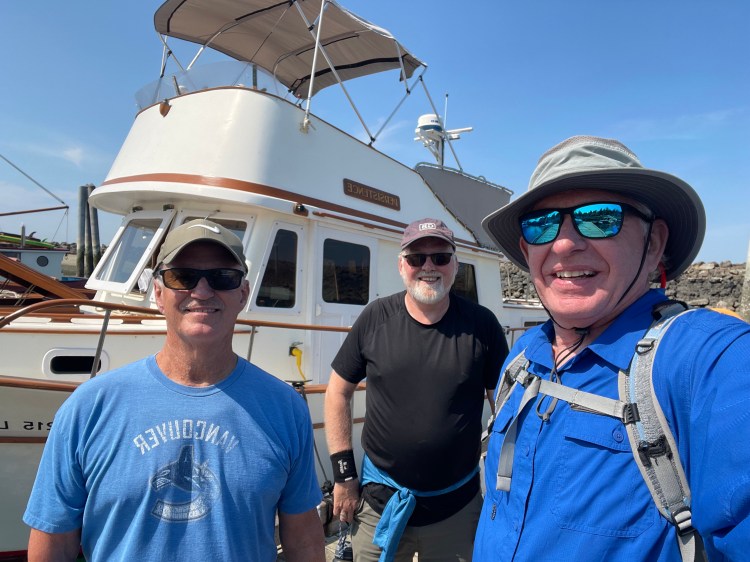
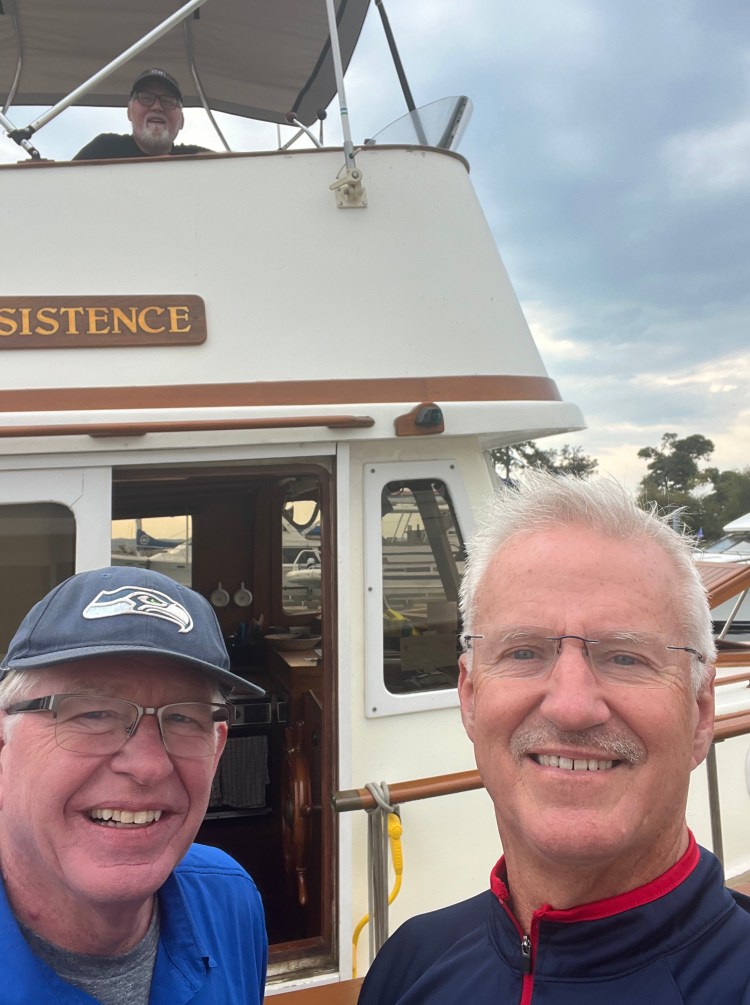
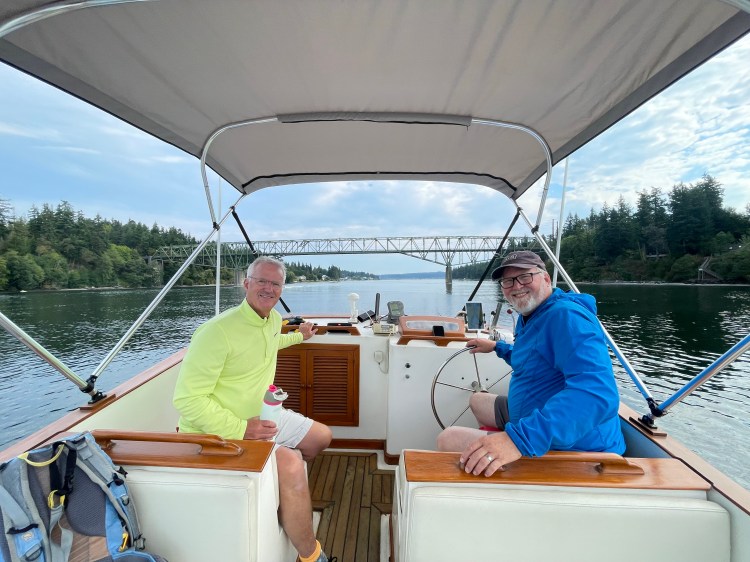
A familiar trio on a three-day boat trip: Myself, Kent Oldenburger and Bob Swenson in front of Kent’s 35-foot Trawler “Persistence” at the Blake Island Marina in Puget Sound.
The Three Amigos.
The Three Vikings.
Three Brothers From Different Mothers.
Or, as Bob Swenson suggested, “Oly, Lund and Swen.”
Whatever the moniker, the three of us have shared many journeys over the years. It’s a bond built on family and friendship. Kent Oldenburger is my brother-in-law. Bob was a groomsman in Vicki and my wedding, and a longtime friend.
For the past 13 years, it was the annual Lund family backpack trip that drew us together. This year, we traded the huffing and puffing up steep mountain trails for a more relaxing passage on Puget Sound’s waterways.
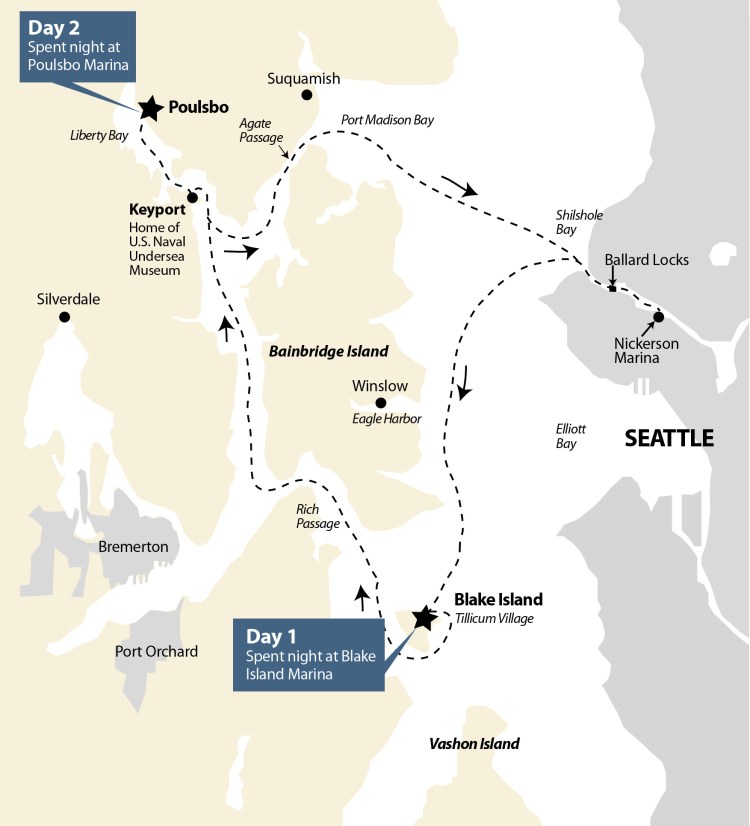
Kent owns a 35-foot trawler named “Persistence.” I had been on the boat a couple times on Seattle’s Lake Union, but never west of the Ballard Locks and the open waters of Puget Sound. Beginning at Nickerson Marina, where Kent’s boat is moored, the three-day trip featured overnight stops at idyllic Blake Island and the quaint Kitsap Peninsula town of Poulsbo, also known as “Little Norway.”
The route of our three-hour – make that three-day – tour. You would have had to have watched Gilligan’s Island to get that one.
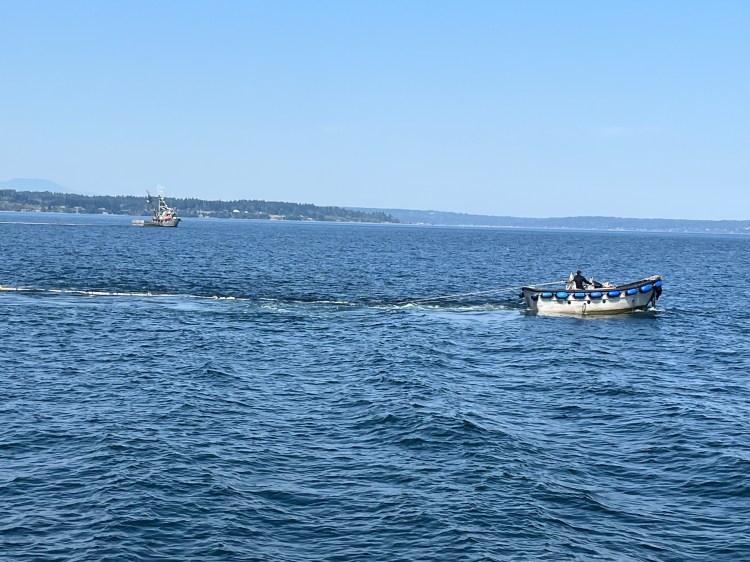
As we motored along shipping lanes and dodged a Washington State ferry shuttling cars and passengers between Seattle and Bainbridge Island, we saw dolphins, seals, and tribal fishermen setting gill nets with the help of a “skiff boat.”
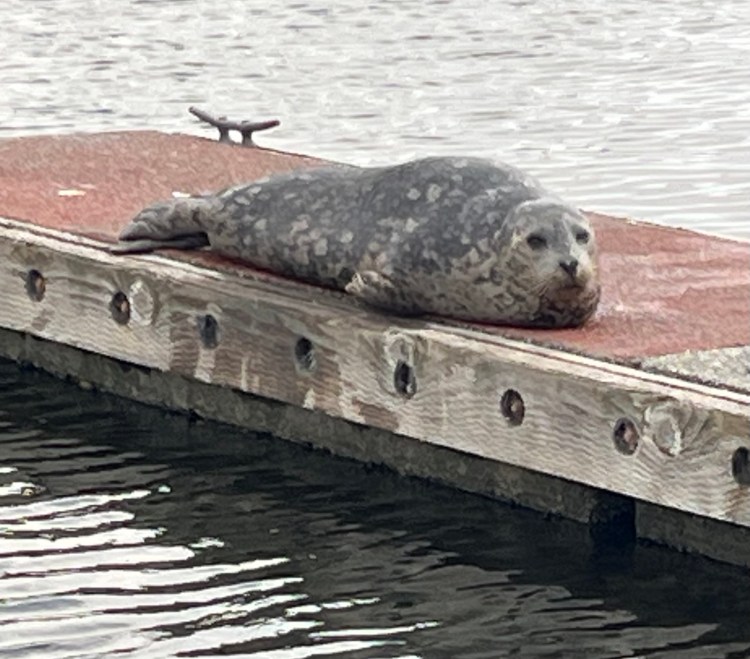
The fishing boat (in the background), also known as a “purse seiner,” releases a small but powerful “skiff boat,” which drags a wall-like net, eventually closing the loop at the fishing vessel to collect fish.We saw seals in the water and on marina docks. We worried beforehand we wouldn’t get a spot at the marinas at Blake and Poulsbo. You could say these critters helped “seal” our reservations.
The sights and sounds along the way, however, ultimately took a backseat to meaningful discourse. As was the case with our backpack trips, it was an opportunity for deep conversations. We talked about the state of our nation, the state of The Church in America, our “faith walk,” our hopes and dreams for the future, and yes, even our regrets.
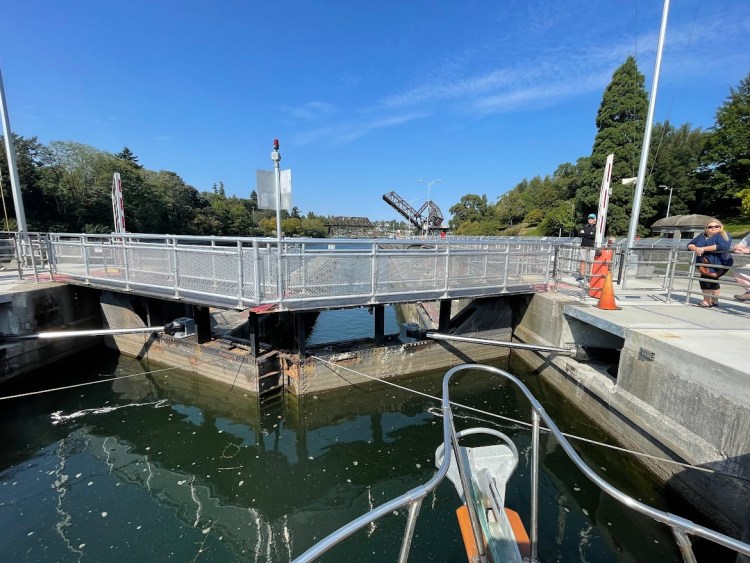
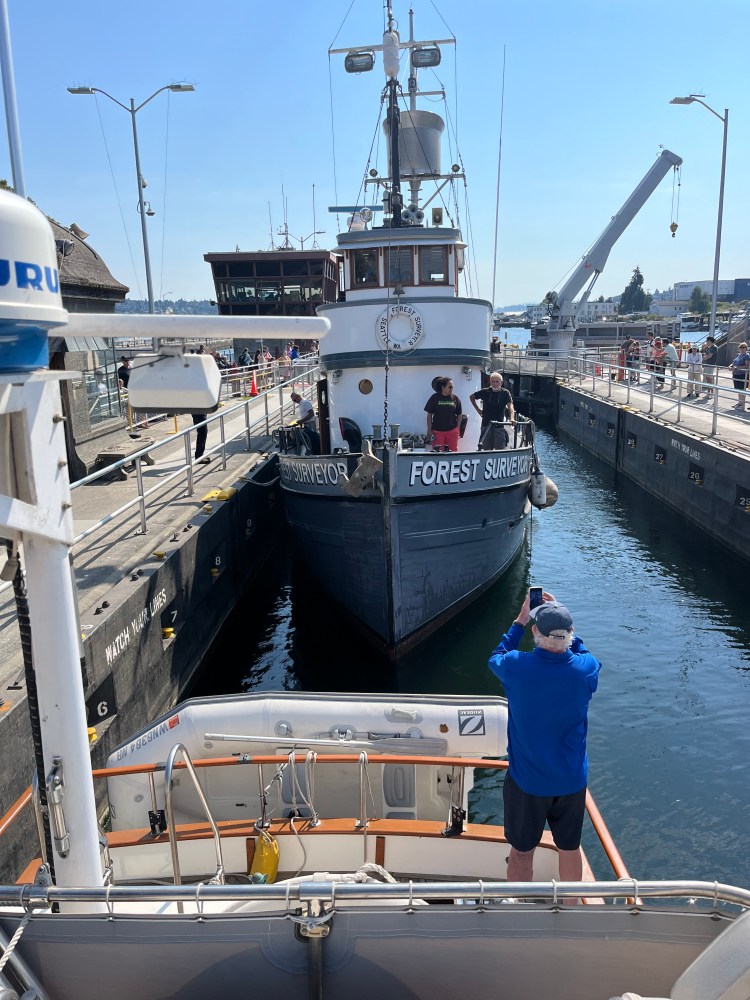
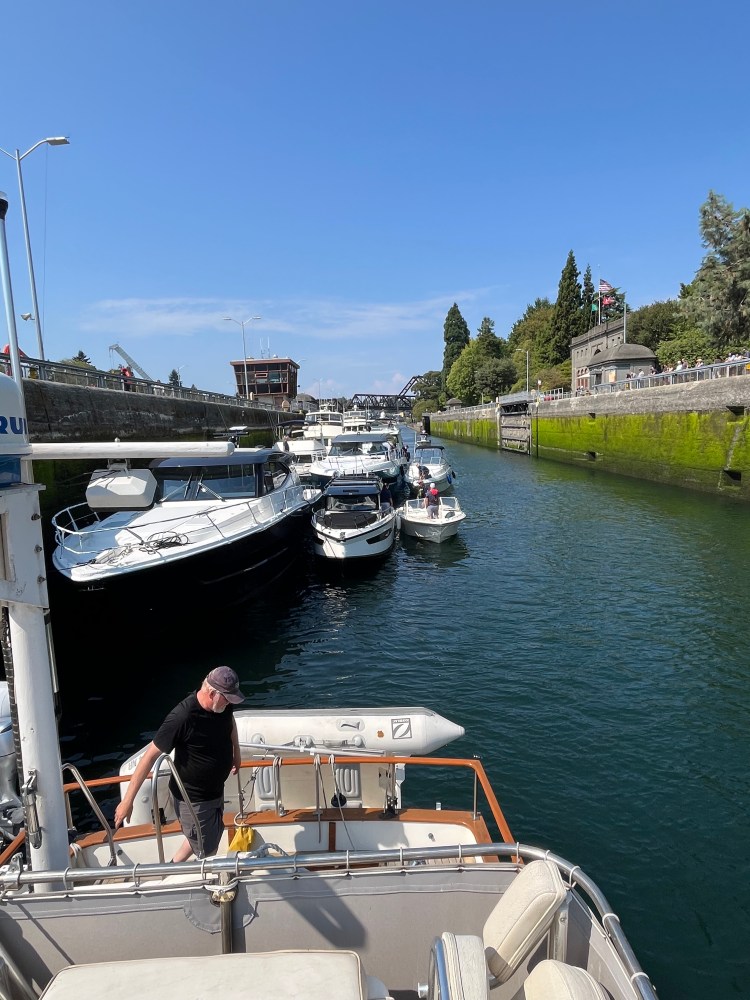
Approaching the “small” Ballard Locks on our way to saltwater. The water level of the Salmon Bay Waterway, Lake Union and Lake Washington is higher than the Puget Sound.Waiting for the water level to drop in the “small” locks, Bob takes a picture of the surveyor boat behind us. I didn’t any “forests” in the ocean.
After we “drop down” to sea level, the doors on the Ballard Locks slowly open up, and we’re on our way.
We made it through the trip, including the harrowing Ballard Locks, without incident. And that’s saying something. When it comes to boating, Kent is detail-oriented and knowledgable. His deckhands – first-mate Bob and second-mate Rick – are borderline teachable. But we did learn – well mostly – to correctly tie rope to a boat cleat.
And for that, we owe a debt of gratitude to our captain.
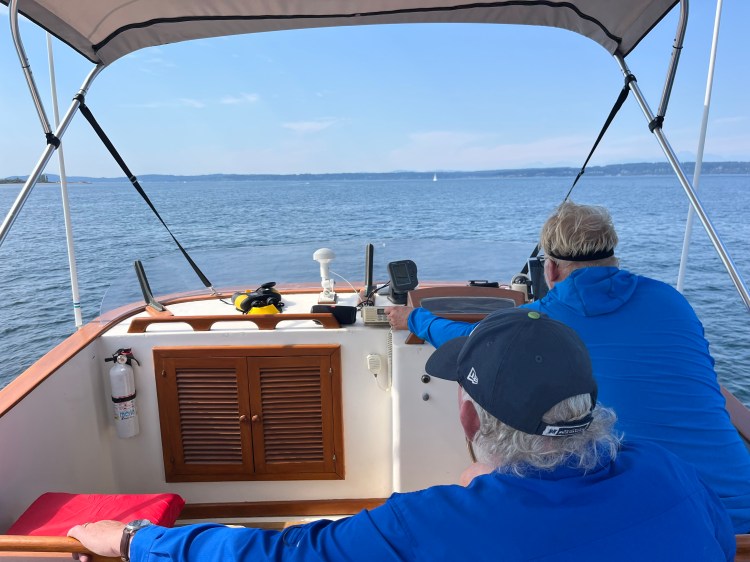
Captain Kent Oldenburger. He put a lot of effort into planning the three-day trip. And while Bob and I had our turns at the wheel, he was always piloting the boat when skill was needed.
Kent-O (Sung to the tune of John Denver’s hit tune “Calypso”)
Aye, Kent-O, the places we’ve been to The things you have taught us The stories we tell Aye, Kent-O, we bow to you, captain We’re the men who have served you So brief, not so well Olole iiiii, ololo ululululu Ololw iiii, ololu uu
Our captain is so high above us. Yet, as the name of the boat suggests, we “persist.”
Some more photos from our trip:
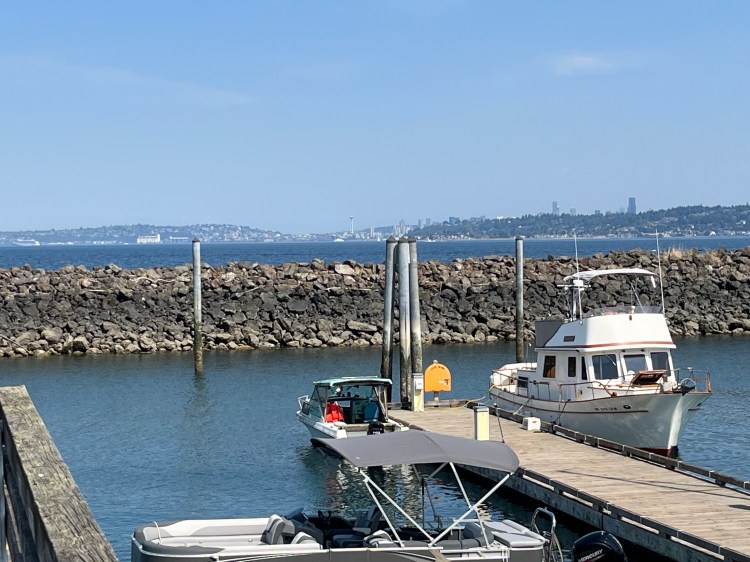
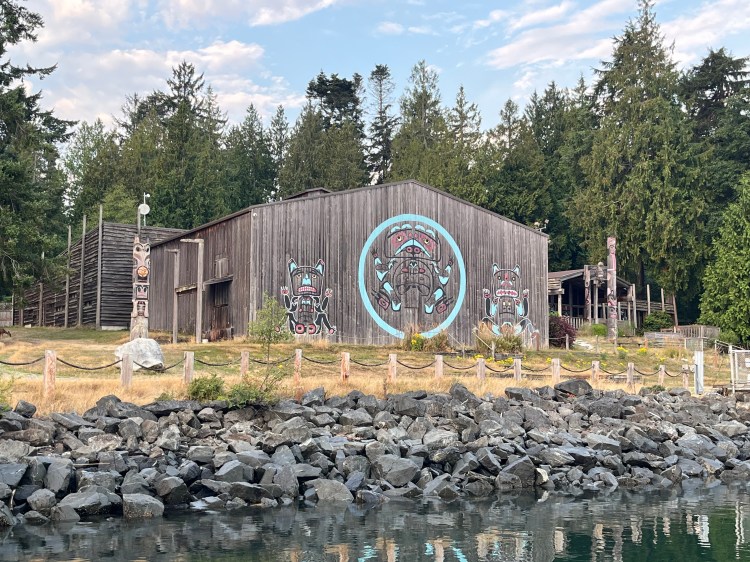
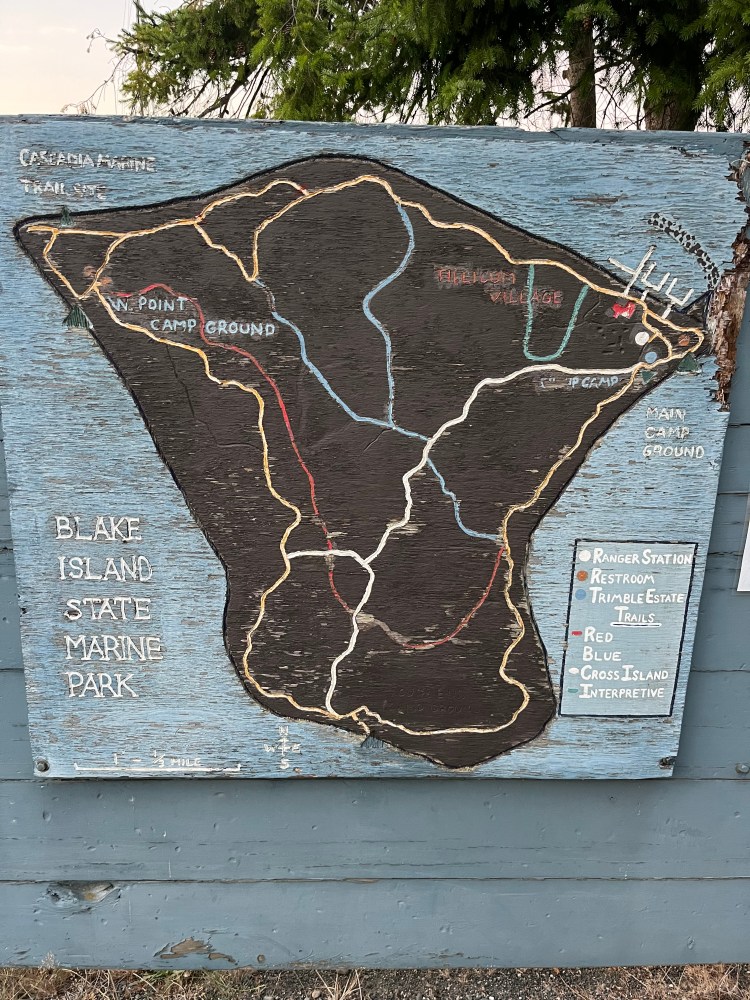
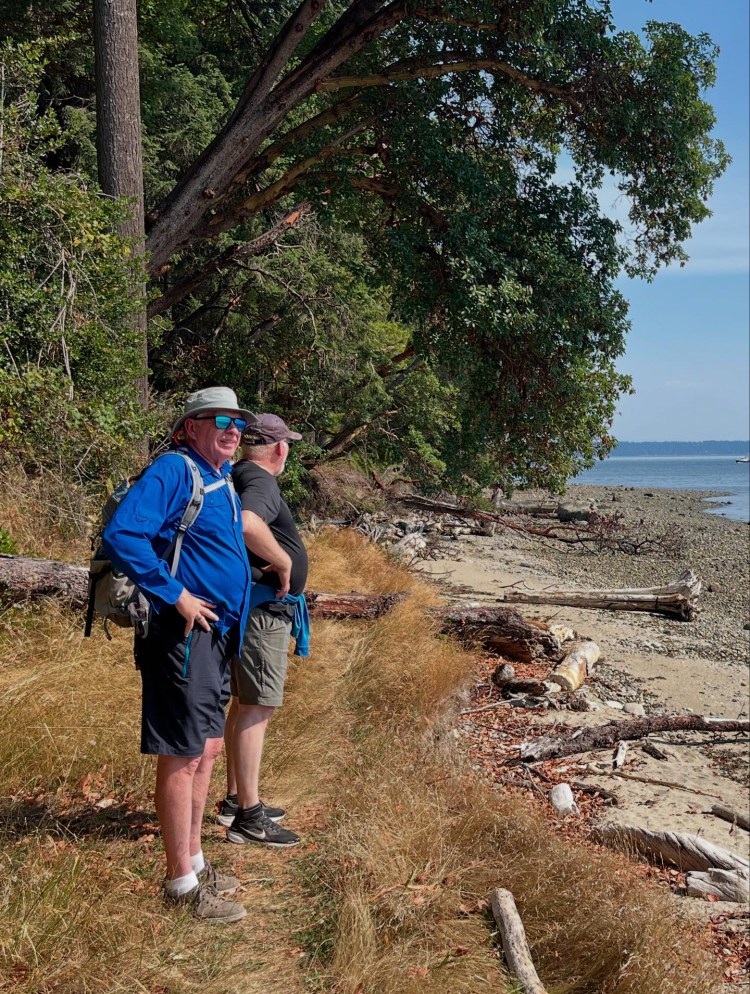
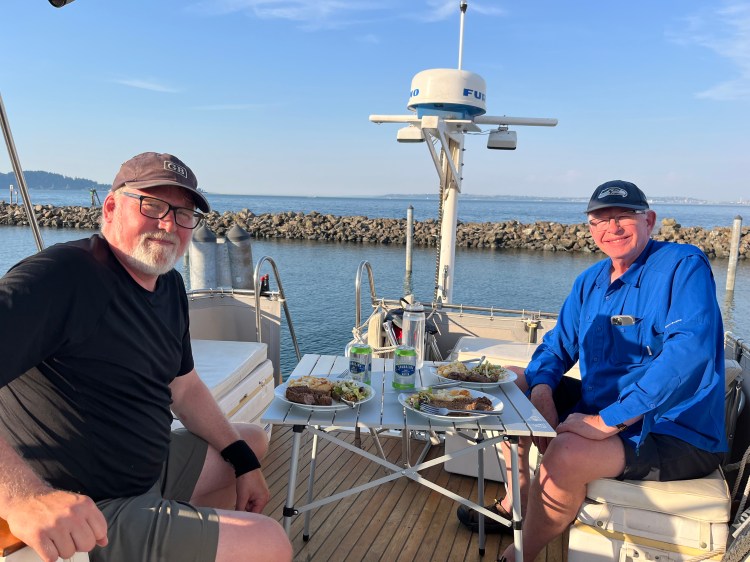
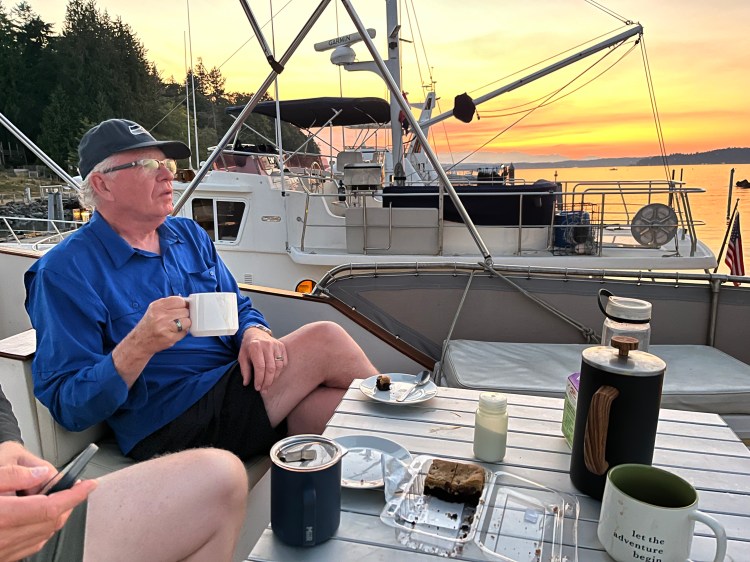
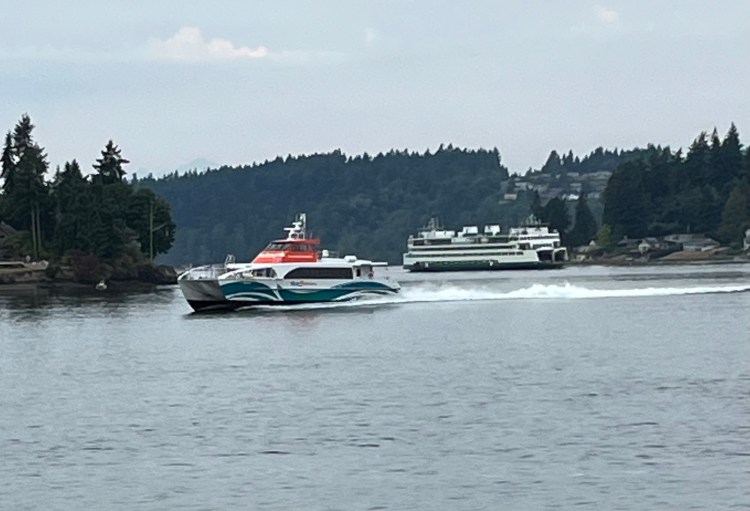
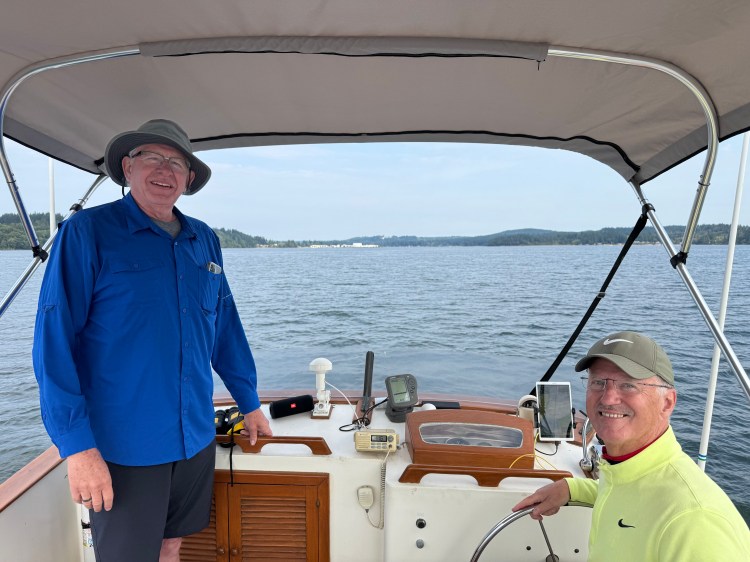
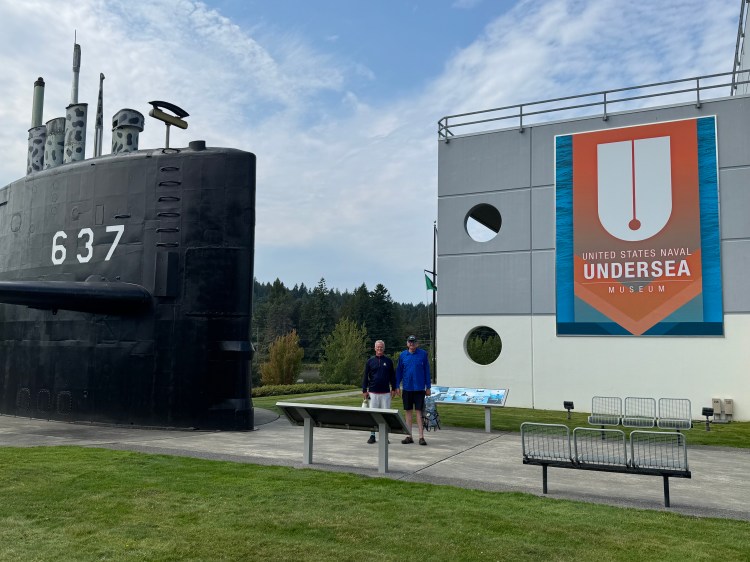
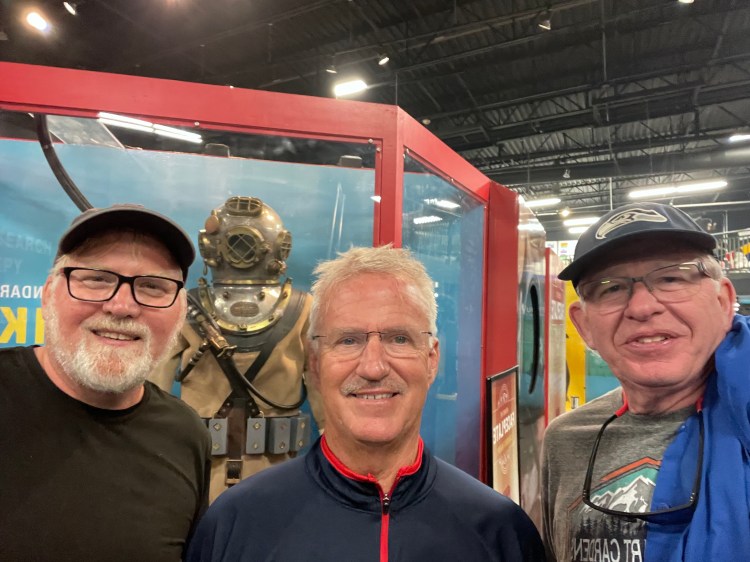
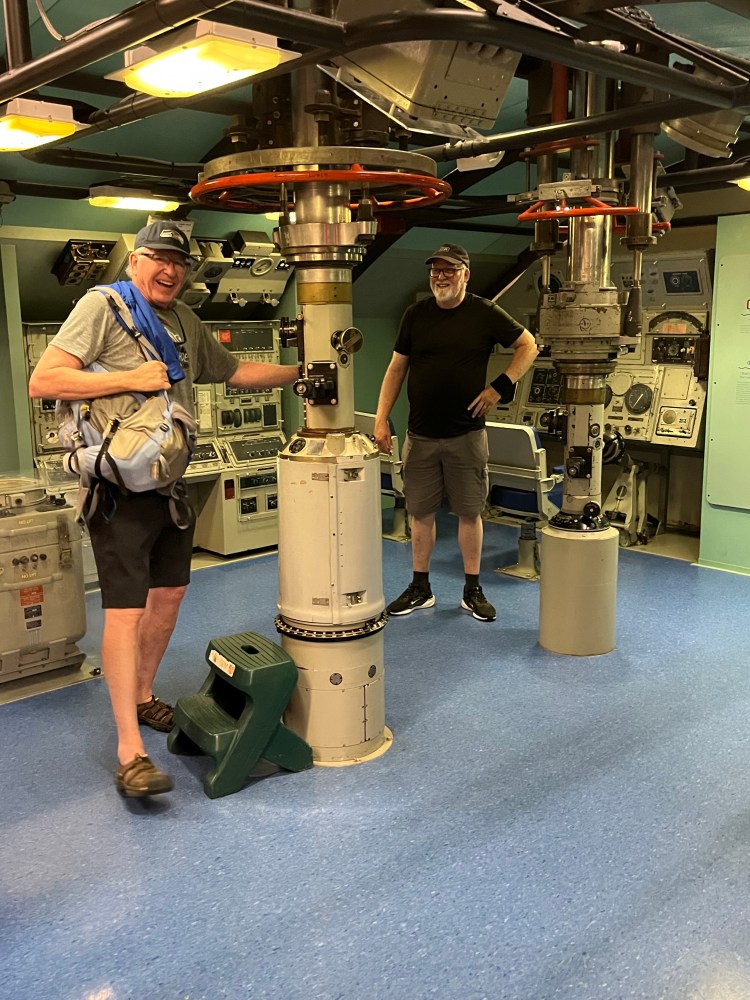
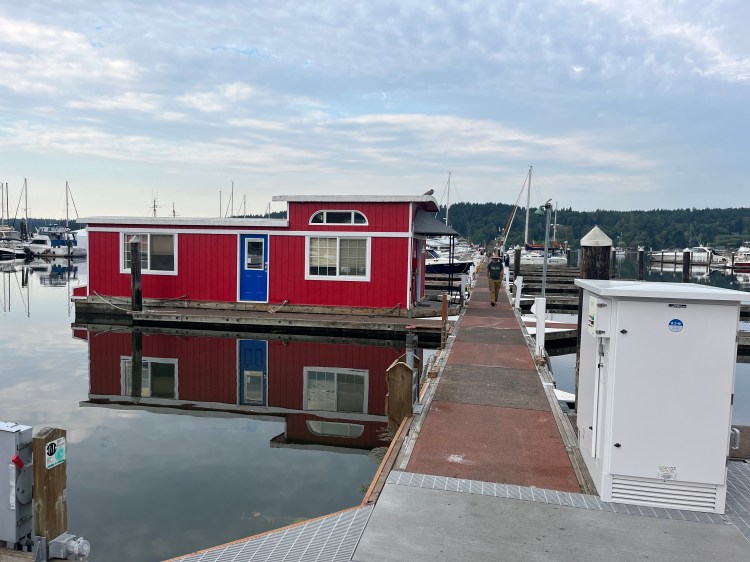
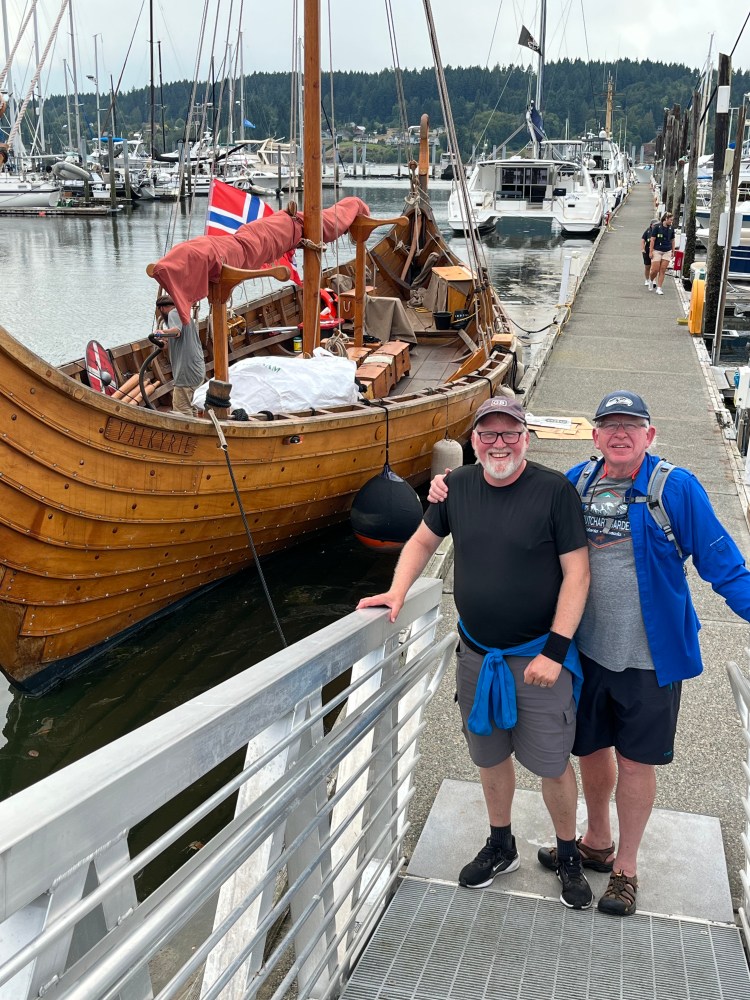
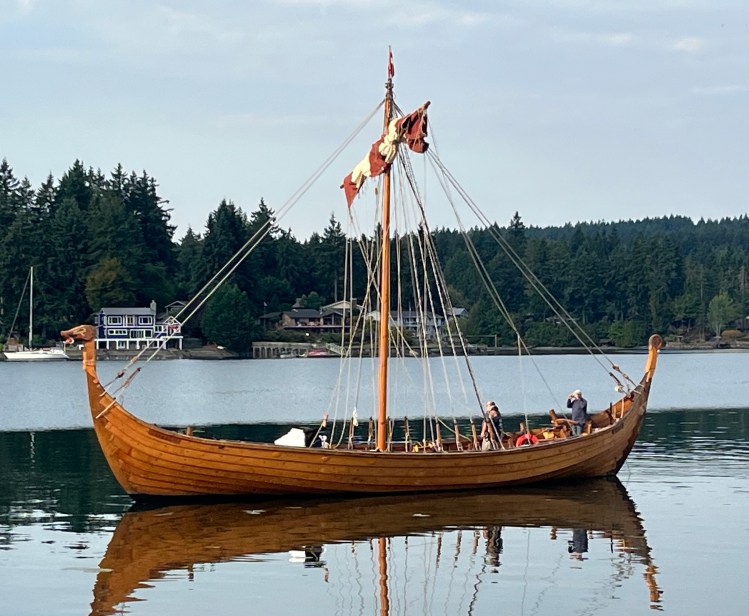
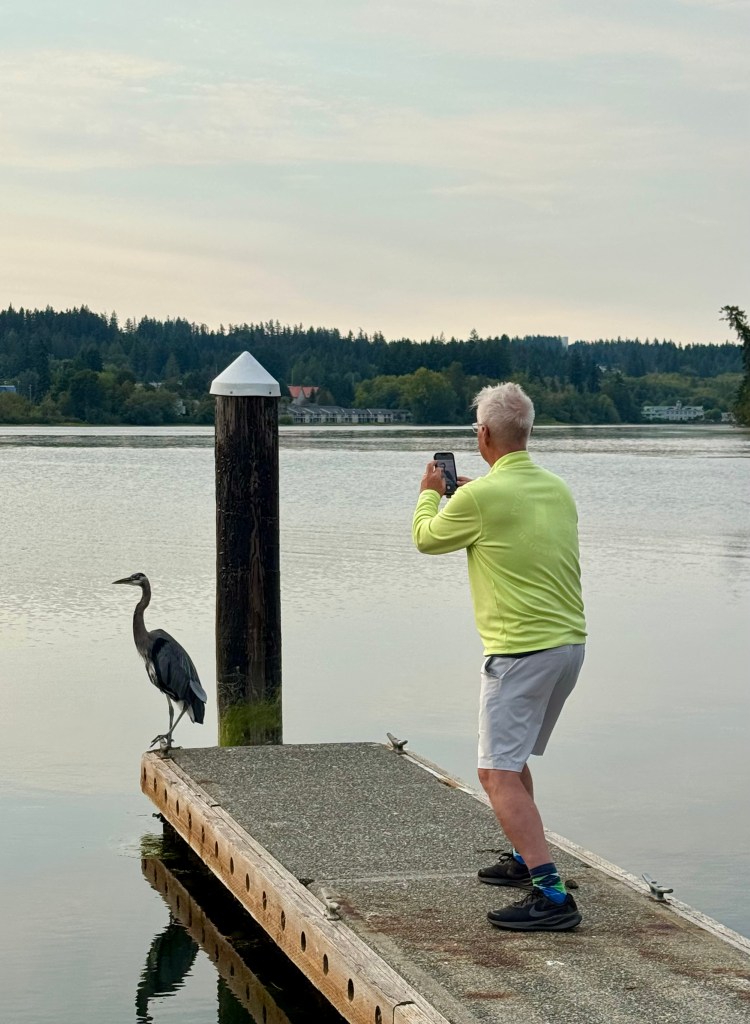
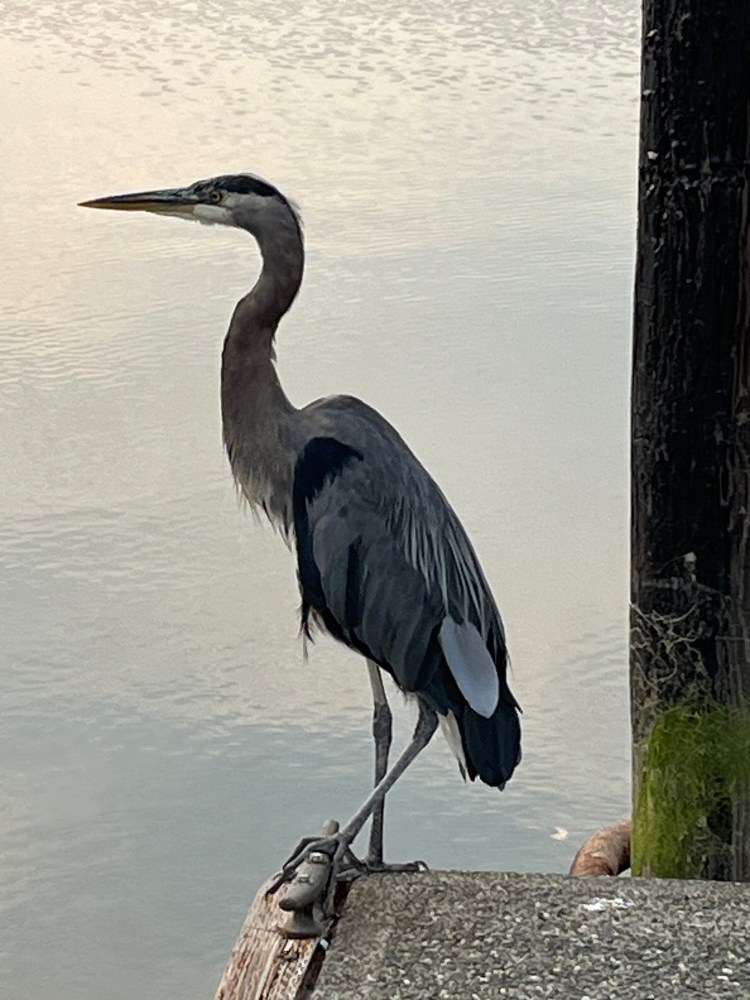
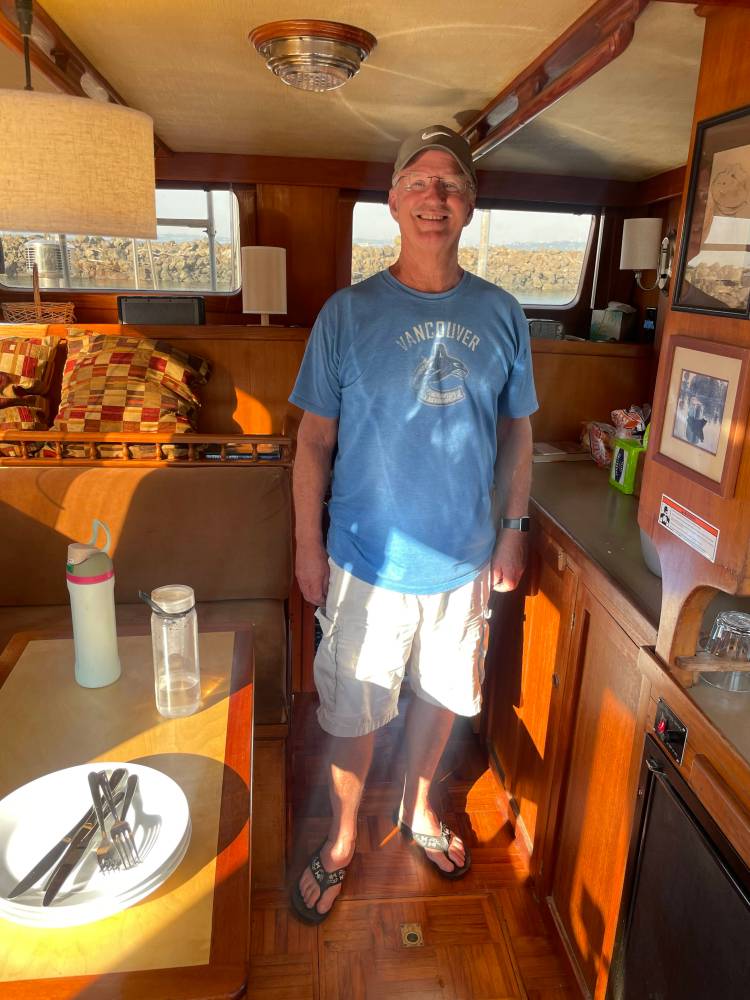
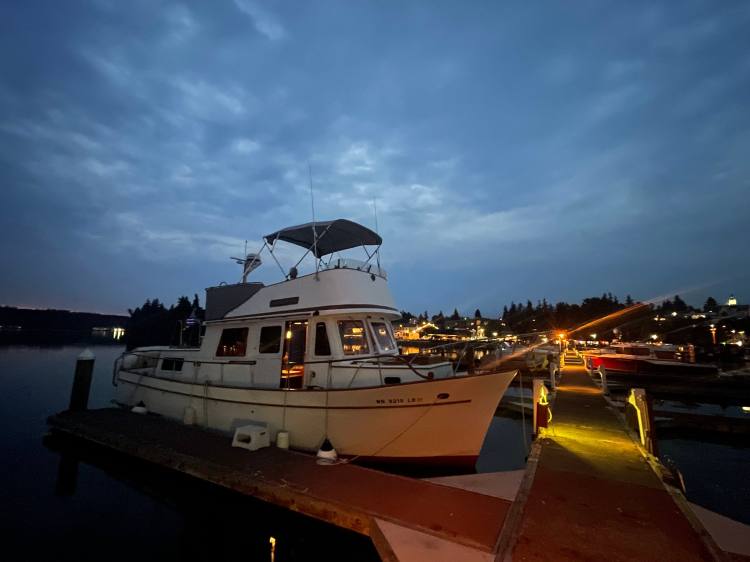
We got a parking spot at Blake Island, southwest of Seattle (background). The marina filled up pretty fast after we arrived. The small boat pulled out, and a yacht Kent said was worth $750,000 pulled up in its place. Tillicum Village over the years has hosted salmon barbecues for tour groups. Vicki and I were here in 1979 for a media event for the Major-League All-Star Game that was played in Seattle. Unfortunately, the tribal village has been closed for the past three years.The trail system on the island. We hiked the four-mile loop trail.We take a break from the hike to survey the scenery on the south end of the island, looking toward both the Vashon and Southworth ferry landings.Kent grilled tri-tip steak for dinner the first day.Dessert and decaf coffee as the sun sets, a perfect setting for meaningful conversations.On our way to Poulsbo, we crossed paths with a Bremerton-bound Washington State Ferry and a smaller, modern “fast ferry” that provides passenger-only service between Seattle, Bremerton and Port Orchard.Approaching Keyport (in the background), and I get a chance to take the wheel.A planned visit on the second day to the United States Naval Undersea Museum in Keyport.The main reason for our visit to the museum was it featured some diver equipment Bob’s father, Bud, wore as a Navy deep sea diver. Bob was excited to see the gear his father used. And it matches the tattoo he has in honor of his father, who died of cancer at a young age, shortly after Bob and Peggy were married.Once again, the threesome, for the obligatory shot in front of Bud Swenson’s gear.Bob and Kent check out what it would have been like to serve on a World War II-vintage submarine.The Poulsbo Marina has a Norwegian flavor. A few of the buildings are painted the colors of the nation’s flag, just like in Norway.A vintage Viking boat in the Poulsbo Marina.The aforementioned Viking ship set sail the next morning, in Liberty Bay.Boys will be boys. Trying to get close to a Heron.And that’s as close as I got before it flew away, but not before he scolded me.Suspect deckhand in the boat cabin.Kent and I on the waterfront with the “Sons of Norway” building in the background.We spent our second night in Poulsbo, which was incorporated in the 1880s. A Norwegian settler suggested it be named “Paulsbo,” after his hometown in Norway. But authorities in the U.S. Post Office in Washington, D.C. misspelled the town’s name, likely misreading the immigrant’s handwritingNight time in Poulsbo. It’s an unique, different lifestyle, this group of boat people who hop from one marina to the next in the Puget Sound during the summer months.Day 3. Heading back to Seattle, and about to pass under the Agate Passage Bridge linking the Kitsap Peninsula to Bainbridge Island.The open water, heading toward Shilshole Bay and the Ballard Locks.
An expensive yacht leaving the Ballard Locks as we waited to enter. He had a Washington State University flag and an Auburn University flag, which was interesting.We passed through the “large” Ballard Locks on our return to Nickerson Marina. The yacht and matching blue “chaser boat” behind us were being delivered to their owner. Kent says as many as 100 boats can fit in the large locks.
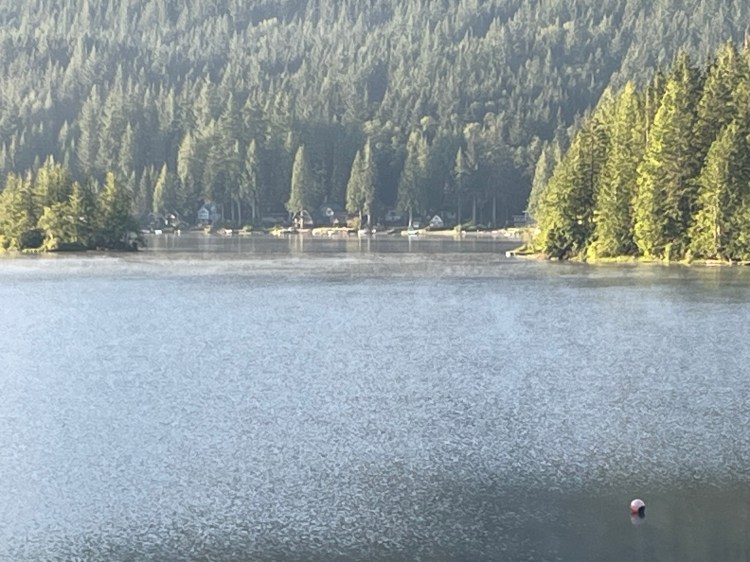
Puffs of fog hover over the cove in the quiet of the morning.
Poem by Bob Swenson
It’s another quiet morning Fog tiptoes over the water The surface is a mirror. Inverted hillsides, clear as day.
The coffee’s ready There’s half & half and sugar. The toaster warms the bread There’s jam in the fridge.
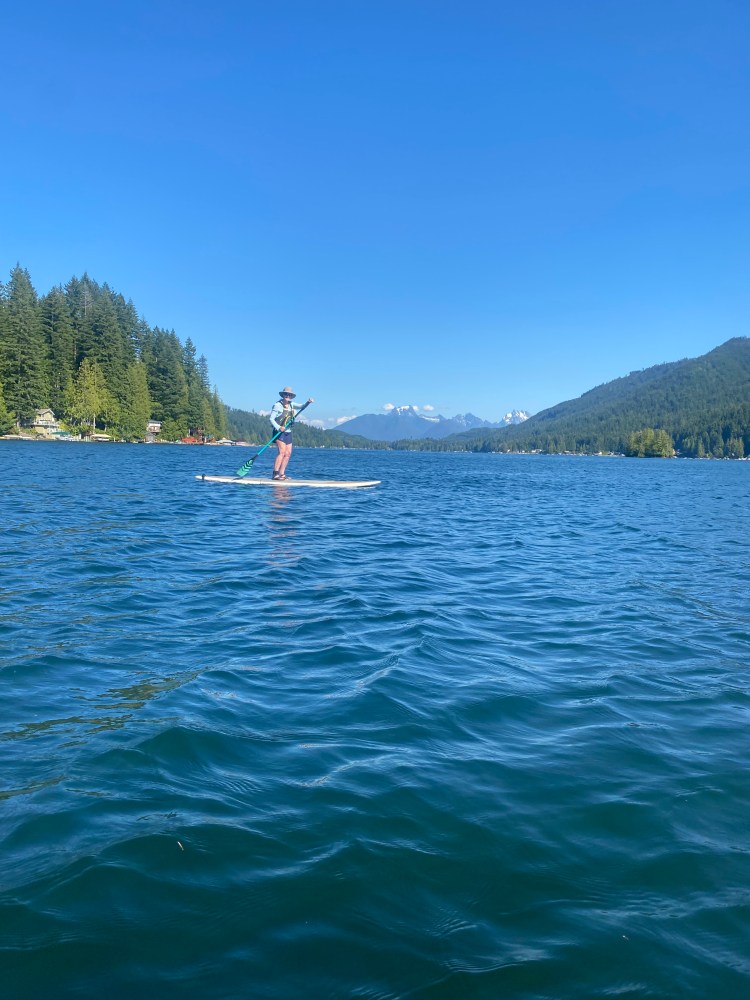
Peggy Swenson paddleboarding on Lake Cavanaugh, with Whitehorse Mountain and Three Fingers in the background.
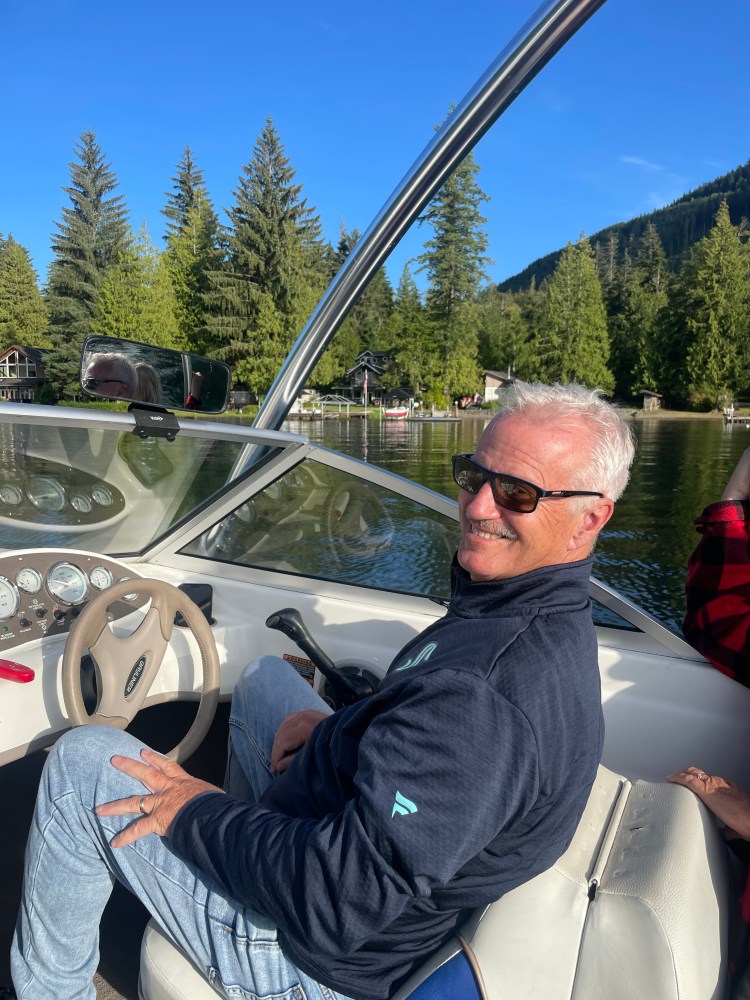
Boat driver
We discuss the plans for the day And wade through the headlines. The world’s a mess. What time is the game?
I think I’ll take the boat out Or maybe the paddle board. We’ll play cornhole after lunch.
The days are long. It stay light till 9. The water’s warm even where it’s deep. There’s nothing better than summer at the lake.
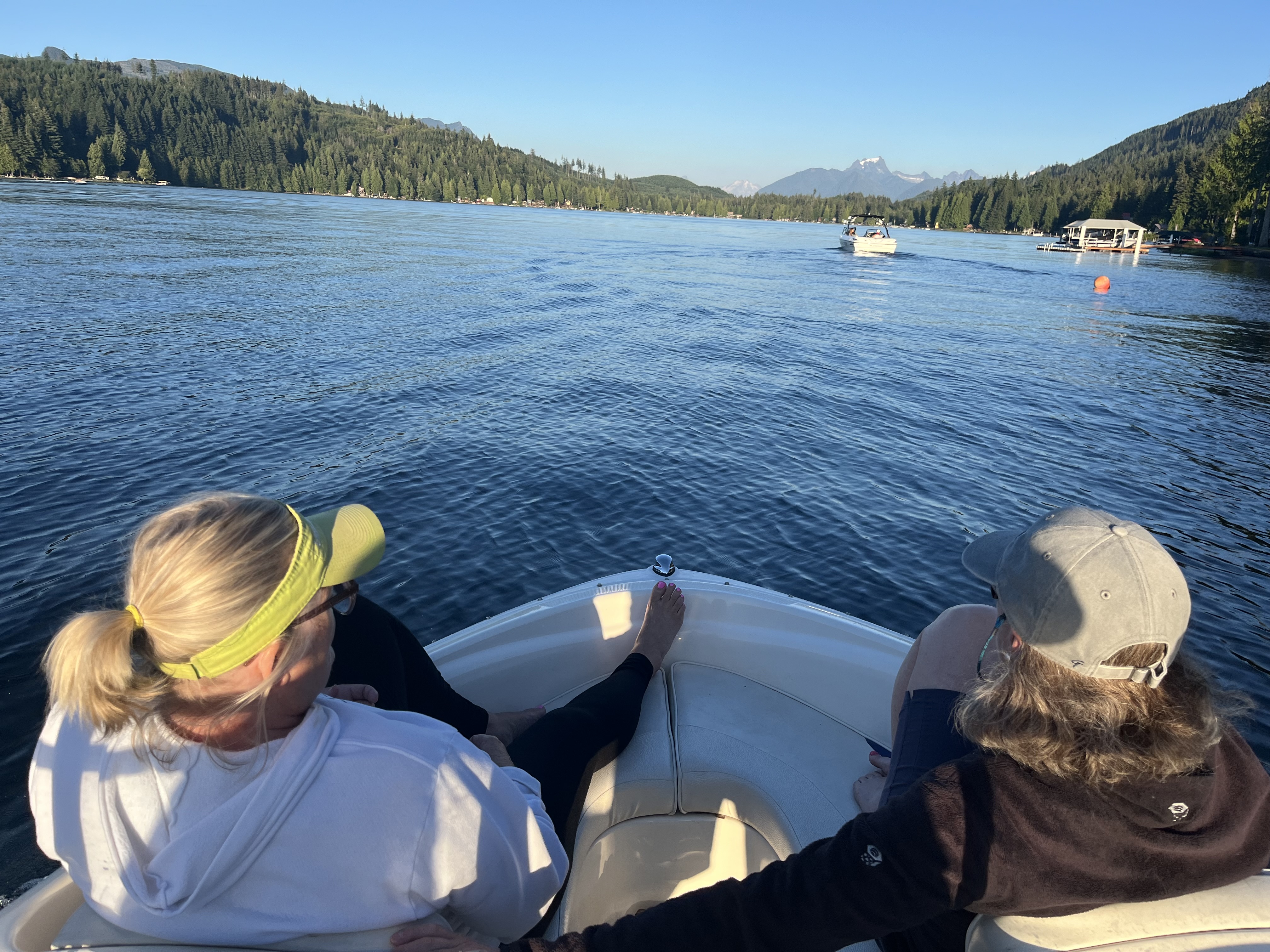
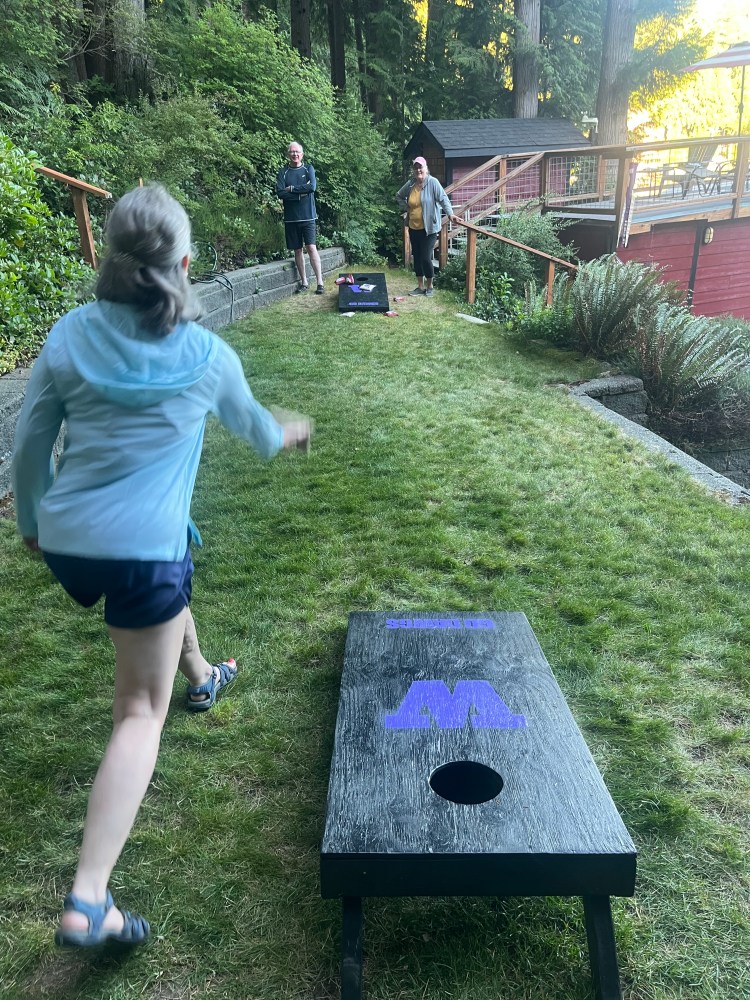
A leisurely, evening cruise around the lake.Peggy throws a bag in the Apple Cup of cornhole, pitting the Swensons (with UW bags) against the Lunds (with WSU bags), complete with Cougar and Husky sound effects. The Swensons cleaned our clocks. But since they were playing with UW bags, I felt like we all won.Longtime friends pose for a photo as our three-day stint at our lake cabin comes to a close.
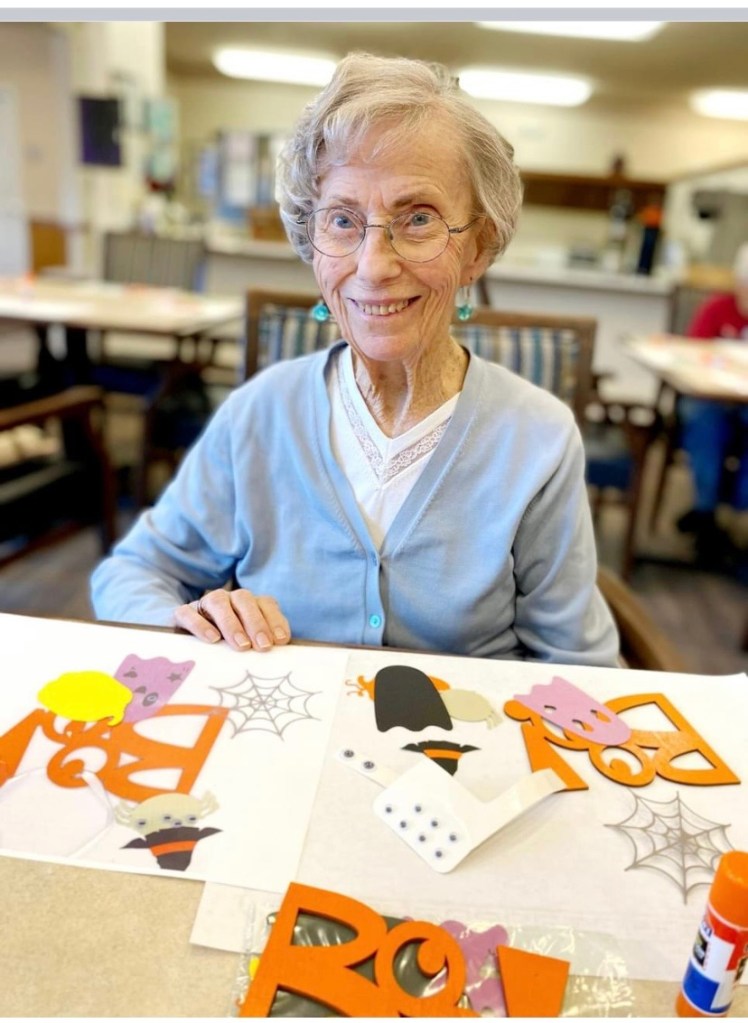
Mom pictured here at Where The Heart Is and Memory Care Center in Burlington. We moved her there in May 2021. It was during this time mom was showing signs of progressive dementia. Memory loss, however, did not rob her of that warm, pleasant smile. She died peacefully on June 24, just three weeks shy of her 92nd birthday.
My mom was “Wonder Woman” long before Lynda Carter assumed that title.
She did all the laundry, always had home-cooked meals on the table, kept an immaculate house, tended to the garden and flower beds, sang in the choir at church, and had my grandparents and other extended family or friends over for dinner many Sundays after church. She did all that while working full-time beginning when I was 12, in an era when it was rare for mothers to work outside the home. Her jobs at Northern State Hospital and Skagit Valley College in essence made it possible for me to attend a private college in Chicago, spread my wings a little bit and meet the woman I would marry. I thought at the time, that was just normal. It wasn’t.
Mom with us three kids, probably late 1950s in our first home in west Mount Vernon.
As I grew into adulthood, I began to appreciate her enormous skill set and the sacrifices she made for our family. It was also during these past eight years since our dad died, when I spent more alone time with her, I learned what she loved.
Music touched her soul. I have vague memories of her as a soloist at church. As time went on, though, she was content to be just another soprano in the choir. Mom was never comfortable in the spotlight. After our dad died, we enjoyed special music concerts at Bethany, and she loved to sing the old hymns here on Sunday mornings. Just before the outbreak of COVID, we were invited by David Benson to a violin and piano concert at Saxon north of Sedro-Woolley. David and the pianist played music from Chopin, Schumann, Beethoven and Fritz Kreisler arrangements of Viennese parlor tunes. At the end of the concert, she turned to me, and with tears in her eyes said, “I loved this music. Thank you so much for bringing me.” Mom had an eclectic taste in music. In fact, she liked some of the music I liked growing up. Dad liked Lawrence Welk music. Mom liked the Bee Gees (So how deep was your love for them, mom, because, I really mean to learn). Mom also wasn’t a stick in the mud when it came to worship music preference in church. She liked music that glorified God – contemporary and traditional.
Mom loved flowers, especially tulips, begonias, gardenias and fuchsias. She told me many times her favorite time of the year was spring – the blossoming of flowers and the budding of leaves, which I think to her also represented renewal and new beginnings. She loved bird watching. She loved the colors pink and especially purple, though she wasn’t necessarily a Husky fan.
Mom was a gourmet cook. I found her recipes hand-written on 3×5 cards, neatly filed in shoe boxes, under specific categories. On the backs of those cards, she wrote the guests she served them to, and the date, and how she thought the meal turned out.
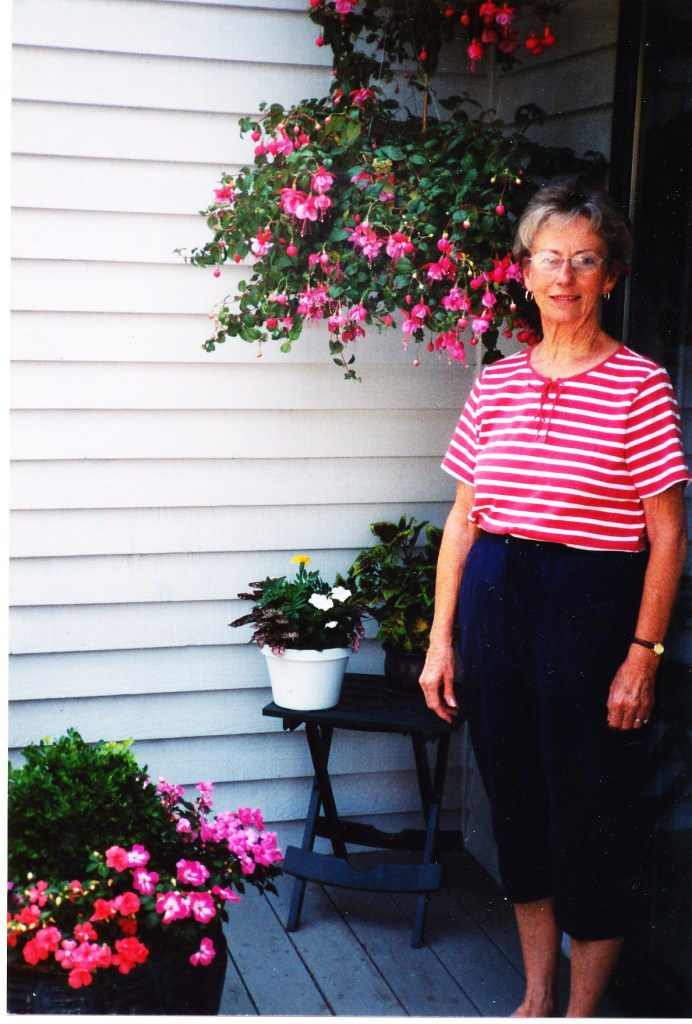
Mom with a hanging fuchsia basket. On the back of the scanned photo she had written I had given her the fuchsia for Mother’s Day.
Mom was dainty, loved to dress up, and took great pride in her hair. That meant having it styled every Friday – without fail! And heaven forbid if I picked her up for an outing on a rainy or windy day, and that fresh hair-do might get messed up!
Mom was the disciplinarian in the house. While dad was no pushover in his gentle way, mom drew a line in the sand – and made sure you didn’t cross it. I occasionally challenged her. Hey it was the late 60s and early 70s! Everyone was protesting. She didn’t like that. I regret that. There were a few instances in high school I wanted to do some things that looking back would have done me great harm. She didn’t let me do them. I could have easily rebelled, but even back then I had this feeling she was just trying to protect me. My parents insisted I go to church when I was young — even on Sunday nights, when frankly I would have rather stayed home and watched Wonderful World of Disney and Bonanza on TV. I am forever grateful for that. Bethany Covenant built a firm foundation for me that would make Jesus the manager of my life and later weather the storms of life.
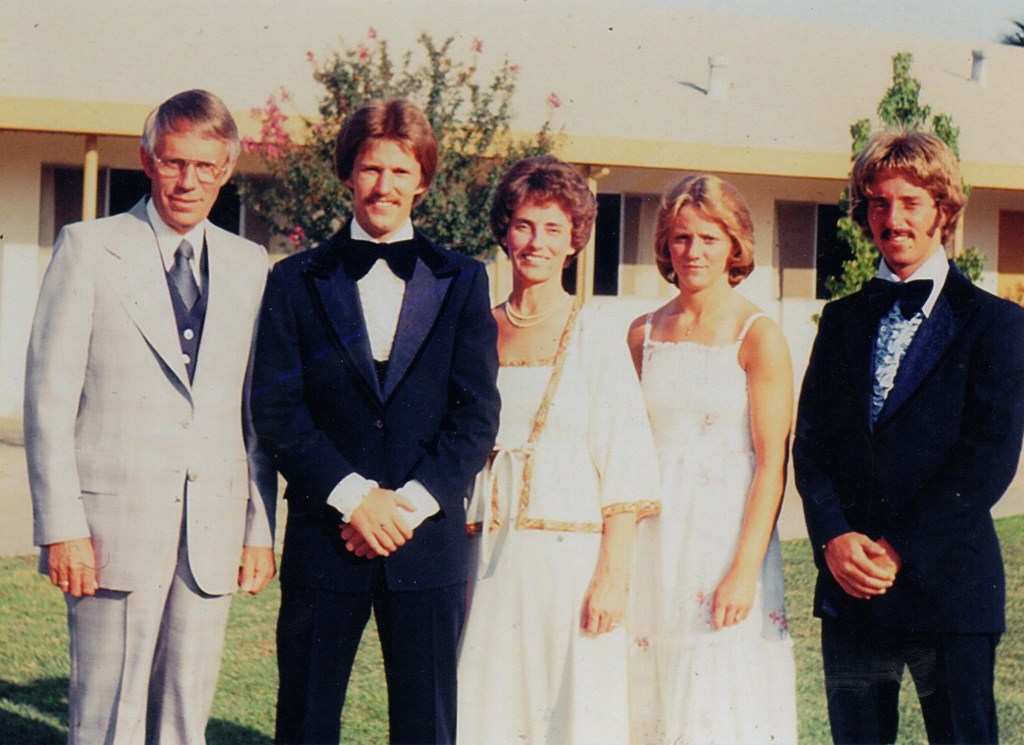
Our family at my wedding in Orangevale, California in 1977.
I only found out in recent years that mom was one of the first to enter the transfer portal, going from Sedro-Woolley High to Mount Vernon High (personally, as a proud Cub, I would have gone the other direction, Mom.) There was no NIL money for mom at Mount Vernon – just dad. And that was gold. She didn’t know then that for most of their marriage, mom would be a caregiver for my dad, who lived with Multiple Sclerosis for more than 55 years. Yet, she never complained.
Everything changed on August 10, 2017, the day my dad died. I was on my way to work in Seattle when I got the frantic call from mom that dad had fallen in the shower, was unresponsive and rushed to Skagit Valley Hospital. For the first time in my life, my self-sufficient mother showed cracks of vulnerability.
“I’m scared,” she told me. “What should I do?”
This would be a devastating blow to my mom, one she never quite recovered from. As you most of you know, our parents were a tight-knit team for 64 years. And dad had taken me aside in the year leading up to his passing to tell me that mom was forgetting things she shouldn’t be forgetting.
It was obvious to anyone who knew my parents that they were a tight-knit team.
Life after dad was hard for mom, and in 2021 it became apparent she could no longer live on her own. She had lost her interest in cooking, and driving the car was problematic.
At this point, the protector role mom played when I was growing up was about to be reversed. It was now my job to protect her. That meant taking the car keys away, which she didn’t like it.
“I’ve never been in an accident,” she told me.
And I said “Yes, and you’re getting older and your reflexes aren’t what they used to be, and that’s why I want to protect you from having one.”
“Well,” she said, “Shirley’s still driving. And by the way, she has a new car.”
Protection also meant taking over her finances to guard her from government imposter scams. Of course, mom wasn’t happy with these changes. “Quit teaching me,” she once said. I think she meant to say “quit challenging me,” but she had forgotten the word.
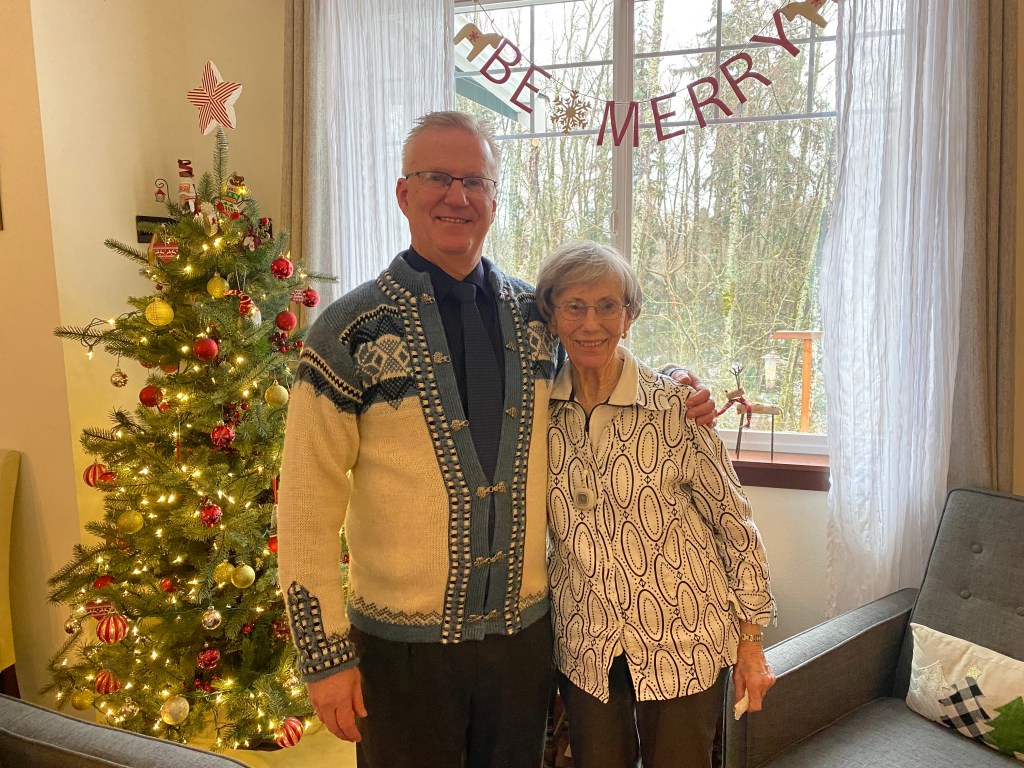
A Christmas with mom at our home. She fought me at first as I tried to take over her finances and protect her. But she eventually trusted me to handle her affairs. We had a sweet relationship in her final years.
Truth be told, however, as a I assumed this role of “her protector” she was in fact “teaching me.” She was teaching me how to take care of her in her final years, as she took care of me when I was young. I am not nurturing by nature. These last years with my mom, it was as if God was telling me “you need to grow in this area.” She began to rely on me. She trusted me.
Dementia has been described as the “long goodbye.” I hardly got to say goodbye to dad. He died suddenly. In the years, months and finally days leading up to mom’s death, I was able to say goodbye to mom – to say the words for years I had too often neglected to say – thank you for making sacrifices for me, for encouraging me, for believing in me, and for loving me, even when I was doofus. In the last year, she was wheelchair-bound from the hip fracture and it was hard to get her out. She had also lost the ability to form words. Our time together often consisted of me reading to her – mostly from Alice Van Liew’s book about growing up in Baker Heights – or playing music, or reviewing her 90th birthday memory book. Or just holding hands. She no longer knew my name. But she always greeted me with that warm smile. She knew my face. She knew my voice.
This photo was taken in her room on Day 4 without food. She had stopped eating. She was not able to speak to me, but took my hand shown here, brought it to her mouth and kissed it. Even in her dying days, memory loss did not take away her ability to express a mother’s love.
I started writing my mom’s obituary about four years ago. It wasn’t that I thought her passing was imminent. I just didn’t know how much of her past she was going to remember. My mom had been so sharp, so well read. But dementia was slowly eroding her cognitive abilities. I started asking questions, like “when did you accept Jesus into your life, mom?” Now this was one of those days when she was having trouble putting a sentence together. But she looked me square in the eye and said “at church, when I was a little girl.”
Even with her clouded mind, mom knew where she was headed. She had “blessed assurance.” A few days before she died, even in her weakened condition, I watched her lift her head up and stretch her arm to the ceiling, as if reaching for something. Then she lowered her arm and closed her eyes again. Did she see an angel? Dad, beckoning her to join him? I couldn’t believe what I just witnessed. I took a picture of it.
This is a filtered version (the original is too hard to look at) of mom having a vision a few days before she passed away. In her weakened condition, she lifted her arm toward the ceiling, eyes wide open, as if reaching for something. She then lowered her arm and closed her eyes.
However many years we have on this broken planet, 70? 80? 90 years? – is just a blink of an eye compared to the trillions of years we’ll spend in eternity. No more sickness. No more wars. No more political divides. No more broken relationships.
As believers, Isn’t that good news?
I may lose my 401K, my house, or my lake cabin – but I will not lose my salvation, the promise of eternal life.
I may lose my health – as my dad did when 55 years of MS crept into his upper-body and claimed his life. But I will not lose the promise of eternal life.
I may lose my mind – as my mom did, in the final years of her life. But I will not lose the promise of eternal life.
You see, when you’ve been born again, you can’t be unborn. When your name is written in the Book of Life, it can never be erased.
Thank you, mom, for all you did for me, and for our family. I’ll see you and dad on the other side.
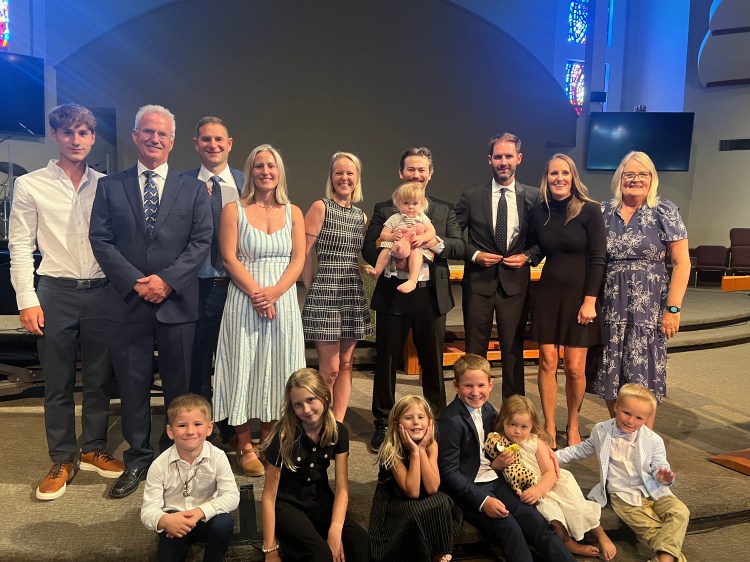
A brief ceremony at the gravesite, before the memorial service, with Rev. Dwight Nelson officiating.Our family, shown here in the Bethany Covenant sanctuary after the memorial service and reception. Great grandson Isaac, top row, far left, read scripture. Granddaughter Greta, top row, second from right, and yours truly were the speakers.Mom and dad’s headstone at a cemetery at Freeborn Lutheran Church east of Stanwood. Mom’s parents, Morris and Sylvia, are buried next to them.
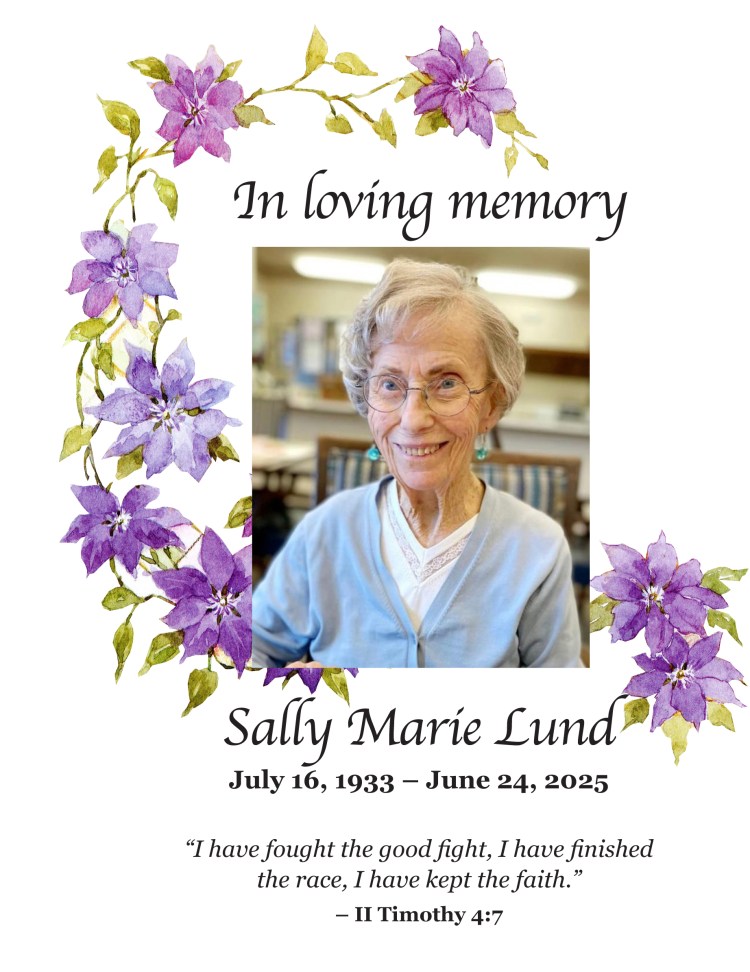
The program I did for mom’s funeral on July 19 at Bethany Covenant Church in Mount Vernon.
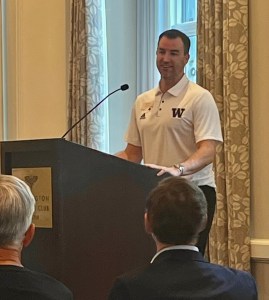
UW Basketball Coach Danny Sprinkle speaks at the “Pacific Northwest Legends” banquet on May 9. That’s “Legends” president and former Sonic and UW great Steve Hawes below the podium, to the right.
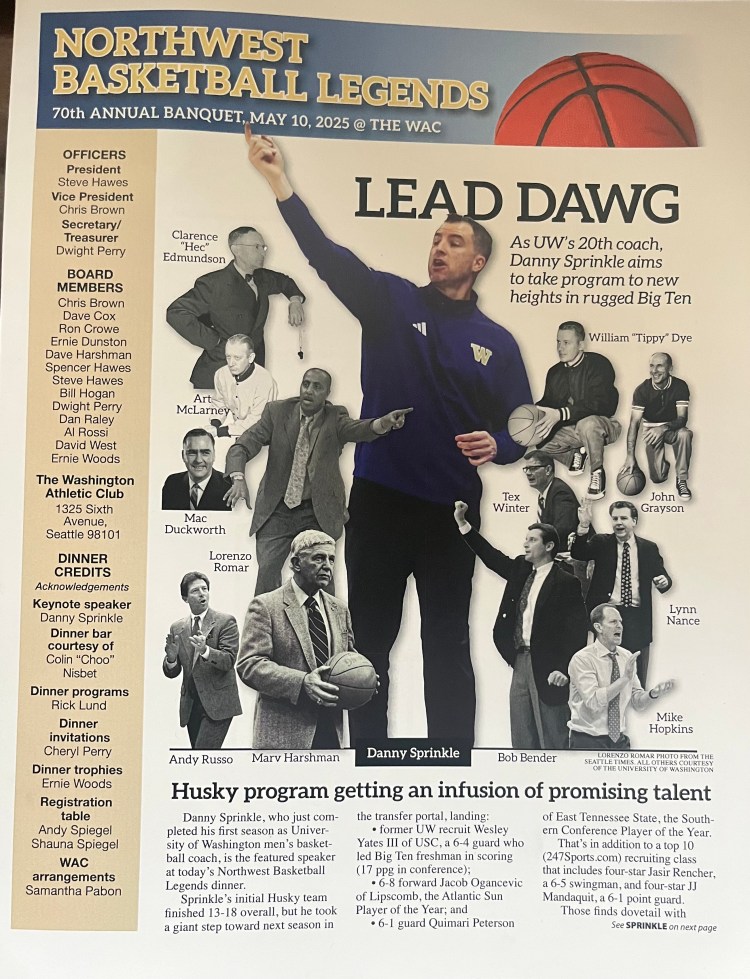
Had to chance to meet UW basketball coach Danny Sprinkle on Saturday at an annual gathering of mostly way-past-their-prime basketball players, coaches and media-types.
Sprinkle spoke to the 70th meeting of the “Northwest Basketball Legends” at the Washington Athletic Club, bringing renewed hope and optimism to a program that hasn’t sniffed the NCAA Tournament since 2019. But first, Sprinkle spoke candidly about the hole he and his staff were faced to try and dig out of when he was named coach on March 25, 2024 to replaced fired Mike Hopkins.
“By the time we got the job, I knew there wasn’t a lot of Big Ten talent left out there,” Sprinkle said.
It wasn’t nearly enough to compete in the rugged Big Ten. The Huskies finished dead-last in the 18-team conference with a 4-16 mark, 13-18 overall. The number of wins might have exceeded his initial expectations.
Ken Bone was in the audience. Apparently, Sprinkle invited the former UW assistant and WSU head coach to come to Montlake before the start of the season to assess the Huskies’ talent level. He may have told Sprinkle they were in trouble.
“Coach Bone saw our team in the summer and early fall, and if you would have told us that we’d win 13 games, I probably would have been pretty damn happy at that time,” Sprinkle said.
Help is on the way. In addition to a top transfer class, UW’s high-school recruiting class of ‘25 is ranked No. 18 in the nation, and No. 1 in the Big Ten, according to 247Sports.com.
Sprinkle bemoaned the Huskies’ erratic guard play during his first season. The team did not have your prototype point guard to direct the offense. Older, seasoned guards via the transfer portal will help against the physical teams in the Big Ten. But Sprinkle is most excited about incoming four-star, point guard JJ Mandaquit, whom he credits assistant Tony Bland for helping land.
“He’s going to be phenomenal,” Sprinkle said of the 6-1 guard from Hurricane, Utah, ranked 10th nationally by 247Sportscom. “If any of you guys saw our games last year, hopefully you wore a football helmet because we threw the ball all over the place. It’s a great to have a true point guard.”
Sprinkle said he also took the job knowing Washington was at a distinct disadvantage when he comes to facilities.
“We have the worst basketball facilities in the Big Ten,” the coach said. He said his team sometimes couldn’t practice on its own court the day before a Big Ten game if there was a volleyball match, for example. He also talked about larger arenas in the Big Ten that are packed to capacity and “electric.”
The practice facility piece is about to change. The school broke ground on a $60 million “high performance basketball center” last June. It will feature two 9,800 square-foot practice courts, one for the men and one for the women, and open in August.
The cover of the program I did for the banquet. Big thanks to UW men’s basketball SID Mitch Praxl for gathering these photos. My earliest recollection of UW basketball is Mac Duckworth. No, I don’t go all the way back to the original Hec Ed, Clarence “Hec” Edmundson.
Sprinkle told the gathering it’s been “an honor to sit in Coach (Marv) Harshman’s old seat, in Coach (Lorenzo) Romar’s seat and represent the program.”
Taking off my journalism cap – which I can do, I’m retired – and putting on my purple cap, I believe Sprinkle will restore UW to the glory years. He appears to me to be driven, a maniacal recruiter, likable, and like Romar, bleeds purple and gold. Many of you know his dad, Bill, played football at UW in the late 60s. Danny grew up rooting for the Huskies.,
I attended many games during the Romar era, either for work or as a fan. I went to two games during Sprinkle’s first season, which is one more than I did during all of Hopkins’ seven-year run at UW. Once the players he inherited from Romar graduated, I found Hopkins’ teams unwatchable.
Though talent-deficient, especially in the backcourt, Sprinkle’s first-year team largely played hard and with a purpose.
“Even though we didn’t have the most successful year, wins and losses wise,” Sprinkle told the group, “I think people can see what we are building.”
Danny and myself after the banquet. I told him I was old enough to see his dad play football at UW. He did not doubt me.
I turned 70 in November. It was a time for celebration while surrounded by family in Arizona. It was also a time for reflection.
Let’s face it, I’m old. On the surface “my work is done” and I’m “over the hill.” My career is in the rear-view mirror. I like to tell people that when I was working “I was pulling down good money. Now that I’m retired, I’m good for nothing.”
And yet, if I’m honest with myself, that’s actually not true. There’s still time – God willing – to make the rest of my life the best of my life. A little more than seven decades on this earth, I’m still learning. I’m not a finished product. Our purpose on earth is not to take up space, make money, retire and go play golf. There’s “more work to do.” I want to be a better person. I want to make a difference. Whatever wisdom I’ve acquired, I want to pass it along to the younger generation.
I’ve lived through many seasons of life—times of joy, challenges, and growth. Now that I’ve returned to the seventies (that’s a joke!), I’ve been thinking a lot about what’s important to me.
The world values position, possession and passion, or in other words, status, salary and sex. My career and the acclaim that went with it was always important to me.
My values? I’d rank humility, integrity and generosity at the top. In this Christmas season of giving, however, I’ve been wrestling with the question: Am I generous man?
For most of my life I’ve been tight-fisted with money, reluctant to give my hard-earned salary to the poor, to the less fortunate. I trust God with my salvation, my life. Why can’t I trust him with my wallet? What I’ve realized since retiring is any money I’ve made is not mine. It’s God’s. I’m just managing it. I certainly can’t take it with me. I’ve never seen a hearse going to a funeral pulling a U-Haul trailer.
And yet, generosity isn’t just about money.
I want to be generous with my praise and affirmation. How often did I praise Vicki, our girls when they were young, the supervisors and co-workers I had, or my friends? Not often enough.
I want to be generous with my attention. When you give someone your attention, and look them in the eye, you’re giving them your life. Have I really listened to people’s concerns, and sympathized with their plight? Or has my mind wandered during those conversations to my own needs and desires?
I want to be generous with the lessons I’ve learned along the way, and share them with my grandchildren and younger men in my life.
I want to be generous with my time. That means babysitting my grandchildren when on days I’d rather be doing something else. That means caring for my 91-year-old mother when it’s hard. Because of her advanced state of dementia, she can’t say my name or hold a conversation – yet her face lights up when she sees me because she knows it’s her son.
I want to be generous with whatever God-given talents I have. That means giving my skills away for free, whether it’s for a faith-based ministry or a Pacific Northwest basketball legends organization.
I’ve come to admire David Brooks, a New York Times columnist and regular contributor to the PBS News Hour. Most Friday evenings, Vicki and I watch the moderately conservative Brooks and Washington Post associate editor Jonathan Capehart, who is more to the left, discuss the week in politics on PBS. Brooks recently wrote a column about his faith. As one who had a 45-year career in journalism, I can’t tell you how unusual that is for a member of the media to reveal his or her spiritual side. In that column, he said this about generosity:
“My life feels remusicked since my own little Exodus journey began. It turns out the experience of desire is shaped by the object of your desire. If you desire money, your desire will always seemed pinched, and if you desire fame, your desire will always be desperate. But if the object of your desire is generosity itself, then your desire for it will open up new dimensions of existence you had never perceived before, for example, the presence in our world as an energy forced called grace.”
The Apostle Paul speaks in the New Testament about faith, hope and love, with the greatest being love. Generosity is the practical expression of those three. It’s been said you can give without loving, but you can’t love without giving.
God has been extravagantly generous with me. As a follower of Jesus, may I also be generous, not only with my money, but with my time, my affirmation and praise, my talents and my attention to the people around me.
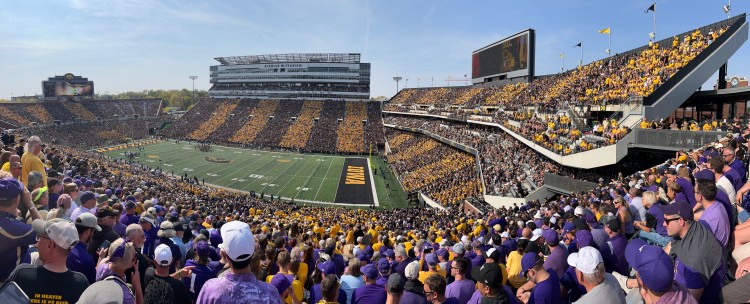
Sold-out Kinnick Stadium for the October 12 game between Iowa and Washington in Iowa City.
“Thanks for coming,” said an Iowa fan, as Vicki and I walked out of Kinnick Stadium near the end of Iowa’s 40-16 dismantling of Washington on Saturday. “I hope our fans here treated you well.”
They certainly did. Better than the visiting team was treated, for sure. We came a long way to watch the visitors from the Pacific Northwest bullied by the always-physical, corn-fed team in America’s Heartland. But while I was expecting the Huskies to be more competitive against slightly-favored Iowa, I’d have to characterize our experience on an unseasonably warm, mid-October afternoon in Iowa City to be a worthwhile experience.
The primary reason for the trip was to visit our daughter Greta and family in their new home in the Chicago suburb of Wheaton, Illinois. But I also am keenly aware that there are eight Big Ten schools within a four-hour drive of Chicago.
I’d circled the UW-Iowa game on October 12 to visit historic Kinnick Stadium before the temperatures dropped too low for comfort. We made the three-hour drive on Friday to Davenport, Iowa, putting us within an hour’s drive of Iowa City for the 11 a.m. local time kickoff the following day.
This quaint college town off Interstate-80 in eastern Iowa was a paradigm shift for me. I was expecting a non-descript town surrounded by corn fields and flat plains. To my surprise, Iowa City is nestled amidst rolling hills. The Iowa River runs through campus.
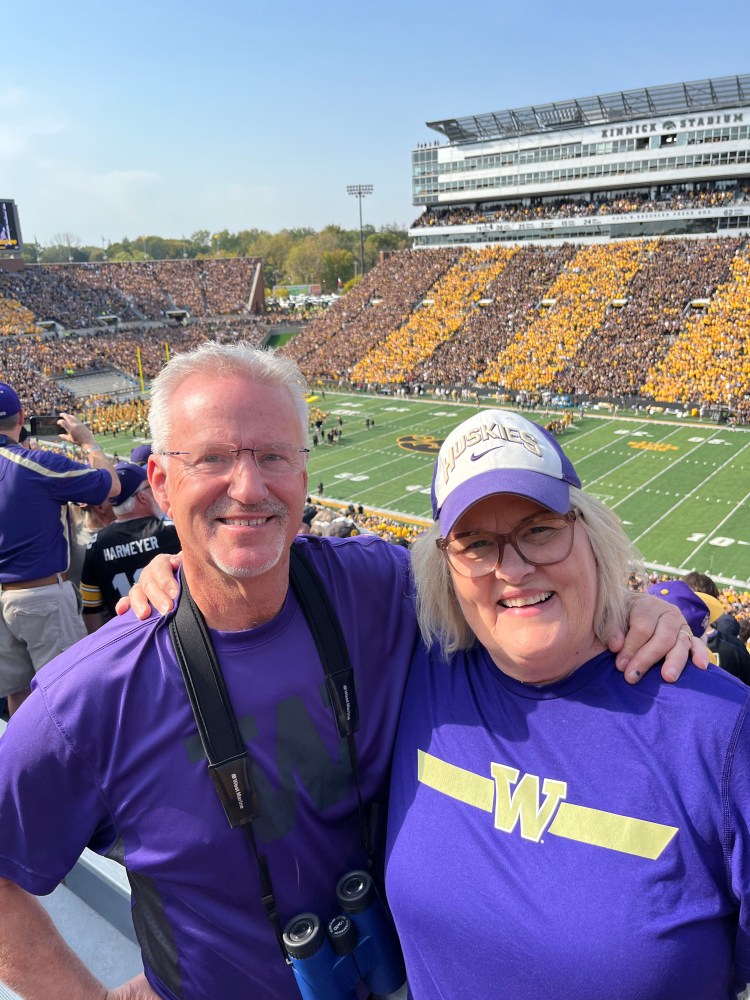
Vicki and I at the game.
The smell of barbecue and big-time college football were in the Midwest air as we walked past Hawkeye tailgaters toward the stadium, named after the school’s lone Heisman Trophy winner, Nile Kinnick. A 20-foot-tall bronze statue of Kinnick resides outside one end of that stadium. The stadium, built in 1929, is wedged between Carver-Hawkeye basketball arena, the university’s children’s hospital and other campus buildings.
The concourse at Kinnick Stadium. Banners of Iowa’s bowl-game appearances are on display, including the 1995 Sun Bowl game between the Hawkeyes and Washington.
Seating capacity is 69,250, slightly smaller than Husky Stadium. Walking down the concourses under the grandstands on each side of the field, the stadium shows its age. It’s obvious the original stadium was much smaller until the first of two major renovations, beginning in 2004, brought the capacity to its current 10th largest in the 18-team, Big Ten.
Some thoughts on the Iowa football experience:
“The Hawkeye Wave” to pediatric patients and their families in a children’s hospital takes place at the end of the first quarter of each Iowa football game.
The Hawkeye Wave: A few Iowa fans told me it’s the best tradition in college football. Not sure I can argue. It does tug on the heart strings. Started in 2017, when the clock hits zero at the end of the first quarter, fans, players and even the game officials turn their attention to the children’s hospital just behind the east grandstand. In unison, they wave to the pediatric patients and their families watching the game.
The game was a “Black and Gold Stripeout” day at Kinnick Stadium.
Striping Kinnick black and gold: The “Stripeout,” as they call it, was on display for this particular game. Fans in alternating sections wore black and gold. Not sure UW fans – perhaps more independent and less inclined to cooperate? – would comply to stripe Husky Stadium purple and gold.
Back in Black: The AC/DC song is blared in the stadium as the black-clad Hawkeyes in their Pittsburgh Steeler-look-alike jerseys make their way out of the locker room toward the tunnel. Not sure if this is a tradition, but on this day anyway, the team formed a large “V formation” and trotted out together holding hands as the band played “Fight, Fight, Fight for Iowa!”
The Iowa Hawkeyes take the field.
I-O-W-A Kinnick chant: A flag for each letter is placed in each corner of the field. In wave-like fashion, fans in each corner of the stadium stand up and yell as that flag is raised for those fans. It goes around the stadium several times. Ironically, the “W” flag happened to be in the corner of the stadium where most UW fans were, so we were happy to stand and salute the “W.”
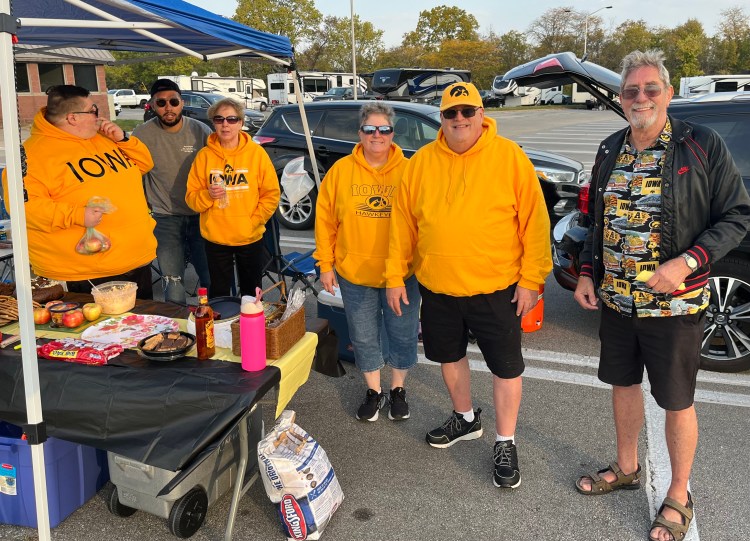
“Iowa Nice:” This is not a tradition, just my observation of Hawkeye football fans in general. I’ve heard of “Minnesota Nice,” not necessarily the Iowa version. But I actually saw an Iowa fan wearing those words on his shirt. It’s true. From the tailgaters in pregame who offered Vicki and I food, to the Iowa fan seated next to me who handed me some me peanuts – well, at least that was after the Hawkeyes had built a comfortable lead – they couldn’t have been more friendly and welcoming.
Struck up a conversation with these Iowa fans in the parking lot before the game. They offered me food.The most recent addition to Kinnick Stadium, the north end zone, completed in 2019.
Blaine and Joanna Newnham at my 60th birthday party in 2014. By this time, Blaine had been retired from full-time journalism for nearly 10 years.
Any baseball player will tell you they remember the day they were called up to the big leagues. I certainly remember a similar life-changing moment on a journalism scale, when in November 1984 I learned I was going from a small-town newspaper in Roseburg, Oregon to The Seattle Times.
I probably skipped at least one stop – like a medium-sized paper – in this move. To put this in sports perspective, this is akin to making the jump from the Class A, minor-league Everett AquaSox to the Seattle Mariners. I was lucky.
My pleasant surprise was only surpassed by the stunned looks on the faces of my colleagues at The News-Review as the announcement was made at a hastily-called staff meeting.
N-R Assistant Sports Editor Bill Reader was in that meeting that day, and he would recall years later that I was “modest and self-effacing, making a joke about delivering papers, but this made no sense to us. Who do you have to know at The Times to get a job there? Blaine Newnham, as it turned out.”
Bill would join me at The Times 15 years later, and we revisited that meeting long ago at our former newspaper at a coffee gathering of current and former Seattle Times sports folks a few days after Blaine passed away June 16 at the age of 82.
I’m not sure where the notion came from that I had some inside connection with Blaine at The Times. Truth is, I had never met Blaine until the day I interviewed in Seattle, which I recall was the day after Ronald Reagan was re-elected to a second term as president of the United States..
There was familiarity, but no prior relationship. I had only observed Blaine from a distance in the press box at an Oregon football or basketball game. He was the sports editor and columnist at the Eugene Register-Guard for 11 years prior to his move to Seattle in 1982. The familiarity apparently went both ways. I would learn later Blaine knew of my work as a sports and news page designer at the southern Oregon newspaper I worked at some 70 miles down I-5.
What I can say is the initial bond Blaine and I shared then, and continued to share in our 20 years together at The Times, was our passion for “story presentation,” a term I wouldn’t have used in the 1980s. That’s because the concept didn’t exist. The importance of story presentation (newspaper layout), graphics and color photos – long relegated to the back seat of the bus driven by emphasis on story form – was just gathering momentum when I was hired as a sports reporter in Roseburg in the fall of 1979.
I was blown away by the Register-Guard sports section, which under Blaine’s leadership in 1976 was named the nation’s best by the Associated Press Sports Editors. I doubt Blaine ever designed a page in his life. But he knew what good design looked like.
The two papers in Seattle at the time – The Times and Post-Intelligencer – were still in the dark ages of newspaper design. That meant multiple stories on the cover, small black-and-white photos and cluttered layout. The R-G, by contrast, covered Oregon football with a flare I had never seen. That meant a clean, impactful display of big, color photos and bold headlines on a cover with a minimum story count, and multiples pages inside with more large photos and game sidebars. The Sunday paper also had separate roundups of major conference football games around the country, something no paper outside of the state of Texas was doing at the time. I bet Blaine’s fingerprints were all over that.
Blaine Newnham was wise, thoughtful and a respected voice in the Pacific Northwest as a longtime sports columnist (Photo by John Lok, Seattle Times)
The newspaper in arguably the “Track Capital of the World” also covered track and field like no other. I’m talking dual meets between Oregon and Pac-10 foes that dominated the cover and jumped to inside spreads. The day before the meets, the paper would print the personal records of contestants in each event, so you could reasonably predict which team would win.
Dave Kayfes, his former Register-Guard and college buddy at Cal who still. lives in Eugene, said in The Times: “He’s still revered down here in the track world. He’ll always be a legend down here. He put together coverage that hasn’t been duplicated.”
The R-G was also one of the first papers on the west coast to provide expansive coverage of college football and basketball recruiting. Blaine was always a big-picture, visionary kind of guy.
While he was making his mark in Eugene, I was doing some innovative stuff in little ole Roseburg. I introduced charts, graphics, photo treatment and type treatment to the readers in southern Oregon. While I started there as a sportswriter, I eventually found myself gravitating to layout. It came easier to me. I started a weekly outdoor, recreation page called “Venture.” I wrote stories on a variety of topics, including hiking, fishing, hunting, motocross, cross-country skiing and Christmas-tree cutting. But what carried the page was the layout using the aforementioned, self-taught skills. The page won awards.
It was a few of those Venture page clippings that caught the eye of Blaine, Times associate editor and columnist, and then-sports editor Del Danielson. I interviewed with a number of higher-ups that day in 1984, but I sensed an instant connection with Blaine. I felt like we shared the same vision and values of what a sports section should be. Although Del would have had the final say on my hire, I suspect Blaine had some sway.
I would be the first full-time sports designer to be hired at The Times. In the few years leading up to that, sports layout duties were shared by the copy desk and sports photographer Harley Soltes, a former Eugene Register-Guard photog who had followed Blaine to Seattle.
Blaine and I would forge a strong working relationship and friendship over the next two decades until his retirement in 2005. He entertained my family at his homes on Bainbridge Island and Indianola. We entertained Blaine and Joanna at our home in Skagit County during a Tulip Festival. He was at my 60th birthday party while I was still working and he had retired.
Thirteen years older than I, he was wise, smart, thoughtful and a good mentor for me in my early years at the paper. He inspired me, just talking to him. He affirmed and encouraged me when I did good work. He got in my face when I was out of line. I took the good and the bad to heart.
Between his stints in Eugene and Seattle, I believe he deserves to be on the Mount Rushmore of sports columnists in the Pacific Northwest. He wrote with authority on college sports. I believe his strength was his coverage of games. He had a knack for breaking down a game and explaining in layman’s terms why the local team won or lost. This was especially true with his coverage of Husky football and basketball (college sports was his first love). If I wanted to know how a Husky football game went down, I read Blaine first. I suspect I wasn’t alone.
I would also say he was a great interviewer. He was a nice, decent man, and approachable. He had a disarming way of making coaches and players feel at ease.
I don’t think I’ve worked with anyone I respected more than Blaine. I would say he was an introvert at heart. He didn’t talk a lot at meetings. But when he spoke, people listened. I sat with him at many weekly sports planning meetings over the years. No one brought more ideas and energy to the table than Blaine. He had great instincts for what our readers wanted to read.
His legacy in journalism, and his impact on my life, will not be lost.
What also isn’t lost on me is he got me the heck out of Roseburg, Oregon.
The last Pac-12 Apple Cup game between Washington and Washington State, played November 25, 2023 at Husky Stadium (Photo by Rick Lund)
The 2024 Apple Cup by all accounts appeared to be one of the more anticipated matchups of the season. The rivalry game between Washington and Washington State that at one point was in danger of being another realignment casualty, was salvaged among the scraps from the wrecking ball that destroyed the Pac-12, sending UW to the Big Ten and its in-state foe with only Oregon State as a conference partner.
But as UW football season ticket holders this past week were invited to an “exclusive pre-sale” of tickets for the Sept. 14 game at neutral-site, Luman Field, the response has been tepid at best.
Dawgman.com, a website for the most rabid of Husky fans, published results of a poll that asked its readers if they were planning to attend the Apple Cup. Only half of the responders said they were going. For a game played in Seattle, that is almost unheard of in the 115-year history of the rivalry, one of the oldest in college athletics.
The Apple Cup may be running out of juice.
Much of the sentiment seems to be that since UW and WSU are no longer in the same conference, the rivalry no longer means as much. The Apple Cup has traditionally been the last game of the regular season, where in many years there was much on the line.
But there’s also the ticket prices. I am one of those season-ticket holders, and I’m still recovering from sticker shock. The cheapest ticket is $94, which gets you in the corners of the 300 level. Most of the seats in the 69,000-seat stadium are more than $200 apiece, and top out at $424.
Because the game will not be played in Husky Stadium, it is not a part of our seven-game, season-ticket package, which is expensive enough. Vicki and I are retired. We had a discussion the other day about the Apple Cup. It was short. We’re gonna pass.
I’m also not sure Cougar fans are chomping at the Apple Cup. The neighbor at our lake cabin is a resident of Sammamish and a longtime Wazzu season-ticket holder. The trip to Luman Field is a 30-minute drive. But he told me the other day that he and his wife aren’t going.
Ticket prices and a less-important, non-conference matchup may have something to do with that. More likely, however, the core of Apple Cup apathy for WSU is hard feelings. Not sure Cougar fans will ever forgive UW for jumping ship to a more lucrative future in the Big Ten, leaving the Cougs to fend for themselves with a conference-replacement schedule of Mountain West schools for at least the next two seasons.
And in this new era of college sports, where geography and tradition no longer seem to matter, that is a darn shame.