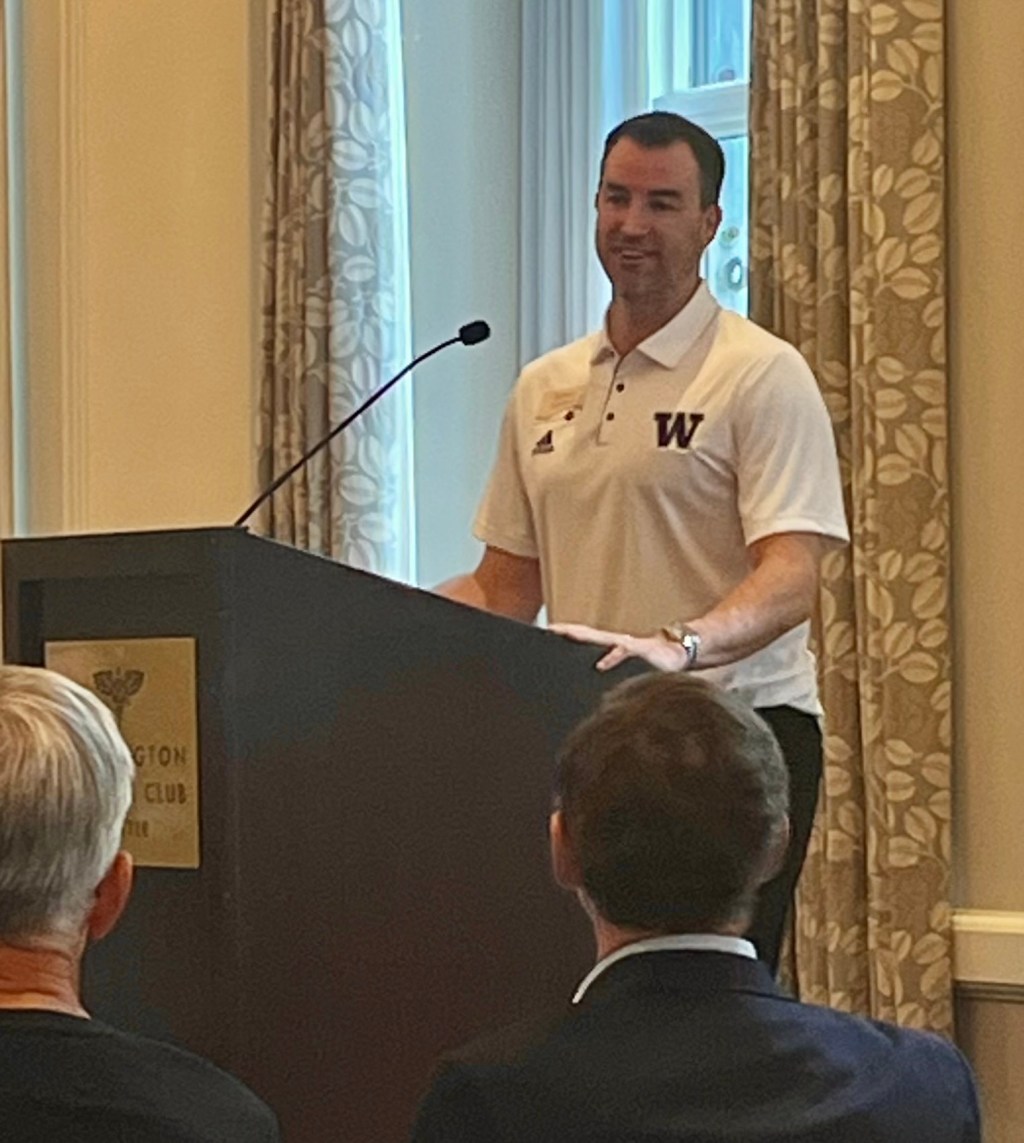
UW Basketball Coach Danny Sprinkle speaks at the “Pacific Northwest Legends” banquet on May 9. That’s “Legends” president and former Sonic and UW great Steve Hawes below the podium, to the right.
Had to chance to meet UW basketball coach Danny Sprinkle on Saturday at an annual gathering of mostly way-past-their-prime basketball players, coaches and media-types.
Sprinkle spoke to the 70th meeting of the “Northwest Basketball Legends” at the Washington Athletic Club, bringing renewed hope and optimism to a program that hasn’t sniffed the NCAA Tournament since 2019. But first, Sprinkle spoke candidly about the hole he and his staff were faced to try and dig out of when he was named coach on March 25, 2024 to replaced fired Mike Hopkins.
“By the time we got the job, I knew there wasn’t a lot of Big Ten talent left out there,” Sprinkle said.
It wasn’t nearly enough to compete in the rugged Big Ten. The Huskies finished dead-last in the 18-team conference with a 4-16 mark, 13-18 overall. The number of wins might have exceeded his initial expectations.
Ken Bone was in the audience. Apparently, Sprinkle invited the former UW assistant and WSU head coach to come to Montlake before the start of the season to assess the Huskies’ talent level. He may have told Sprinkle they were in trouble.
“Coach Bone saw our team in the summer and early fall, and if you would have told us that we’d win 13 games, I probably would have been pretty damn happy at that time,” Sprinkle said.
Help is on the way. In addition to a top transfer class, UW’s high-school recruiting class of ‘25 is ranked No. 18 in the nation, and No. 1 in the Big Ten, according to 247Sports.com.
Sprinkle bemoaned the Huskies’ erratic guard play during his first season. The team did not have your prototype point guard to direct the offense. Older, seasoned guards via the transfer portal will help against the physical teams in the Big Ten. But Sprinkle is most excited about incoming four-star, point guard JJ Mandaquit, whom he credits assistant Tony Bland for helping land.
“He’s going to be phenomenal,” Sprinkle said of the 6-1 guard from Hurricane, Utah, ranked 10th nationally by 247Sportscom. “If any of you guys saw our games last year, hopefully you wore a football helmet because we threw the ball all over the place. It’s a great to have a true point guard.”
Sprinkle said he also took the job knowing Washington was at a distinct disadvantage when he comes to facilities.
“We have the worst basketball facilities in the Big Ten,” the coach said. He said his team sometimes couldn’t practice on its own court the day before a Big Ten game if there was a volleyball match, for example. He also talked about larger arenas in the Big Ten that are packed to capacity and “electric.”
The practice facility piece is about to change. The school broke ground on a $60 million “high performance basketball center” last June. It will feature two 9,800 square-foot practice courts, one for the men and one for the women, and open in August.
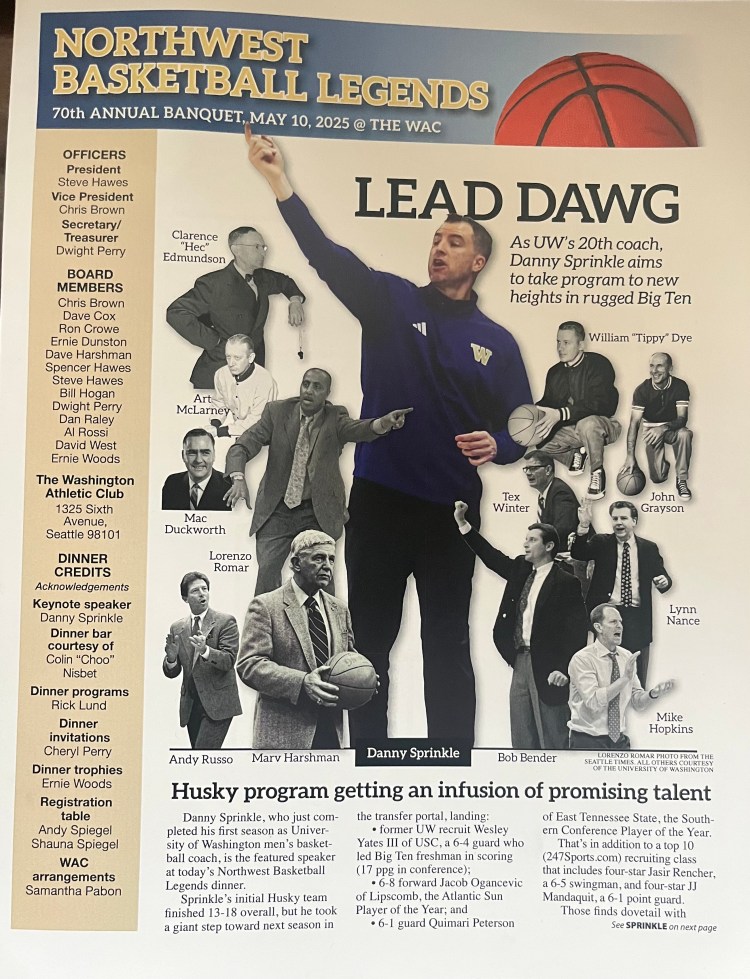
The cover of the program I did for the banquet. Big thanks to UW men’s basketball SID Mitch Praxl for gathering these photos. My earliest recollection of UW basketball is Mac Duckworth. No, I don’t go all the way back to the original Hec Ed, Clarence “Hec” Edmundson.
Sprinkle told the gathering it’s been “an honor to sit in Coach (Marv) Harshman’s old seat, in Coach (Lorenzo) Romar’s seat and represent the program.”
Taking off my journalism cap – which I can do, I’m retired – and putting on my purple cap, I believe Sprinkle will restore UW to the glory years. He appears to me to be driven, a maniacal recruiter, likable, and like Romar, bleeds purple and gold. Many of you know his dad, Bill, played football at UW in the late 60s. Danny grew up rooting for the Huskies.,
I attended many games during the Romar era, either for work or as a fan. I went to two games during Sprinkle’s first season, which is one more than I did during all of Hopkins’ seven-year run at UW. Once the players he inherited from Romar graduated, I found Hopkins’ teams unwatchable.
Though talent-deficient, especially in the backcourt, Sprinkle’s first-year team largely played hard and with a purpose.
“Even though we didn’t have the most successful year, wins and losses wise,” Sprinkle told the group, “I think people can see what we are building.”
Danny and myself after the banquet. I told him I was old enough to see his dad play football at UW. He did not doubt me.
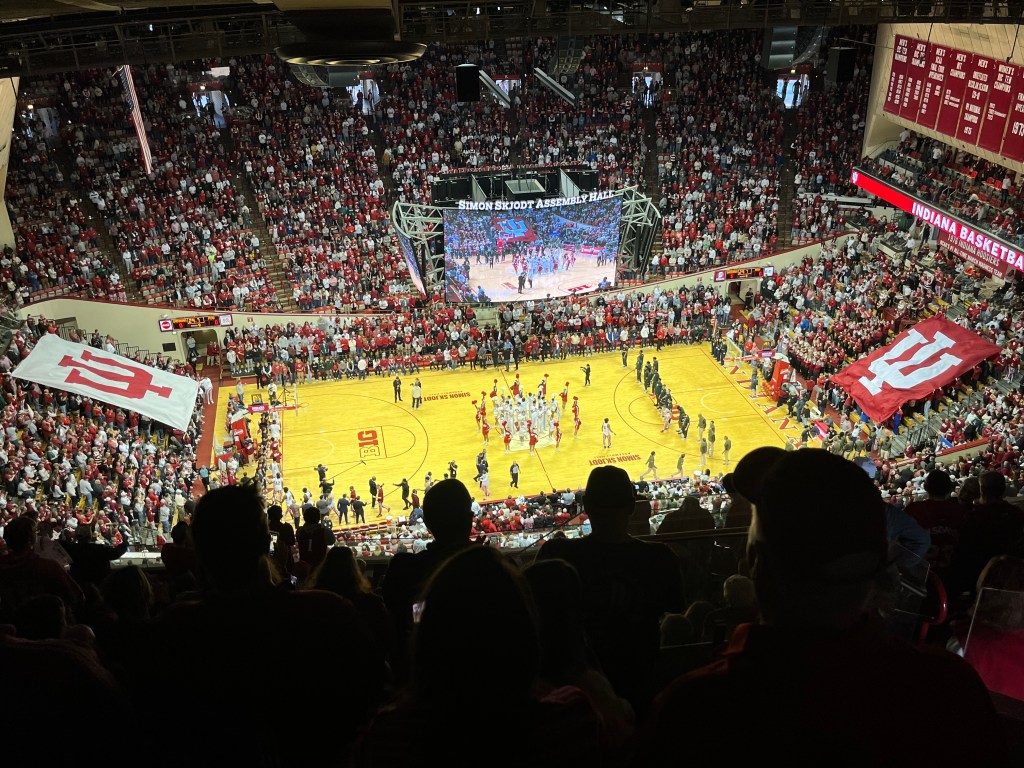
Indiana prepares to face Michigan State March 10 in Simon Skjodt Assembly Hall in Bloomington, Indiana. Built in 1971, this iconic basketball arena holds 17,222 fans. Basketball is more than a game in Indiana. It’s a way of life.
Never daunted, we cannot falter
In the battle, we’re tried and true
Indiana, our Indiana
Indiana we’re all for you! I-U!
BLOOMINGTON, Indiana – Most of the 16,000-plus fans were clearly all for Indiana on a crisp, sunny Sunday afternoon here in the heart of the Hoosier State.
That would include myself, admittedly a college sports nut, and wife Vicki, who has become a fan of college athletics largely through osmosis , i.e. married to me for nearly 47 years. I’ve had a long fascination with college football stadiums and college basketball arenas. Iconic Assembly Hall, if not the Holy Grail, was as least toward the top of my bucket list.
I had seen countless televised games from venerable Assembly Hall. To finally step inside the 53-year-old arena was a thrill (I know, I’m easily entertained). My eyes immediately went to the familiar outline of the state of Indiana at half court, and the iconic steep wall behind one basket. The majority of the 17,222 seats are along the sideline. Only a limited number of seats are behind the two baskets. Assembly Hall is known for its unique design of steep sides, which combined with capacity crowds, makes it one of the loudest venues in college basketball. A 2012 poll of four ESPN pundits ranked it third in terms of best home-court advantage in the country.
It’s more than steep sides and big crowds, however, that has made this place a living hell for opponents. More often, it’s been the home team wearing crimson and cream. Assembly Hall has been the home to three national championships, 32 straight winning teams, 14 conference champions and home winning streaks of 50 and 35 games.
Before the game, Vicki and I toured the massive lobby leading to the arena, which proudly displays the school’s championship banners, trophies and sculptures of Indiana greats. We had our picture taken in front of the sculptures of Indiana’s unbeaten, national championship team from the 1975-76 season.
Posing for a picture in front of sculptures of the starting and senior players from Indiana’s historic 1975-76 team that went 32-0 and claimed the school’s third national championship. The players are Bobby Wilkerson, Kent Benson, Scott May, Quinn Buckner, Jim Crews and Tom Abernathy. Its coach, Bob Knight, requested he not be dipicted in this sculpture. This team remains the last undefeated NCAA men’s basketball champion.
The Hoosier team we saw play Michigan State isn’t one of those great teams. These days, Indiana is middle-of-the-pack in the Big Ten, a far cry from the perennial national championship contenders under legendary Coach Bob Knight, whose 29-year reign abruptly ended with his controversial firing in 2000.
Twenty-four years later, however, the coach they called “The General” still casts a long shadow. Alhough you won’t find a statue of Knight in or outside the building (Knight’s choice), his image popped up frequently on the video screen overhead the court. Perched in our balcony seats high above the Indiana bench, I could only imagine what it was like that day in 1985 when Knight, in a fit of rage, famously threw a chair across the court after being assessed a technical. You can watch it here:
The Knight-Indiana divorce was messy. The bitter coach for many years refused to show his face at Assembly Hall, even though he had moved back to Bloomington after retiring from coaching at Texas Tech in 2008. He finally relented in 2020 to attend a game along with many of his former players, about 20 years after his ouster. The Hoosier crowd roared. Less than three years later, he passed away at the age of 83.
Despite the program’s downturn after the Knight era, you’d think this last game of the regular season had conference title implications. The near-capacity, Hoosier faithful were on their feet for much of the game, clapping in unison whenever the pep band played the school’s fight song “Indiana, Our Indiana,” during timeouts, and roaring with approval when the home team went on a scoring run.
Fans are on their feet during a break in the action, singing along to the school fight song played by the IU pep band.
The University of Washington needs to work on its game-day experience once it enters the Big Ten next fall. Basketball is more than just a game here in the Heartland. In Indiana, it’s a way of life. The Huskies will not only face good basketball teams in their new conference, but big-time venues fueled by large, passionate crowds.
On this second Sunday in March, the hot-shooting Hoosiers jumped out to a 20-5 lead, only to fall behind in the second half before rallying at the end for a nail-biting, 65-64 victory.
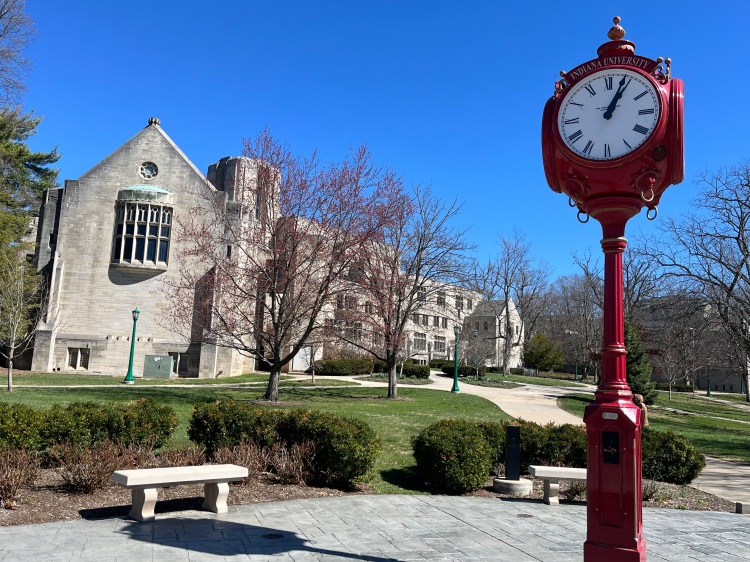
Before the game, we took a walk through the old part of IU’s beautiful campus. Most or all of the buildings are built from Indiana limestone mined from the famous quarries south of Bloomington, also known as “B-Town.” We also stopped in at the Student Union Building, which houses the bookstore and a massive selection of IU shirts, hats and other gear. The Journalism School is next door, named after its most famous alum, Pulitzer Prize-winning journalist and World War II correspondent Ernie Pyle.
All of these tour tips came from my former boss, Bob Silver, who served as sports editor at The Seattle Times early in my tenure there. Bob is an IU alum, and was a member of the school’s swim team. Bob now lives in Walla Walla, Washington, and is retired, but says he if were to ever live in the Midwest again, he’d choose Bloomington.
The old part of Indiana’s University’s campus. Most of the buildings were built from Indiana limestone.
French Lick? Hick, yes!
We flew to Indiana to visit our daughter, Greta, and family, who live in Valparaiso. In previous visits we had never ventured south of Indianapolis. But this time, after three days in Louisville, Kentucky, we took some back roads to French Lick, the home of Boston Celtic legend Larry Bird, on our way to Bloomington.
I will have to say this stop off the beaten path took some convincing. Vicki was not a fan of the extra 45 minutes it would add to the drive to B-Town and the Indiana-Michigan State basketball game later that afternoon. But this wide spot in the road in southwest Indiana was also on my bucket list.
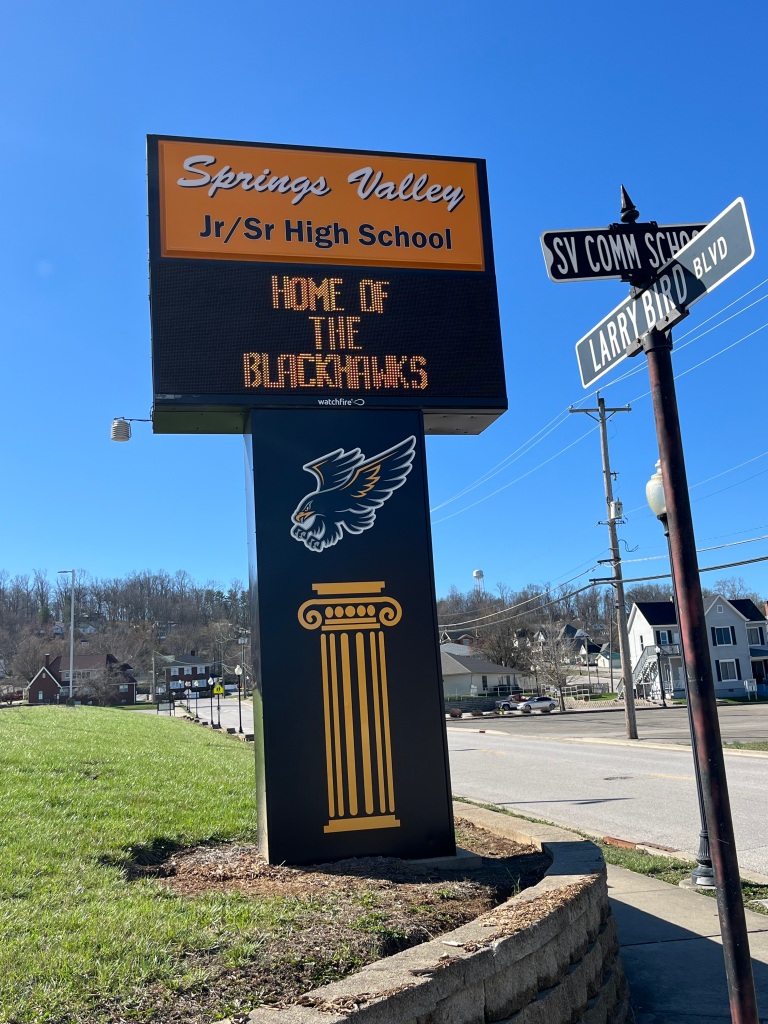
Tiny Springs Valley High School is just off State Route 145 on Larry Bird Boulevard.
We drove down Larry Bird Boulevard to his old stomping grounds, Springs Valley High School and the teen center and outdoor court where he used to play. A bust of Larry Bird resides outside the teen center.
The bust of Larry Bird, known as “The Hick from French Lick,” at the teen center next to Springs Valley High School.
Larry Bird, if you haven’t heard of him, is widely regarded as one of the greatest basketball players of all time. That he played ball at tiny Springs Valley High School in one of the poorest regions of the state is even more remarkable.
Larry’s father, Joe Bird, struggled to hold a job. A veteran of the Korean War, he suffered from what we know now as post traumatic stress disorder. He was a heavy drinker. He often threatened to kill himself. Finally, he delivered on that promise, taking his life at age 48. The financial burden in the family fell to Bird’s mother, Georgia. As a waitress at a restaurant, she barely made enough to put food on the table.
Years later, Bird would say, “growing up we didn’t have much. I just spent all my time playing basketball.”
Even so, Bird was not an instant sensation. He barely made the varsity team as a 6-foot-1 sophomore. As a junior he had grown two more inches, but was known more as a defensive specialist. But by his senior year, he put it all together. He had grown to six-foot-seven-inches. As he perfected his offensive game, he began to dominate high-school competition.
Inside the Springs Valley High gym, where Larry Bird dominated play, averaging more than 30 points and 20 rebounds per game his senior season.
Playing in front of a a packed house in his home gym for every game, Bird averaged 30.6 points and 20.5 rebounds his senior season, making the all-state team. He was offered scholarships to Kentucky and Indiana, among others, choosing to sign with Bob Knight’s Hoosiers. But whether it was living in the bigger city of Bloomington, or he got cold feet at the prospect of playing for the demanding and volatile Knight, one month into his freshman year Bird walked away. He returned to French Lick, enrolled in a local school, Northwood Institute, and went to work as a garbage man to help pay for tuition. He would eventually leave that school as well. Indiana State Coach Bill Hodges, however, didn’t give up on Bird and convinced him to join the Sycamores in Terre Haute the following season.
Bird would soon become among the leading scorers in the nation. After being drafted by the Boston Celtics after his junior season, Bird elected to return to college for the 1978-79 season. He would lead Indiana State to an undefeated regular season, and finished the season with a national championship game matchup with future NBA great Magic Johnson and Michigan State. The Spartans won in one of the most-watched title games in history, a game which elevated college basketball to another level.
Eventually, the “Hick from French Lick” would be known around the world as “Larry Legend.” Bird would play all 13 of his NBA seasons with Boston, leading them to three NBA championships. He was a 12-time NBA All-Star, won two NBA Finals MVP awards and received the NBA Most Valuable Player award three consecutive times (1984-86).
For a college basketball fan, there may be no finer place to be on a winter Saturday afternoon than historic Hinkle Fieldhouse, the sunlight streaming through the windows as the Butler players run onto the floor to the tune of fans singing the school fight song.
I have a deep affinity for college basketball and football venues. It’s no secret to Vicki, our daughters (trust me, they have childhood memories of trips to college campuses to prove it), or anyone who knows me very well. For me, it’s as if the place the game is played is as interesting as the game itself.
So imagine my excitement when I had the opportunity to visit the holy grail of all college basketball venues: Historic Hinkle Fieldhouse on the campus of Butler University on the north outskirts of Indianapolis. We had flown to Indy the night before, and were on our way to Valparaiso on Memorial Day weekend to meet our two-week-old grandson, Aksel, celebrate daughter Greta’s 34th birthday, and her 2-year-old daughter Ida’s birthday the following week.
“How about we visit Butler University on our way to Valparaiso?” I asked Vicki, before our trip. These questions are usually met with a rolling-of-the-eyes look. But because she was already familiar with the Butler gym –the two of us in March had watched several NCAA Tournament games played at Indianapolis-area arenas, including Hinkle – she was game.
The original basketball court at Hinkle Fieldhouse faced the windows, but was changed after players complained the sunlight was in their eyes dribbling toward the baskets. Several NCAA Tournament games were played there this past March.
I called the athletics department at Butler and asked if we could get a peek at the fieldhouse. I explained I was a recently retired Seattle Times journalist, and that it was a dream of mine to visit this most hallowed hardwood in basketball-crazed Indiana. An athletics representative named Kelsey said “sure, I’ll give you a tour.”
Milan’s upset win over Muncie Central in 1954 inspired the 1986 movie “Hoosiers” starring Gene Hackman.
Kelsey and a security guard named Martin met us at the front entrance to the brick building, which is marked by a statue of the arena’s namesake, Tony Hinkle, a longtime coach and athletic director at Butler. We walked through the narrow concourse that surrounds the arena, gazing at the historic photos and trophies along the way. Then Martin unlocked the door that led us to the fieldhouse floor.
There she was, in all her glory, as I had imagined it. The arching steel roof trusses, and the windows at each of the end of the fieldhouse that prompted former Butler star guard Shelvin Mack to say there’s nothing like a Saturday afternoon game at Butler “with the sun coming in and everyone singing the Butler fight song.”
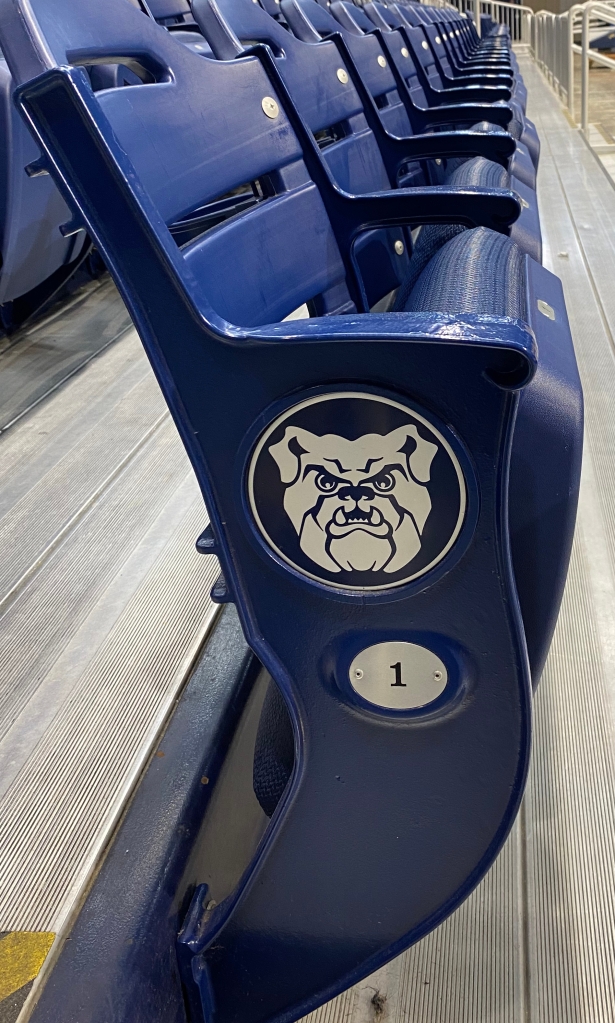
The Butler Bulldogs, who compete in the Big East Conference, narrowly lost to Duke in the 2010 national championship game.
Hinkle Fieldhouse, which opened in 1927, is a gem. I could smell history in the air.
For more than 40 years, Hinkle was the stage for Indiana’s high-school basketball state tournament. In 1954, in a game that would define basketball in Indiana, tiny Milan High school (enrollment 161) beat Muncie Central for the state championship, which proved to be the inspiration for the iconic 1986 movie “Hoosiers.” In that era, all schools big and small competed in the same tournament. To put this game in perspective, this would be the state-of-Washington equivalent of La Conner High School beating Seattle’s Garfield High for the state title.
As I walked onto the floor of the old barn, which reminded me of the University of Washington’s original Hec Edmundson Pavilion built in the same era, I also imagined what this place felt like during Butler’s banner 2009-2010 season. That was the year the Bulldogs sprang onto the national stage under coach Brad Stevens, who would leave Butler a couple years later to become the head coach of the Boston Celtics and was just promoted to the team’s GM position. Mack and teammate Gordon Hayward led the little school from Indianapolis all the way to the national championship game against Duke in nearby Lucas Oil Stadium. Hayward missed a half-court shot at the buzzer that would have given Butler its first title.
Thanks to its Final Four run, Butler’s days of toiling in obscurity are in the rear-view mirror. The small, private university with an enrollment of just over 5,000 is big time now. The Bulldogs compete in the basketball-strong Big East Conference against the likes Georgetown, Xavier, Connecticut, Marquette, DePaul, Providence, Creighton and Villanova, which Martin the security guard said is Butler’s biggest rival.
But after visiting this most sacred cathedral of basketball, I can say this about Hinkle Fieldhouse: It has no rival.
All Dawgs, including Huskies, are welcome at Butler, home of the Bulldogs. But no Ducks. Absolutely, no Ducks are permitted through these doors.The windows at each end of the fieldhouse remind me of Hec Edmundson Pavilion at the University of Washington. The IHSAA state basketball championships were held here from 1928-1971. Legendary UCLA coach John Wooden played in the first championship here for Martinsville High. He would go on to become an All-American at Purdue, where a street leading to the arena is named “Wooden Way.” Other Indiana high-school legends made their mark here, including twins Tom and Dick Van Arsdale (Manual High School), Rick Mount ILebanon), George McGinnis and Steve Downing (Washington) and Steve Alford (New Castle), who became an All-American at Indiana U. and went on to become a successful college coach.Recent renovations at Hinkle Fieldhouse have reduced seating capacity from 15,000 to 9,100. In 1987 it was named to the National Register of Historic Places. Wouldn’t it be something if Butler’s coach was (Oregon State’s) Wayne Tinkle and the Bulldogs’ beat reporter for the local newspaper was (former Seattle Times sports editor) Cathy Henkel?
Chain-smoking Ralph Miller was the head men’s basketball coach at Oregon State for 19 seasons until his retirement in 1989. Miller’s Beavers were always among the top teams in the Pac-8 and Pac-10, and for a stretch in the 1980s were among the best in the nation.
Oregon State basketball’s glory years, under the late, great – and chain-smoking – Ralph Miller
These are heady times for Oregon State fans. The Beavers, picked in preseason to finish last in the Pac-12, won their first-ever conference tournament on Saturday night, thereby earning a rare appearance in the NCAA Tournament this week against Tennessee.
Forgive them if they’re acting like they haven’t been there before. They actually have. It’s just been awhile since OSU has been relevant. I’m dating myself here, but I remember a time when an Oregon State team in the NCAA Tournament was a familiar rite of spring. Unless you followed the old Pac-10 in the late 1970s and 1980s, it’s almost hard to imagine today the school from Corvallis was a national power. But it was real.
Coached by the masterful Ralph Miller, “The Orange Express,” as they were called then, rolled through the Pac-10 for a chunk of the 1980s virtually unchecked. And that included dominating UCLA, which wasn’t that far removed from the dynasty teams in the 1970s under legendary coach John Wooden.
OSU won the conference title easily four of five seasons between 1980 and 1984, never losing more than three league games. The Beavers went to the postseason 10 of the last 11 seasons under Miller. The 1981-82 team went all the way to the NCAA Elite Eight before falling to Patrick Ewing and the Georgetown Hoyas.
The 1980-81 team, which finished 17-1 in the Pac-10 and 26-2 overall, was particularly menacing, and one of the better college basketball teams I’ve ever seen. The Beavers were ranked No. 1 in the nation eight weeks that season, defeated UCLA twice, mauled rival Oregon three times by a combined 54 points and beat St. John’s in New York City.
Ralph Miller arrived in Corvallis in 1970 from Iowa, where in his final year there he led the Hawkeyes to the Big Ten Championship with future Seattle SuperSonic greats Fred Brown and John “J.J.” Johnson.
The Beavers didn’t just beat teams. They destroyed them.
I witnessed one of those beatdowns on a rainy February evening in Corvallis in ’81 as a fledgling sportswriter for The News-Review in Roseburg, Oregon. I didn’t cover a lot of Beaver games in those days. After all, it was more than a two-hour drive to Corvallis. But this one caught my attention. The opponent was Washington, a school I had followed closely growing up in the Skagit Valley. Adding further interest to the game was Marv Harshman’s Huskies, that hated team from the north, had taken the unbeaten and No. 1-ranked Beavers to overtime in Seattle one month earlier, before succumbing 97-91.
It was my first visit to venerable Gill Coliseum, and one I will never forget. It seemed every one of the 10,059 fans in the building that night were on their feet when the mighty Beavers confidently took the floor as the pep band, swaying back and forth, blared the school’s fight song, “Hail to Old OSU.” I still get goosebumps just thinking about it.
The details are a little hazy 40 years later, but I recall the Beavers jumped on UW early with a smothering defense. Steve Johnson, OSU’s 6-10 All-American center, also had a monster game backing down UW’s Kenny Lyles and Dan Caldwell for easy buckets. Johnson would set an NCAA record that season for field-goal percentage (.746% that stood until 2017)
I’m sure there were a lot of “Holy jumpin’ up and down Martha” exclamations on the radio that night, OSU play-by-play man Darrell Aune’s signature call when the Beavs did something great. The Beavers dismantled the Huskies that night, 89-63. And it wasn’t even that close.
After the game, in a scene that in retrospect seems unfathomable, the nattily-dressed Miller sat cross-legged in a chair and fielded questions while puffing on a tiparillo cigar. You would never see a coach today smoking during a press conference. But Miller was a well-known chain smoker, who puffed often during practice, in his office, and on the team bus. His smoking habit would catch up with him at the end. He passed away in 2001 at the age of 82 from congestive heart failure and complications from emphysema.
Believe me, I’m not blowing smoke when I tell you the 1980-81 team would blow away the current Beaver outfit that’s headed for the Big Dance. They sliced and diced opponents with precision passing, an art that was perfected in practice when Miller insisted the team use a deflated basketball that couldn’t be bounced. Miller never would have tolerated today’s game of one-on-one dribbling.
The Beavers had all the pieces for a Final Four run. While Johnson hailed from San Bernardino, California, most of the talented nucleus was home-grown: Sharp-shooting, all-Pac-10 guards Mark Radford (Grant High of Portland) and Ray Blume (Parkrose of Portland) and forwards Rob Holbrook (Parkrose), Jeff Stoutt (Lake Oswego) and Charlie Sitton, a promising freshman out of McMinnville. Reserve guard Lester Conner, out of Oakland, California, was a premier defender, and would become an All-American the following season.
The season, however, would end with a thud in the second round of the NCAA Tournament. The Beavers were upset by No. 8 seed Kansas State on a last-second shot by future NBA star Rolando Blackman. The buzzer-beating basket would be immortalized the following week on the cover of Sports Illustrated.
The Beavers would go on to have many more successful seasons under Miller. He would recruit and coach many more great players, including A.C. Green, another local product out of Benson Tech in Portland who would later play many seasons in the NBA. And of course, perhaps his greatest player, future Seattle SuperSonic legend Gary Payton.
Once Miller retired in 1989, handing over the reins to longtime assistant Jimmy Anderson, the Beavers never came close to the success they enjoyed under the crusty old coach from Chanute, Kansas. Miller definitely left his mark. He was a two-time national coach of the year (1981 and 1982), and in 1988, just before his final season, was elected into the Naismith Basketball Hall of Fame. The Beavers play today on what is known as “Ralph Miller Court.”
While Miller wouldn’t always approve of the shot selection these modern-day Beavers are taking, I’m sure he’s proud of the job current coach Wayne Tinkle has done.
Looking down on all this, he’s probably smiling – and, of course, smoking.
Ralph Miller’s record in his 19 seasons at Oregon State
Season
W-L (Conf.)
Place
W-L (Overall)
Postseason
1970-71
4-10
6th
12-14
1971-72
9-5
3rd
18-10
1972-73
6-8
5th
15-11
1973-74
6-8
5th
13-13
1974-75
10-4
2nd
19-12
NCAA, 2nd round
1975-76
10-4
2nd
18-9*
1976-77
8-6
3rd
16-13
1977-78
9-5
2nd
16-11
1978-79
11-7
3rd
18-10
NIT, 1st round
1979-80
16-2
1st
26-4
NCAA, 2nd round
1980-81
17-1
1st
26-2
NCAA, 2nd round
1981-82
16-2
1st
25-5
NCAA, Elite Eight
1982-83
12-6
3rd
20-11
NIT, quarterfinals
1983-84
15-3
1st
22-7
NCAA, 1st round
1984-85
12-6
2nd
22-9
NCAA, 1st round
1985-86
8-10
5th
12-15
1986-87
10-8
3rd
19-11
NIT, 2nd round
1987-88
12-6
2nd
20-11
NCAA, 1st round
1988-89
13-5
3rd
22-8
NCAA, 1st round
Total
205-114
342-198
* 15 wins were forfeited due to ineligible player (Lonnie Shelton). Official record for that season is 3-24
The meteoric rise and fall of Bob Bender, Washington’s once promising, young college basketball coach.
Bob Bender was one of the bright, young college basketball coaches in the nation in the late 1990s when he led the University of Washington to the Sweet 16. He was fired after the 2001-02 season, and never coached a college basketball game again. (Photo by Harley Soltes / Seattle Times).
With apologies to soccer star David Beckham, no one could bend it like Bob Bender.
He had it all. Good looks. Infectious personality. Energetic recruiter. A son of a successful high-school basketball coach. A standout player at Indiana and Duke, two of college basketball’s blueblood programs. A coaching disciple of legendary Duke coach Mike Krzyzewski.
Arriving at the University of Washington in 1993 as its 17th basketball coach, Bender had his work cut out for him. The program he inherited from Lynn Nance was in disarray.
The cover of the UW basketball media guide for Bob Bender’s first season at Montlake. The Huskies went just 5-22 that first year, but by Year 5 Bender had UW back in the NCAA Tournament for the first time in 12 seasons.
But Bender had big plans. He had every intention of building the Huskies into “the Duke of the West.”
When his Husky team advanced to the Sweet 16 in 1998, coming within a buzzer-beater putback by UConn’s “Rip” Hamilton from moving to the Elite Eight, UW was looking a lot like Coach K’s teams from Durham, North Carolina. Bender’s star was soaring as high as Microsoft stock. Texas and other suitors lined up to lure him away. But four years later he was out the door, caught in the spin cycle of a “what-have-you-have-done-for-me-lately” culture that is not only indicative of our society today, but is especially true of college and professional sports.
I caught up with Bender in early January to talk about the current woes of UW’s basketball program. He expressed empathy for the “down cycle” Mike Hopkins is currently going through, recognizing how difficult it is to sustain a winning program in today’s era of one-and-done players and the increasingly popular transfer portal. He cited North Carolina and Kentucky’s recent struggles as examples that even the best college programs go through tough times. He certainly experienced a dropoff at Washington. It would cost him dearly.
After taking the Huskies to back-to-back NCAA Tournament berths, Bender’s last three teams never came close to reaching the postseason. But help was on the way. He had secured Brandon Roy and Nate Robinson in his final recruiting class. He never got to coach them. Instead, the two future NBA stars would become the springboard for the program’s early turnaround under his successor, Lorenzo Romar. This must have been hard for Bender to watch.
Bob Bender played one year for Bob Knight at Indiana, then transferred to Duke. He is the only college basketball player to play in two national championship games at two different schools.
According to a well-placed source, after Bender’s last game – a 86-64 loss to Oregon in the first round of the 2002 Pac-10 Tournament in which UW had jumped out to an early lead, Bender thought he was done. His wife, Alice, was seen outside the locker room crying. But when the team returned to Seattle, UW Athletic Director Barbara Hedges led Bender to believe he would be back. He held end-of-season meetings with his players with that in mind.
Ten days after the season, according to this source, Hedges reversed course and fired Bender.
For years, Bender never spoke to reporters about his ouster at UW, though I’m told they tried. He would only talk about how he enjoyed his new life as an NBA assistant coach, which he did for 15 years until his retirement two years ago. Perhaps his talking about his exit would be interpreted as sour grapes.
For whatever reason – perhaps time has at least partially healed some wounds – he graciously talked to me. After making several calls to cell phones that were either disconnected or wrong numbers, on my final attempt I reached a number that belonged to Alice. She handed the phone to Bob. He talked, at first reluctantly, then opened up as we went along.
Talented 7-foot center Todd MacCulloch, who played four seasons in the NBA, was a major building block in Bob Bender’s rebuild of the Husky basketball program
We didn’t address his firing specifically, but he said his final team, which finished 5-13 in conference play and 11-18 overall, “fought hard, but we just didn’t get the job done.”
At the end of Bender’s tenure at UW, he didn’t have much to fight with.
When Ray Giacoletti left in 1997 to take the head coaching job at North Dakota State, Bender not only lost his trusted, top assistant coach, but also his best recruiter. Giacoletti was largely responsible for landing Todd MacCulloch, a raw, 7-foot center from Winnipeg, Manitoba, who would become an All-American, lead the nation in field-goal percentage for three seasons and finish as one of the top scorers in school history.
And he had help. The UW coaching staff spanned the globe for the other starters on the 1998 Sweet 16 team, arguably one of the most talented groups in school history:
Patrick Femmerling, a 7-foot-1 rim protector (Dusseldorf, Germany); shooting guards Deon Luton (Del City, Oklahoma) and Donald Watts (Lake Washington High, Kirkland), son of former Sonic great Slick Watts; and point guard Jan Wooten (Elizabeth, New Jersey). Bench depth included freshman forward Thalo Green (Salem, Oregon) and point guard Dan Dickau (Prairie High, Vancouver, Washington), who would later become an All-American player at Gonzaga. That team very easily could have featured Watts and future NBA star Jason Terry in the same backcourt. Both were UW verbal commits in the same class. But in a signing day surprise, Terry, who starred at Seattle’s Franklin High School, cast his lot with Lute Olson and Arizona.
Two seasons later, the bulk of that group that lost to UConn at the buzzer in the Sweet 16 had graduated, and the talent drain was underway.
Dickau transferred to Gonzaga, an alarming trend that would later see promising point guard Senque Carey leave for New Mexico and guard Erroll Knight for Gonzaga. Bender’s final three teams were, for the most part, not very athletic and undersized –unless you count 6-11, 300-pound center David Dixon, who arrived from a Texas junior college overweight and out of shape. Dixon could not play for very long stretches at a time. When he was out of the game, he was often seen on the sidelines riding an exercise bike.
Bender thought he was poised for a turnaround with Robinson and Roy on board for the 2002-2003 season. But three consecutive losing seasons at most Power Five schools today will get you fired, and that was even true back then. Looking back on it years later, Bender says he left the program in much better shape than when he arrived.
“We rebuilt the program and left a foundation for Lorenzo, and now going forward,” he told me. “It should always be in a position to have success.”
Of course we know now fans and athletic directors have a short memory when it comes to success. The Husky basketball program, just two years removed from an NCAA Tournament berth, is struggling mightily in Hopkins’ fourth season there, his team on track to one of the worst win-loss records in school history. Now fans are calling for Hopkins’ head.
Winningest UW coaches
Wins
Years
1. Clarence “Hec” Edmundson
488
1921-1947
2. Lorenzo Romar
298
2003-2017
3. Marv Harshman
246
1972-1985
4. Tippy Dye
156
1951-1959
5. Bob Bender
116
1994-2002
The UW’s Sweet 16 run is just one of many fond memories Bender had at Washington. He and Alice started their family in Seattle, made good friends there. They spent a month last summer at Sun Valley Resort in Idaho, reconnecting with some of those friends they hadn’t seen since they left the Emerald City nearly two decades ago.
Time has moved on. People have moved on. Bender said the only person he’d recognize in the UW athletic department now would be current AD Jen Cohen, who was just beginning her climb up the ranks back then. “She was awesome,” he said.
Bob Bender in later years as an NBA assistant coach, with Quin Snyder, left, who Bender recruited to Duke when he was an assistant under coach Mike Krzyzewski. Snyder was a high-school All-American point guard at Mercer Island High, and broke Husky fans’ hearts when he chose Duke over Washington, then coached by Marv Harshman. Snyder, also a former Duke assistant coach, is the now head coach for the NBA Utah Jazz.
People I talked to inside and outside the UW also liked Bender. It remains a mystery to me how this shooting star in the college basketball coaching ranks fell prematurely to earth, never to coach a college game again.
In my wide-ranging interview with him, he talked about his recollection of his first team at UW, the gut-wrenching, Sweet 16 loss to UConn, and his time in the NBA, among other topics, in my story for The Seattle Times in January. Here’s the link: