Tag: faith

  • I believe. Help me in my unbelief.

    Dr. Sarah Psutka, one of the leading kidney cancer surgeons in the U.S., wouldn’t rest until my kidney was healed. She once told me “I think I grew some gray hairs over this one.” She was relentless. She fought for me.

    I’m healed!

    I yelled those words to anyone within earshot at our lake cabin the evening of August 4. I had just gotten off a Face Time call with Dr. Sarah Psutka, my surgeon at UW Medical Center. The proof was on Dr. Psutka’s computer, as she displayed images from a CT scan taken 24 hours earlier.

    “You can see here the kidney has closed up and healing on its own,” said Dr. Psutka pointing to shades of gray and white tissue that I did not fully understand. “I viewed the images last night, and I was hopeful. But I wanted to talk to the radiologist today, and confirm what I saw before I delivered the good news.”

    Good news, indeed. All three of our daughters and their families were at the lake to receive the news. But did I really believe it? (More on that later)

    Anyone who has read my blog posts over the summer knows I had serious complications following my successful surgery on May 20 to remove a cancerous tumor on my right kidney. There were painful procedures (tubes hooked up to me I didn’t want to be hooked up to). There were sleepless nights. There were moments of despair. There were moments of doubt.

    But something happened during the last days of July that changed everything.

    Dr. Psutka is one of the leading oncology kidney surgeons in the U.S. She’s used to performing successful surgeries. She’s not used to complications. Vicki and I had a Face Time call with Dr. Psutka on July 17 on the heels of several disappointing drain fluid tests that indicated the kidney was still leaking. Up to that point, procedures designed to expedite the healing process had proven to be futile. Dr. Psutka told us my surgery was one of the more complicated she had ever performed. Lucky me! She said in her 11 years at the UW she had only one patient that had complications like mine. She said her partner at the UW, who has been there 17 years, has only had three cases similar to mine. Clearly frustrated and searching for answers, Dr. Psutka told us she had reached out to one of her colleagues at the Mayo Clinic in Minnesota for some advice.

    “My colleague thinks the drain could be doing more harm than good,” she told us, noting that the second drain put in June 8 after my first infection might be unnecessarily pulling urine from the kidney, spiking my creatinine levels . “He thinks I should pull the drain, the stent and tubes (I’ll spare you the gory details). I prefer a step-by-step approach.”

    The drain was pulled on July 20 at UW. A follow-up scan to see if the leak still existed was done three days later. It indeed showed a small collection of perinephric fluid “compatible with a urine leak.”

    Not good news. Dr. Psutka’s assistant, Jade Meaker, met with us to explain the next move was to install a temporary “nephrostomy tube” into my right kidney to drain urine into a bag attached to my leg. This procedure, it was explained, would allow the surgically-repaired kidney to heal. The left kidney would drain urine naturally.

    Jade said the procedure was basically a ‘Hail Mary,’” or in other words a last-gasp effort before Dr. Psutka would have to remove the entire right kidney that she had operated on only two months earlier. And trust me, she did NOT want to take that kidney out.

    We were devastated. Our planned trip to Europe in September that was a year in the making was now in question. My psyche, rocked by one bit of bad news after another, was also in question. The procedure, scheduled for the following Monday July 27, would be invasive.

    This is when the tide began to turn. It was the “comeback after the setback” I had hoped for, and inferred in my earlier blog posts.

    Dr. Psutka, after performing a surgery at Harborview Medical Center on Friday evening, July 24, had taken a red-eye flight the same night to Indianapolis. She was in Indianapolis for the weekend to speak at a medical convention. For all I know, she went off script and told the gathered group of doctors she was baffled by complications with a particular patient from a partial nephrectomy surgery.

    She called me Saturday morning that weekend, asking “How are you feeling.” I replied “I’m feeling great.” Based on my CT results two days earlier, without saying as much, Dr. Psutka suspected I would get another infection. On Sunday evening, while on her flight back to Seattle, and just hours before my 10 a.m. appointment the next day for my nephrostomy tube procedure, she texted me, “How are you feeling.” Again, I replied “I feel fine.” Full disclosure here. How many doctors give their patients their private cell phone number and call them on weekends and when they’re out of state?

    At this point, I had come to a crossroads. The night before, I sensed an inner voice telling me, “this kidney could heal on its own.” I debated whether to even bring that up with Dr. Psutka – would she think I was crazy? – but finally decided to do so, asking in a text if the kidney could heal without intervention. She got right back to me: “I’ve been thinking the same thing over the weekend.” She said she would call me when she landed in Seattle.

    An hour or so later, while Dr. Psutka was on an Uber ride from Sea-Tac Airport to her home in Seattle, she called. She said “we have two good options here. We do the safe thing by putting in the (nephrostomy) tube, or see if it will heal on its own. There is no clear (correct) solution.”

    I said, “let’s see if it will heal.”

    Less than 12 hours before a team of doctors, nurses and an anesthesiologist were scheduled to install the nephrostomy tube and remove the small collection of fluid from the suspected leak, the procedure was called off. Instead, Dr. Psutka removed the urethral stent and “tubes” the next day (Monday), as the colleague from the Mayo Clinic had recommended.

    Afterward, Dr. Psutka said she wanted to speak with Vicki, who was in the waiting room, to see if she had any questions. Vicki, for whatever reason, told Dr. Psutka “that kidney is going to heal on its own. A lot of people are praying for Rick.” Vicki said Dr. Psutka looked doubtful. As we know now, the results from the CT scan the next week proved Vicki was right.

    Fast forward to August 24, about three weeks after I had received the initial news from Dr. Psutka at the lake cabin that my kidney had healed. I was scheduled for two more CT scans. One was the three-month checkup to see if there was any evidence of cancer at the surgical site or nearby organs. The other was to take yet another look at the right kidney, to make sure it had healed up.

    I must admit I approached the scans and subsequent follow-up appointment with Dr. Psutka with some fear and trepidation. I had experienced some PTSD over the course of the summer. I was a little skeptical. In my mind, there remained “scar tissue.”

    Vicki was a little puzzled by this, telling me “your kidney has healed. Dr. Psutka already told you. Why are you nervous?”

    It occurred to me I had not completely bought into the fact I had “been healed,” no matter what I yelled that day at the lake cabin.

    It reminded me of a story in the Bible. In Mark 9, a desperate father asks Jesus to heal his son, crying out with both faith and doubt. The father basically tells Jesus in verse 22 “heal my son if you can.”

    Jesus replies to the father “If you can? All things are possible to him who believes.”

    Jesus could have said “you don’t have enough faith, so I’m just movin’ on to someone else.” But he doesn’t do that. What happens next is very moving.

    Verse 24 says the boy’s father told Jesus, “I do believe; help me in my unbelief.” Jesus rebukes the unclean spirit in the boy, and heals him.

    Both of my scans on August 24 came back clean. I have no cancer, thanks to Dr. Psutka, who preserved 85 percent of my right kidney. I have some collateral damage from some procedures. But my kidney has healed. I asked Dr. Psutka, “could it start leaking again?” She replied, “only if I opened you up again and starting cutting on it.” She cleared me for our trip to Europe.

    How often have we prayed for something, God answers that prayer, and we attribute the favorable outcome to something else? We all know that there are times God doesn’t grant us what we’ve prayed for. But does that cloud our ability to appreciate when prayer is answered?

    I know, without a doubt, God has led me through several storms in my life. I am not unique. We all go through storms. It can be a financial storm. It can be a relationship storm. It can be a medical storm. This battle with kidney cancer was a storm.

    There will be more storms in the future. I will be fearful. And yes, I probably will be doubtful. But in my finiteness, in my short-sightedness, in my weakness, I will say:

    I do believe. Help me in my unbelief.
  • Hope in the midst of fear

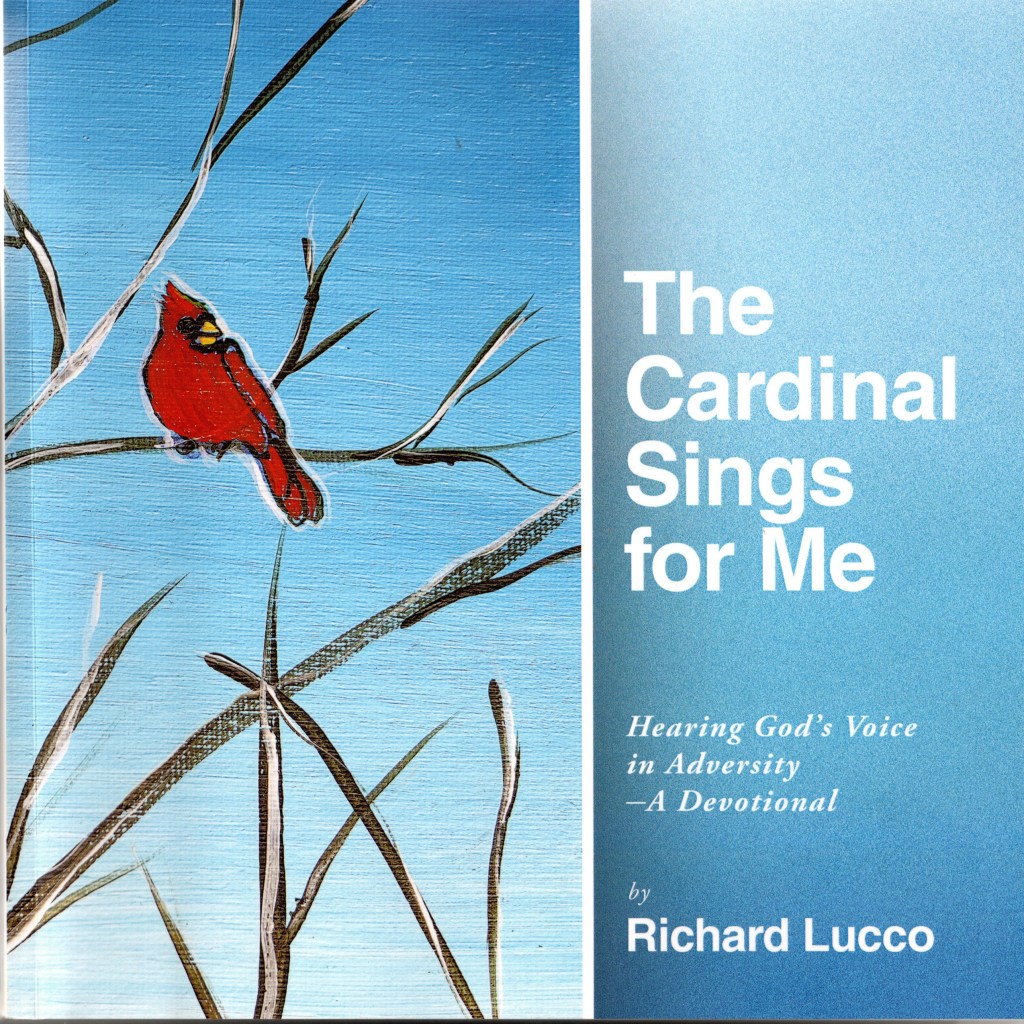
    The Covenant Church put together this book of devotional writings from Dick Lucco after the former Covenant pastor died from prostate cancer in 2022.

    I’ve had a lot of time on my hands while recovering from kidney cancer surgery. Vicki and I have watched a lot of World Cup soccer – too many, to be quite honest, because I’m not really a big soccer fan – and a wide assortment of Netflix movies. It’s also been an opportunity to catch up on some reading.

    My favorite book has been “The Cardinal Sings for Me.” It’s a collection of devotionals by Dick Lucco, a longtime pastor and conference superintendent in the Covenant Church. The devotionals were written from March 2020 through May 2021 for the congregation he was serving, Northwest Covenant in Mount Prospect, Illinois, during the height of the COVID-19 global pandemic.

    While some of the devotionals were written to help his congregation deal with the confinements of the pandemic, many of his writings were deeply personal. Dick was simultaneously dealing with the ups and downs of his own battle with prostate cancer, which he eventually succumbed to. He passed away on May 17, 2022, just one day shy of his 71st birthday.

    His writings are humorous and sad, touching and deeply spiritual. He often makes light of his cancer treatment. But he’s also brutally honest about his “bad days,” writing in one devotional, “there are days – and this is one of them for me – when I can’t seem to get out of a ditch of discouragement and despair.” But it’s in those dark moments, however, that Dick says God changes his attitude to a spirit of gratitude.

    That’s where the title of the book comes in. Dick was fascinated with the cardinal. The striking, vivid red of the male cardinal, though never mentioned in the Bible, is widely seen as a symbol of hope and God’s presence. In his book, Dick quotes Emily Dickinson: “Hope is the thing with feathers that perches in the soul.” Dick writes in his book there “were and are times when I desperately need hope to perch in my soul.”

    I suspect that during the lockdown of the pandemic Dick spent many days staring out the window at this beautiful bird that is plentiful in the midwest. While other birds fly south for the winter – and you could say when our health and other life challenges head south – the devoted cardinal remains rooted in the dark, gray days of the midwest winter. It’s also probably no coincidence that in the Catholic Church a cardinal is a high-ranking bishop or priest.

    Dick carried a miniature cardinal in his pocket and collected cardinal trinkets. It should also be noted the native of St. Louis was a big fan of the major-league baseball Cardinals. He was known to proudly wear a Cardinals baseball cap while living many years in the Chicago area, a staunch Cubs town.

    I resonate with Dick’s writings. Although I am currently cleared of cancer, I too have had many fear-filled nights when my arduous and painful road to recovery from Kidney cancer surgery has seemed hopeless. It is in those moments, however, when I cry out to God, that He gives me just enough hope and peace to fall back asleep.

    Perhaps I’ll one day write a book about my experience with kidney cancer. Anyone who knows me well is aware I’m a loyal, longtime fan of University of Washington athletics. In the Bible, the color purple represents royal, majesty and divine authority. The Siberian Husky is a magnificent animal.

    Not to make light of Dick’s writings, but perhaps mine will be called “The Husky Barks for Me.”

  • The waiting room of life

    If you’re like me, it’s hard to be patient. I’m in a waiting game right now. My whole journey since my kidney cancer diagnosis in February has been one delay after another.

    My urologist in late February referred me to the University of Washington. But wait! The UW has to process that referral and get approval from my insurance.

    My referral was approved and a surgeon was selected to cut out the cancer. But wait! She’s not available to meet with Vicki and I until March 30.

    Dr. Sarah Psutka recommends a partial nephrectomy surgery at our meeting. But wait! She tells us she’s booked out and doesn’t think she can do it until the summer (as it turned out, the surgery date was set for May 20).

    Dr. Psutka tells us the surgery was a success. The cancerous tumor was removed and there’s no cancer “in the margins” or surrounding tissue. But wait! The drain tube I’m sent home with fails. I begin running a fever, an infection develops, and on June 5 I’m back at UW Hospital for doses of antibiotics. A new, more sophisticated drain tube is placed. Dr. Psutka says there’s a small urinary leak in my kidney that hasn’t healed.

    The new drain tube I’m sent home with is working. I feel good. I have no more fever. But wait! Weekly tests for creatinine levels from fluid in the drain tube are higher than they should be. The urinary leak isn’t closing up.

    I have a second, less-invasive surgery on July 7 called a “Cystoscopy with Retrograde Pyelogram and Ureteral Stent Insertion.” They found the small leak and closed it off with a temporary stent that is supposed to divert urine away from the kidney and surgical site to let it heal. But wait! My next appointment to see if this is working isn’t until July 23.

    So that’s where I am. Still in the waiting room.

    As Americans who live in a fast-paced culture, we struggle mightily with waiting. Technology has made us less patient. We’ve conditioned our brains to expect instant gratification. Because high-speed internet and one-day delivery by Amazon rewards us without delay, we get frustrated when daily processes – whether it be the loading of a website or simply waiting for the traffic light to green while giving in to the urge to look at our phone – take more than a few seconds.

    I’ve learned from experience that my sense of timing is vastly different than God’s. God has His own timetable. You may have heard this joke that refers to how time flies in the divine realm:

    A man is speaking to God and asks, “God, now long is a million years to you?

    God answers: “To Me, it’s about a second.”

    The man then asks, “God, how much is a million dollars to You?”

    God answers, “To Me, it’s like a single penny.”

    The man thinks for a moment, gets a hopeful look in his eye, and asks, “God, could you give me one of your pennies?”

    And God cheerfully replies, “Sure! Just a second.”

    It’s a lighthearted take on the scripture passage 2 Peter 3:8, which says “with the Lord one day is like a thousand years, and thousand years are like one day.”

    I’ve learned over the years God is not a vending machine. You don’t press a button, and get what you want right away. If that were the case, we’d probably be spoiled brats. Sometimes the answer is “yes.” Sometimes the answer is “no.” Sometimes the answer is “not yet.” A delay is not necessarily a denial.

    Many people have been praying for me. I have felt those prayers. It shouldn’t be lost on me that I am cancer-free. Vicki and I, however, pray daily for complete healing. I feel like my life has been “on hold” for nearly two months. With two different sets of “plumbing for bodily fluids,” it’s difficult to go anywhere in public. We’re missing out on “summer.” I’m largely housebound – and sadly, so is Vicki, who’s been a great nurse and support by the way! I know I couldn’t do this alone.

    For whatever reason, I’ve had to walk this path. This is another setback. There have been more times in the middle of the night when things have seemed hopeless. But there’s also been times when a scripture or podcast I’m listening to addresses the specific affliction I’m going through, and gives me hope. In those instances, I choose worship over worry, and praying over panic.

    I’m hoping when I come out the other side, I’ll be more appreciative of my overall good health that I’ve taken for granted, have more empathy for people who are cancer-ridden and struggle daily with chronic pain and disease, and be more grateful to a God who has richly blessed me in so many ways.

  • From a setback to a comeback?

    I had a little setback following my surgery for kidney cancer on May 20. I had barely been declared “cancer-free” when I began to experience over the course of several days a low-grade fever and chills. It ultimately led to a trip to the emergency room at the University of Washington on June 5.

    CT scans that evening revealed a 8.3-centimeter-sized abscess below my stitched-up right kidney. In other words, I had a very bad infection. During my four-night stay at UW, I received heavy doses of antibiotics, as well as a much-needed procedure to properly drain the infected site.

    I have to admit I had some anxious moments, lying there in my hospital bed, wide awake at 3 in the morning. Sleep-deprived and running a fever, I felt miserable and a little discouraged. I felt like I was in a “battle.”

    For the past six months, I’ve been a youth group volunteer leader at Bethany Covenant Church. I work with high-school boys, and in our small group I’ve talked to them about the physical, three-dimensional world we see, and the fourth dimension that we don’t see. The “unseen spiritual world” is beyond human perception, a realm inhabited by God, angels ,and yes, forces of evil that seek to “undo us.” There’s also a fifth dimension. But for those of you who are older, that was a rock group from the seventies!

    But I digress. Back to the fourth dimension, where spiritual wars are waged. The Apostle Paul in the book of Ephesians uses the image of a Roman soldier’s armor to describe how believers can stand firm in the midst of spiritual challenges. That armor includes prayer, memorized scripture, and for me even lyrics to a Christian worship song.

    One song stood out to me, and helped me during my darkest night, on June 6. It’s called “Way Maker,” by the group Leeland. We sang it almost every week at youth group. To be honest, it isn’t one of my favorite songs. It’s one of those “7-11 songs,” you know where you sing the same 7 words 11 times. But the words were so drilled into my head that they came to me in the midst of my fear that night at UW. The lyrics go like this:

    And You are
    Way maker, miracle worker
    Promise keeper, light in the darkness
    My God, that is who You are

    The words to the chorus also spoke to God’s presence, as I chose to walk by faith, and not by sight. I was not alone. He was with me “in the fire,” standing next to me. I could not see God working, but had this sense that things were going to be alright.

    Even when I don’t see it, You’re workin’
    Even when I don’t feel it, You’re workin’
    You never stop, You never stop workin’

    My surgeon, Dr. Sarah Psutka, said I had a “small leak” from my kidney following surgery. That was always considered a slight risk with a partial nephrectomy. As I write this blog, I am in Day 4 since my release from UW Hospital. I have no fever. The drain is clearing out the bacteria from the infection. I continue to heal and recover from what was a major, delicate surgery. I’m also sleeping better now.

    I’ve had my share of setbacks in life, as I’m sure you have. It can be a setback at your job, your career. It can be a broken or a strained relationship. It can be a financial setback. It can be the loss of a loved one. It can be the pain of regret. In those moments, we can’t see the whole picture. But God sees the end of the story. There can be no comeback without a setback. A setback can merely be a stepping stone to success, to a place where God wants us to be.

  • The pursuit of radical generosity

    I turned 70 in November. It was a time for celebration while surrounded by family in Arizona. It was also a time for reflection.

    Let’s face it, I’m old. On the surface “my work is done” and I’m “over the hill.” My career is in the rear-view mirror. I like to tell people that when I was working “I was pulling down good money. Now that I’m retired, I’m good for nothing.”

    And yet, if I’m honest with myself, that’s actually not true. There’s still time – God willing – to make the rest of my life the best of my life. A little more than seven decades on this earth, I’m still learning. I’m not a finished product. Our purpose on earth is not to take up space, make money, retire and go play golf. There’s “more work to do.” I want to be a better person. I want to make a difference. Whatever wisdom I’ve acquired, I want to pass it along to the younger generation.

    I’ve lived through many seasons of life—times of joy, challenges, and growth. Now that I’ve returned to the seventies (that’s a joke!), I’ve been thinking a lot about what’s important to me.

    The world values position, possession and passion, or in other words, status, salary and sex. My career and the acclaim that went with it was always important to me.

    My values? I’d rank humility, integrity and generosity at the top. In this Christmas season of giving, however, I’ve been wrestling with the question: Am I generous man?

    For most of my life I’ve been tight-fisted with money, reluctant to give my hard-earned salary to the poor, to the less fortunate. I trust God with my salvation, my life. Why can’t I trust him with my wallet? What I’ve realized since retiring is any money I’ve made is not mine. It’s God’s. I’m just managing it. I certainly can’t take it with me. I’ve never seen a hearse going to a funeral pulling a U-Haul trailer.

    And yet, generosity isn’t just about money.

    I want to be generous with my praise and affirmation. How often did I praise Vicki, our girls when they were young, the supervisors and co-workers I had, or my friends? Not often enough.

    I want to be generous with my attention. When you give someone your attention, and look them in the eye, you’re giving them your life. Have I really listened to people’s concerns, and sympathized with their plight? Or has my mind wandered during those conversations to my own needs and desires?

    I want to be generous with the lessons I’ve learned along the way, and share them with my grandchildren and younger men in my life.

    I want to be generous with my time. That means babysitting my grandchildren when on days I’d rather be doing something else. That means caring for my 91-year-old mother when it’s hard. Because of her advanced state of dementia, she can’t say my name or hold a conversation – yet her face lights up when she sees me because she knows it’s her son.

    I want to be generous with whatever God-given talents I have. That means giving my skills away for free, whether it’s for a faith-based ministry or a Pacific Northwest basketball legends organization.

    I’ve come to admire David Brooks, a New York Times columnist and regular contributor to the PBS News Hour. Most Friday evenings, Vicki and I watch the moderately conservative Brooks and Washington Post associate editor Jonathan Capehart, who is more to the left, discuss the week in politics on PBS. Brooks recently wrote a column about his faith. As one who had a 45-year career in journalism, I can’t tell you how unusual that is for a member of the media to reveal his or her spiritual side. In that column, he said this about generosity:

    “My life feels remusicked since my own little Exodus journey began. It turns out the experience of desire is shaped by the object of your desire. If you desire money, your desire will always seemed pinched, and if you desire fame, your desire will always be desperate. But if the object of your desire is generosity itself, then your desire for it will open up new dimensions of existence you had never perceived before, for example, the presence in our world as an energy forced called grace.”

    The Apostle Paul speaks in the New Testament about faith, hope and love, with the greatest being love. Generosity is the practical expression of those three. It’s been said you can give without loving, but you can’t love without giving.

    God has been extravagantly generous with me. As a follower of Jesus, may I also be generous, not only with my money, but with my time, my affirmation and praise, my talents and my attention to the people around me.