Tag: family

  • I believe. Help me in my unbelief.

    Dr. Sarah Psutka, one of the leading kidney cancer surgeons in the U.S., wouldn’t rest until my kidney was healed. She once told me “I think I grew some gray hairs over this one.” She was relentless. She fought for me.

    I’m healed!

    I yelled those words to anyone within earshot at our lake cabin the evening of August 4. I had just gotten off a Face Time call with Dr. Sarah Psutka, my surgeon at UW Medical Center. The proof was on Dr. Psutka’s computer, as she displayed images from a CT scan taken 24 hours earlier.

    “You can see here the kidney has closed up and healing on its own,” said Dr. Psutka pointing to shades of gray and white tissue that I did not fully understand. “I viewed the images last night, and I was hopeful. But I wanted to talk to the radiologist today, and confirm what I saw before I delivered the good news.”

    Good news, indeed. All three of our daughters and their families were at the lake to receive the news. But did I really believe it? (More on that later)

    Anyone who has read my blog posts over the summer knows I had serious complications following my successful surgery on May 20 to remove a cancerous tumor on my right kidney. There were painful procedures (tubes hooked up to me I didn’t want to be hooked up to). There were sleepless nights. There were moments of despair. There were moments of doubt.

    But something happened during the last days of July that changed everything.

    Dr. Psutka is one of the leading oncology kidney surgeons in the U.S. She’s used to performing successful surgeries. She’s not used to complications. Vicki and I had a Face Time call with Dr. Psutka on July 17 on the heels of several disappointing drain fluid tests that indicated the kidney was still leaking. Up to that point, procedures designed to expedite the healing process had proven to be futile. Dr. Psutka told us my surgery was one of the more complicated she had ever performed. Lucky me! She said in her 11 years at the UW she had only one patient that had complications like mine. She said her partner at the UW, who has been there 17 years, has only had three cases similar to mine. Clearly frustrated and searching for answers, Dr. Psutka told us she had reached out to one of her colleagues at the Mayo Clinic in Minnesota for some advice.

    “My colleague thinks the drain could be doing more harm than good,” she told us, noting that the second drain put in June 8 after my first infection might be unnecessarily pulling urine from the kidney, spiking my creatinine levels . “He thinks I should pull the drain, the stent and tubes (I’ll spare you the gory details). I prefer a step-by-step approach.”

    The drain was pulled on July 20 at UW. A follow-up scan to see if the leak still existed was done three days later. It indeed showed a small collection of perinephric fluid “compatible with a urine leak.”

    Not good news. Dr. Psutka’s assistant, Jade Meaker, met with us to explain the next move was to install a temporary “nephrostomy tube” into my right kidney to drain urine into a bag attached to my leg. This procedure, it was explained, would allow the surgically-repaired kidney to heal. The left kidney would drain urine naturally.

    Jade said the procedure was basically a ‘Hail Mary,’” or in other words a last-gasp effort before Dr. Psutka would have to remove the entire right kidney that she had operated on only two months earlier. And trust me, she did NOT want to take that kidney out.

    We were devastated. Our planned trip to Europe in September that was a year in the making was now in question. My psyche, rocked by one bit of bad news after another, was also in question. The procedure, scheduled for the following Monday July 27, would be invasive.

    This is when the tide began to turn. It was the “comeback after the setback” I had hoped for, and inferred in my earlier blog posts.

    Dr. Psutka, after performing a surgery at Harborview Medical Center on Friday evening, July 24, had taken a red-eye flight the same night to Indianapolis. She was in Indianapolis for the weekend to speak at a medical convention. For all I know, she went off script and told the gathered group of doctors she was baffled by complications with a particular patient from a partial nephrectomy surgery.

    She called me Saturday morning that weekend, asking “How are you feeling.” I replied “I’m feeling great.” Based on my CT results two days earlier, without saying as much, Dr. Psutka suspected I would get another infection. On Sunday evening, while on her flight back to Seattle, and just hours before my 10 a.m. appointment the next day for my nephrostomy tube procedure, she texted me, “How are you feeling.” Again, I replied “I feel fine.” Full disclosure here. How many doctors give their patients their private cell phone number and call them on weekends and when they’re out of state?

    At this point, I had come to a crossroads. The night before, I sensed an inner voice telling me, “this kidney could heal on its own.” I debated whether to even bring that up with Dr. Psutka – would she think I was crazy? – but finally decided to do so, asking in a text if the kidney could heal without intervention. She got right back to me: “I’ve been thinking the same thing over the weekend.” She said she would call me when she landed in Seattle.

    An hour or so later, while Dr. Psutka was on an Uber ride from Sea-Tac Airport to her home in Seattle, she called. She said “we have two good options here. We do the safe thing by putting in the (nephrostomy) tube, or see if it will heal on its own. There is no clear (correct) solution.”

    I said, “let’s see if it will heal.”

    Less than 12 hours before a team of doctors, nurses and an anesthesiologist were scheduled to install the nephrostomy tube and remove the small collection of fluid from the suspected leak, the procedure was called off. Instead, Dr. Psutka removed the urethral stent and “tubes” the next day (Monday), as the colleague from the Mayo Clinic had recommended.

    Afterward, Dr. Psutka said she wanted to speak with Vicki, who was in the waiting room, to see if she had any questions. Vicki, for whatever reason, told Dr. Psutka “that kidney is going to heal on its own. A lot of people are praying for Rick.” Vicki said Dr. Psutka looked doubtful. As we know now, the results from the CT scan the next week proved Vicki was right.

    Fast forward to August 24, about three weeks after I had received the initial news from Dr. Psutka at the lake cabin that my kidney had healed. I was scheduled for two more CT scans. One was the three-month checkup to see if there was any evidence of cancer at the surgical site or nearby organs. The other was to take yet another look at the right kidney, to make sure it had healed up.

    I must admit I approached the scans and subsequent follow-up appointment with Dr. Psutka with some fear and trepidation. I had experienced some PTSD over the course of the summer. I was a little skeptical. In my mind, there remained “scar tissue.”

    Vicki was a little puzzled by this, telling me “your kidney has healed. Dr. Psutka already told you. Why are you nervous?”

    It occurred to me I had not completely bought into the fact I had “been healed,” no matter what I yelled that day at the lake cabin.

    It reminded me of a story in the Bible. In Mark 9, a desperate father asks Jesus to heal his son, crying out with both faith and doubt. The father basically tells Jesus in verse 22 “heal my son if you can.”

    Jesus replies to the father “If you can? All things are possible to him who believes.”

    Jesus could have said “you don’t have enough faith, so I’m just movin’ on to someone else.” But he doesn’t do that. What happens next is very moving.

    Verse 24 says the boy’s father told Jesus, “I do believe; help me in my unbelief.” Jesus rebukes the unclean spirit in the boy, and heals him.

    Both of my scans on August 24 came back clean. I have no cancer, thanks to Dr. Psutka, who preserved 85 percent of my right kidney. I have some collateral damage from some procedures. But my kidney has healed. I asked Dr. Psutka, “could it start leaking again?” She replied, “only if I opened you up again and starting cutting on it.” She cleared me for our trip to Europe.

    How often have we prayed for something, God answers that prayer, and we attribute the favorable outcome to something else? We all know that there are times God doesn’t grant us what we’ve prayed for. But does that cloud our ability to appreciate when prayer is answered?

    I know, without a doubt, God has led me through several storms in my life. I am not unique. We all go through storms. It can be a financial storm. It can be a relationship storm. It can be a medical storm. This battle with kidney cancer was a storm.

    There will be more storms in the future. I will be fearful. And yes, I probably will be doubtful. But in my finiteness, in my short-sightedness, in my weakness, I will say:

    I do believe. Help me in my unbelief.

  • Committed. Devoted. All in. That’s who she is.

    Our wedding day, August 13, 1977, at Redeemer Covenant Church in Orangevale, California.

    I, take you, Vicki/Rick, to be my wedded wife/husband, to have and to hold from this day forward, for better, for worse, for richer, for poorer, in sickness and in health, to love and to cherish, till death do us part.

    We recited those vows 49 years ago today, on a sweltering, late-summer California evening in a small church a few miles east of Sacramento. The “sickness and health” portion of those vows seemed so foreign at the time. We were young, vibrant and carefree.

    Decades later, those words hit home. In February, I was diagnosed with kidney cancer. While the surgery in May was a success – no cancer was found in nearby organs or in the margins – complications ensued. I had an infection, followed by several weeks of procedures designed to speed up the healing process in my leaking, surgically-repaired right kidney. It was hard. It was often painful. It was tiresome.

    Vicki wearing “protective gear” during my second hospitalization for an infection at University of Washington Medical Center. The day before my release, the infectious disease team at UW got involved in my care, saying I had tested positive for “MRSA.” That meant anyone who entered my room, including nurses, had to don protective clothing. My surgeon would later confide that this was an overreaction.

    But the girl I married never wavered. If you know anything about Vicki, once she commits to something, she’s “all in,” whether that’s to a task, her daughters, her grandchildren, or her husband. That meant long days at the UW Hospital when I was admitted there. That meant multiple trips with me to the hospital for tests and follow-up procedures. That meant changing bandages at two different drain sites on a daily basis. That meant missing out on social events because she’d rather be at my side. Thankfully, I’ve come out the other side of this ordeal.

    Of course, I was not surprised that Vicki would respond this way. I’ve known her devotion, her unwavering commitment and her tenacity for a very long time. It’s who she is.

    I met Vicki in 1975. We were students at North Park College in Chicago. I was in charge of a school Valentine’s Day dance. I needed a date. Vicki and I had worked in the school cafeteria together, so we knew each other. I asked her to the dance. She said “yes.” We had a good time.

    A couple weeks later was “Turnabout” on campus. “Turnabout,” at least back in the ’70s, was when normal social roles were flipped, and girls asked the guys out. Vicki took me out to dinner at a nice restaurant in downtown Chicago. We started dating.

    I have to admit I was a little surprised by these developments. Vicki was absolutely gorgeous. She could have dated anyone she wanted on campus. I believe I had “outkicked my coverage.” (For those of you who have never heard that term, google it). As it turned out, the affection was mutual. It was obvious early on that there was immediately “chemistry” between us, i.e. a physical attraction.

    Vicki and I met at North Park College in Chicago.

    I was a sophomore. She was a freshman.The problem was, I wouldn’t be returning to North Park for my junior year. I had already made up my mind I was transferring to Western Washington University. To be honest, when she returned to California and I to Washington at the end of the ’74-’75 school year, I thought that was the end of the relationship. Boy was I wrong. She kept it alive, inviting me to Sacramento that summer to meet her family.

    During that year of separation – she in Chicago, me in Mount Vernon – I learned a lot about Vicki. She was also beautiful on the inside. She was loyal. She was committed. Our relationship during that year actually grew deeper. During the few occasions we got together, we learned we shared the same values.

    We both wanted to become people molded in the likeness of Jesus. We both wanted to use our gifts, not for ourselves, but to serve others and the “Body of Christ,” i.e. the Church, and bring glory to His name. We shared a Puritan work ethic that had been instilled in us by our parents, a cultural and spiritual belief that hard work, frugality and discipline are core moral duties. As husband and wife, we wanted to be a “team,” where we shared daily responsibilities and made major life and financial decisions together with mutual respect. We would learn later that we were different in many ways, but that each of us had strengths and weaknesses that complimented each other. I married a sinner. She married a bigger one. Each of us were “works in progress.” We gave each other grace.

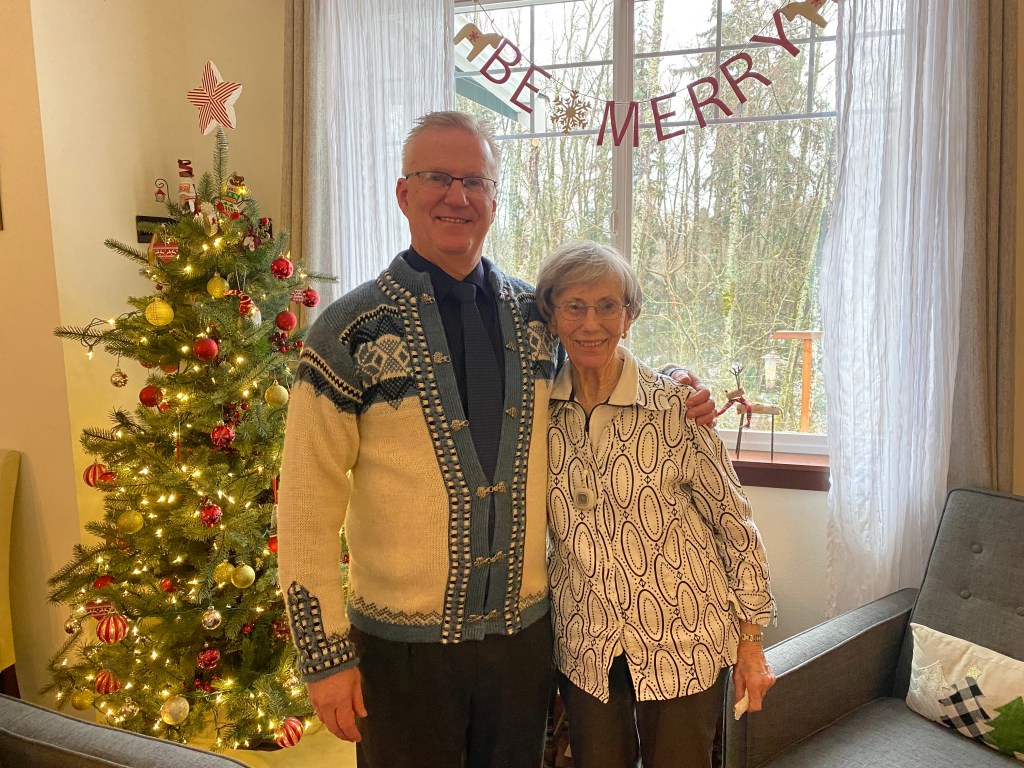
    We’re much older now, though Vicki still has her blonde hair!

    Extra grace was required these past six months. But the girl I fell in love with so many years ago never blinked. Always committed. Always a steadfast partner through all of life’s changes.

    Here’s to Year 50, my love. It’s going to be a good one.

  • Remembering mom

    Remembering mom

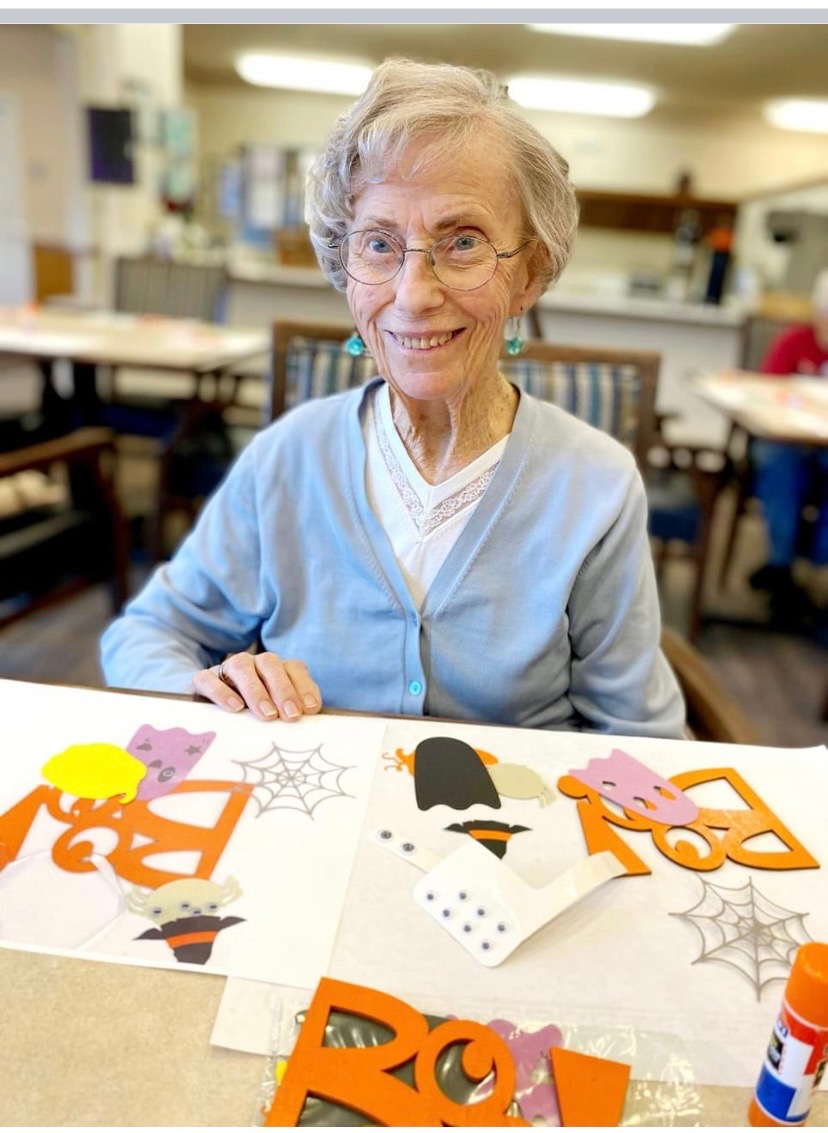
    Mom pictured here at Where The Heart Is and Memory Care Center in Burlington. We moved her there in May 2021. It was during this time mom was showing signs of progressive dementia. Memory loss, however, did not rob her of that warm, pleasant smile. She died peacefully on June 24, just three weeks shy of her 92nd birthday.

    My mom was “Wonder Woman” long before Lynda Carter assumed that title.

    She did all the laundry, always had home-cooked meals on the table, kept an immaculate house, tended to the garden and flower beds, sang in the choir at church, and had my grandparents and other extended family or friends over for dinner many Sundays after church. She did all that while working full-time beginning when I was 12, in an era when it was rare for mothers to work outside the home. Her jobs at Northern State Hospital and Skagit Valley College in essence made it possible for me to attend a private college in Chicago, spread my wings a little bit and meet the woman I would marry. I thought at the time, that was just normal. It wasn’t.

    Mom with us three kids, probably late 1950s in our first home in west Mount Vernon.

    As I grew into adulthood, I began to appreciate her enormous skill set and the sacrifices she made for our family. It was also during these past eight years since our dad died, when I spent more alone time with her, I learned what she loved.

    Music touched her soul. I have vague memories of her as a soloist at church. As time went on, though, she was content to be just another soprano in the choir. Mom was never comfortable in the spotlight. After our dad died, we enjoyed special music concerts at Bethany, and she loved to sing the old hymns here on Sunday mornings. Just before the outbreak of COVID, we were invited by David Benson to a violin and piano concert at Saxon north of Sedro-Woolley. David and the pianist played music from Chopin, Schumann, Beethoven and Fritz Kreisler arrangements of Viennese parlor tunes. At the end of the concert, she turned to me, and with tears in her eyes said, “I loved this music. Thank you so much for bringing me.” Mom had an eclectic taste in music. In fact, she liked some of the music I liked growing up. Dad liked Lawrence Welk music. Mom liked the Bee Gees (So how deep was your love for them, mom, because, I really mean to learn). Mom also wasn’t a stick in the mud when it came to worship music preference in church. She liked music that glorified God – contemporary and traditional.

    Mom loved flowers, especially tulips, begonias, gardenias and fuchsias. She told me many times her favorite time of the year was spring ­– the blossoming of flowers and the budding of leaves, which I think to her also represented renewal and new beginnings. She loved bird watching. She loved the colors pink and especially purple, though she wasn’t necessarily a Husky fan.

    Mom was a gourmet cook. I found her recipes hand-written on 3×5 cards, neatly filed in shoe boxes, under specific categories. On the backs of those cards, she wrote the guests she served them to, and the date, and how she thought the meal turned out.

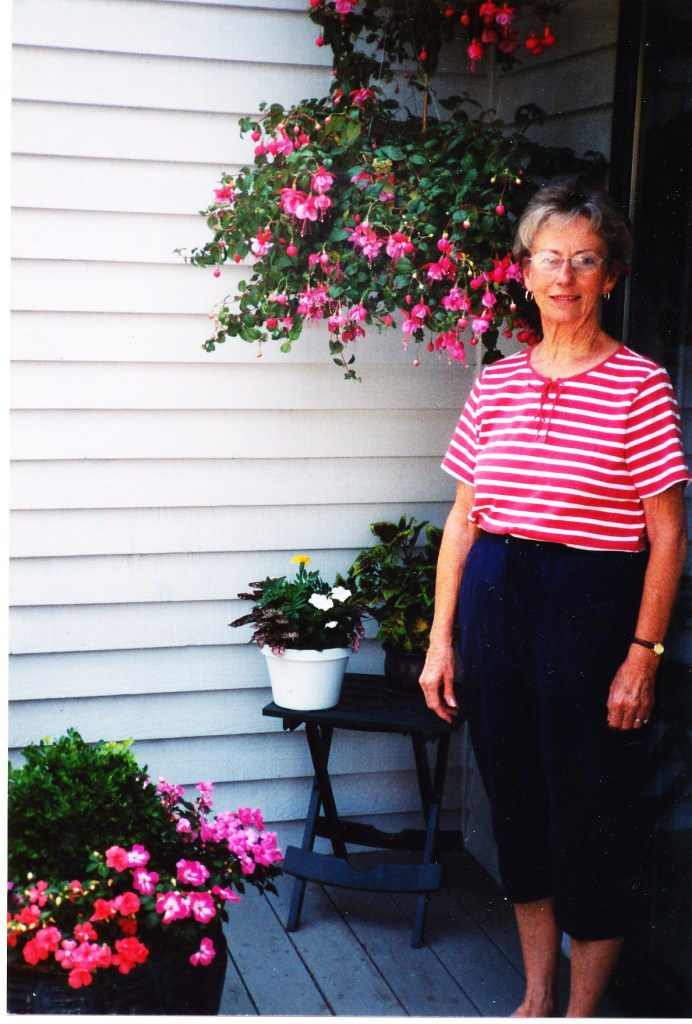
    Mom with a hanging fuchsia basket. On the back of the scanned photo she had written I had given her the fuchsia for Mother’s Day.

    Mom was dainty, loved to dress up, and took great pride in her hair. That meant having it styled every Friday ­– without fail! And heaven forbid if I picked her up for an outing on a rainy or windy day, and that fresh hair-do might get messed up!

    Mom was the disciplinarian in the house. While dad was no pushover in his gentle way, mom drew a line in the sand ­– and made sure you didn’t cross it. I occasionally challenged her. Hey it was the late 60s and early 70s! Everyone was protesting. She didn’t like that. I regret that. There were a few instances in high school I wanted to do some things that looking back would have done me great harm. She didn’t let me do them. I could have easily rebelled, but even back then I had this feeling she was just trying to protect me. My parents insisted I go to church when I was young — even on Sunday nights, when frankly I would have rather stayed home and watched Wonderful World of Disney and Bonanza on TV. I am forever grateful for that. Bethany Covenant built a firm foundation for me that would make Jesus the manager of my life and later weather the storms of life.

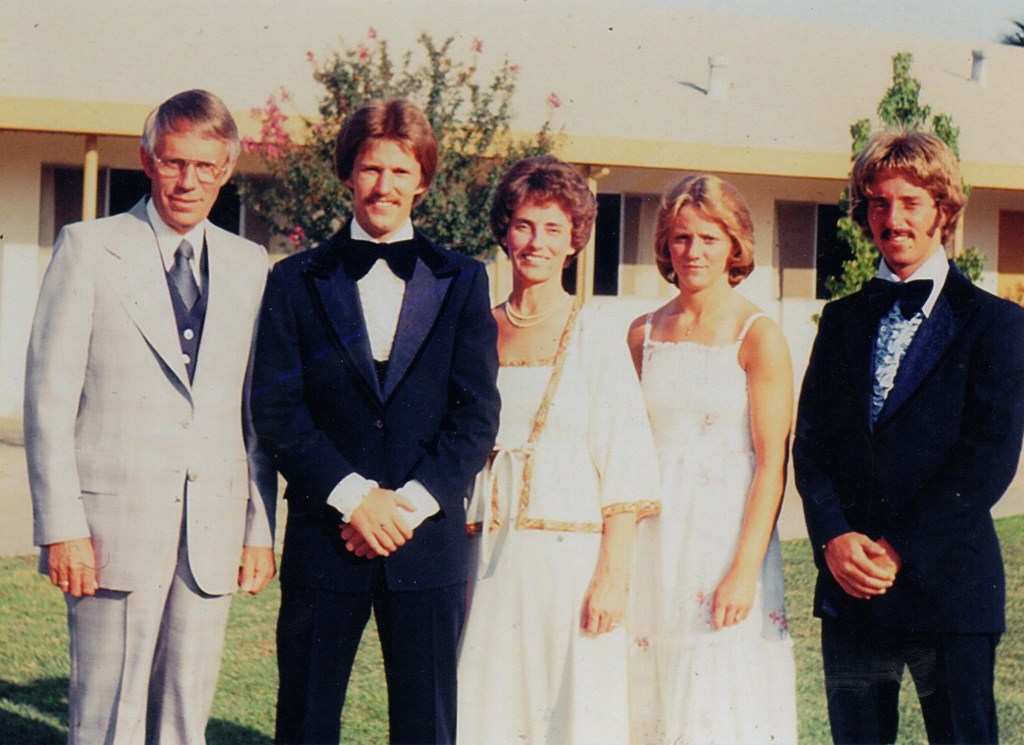
    Our family at my wedding in Orangevale, California in 1977.

    I only found out in recent years that mom was one of the first to enter the transfer portal, going from Sedro-Woolley High to Mount Vernon High (personally, as a proud Cub, I would have gone the other direction, Mom.) There was no NIL money for mom at Mount Vernon – just dad. And that was gold. She didn’t know then that for most of their marriage, mom would be a caregiver for my dad, who lived with Multiple Sclerosis for more than 55 years. Yet, she never complained.

    Everything changed on August 10, 2017, the day my dad died. I was on my way to work in Seattle when I got the frantic call from mom that dad had fallen in the shower, was unresponsive and rushed to Skagit Valley Hospital. For the first time in my life, my self-sufficient mother showed cracks of vulnerability.

    “I’m scared,” she told me. “What should I do?”

    This would be a devastating blow to my mom, one she never quite recovered from. As you most of you know, our parents were a tight-knit team for 64 years. And dad had taken me aside in the year leading up to his passing to tell me that mom was forgetting things she shouldn’t be forgetting.

    It was obvious to anyone who knew my parents that they were a tight-knit team.

    Life after dad was hard for mom, and in 2021 it became apparent she could no longer live on her own. She had lost her interest in cooking, and driving the car was problematic.

    At this point, the protector role mom played when I was growing up was about to be reversed. It was now my job to protect her. That meant taking the car keys away, which she didn’t like it.

    “I’ve never been in an accident,” she told me.

    And I said “Yes, and you’re getting older and your reflexes aren’t what they used to be, and that’s why I want to protect you from having one.”

    “Well,” she said, “Shirley’s still driving. And by the way, she has a new car.”

    Protection also meant taking over her finances to guard her from government imposter scams. Of course, mom wasn’t happy with these changes. “Quit teaching me,” she once said. I think she meant to say “quit challenging me,” but she had forgotten the word.

    A Christmas with mom at our home. She fought me at first as I tried to take over her finances and protect her. But she eventually trusted me to handle her affairs. We had a sweet relationship in her final years.

    Truth be told, however, as a I assumed this role of “her protector” she was in fact “teaching me.” She was teaching me how to take care of her in her final years, as she took care of me when I was young. I am not nurturing by nature. These last years with my mom, it was as if God was telling me “you need to grow in this area.” She began to rely on me. She trusted me.

    Dementia has been described as the “long goodbye.” I hardly got to say goodbye to dad. He died suddenly. In the years, months and finally days leading up to mom’s death, I was able to say goodbye to mom – to say the words for years I had too often neglected to say – thank you for making sacrifices for me, for encouraging me, for believing in me, and for loving me, even when I was doofus.  In the last year, she was wheelchair-bound from the hip fracture and it was hard to get her out. She had also lost the ability to form words. Our time together often consisted of me reading to her – mostly from Alice Van Liew’s book about growing up in Baker Heights – or playing music, or reviewing her 90th birthday memory book. Or just holding hands. She no longer knew my name. But she always greeted me with that warm smile. She knew my face. She knew my voice.

    This photo was taken in her room on Day 4 without food. She had stopped eating. She was not able to speak to me, but took my hand shown here, brought it to her mouth and kissed it. Even in her dying days, memory loss did not take away her ability to express a mother’s love.

    I started writing my mom’s obituary about four years ago. It wasn’t that I thought her passing was imminent. I just didn’t know how much of her past she was going to remember. My mom had been so sharp, so well read. But dementia was slowly eroding her cognitive abilities. I started asking questions, like “when did you accept Jesus into your life, mom?” Now this was one of those days when she was having trouble putting a sentence together. But she looked me square in the eye and said “at church, when I was a little girl.”

    Even with her clouded mind, mom knew where she was headed. She had “blessed assurance.” A few days before she died, even in her weakened condition, I watched her lift her head up and stretch her arm to the ceiling, as if reaching for something. Then she lowered her arm and closed her eyes again. Did she see an angel? Dad, beckoning her to join him? I couldn’t believe what I just witnessed. I took a picture of it.

    This is a filtered version (the original is too hard to look at) of mom having a vision a few days before she passed away. In her weakened condition, she lifted her arm toward the ceiling, eyes wide open, as if reaching for something. She then lowered her arm and closed her eyes.

    However many years we have on this broken planet, 70? 80? 90 years? ­– is just a blink of an eye compared to the trillions of years we’ll spend in eternity. No more sickness. No more wars. No more political divides. No more broken relationships.

    As believers, Isn’t that good news?

    I may lose my 401K, my house, or my lake cabin – but I will not lose my salvation, the promise of eternal life.

    I may lose my health – as my dad did when 55 years of MS crept into his upper-body and claimed his life. But I will not lose the promise of eternal life.

    I may lose my mind – as my mom did, in the final years of her life. But I will not lose the promise of eternal life.

    You see, when you’ve been born again, you can’t be unborn. When your name is written in the Book of Life, it can never be erased.

    Thank you, mom, for all you did for me, and for our family. I’ll see you and dad on the other side.

    A brief ceremony at the gravesite, before the memorial service, with Rev. Dwight Nelson officiating.
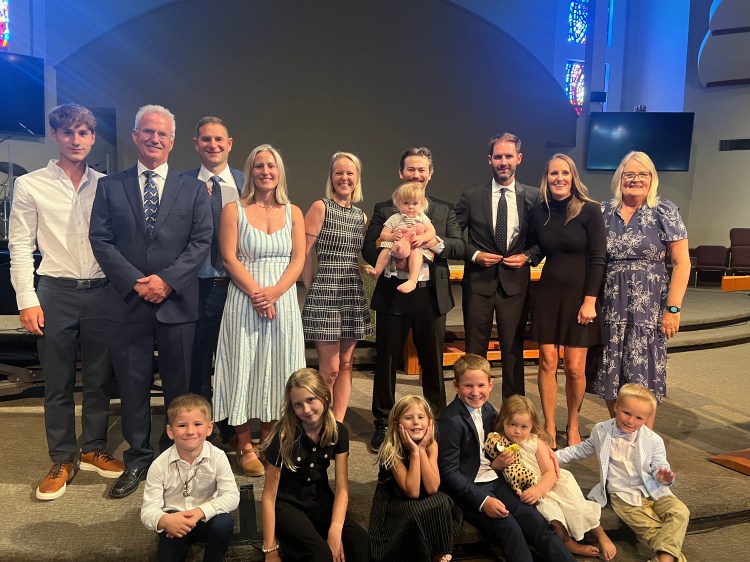
    Our family, shown here in the Bethany Covenant sanctuary after the memorial service and reception. Great grandson Isaac, top row, far left, read scripture. Granddaughter Greta, top row, second from right, and yours truly were the speakers.
    Mom and dad’s headstone at a cemetery at Freeborn Lutheran Church east of Stanwood. Mom’s parents, Morris and Sylvia, are buried next to them.


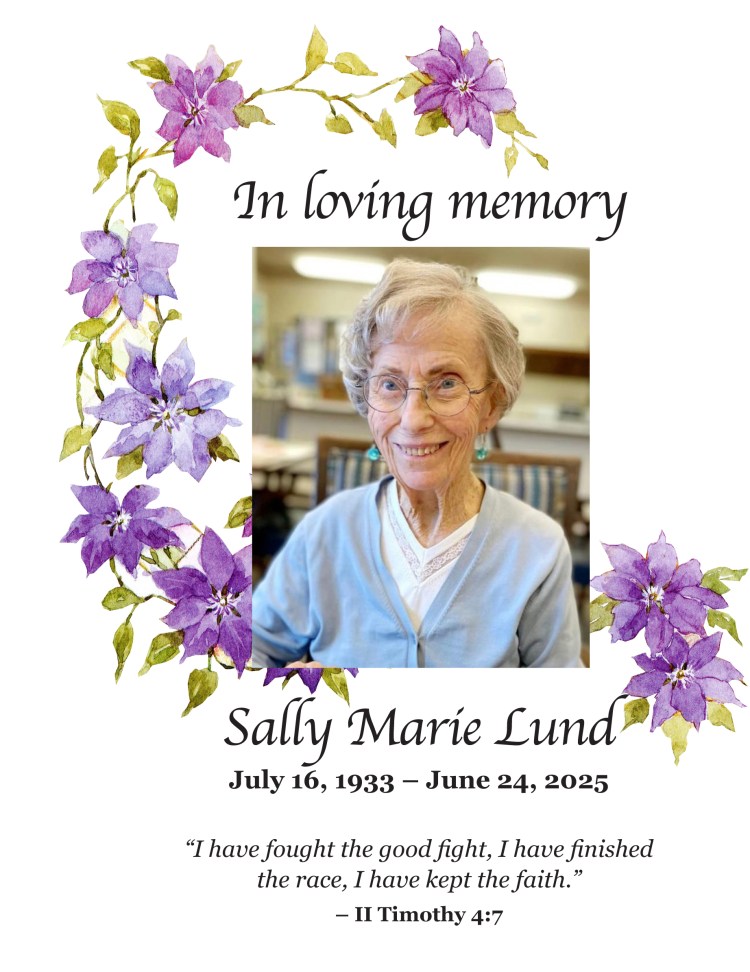
    The program I did for mom’s funeral on July 19 at Bethany Covenant Church in Mount Vernon.