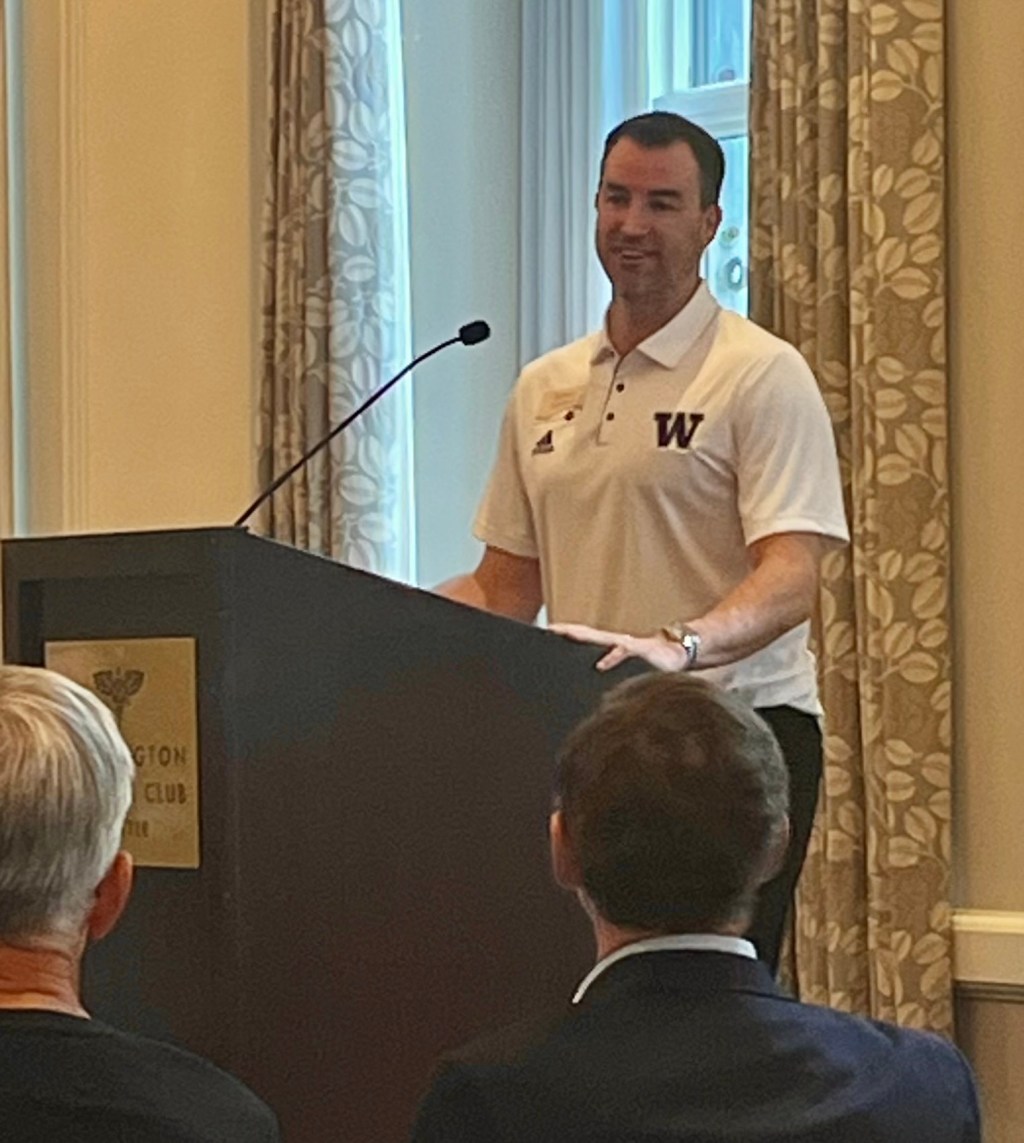
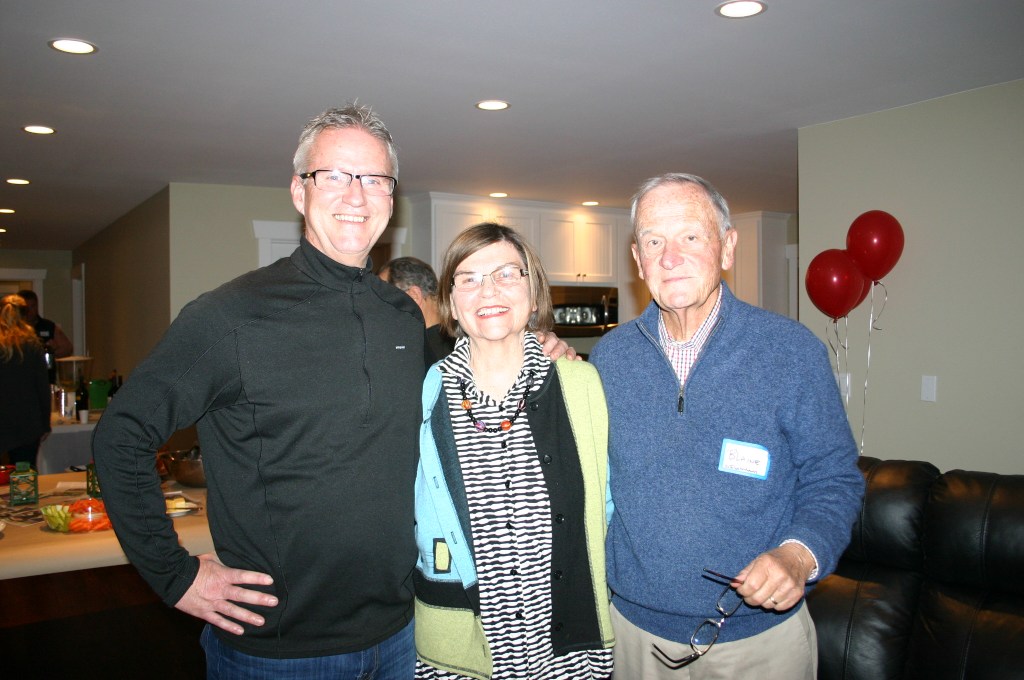
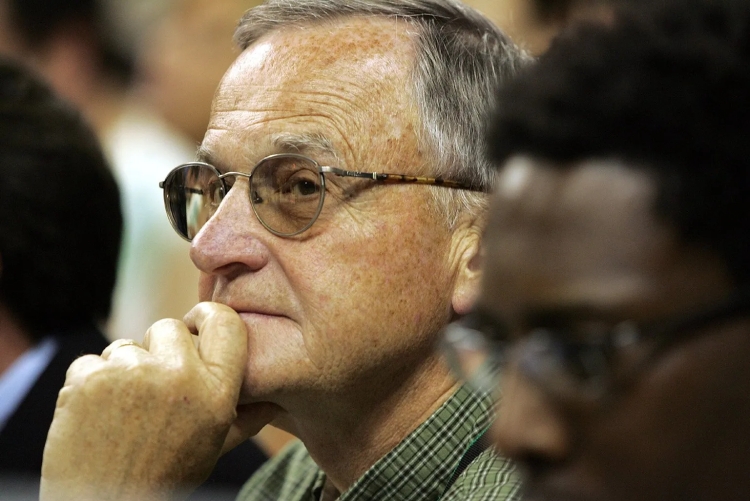
UW Basketball Coach Danny Sprinkle speaks at the “Pacific Northwest Legends” banquet on May 9. That’s “Legends” president and former Sonic and UW great Steve Hawes below the podium, to the right.
Had to chance to meet UW basketball coach Danny Sprinkle on Saturday at an annual gathering of mostly way-past-their-prime basketball players, coaches and media-types.
Sprinkle spoke to the 70th meeting of the “Northwest Basketball Legends” at the Washington Athletic Club, bringing renewed hope and optimism to a program that hasn’t sniffed the NCAA Tournament since 2019. But first, Sprinkle spoke candidly about the hole he and his staff were faced to try and dig out of when he was named coach on March 25, 2024 to replaced fired Mike Hopkins.
“By the time we got the job, I knew there wasn’t a lot of Big Ten talent left out there,” Sprinkle said.
It wasn’t nearly enough to compete in the rugged Big Ten. The Huskies finished dead-last in the 18-team conference with a 4-16 mark, 13-18 overall. The number of wins might have exceeded his initial expectations.
Ken Bone was in the audience. Apparently, Sprinkle invited the former UW assistant and WSU head coach to come to Montlake before the start of the season to assess the Huskies’ talent level. He may have told Sprinkle they were in trouble.
“Coach Bone saw our team in the summer and early fall, and if you would have told us that we’d win 13 games, I probably would have been pretty damn happy at that time,” Sprinkle said.
Help is on the way. In addition to a top transfer class, UW’s high-school recruiting class of ‘25 is ranked No. 18 in the nation, and No. 1 in the Big Ten, according to 247Sports.com.
Sprinkle bemoaned the Huskies’ erratic guard play during his first season. The team did not have your prototype point guard to direct the offense. Older, seasoned guards via the transfer portal will help against the physical teams in the Big Ten. But Sprinkle is most excited about incoming four-star, point guard JJ Mandaquit, whom he credits assistant Tony Bland for helping land.
“He’s going to be phenomenal,” Sprinkle said of the 6-1 guard from Hurricane, Utah, ranked 10th nationally by 247Sportscom. “If any of you guys saw our games last year, hopefully you wore a football helmet because we threw the ball all over the place. It’s a great to have a true point guard.”
Sprinkle said he also took the job knowing Washington was at a distinct disadvantage when he comes to facilities.
“We have the worst basketball facilities in the Big Ten,” the coach said. He said his team sometimes couldn’t practice on its own court the day before a Big Ten game if there was a volleyball match, for example. He also talked about larger arenas in the Big Ten that are packed to capacity and “electric.”
The practice facility piece is about to change. The school broke ground on a $60 million “high performance basketball center” last June. It will feature two 9,800 square-foot practice courts, one for the men and one for the women, and open in August.
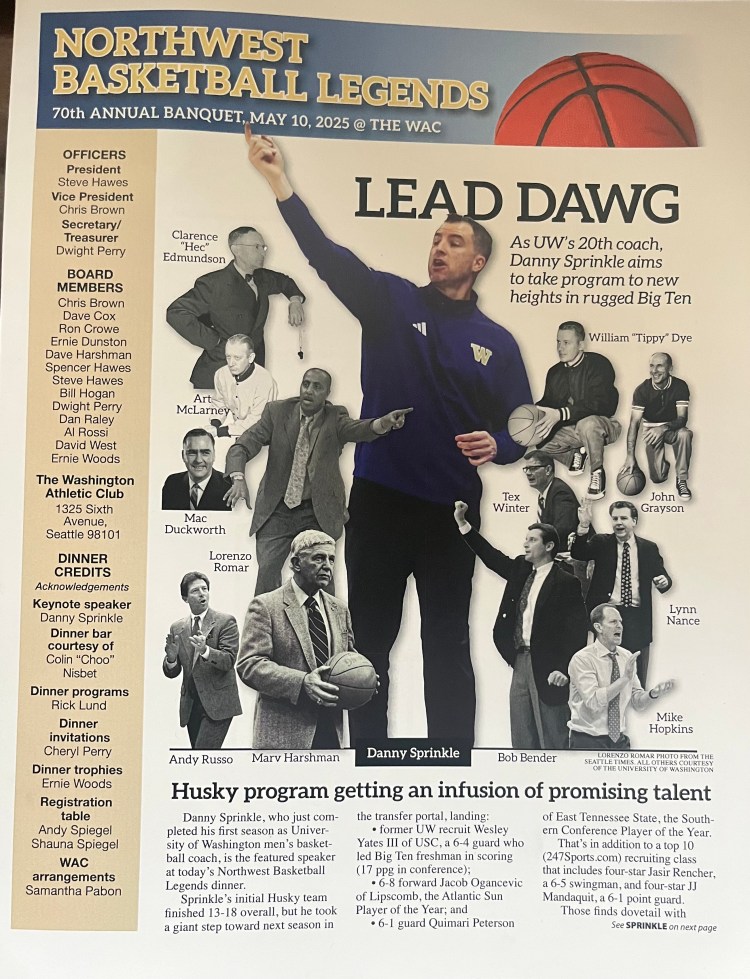
The cover of the program I did for the banquet. Big thanks to UW men’s basketball SID Mitch Praxl for gathering these photos. My earliest recollection of UW basketball is Mac Duckworth. No, I don’t go all the way back to the original Hec Ed, Clarence “Hec” Edmundson.
Sprinkle told the gathering it’s been “an honor to sit in Coach (Marv) Harshman’s old seat, in Coach (Lorenzo) Romar’s seat and represent the program.”
Taking off my journalism cap – which I can do, I’m retired – and putting on my purple cap, I believe Sprinkle will restore UW to the glory years. He appears to me to be driven, a maniacal recruiter, likable, and like Romar, bleeds purple and gold. Many of you know his dad, Bill, played football at UW in the late 60s. Danny grew up rooting for the Huskies.,
I attended many games during the Romar era, either for work or as a fan. I went to two games during Sprinkle’s first season, which is one more than I did during all of Hopkins’ seven-year run at UW. Once the players he inherited from Romar graduated, I found Hopkins’ teams unwatchable.
Though talent-deficient, especially in the backcourt, Sprinkle’s first-year team largely played hard and with a purpose.
“Even though we didn’t have the most successful year, wins and losses wise,” Sprinkle told the group, “I think people can see what we are building.”
Danny and myself after the banquet. I told him I was old enough to see his dad play football at UW. He did not doubt me.
I turned 70 in November. It was a time for celebration while surrounded by family in Arizona. It was also a time for reflection.
Let’s face it, I’m old. On the surface “my work is done” and I’m “over the hill.” My career is in the rear-view mirror. I like to tell people that when I was working “I was pulling down good money. Now that I’m retired, I’m good for nothing.”
And yet, if I’m honest with myself, that’s actually not true. There’s still time – God willing – to make the rest of my life the best of my life. A little more than seven decades on this earth, I’m still learning. I’m not a finished product. Our purpose on earth is not to take up space, make money, retire and go play golf. There’s “more work to do.” I want to be a better person. I want to make a difference. Whatever wisdom I’ve acquired, I want to pass it along to the younger generation.
I’ve lived through many seasons of life—times of joy, challenges, and growth. Now that I’ve returned to the seventies (that’s a joke!), I’ve been thinking a lot about what’s important to me.
The world values position, possession and passion, or in other words, status, salary and sex. My career and the acclaim that went with it was always important to me.
My values? I’d rank humility, integrity and generosity at the top. In this Christmas season of giving, however, I’ve been wrestling with the question: Am I generous man?
For most of my life I’ve been tight-fisted with money, reluctant to give my hard-earned salary to the poor, to the less fortunate. I trust God with my salvation, my life. Why can’t I trust him with my wallet? What I’ve realized since retiring is any money I’ve made is not mine. It’s God’s. I’m just managing it. I certainly can’t take it with me. I’ve never seen a hearse going to a funeral pulling a U-Haul trailer.
And yet, generosity isn’t just about money.
I want to be generous with my praise and affirmation. How often did I praise Vicki, our girls when they were young, the supervisors and co-workers I had, or my friends? Not often enough.
I want to be generous with my attention. When you give someone your attention, and look them in the eye, you’re giving them your life. Have I really listened to people’s concerns, and sympathized with their plight? Or has my mind wandered during those conversations to my own needs and desires?
I want to be generous with the lessons I’ve learned along the way, and share them with my grandchildren and younger men in my life.
I want to be generous with my time. That means babysitting my grandchildren when on days I’d rather be doing something else. That means caring for my 91-year-old mother when it’s hard. Because of her advanced state of dementia, she can’t say my name or hold a conversation – yet her face lights up when she sees me because she knows it’s her son.
I want to be generous with whatever God-given talents I have. That means giving my skills away for free, whether it’s for a faith-based ministry or a Pacific Northwest basketball legends organization.
I’ve come to admire David Brooks, a New York Times columnist and regular contributor to the PBS News Hour. Most Friday evenings, Vicki and I watch the moderately conservative Brooks and Washington Post associate editor Jonathan Capehart, who is more to the left, discuss the week in politics on PBS. Brooks recently wrote a column about his faith. As one who had a 45-year career in journalism, I can’t tell you how unusual that is for a member of the media to reveal his or her spiritual side. In that column, he said this about generosity:
“My life feels remusicked since my own little Exodus journey began. It turns out the experience of desire is shaped by the object of your desire. If you desire money, your desire will always seemed pinched, and if you desire fame, your desire will always be desperate. But if the object of your desire is generosity itself, then your desire for it will open up new dimensions of existence you had never perceived before, for example, the presence in our world as an energy forced called grace.”
The Apostle Paul speaks in the New Testament about faith, hope and love, with the greatest being love. Generosity is the practical expression of those three. It’s been said you can give without loving, but you can’t love without giving.
God has been extravagantly generous with me. As a follower of Jesus, may I also be generous, not only with my money, but with my time, my affirmation and praise, my talents and my attention to the people around me.
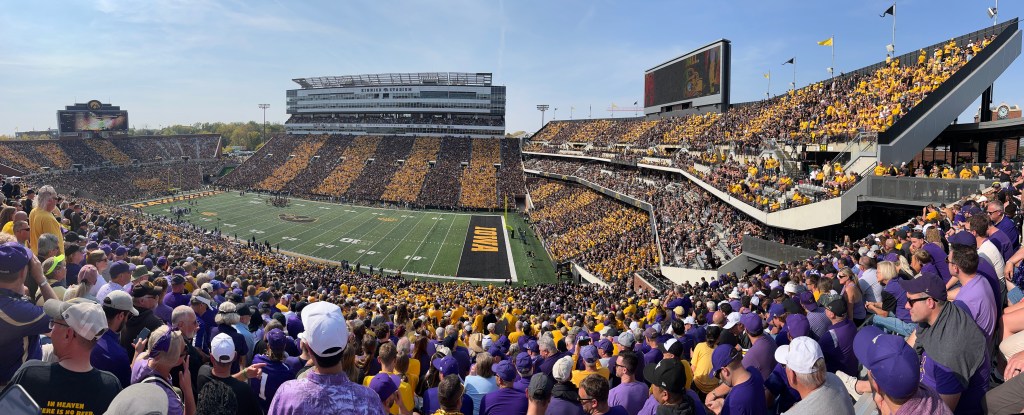
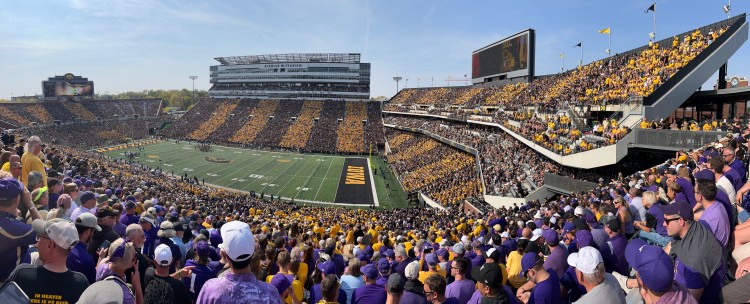
Sold-out Kinnick Stadium for the October 12 game between Iowa and Washington in Iowa City.
“Thanks for coming,” said an Iowa fan, as Vicki and I walked out of Kinnick Stadium near the end of Iowa’s 40-16 dismantling of Washington on Saturday. “I hope our fans here treated you well.”
They certainly did. Better than the visiting team was treated, for sure. We came a long way to watch the visitors from the Pacific Northwest bullied by the always-physical, corn-fed team in America’s Heartland. But while I was expecting the Huskies to be more competitive against slightly-favored Iowa, I’d have to characterize our experience on an unseasonably warm, mid-October afternoon in Iowa City to be a worthwhile experience.
The primary reason for the trip was to visit our daughter Greta and family in their new home in the Chicago suburb of Wheaton, Illinois. But I also am keenly aware that there are eight Big Ten schools within a four-hour drive of Chicago.
I’d circled the UW-Iowa game on October 12 to visit historic Kinnick Stadium before the temperatures dropped too low for comfort. We made the three-hour drive on Friday to Davenport, Iowa, putting us within an hour’s drive of Iowa City for the 11 a.m. local time kickoff the following day.
This quaint college town off Interstate-80 in eastern Iowa was a paradigm shift for me. I was expecting a non-descript town surrounded by corn fields and flat plains. To my surprise, Iowa City is nestled amidst rolling hills. The Iowa River runs through campus.
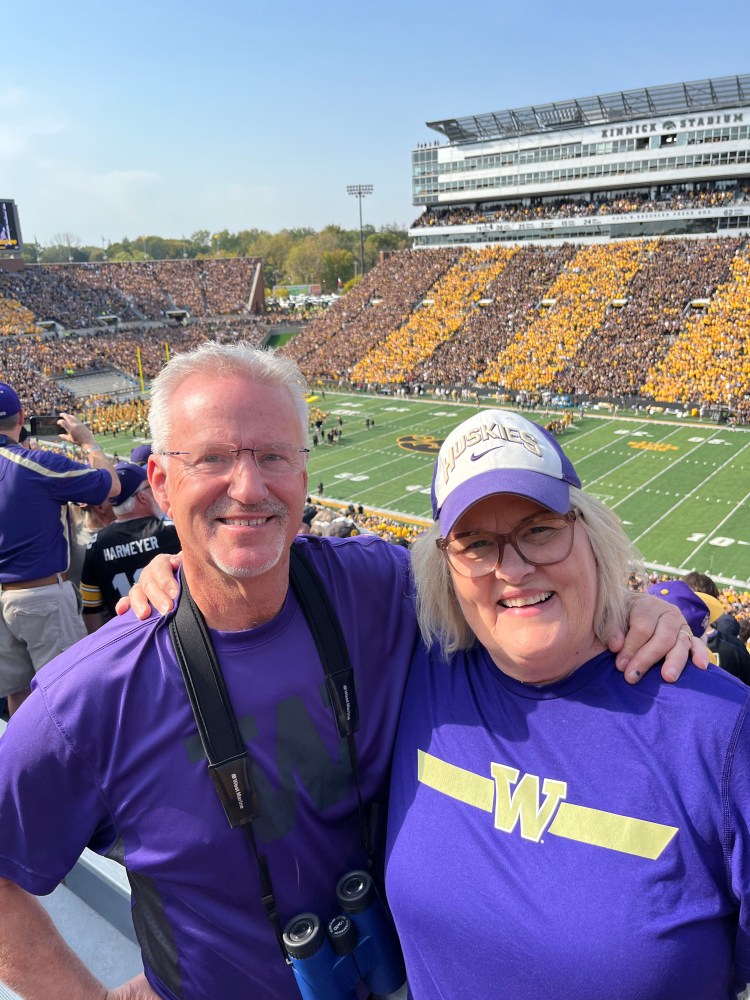
Vicki and I at the game.
The smell of barbecue and big-time college football were in the Midwest air as we walked past Hawkeye tailgaters toward the stadium, named after the school’s lone Heisman Trophy winner, Nile Kinnick. A 20-foot-tall bronze statue of Kinnick resides outside one end of that stadium. The stadium, built in 1929, is wedged between Carver-Hawkeye basketball arena, the university’s children’s hospital and other campus buildings.
The concourse at Kinnick Stadium. Banners of Iowa’s bowl-game appearances are on display, including the 1995 Sun Bowl game between the Hawkeyes and Washington.
Seating capacity is 69,250, slightly smaller than Husky Stadium. Walking down the concourses under the grandstands on each side of the field, the stadium shows its age. It’s obvious the original stadium was much smaller until the first of two major renovations, beginning in 2004, brought the capacity to its current 10th largest in the 18-team, Big Ten.
Some thoughts on the Iowa football experience:
“The Hawkeye Wave” to pediatric patients and their families in a children’s hospital takes place at the end of the first quarter of each Iowa football game.
The Hawkeye Wave: A few Iowa fans told me it’s the best tradition in college football. Not sure I can argue. It does tug on the heart strings. Started in 2017, when the clock hits zero at the end of the first quarter, fans, players and even the game officials turn their attention to the children’s hospital just behind the east grandstand. In unison, they wave to the pediatric patients and their families watching the game.
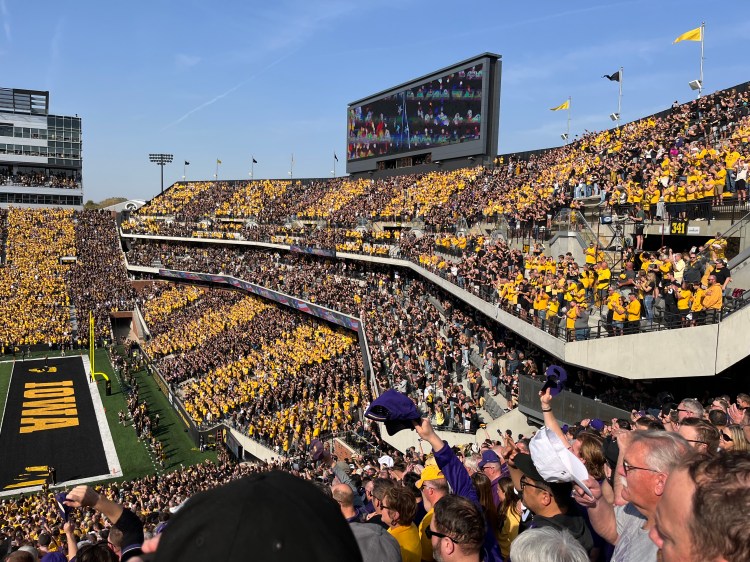
The game was a “Black and Gold Stripeout” day at Kinnick Stadium.
Striping Kinnick black and gold: The “Stripeout,” as they call it, was on display for this particular game. Fans in alternating sections wore black and gold. Not sure UW fans – perhaps more independent and less inclined to cooperate? – would comply to stripe Husky Stadium purple and gold.
Back in Black: The AC/DC song is blared in the stadium as the black-clad Hawkeyes in their Pittsburgh Steeler-look-alike jerseys make their way out of the locker room toward the tunnel. Not sure if this is a tradition, but on this day anyway, the team formed a large “V formation” and trotted out together holding hands as the band played “Fight, Fight, Fight for Iowa!”
The Iowa Hawkeyes take the field.
I-O-W-A Kinnick chant: A flag for each letter is placed in each corner of the field. In wave-like fashion, fans in each corner of the stadium stand up and yell as that flag is raised for those fans. It goes around the stadium several times. Ironically, the “W” flag happened to be in the corner of the stadium where most UW fans were, so we were happy to stand and salute the “W.”
“Iowa Nice:” This is not a tradition, just my observation of Hawkeye football fans in general. I’ve heard of “Minnesota Nice,” not necessarily the Iowa version. But I actually saw an Iowa fan wearing those words on his shirt. It’s true. From the tailgaters in pregame who offered Vicki and I food, to the Iowa fan seated next to me who handed me some me peanuts – well, at least that was after the Hawkeyes had built a comfortable lead – they couldn’t have been more friendly and welcoming.
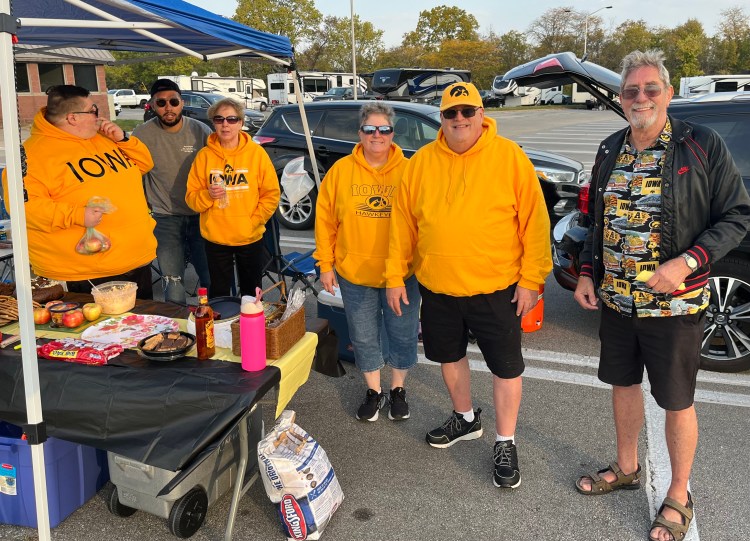
Struck up a conversation with these Iowa fans in the parking lot before the game. They offered me food.The most recent addition to Kinnick Stadium, the north end zone, completed in 2019.
Blaine and Joanna Newnham at my 60th birthday party in 2014. By this time, Blaine had been retired from full-time journalism for nearly 10 years.
Any baseball player will tell you they remember the day they were called up to the big leagues. I certainly remember a similar life-changing moment on a journalism scale, when in November 1984 I learned I was going from a small-town newspaper in Roseburg, Oregon to The Seattle Times.
I probably skipped at least one stop – like a medium-sized paper – in this move. To put this in sports perspective, this is akin to making the jump from the Class A, minor-league Everett AquaSox to the Seattle Mariners. I was lucky.
My pleasant surprise was only surpassed by the stunned looks on the faces of my colleagues at The News-Review as the announcement was made at a hastily-called staff meeting.
N-R Assistant Sports Editor Bill Reader was in that meeting that day, and he would recall years later that I was “modest and self-effacing, making a joke about delivering papers, but this made no sense to us. Who do you have to know at The Times to get a job there? Blaine Newnham, as it turned out.”
Bill would join me at The Times 15 years later, and we revisited that meeting long ago at our former newspaper at a coffee gathering of current and former Seattle Times sports folks a few days after Blaine passed away June 16 at the age of 82.
I’m not sure where the notion came from that I had some inside connection with Blaine at The Times. Truth is, I had never met Blaine until the day I interviewed in Seattle, which I recall was the day after Ronald Reagan was re-elected to a second term as president of the United States..
There was familiarity, but no prior relationship. I had only observed Blaine from a distance in the press box at an Oregon football or basketball game. He was the sports editor and columnist at the Eugene Register-Guard for 11 years prior to his move to Seattle in 1982. The familiarity apparently went both ways. I would learn later Blaine knew of my work as a sports and news page designer at the southern Oregon newspaper I worked at some 70 miles down I-5.
What I can say is the initial bond Blaine and I shared then, and continued to share in our 20 years together at The Times, was our passion for “story presentation,” a term I wouldn’t have used in the 1980s. That’s because the concept didn’t exist. The importance of story presentation (newspaper layout), graphics and color photos – long relegated to the back seat of the bus driven by emphasis on story form – was just gathering momentum when I was hired as a sports reporter in Roseburg in the fall of 1979.
I was blown away by the Register-Guard sports section, which under Blaine’s leadership in 1976 was named the nation’s best by the Associated Press Sports Editors. I doubt Blaine ever designed a page in his life. But he knew what good design looked like.
The two papers in Seattle at the time – The Times and Post-Intelligencer – were still in the dark ages of newspaper design. That meant multiple stories on the cover, small black-and-white photos and cluttered layout. The R-G, by contrast, covered Oregon football with a flare I had never seen. That meant a clean, impactful display of big, color photos and bold headlines on a cover with a minimum story count, and multiples pages inside with more large photos and game sidebars. The Sunday paper also had separate roundups of major conference football games around the country, something no paper outside of the state of Texas was doing at the time. I bet Blaine’s fingerprints were all over that.
Blaine Newnham was wise, thoughtful and a respected voice in the Pacific Northwest as a longtime sports columnist (Photo by John Lok, Seattle Times)
The newspaper in arguably the “Track Capital of the World” also covered track and field like no other. I’m talking dual meets between Oregon and Pac-10 foes that dominated the cover and jumped to inside spreads. The day before the meets, the paper would print the personal records of contestants in each event, so you could reasonably predict which team would win.
Dave Kayfes, his former Register-Guard and college buddy at Cal who still. lives in Eugene, said in The Times: “He’s still revered down here in the track world. He’ll always be a legend down here. He put together coverage that hasn’t been duplicated.”
The R-G was also one of the first papers on the west coast to provide expansive coverage of college football and basketball recruiting. Blaine was always a big-picture, visionary kind of guy.
While he was making his mark in Eugene, I was doing some innovative stuff in little ole Roseburg. I introduced charts, graphics, photo treatment and type treatment to the readers in southern Oregon. While I started there as a sportswriter, I eventually found myself gravitating to layout. It came easier to me. I started a weekly outdoor, recreation page called “Venture.” I wrote stories on a variety of topics, including hiking, fishing, hunting, motocross, cross-country skiing and Christmas-tree cutting. But what carried the page was the layout using the aforementioned, self-taught skills. The page won awards.
It was a few of those Venture page clippings that caught the eye of Blaine, Times associate editor and columnist, and then-sports editor Del Danielson. I interviewed with a number of higher-ups that day in 1984, but I sensed an instant connection with Blaine. I felt like we shared the same vision and values of what a sports section should be. Although Del would have had the final say on my hire, I suspect Blaine had some sway.
I would be the first full-time sports designer to be hired at The Times. In the few years leading up to that, sports layout duties were shared by the copy desk and sports photographer Harley Soltes, a former Eugene Register-Guard photog who had followed Blaine to Seattle.
Blaine and I would forge a strong working relationship and friendship over the next two decades until his retirement in 2005. He entertained my family at his homes on Bainbridge Island and Indianola. We entertained Blaine and Joanna at our home in Skagit County during a Tulip Festival. He was at my 60th birthday party while I was still working and he had retired.
Thirteen years older than I, he was wise, smart, thoughtful and a good mentor for me in my early years at the paper. He inspired me, just talking to him. He affirmed and encouraged me when I did good work. He got in my face when I was out of line. I took the good and the bad to heart.
Between his stints in Eugene and Seattle, I believe he deserves to be on the Mount Rushmore of sports columnists in the Pacific Northwest. He wrote with authority on college sports. I believe his strength was his coverage of games. He had a knack for breaking down a game and explaining in layman’s terms why the local team won or lost. This was especially true with his coverage of Husky football and basketball (college sports was his first love). If I wanted to know how a Husky football game went down, I read Blaine first. I suspect I wasn’t alone.
I would also say he was a great interviewer. He was a nice, decent man, and approachable. He had a disarming way of making coaches and players feel at ease.
I don’t think I’ve worked with anyone I respected more than Blaine. I would say he was an introvert at heart. He didn’t talk a lot at meetings. But when he spoke, people listened. I sat with him at many weekly sports planning meetings over the years. No one brought more ideas and energy to the table than Blaine. He had great instincts for what our readers wanted to read.
His legacy in journalism, and his impact on my life, will not be lost.
What also isn’t lost on me is he got me the heck out of Roseburg, Oregon.
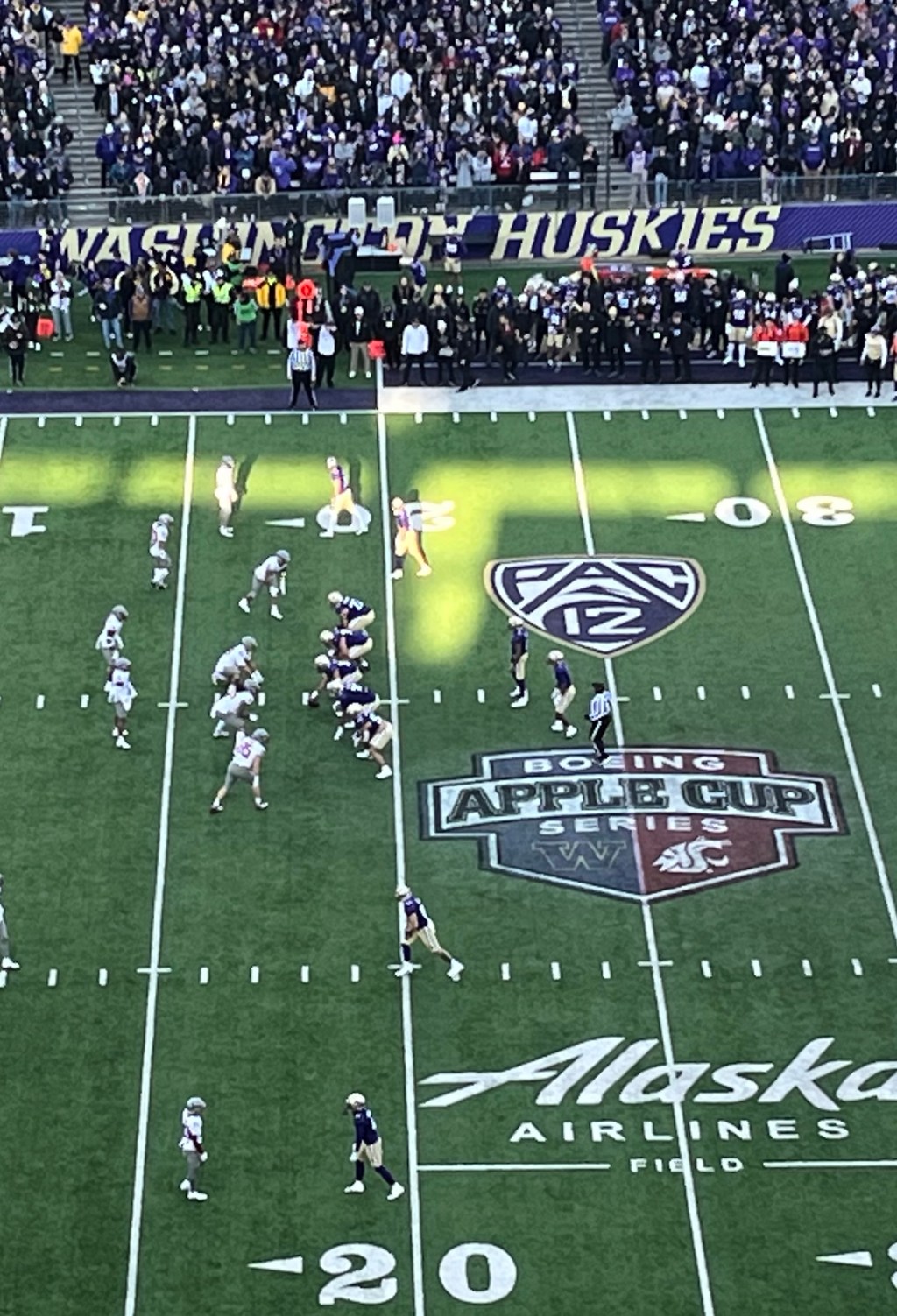
The last Pac-12 Apple Cup game between Washington and Washington State, played November 25, 2023 at Husky Stadium (Photo by Rick Lund)
The 2024 Apple Cup by all accounts appeared to be one of the more anticipated matchups of the season. The rivalry game between Washington and Washington State that at one point was in danger of being another realignment casualty, was salvaged among the scraps from the wrecking ball that destroyed the Pac-12, sending UW to the Big Ten and its in-state foe with only Oregon State as a conference partner.
But as UW football season ticket holders this past week were invited to an “exclusive pre-sale” of tickets for the Sept. 14 game at neutral-site, Luman Field, the response has been tepid at best.
Dawgman.com, a website for the most rabid of Husky fans, published results of a poll that asked its readers if they were planning to attend the Apple Cup. Only half of the responders said they were going. For a game played in Seattle, that is almost unheard of in the 115-year history of the rivalry, one of the oldest in college athletics.
The Apple Cup may be running out of juice.
Much of the sentiment seems to be that since UW and WSU are no longer in the same conference, the rivalry no longer means as much. The Apple Cup has traditionally been the last game of the regular season, where in many years there was much on the line.
But there’s also the ticket prices. I am one of those season-ticket holders, and I’m still recovering from sticker shock. The cheapest ticket is $94, which gets you in the corners of the 300 level. Most of the seats in the 69,000-seat stadium are more than $200 apiece, and top out at $424.
Because the game will not be played in Husky Stadium, it is not a part of our seven-game, season-ticket package, which is expensive enough. Vicki and I are retired. We had a discussion the other day about the Apple Cup. It was short. We’re gonna pass.
I’m also not sure Cougar fans are chomping at the Apple Cup. The neighbor at our lake cabin is a resident of Sammamish and a longtime Wazzu season-ticket holder. The trip to Luman Field is a 30-minute drive. But he told me the other day that he and his wife aren’t going.
Ticket prices and a less-important, non-conference matchup may have something to do with that. More likely, however, the core of Apple Cup apathy for WSU is hard feelings. Not sure Cougar fans will ever forgive UW for jumping ship to a more lucrative future in the Big Ten, leaving the Cougs to fend for themselves with a conference-replacement schedule of Mountain West schools for at least the next two seasons.
And in this new era of college sports, where geography and tradition no longer seem to matter, that is a darn shame.
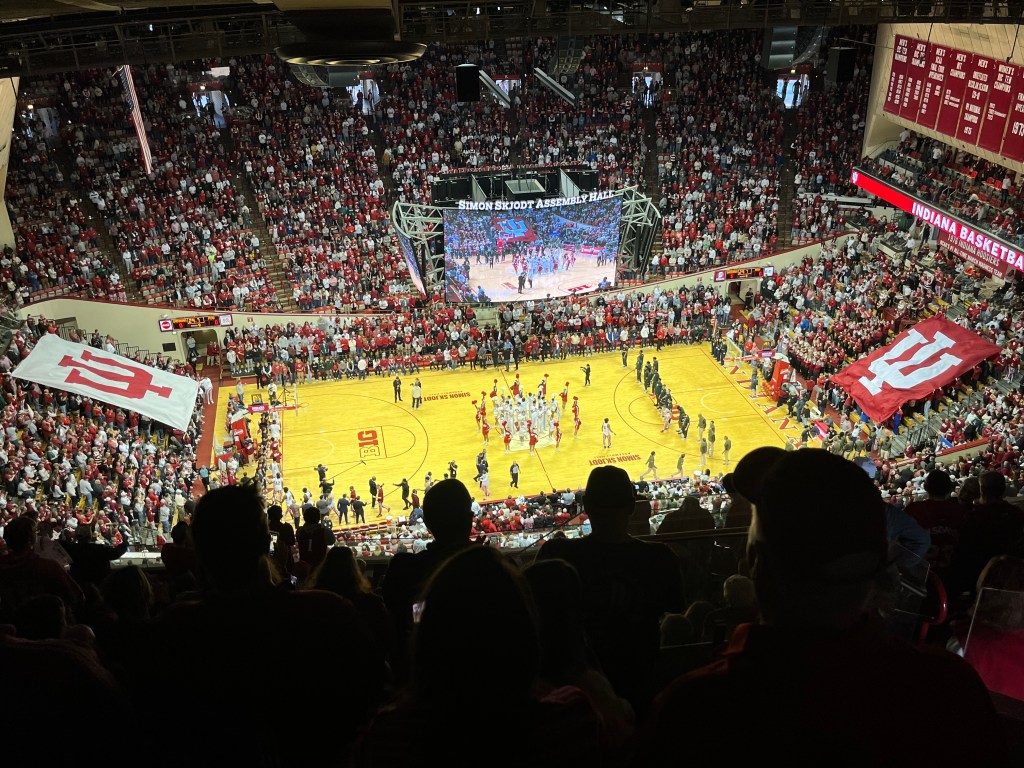
Indiana prepares to face Michigan State March 10 in Simon Skjodt Assembly Hall in Bloomington, Indiana. Built in 1971, this iconic basketball arena holds 17,222 fans. Basketball is more than a game in Indiana. It’s a way of life.
Never daunted, we cannot falter
In the battle, we’re tried and true
Indiana, our Indiana
Indiana we’re all for you! I-U!
BLOOMINGTON, Indiana – Most of the 16,000-plus fans were clearly all for Indiana on a crisp, sunny Sunday afternoon here in the heart of the Hoosier State.
That would include myself, admittedly a college sports nut, and wife Vicki, who has become a fan of college athletics largely through osmosis , i.e. married to me for nearly 47 years. I’ve had a long fascination with college football stadiums and college basketball arenas. Iconic Assembly Hall, if not the Holy Grail, was as least toward the top of my bucket list.
I had seen countless televised games from venerable Assembly Hall. To finally step inside the 53-year-old arena was a thrill (I know, I’m easily entertained). My eyes immediately went to the familiar outline of the state of Indiana at half court, and the iconic steep wall behind one basket. The majority of the 17,222 seats are along the sideline. Only a limited number of seats are behind the two baskets. Assembly Hall is known for its unique design of steep sides, which combined with capacity crowds, makes it one of the loudest venues in college basketball. A 2012 poll of four ESPN pundits ranked it third in terms of best home-court advantage in the country.
It’s more than steep sides and big crowds, however, that has made this place a living hell for opponents. More often, it’s been the home team wearing crimson and cream. Assembly Hall has been the home to three national championships, 32 straight winning teams, 14 conference champions and home winning streaks of 50 and 35 games.
Before the game, Vicki and I toured the massive lobby leading to the arena, which proudly displays the school’s championship banners, trophies and sculptures of Indiana greats. We had our picture taken in front of the sculptures of Indiana’s unbeaten, national championship team from the 1975-76 season.
Posing for a picture in front of sculptures of the starting and senior players from Indiana’s historic 1975-76 team that went 32-0 and claimed the school’s third national championship. The players are Bobby Wilkerson, Kent Benson, Scott May, Quinn Buckner, Jim Crews and Tom Abernathy. Its coach, Bob Knight, requested he not be dipicted in this sculpture. This team remains the last undefeated NCAA men’s basketball champion.
The Hoosier team we saw play Michigan State isn’t one of those great teams. These days, Indiana is middle-of-the-pack in the Big Ten, a far cry from the perennial national championship contenders under legendary Coach Bob Knight, whose 29-year reign abruptly ended with his controversial firing in 2000.
Twenty-four years later, however, the coach they called “The General” still casts a long shadow. Alhough you won’t find a statue of Knight in or outside the building (Knight’s choice), his image popped up frequently on the video screen overhead the court. Perched in our balcony seats high above the Indiana bench, I could only imagine what it was like that day in 1985 when Knight, in a fit of rage, famously threw a chair across the court after being assessed a technical. You can watch it here:
The Knight-Indiana divorce was messy. The bitter coach for many years refused to show his face at Assembly Hall, even though he had moved back to Bloomington after retiring from coaching at Texas Tech in 2008. He finally relented in 2020 to attend a game along with many of his former players, about 20 years after his ouster. The Hoosier crowd roared. Less than three years later, he passed away at the age of 83.
Despite the program’s downturn after the Knight era, you’d think this last game of the regular season had conference title implications. The near-capacity, Hoosier faithful were on their feet for much of the game, clapping in unison whenever the pep band played the school’s fight song “Indiana, Our Indiana,” during timeouts, and roaring with approval when the home team went on a scoring run.
Fans are on their feet during a break in the action, singing along to the school fight song played by the IU pep band.
The University of Washington needs to work on its game-day experience once it enters the Big Ten next fall. Basketball is more than just a game here in the Heartland. In Indiana, it’s a way of life. The Huskies will not only face good basketball teams in their new conference, but big-time venues fueled by large, passionate crowds.
On this second Sunday in March, the hot-shooting Hoosiers jumped out to a 20-5 lead, only to fall behind in the second half before rallying at the end for a nail-biting, 65-64 victory.
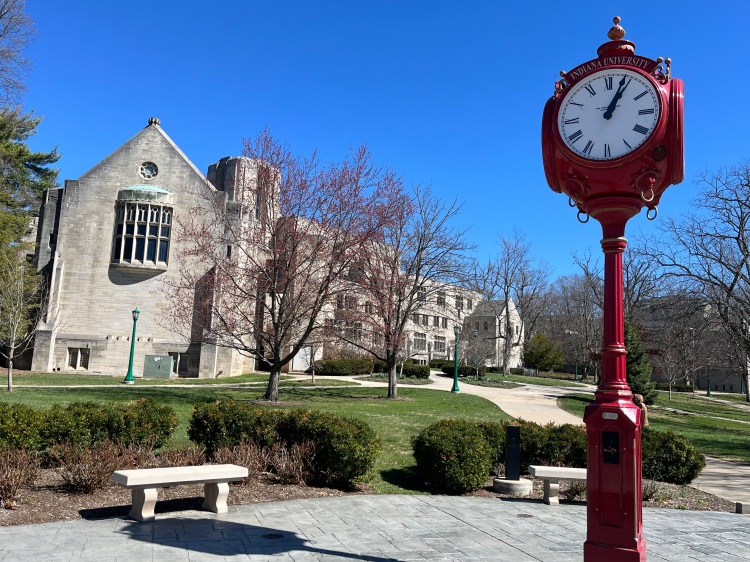
Before the game, we took a walk through the old part of IU’s beautiful campus. Most or all of the buildings are built from Indiana limestone mined from the famous quarries south of Bloomington, also known as “B-Town.” We also stopped in at the Student Union Building, which houses the bookstore and a massive selection of IU shirts, hats and other gear. The Journalism School is next door, named after its most famous alum, Pulitzer Prize-winning journalist and World War II correspondent Ernie Pyle.
All of these tour tips came from my former boss, Bob Silver, who served as sports editor at The Seattle Times early in my tenure there. Bob is an IU alum, and was a member of the school’s swim team. Bob now lives in Walla Walla, Washington, and is retired, but says he if were to ever live in the Midwest again, he’d choose Bloomington.
The old part of Indiana’s University’s campus. Most of the buildings were built from Indiana limestone.
French Lick? Hick, yes!
We flew to Indiana to visit our daughter, Greta, and family, who live in Valparaiso. In previous visits we had never ventured south of Indianapolis. But this time, after three days in Louisville, Kentucky, we took some back roads to French Lick, the home of Boston Celtic legend Larry Bird, on our way to Bloomington.
I will have to say this stop off the beaten path took some convincing. Vicki was not a fan of the extra 45 minutes it would add to the drive to B-Town and the Indiana-Michigan State basketball game later that afternoon. But this wide spot in the road in southwest Indiana was also on my bucket list.
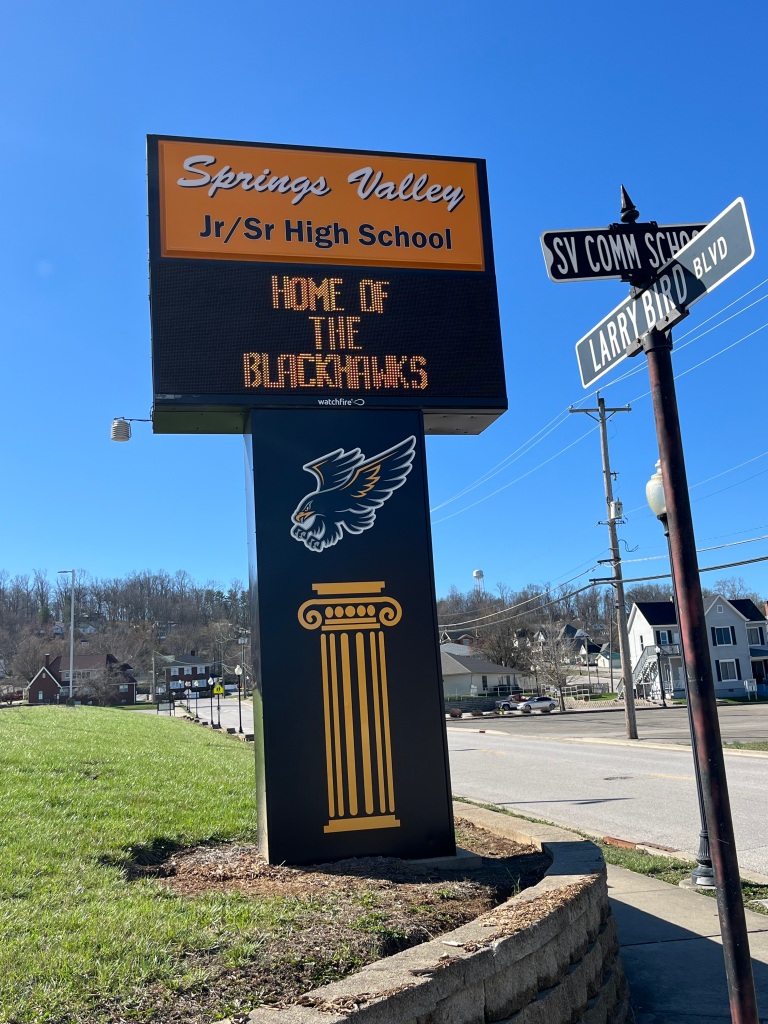
Tiny Springs Valley High School is just off State Route 145 on Larry Bird Boulevard.
We drove down Larry Bird Boulevard to his old stomping grounds, Springs Valley High School and the teen center and outdoor court where he used to play. A bust of Larry Bird resides outside the teen center.
The bust of Larry Bird, known as “The Hick from French Lick,” at the teen center next to Springs Valley High School.
Larry Bird, if you haven’t heard of him, is widely regarded as one of the greatest basketball players of all time. That he played ball at tiny Springs Valley High School in one of the poorest regions of the state is even more remarkable.
Larry’s father, Joe Bird, struggled to hold a job. A veteran of the Korean War, he suffered from what we know now as post traumatic stress disorder. He was a heavy drinker. He often threatened to kill himself. Finally, he delivered on that promise, taking his life at age 48. The financial burden in the family fell to Bird’s mother, Georgia. As a waitress at a restaurant, she barely made enough to put food on the table.
Years later, Bird would say, “growing up we didn’t have much. I just spent all my time playing basketball.”
Even so, Bird was not an instant sensation. He barely made the varsity team as a 6-foot-1 sophomore. As a junior he had grown two more inches, but was known more as a defensive specialist. But by his senior year, he put it all together. He had grown to six-foot-seven-inches. As he perfected his offensive game, he began to dominate high-school competition.
Inside the Springs Valley High gym, where Larry Bird dominated play, averaging more than 30 points and 20 rebounds per game his senior season.
Playing in front of a a packed house in his home gym for every game, Bird averaged 30.6 points and 20.5 rebounds his senior season, making the all-state team. He was offered scholarships to Kentucky and Indiana, among others, choosing to sign with Bob Knight’s Hoosiers. But whether it was living in the bigger city of Bloomington, or he got cold feet at the prospect of playing for the demanding and volatile Knight, one month into his freshman year Bird walked away. He returned to French Lick, enrolled in a local school, Northwood Institute, and went to work as a garbage man to help pay for tuition. He would eventually leave that school as well. Indiana State Coach Bill Hodges, however, didn’t give up on Bird and convinced him to join the Sycamores in Terre Haute the following season.
Bird would soon become among the leading scorers in the nation. After being drafted by the Boston Celtics after his junior season, Bird elected to return to college for the 1978-79 season. He would lead Indiana State to an undefeated regular season, and finished the season with a national championship game matchup with future NBA great Magic Johnson and Michigan State. The Spartans won in one of the most-watched title games in history, a game which elevated college basketball to another level.
Eventually, the “Hick from French Lick” would be known around the world as “Larry Legend.” Bird would play all 13 of his NBA seasons with Boston, leading them to three NBA championships. He was a 12-time NBA All-Star, won two NBA Finals MVP awards and received the NBA Most Valuable Player award three consecutive times (1984-86).
On a dark, frigid afternoon in the Pacific Northwest just two days before Christmas, the email from The Seattle Times that popped up on my phone took my breath away.
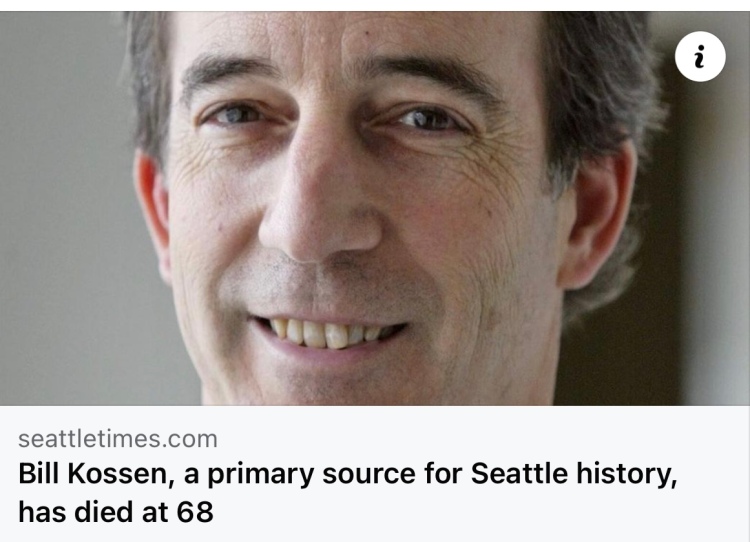
“Passing along sad news from Beth,” wrote Angela Lo, my former colleague, referencing the Metro editor working the news desk that day. ”Bill Kossen died of a heart attach today. He collapsed after a running event.”
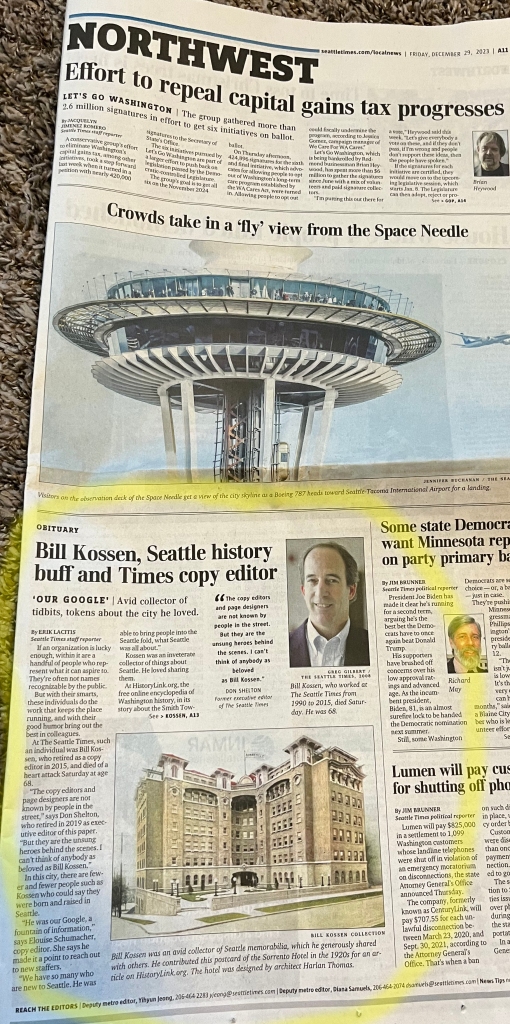
Bill’s online obituary.
I stopped in my tracks on our walk with a couple of our friends. I couldn’t believe what I was reading. Not Bill, I thought. Not one of the good guys.
Bill was only 68 when he collapsed and could not be revived during a Holiday Fun Run at Magnuson Park in Seattle. The news sent shock waves through The Times. That would include not only people who work there now, but many more people no longer with the paper.
Even though Bill retired in 2015, ending a 25-year run at The Times, Bill’s death was felt deeply by all who knew him. Bill was selfless. He retired, in part, to spare a younger journalist from being laid off at a time when the paper was cutting staff. In his retirement, he volunteered many hours at Garfield High School.
Bill was a dear friend. I got to know him in 2006, when he embraced me during my awkward landing in News and Business from Sports. Bill was bright, informed about all things Seattle, and hilariously funny. We were both members of the “Northwest Basketball Legends.” I last saw him in May at our annual luncheon.
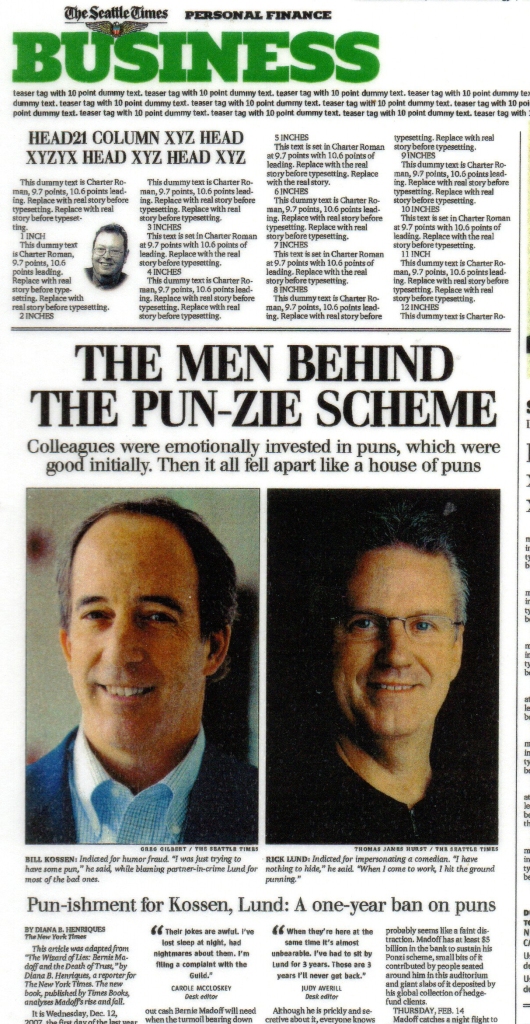
You think I’m a punster? Bill was the “Pontiff of Puns.” But Bill begged to differ.
When I retired in 2020, he wrote on my farewell page: “It was the best of puns. It was the worst of puns. It is a tale of two guys, Rick and Bill, the so-called Punzi-scheme brothers. So called because that’s what Rick called us. He was the kingpun. No one could top Rick’s wayward way with words. I tried.”
A mock Business cover front I did a few years back. Rick and Bill were known to “pun-tificate” at Business meetings at The Times.
We quickly became “Partners in Pun” as we worked together on the Business section, turning what should have been 10-minute, weekend planning meetings into 30-minute sessions as we rifted back and forth.
Bill was one of several of my Times colleagues who attended my 60th birthday party in Skagit County in 2014. In fact, he was one of the speakers, sharing the page you see above, as well as a box of “Lund’s Swedish Puncakes” he had given me as a present.
When it came time for me to speak, I mentioned that although I never made a lot of money as a journalist, as I stood surrounded by my family and friends, I considered myself that day “a rich man.” That line seemed to resonate with Bill. When I saw him in the office the next week, he said “hey, it’s filthy-rich Rick!”
While Bill was popular at The Times, and one who was great up front as a comical emcee at “Times farewell-to-employee gatherings,” he also had a serious side.
He was a big fan of Rev. Dale Turner, who served for 24 years as senior pastor of University Congregational Church in Seattle, and wrote a religion column for The Seattle Times for 21 years. He had all of Rev. Turner’s devotional booklets. We talked about our faith journeys. Bill was moved by the story I wrote for The Times in 2006 about my church-sponsored, multiracial bus tour of the Deep South called “The Sankofa Journey.” The two of us attended the funeral of our beloved colleague at The Times, Charles Brown, at Mount Zion Baptist Church in Seattle, where Charles was a member. Charles was one of the first African-American reporters at The Times.
We usually don’t give much display to staffers who pass away. I was steering the bus this day. I threw that unwritten rule out the window.
I was working under contract with The Times on a part-time basis when Bill passed away. And I was working the night his obituary was to be published. Coincidence? No. It was surreal, and with a heavy heart, that I designed the story on the local “Northwest” section cover print edition. I gave him extra treatment and space, did my best for him, and yet I didn’t, couldn’t, do him justice.
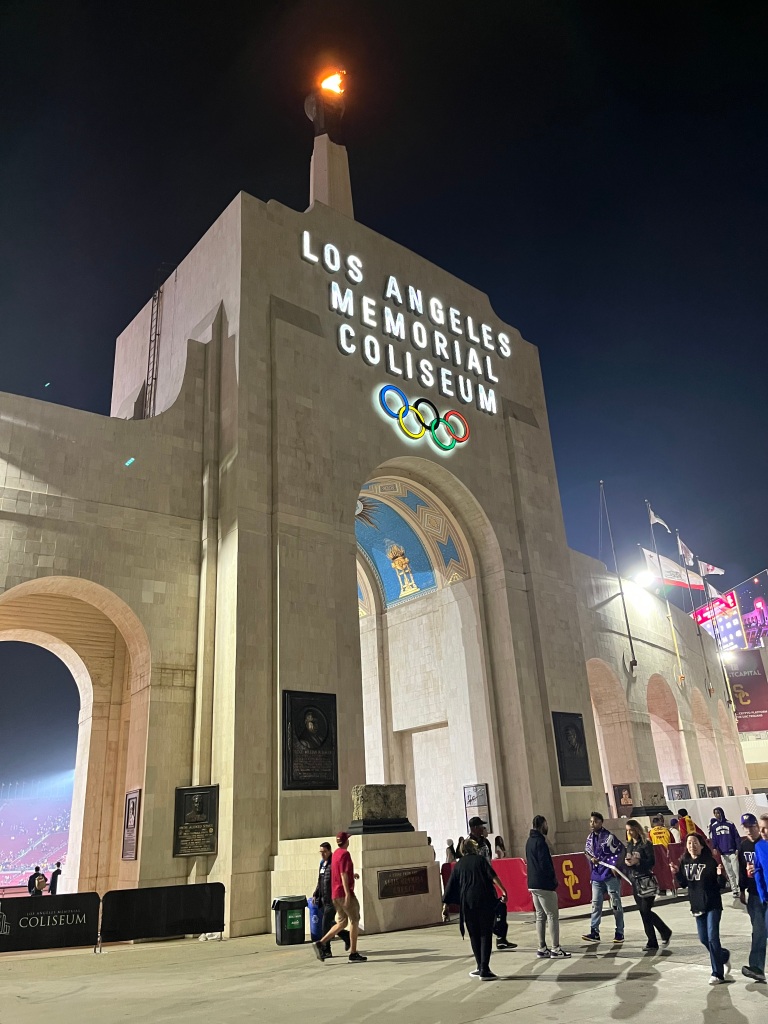
The sun sets behind historic LA Memorial Coliseum at halftime of Saturday’s game between Washington and USC.
What a day in LA LA land.
The University of Southern California has a rich football tradition. All that history, SC’s game-day traditions and the pageantry of the great game of college football were on full display on a beautiful, sunny day in Los Angeles.
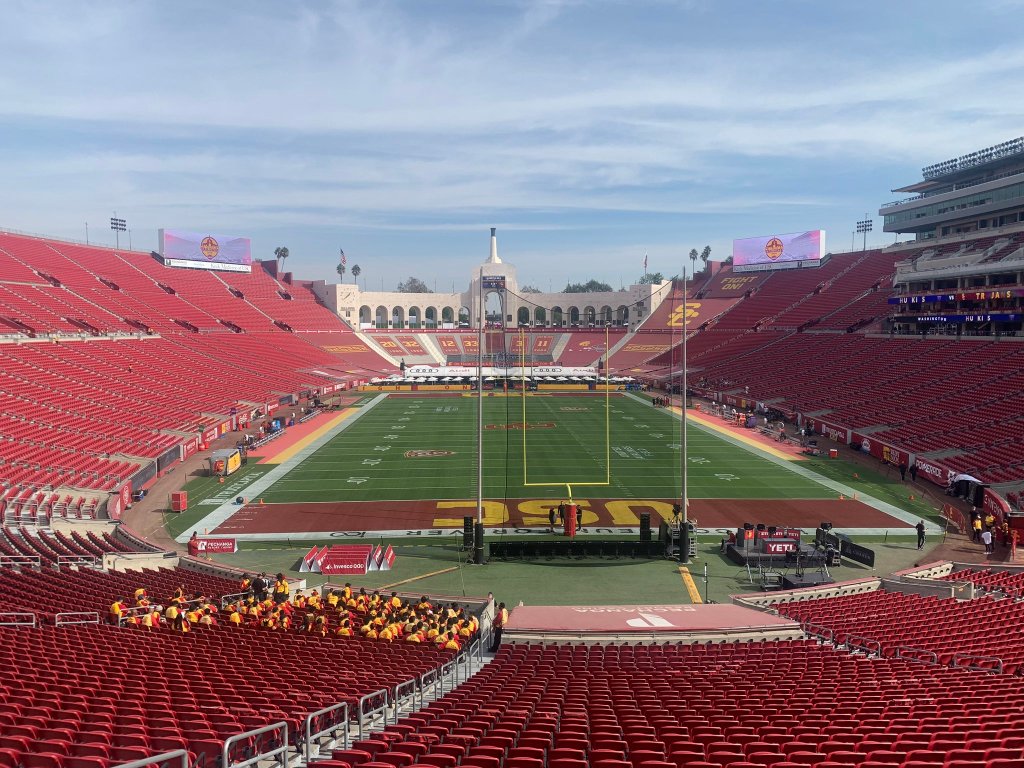
We flew into Santa Ana on Friday, and made the hour or so drive to the USC campus Saturday morning, long before the 4:30 p.m. kickoff. The LA Memorial Coliseum, the home of the Trojans since 1923, is adjacent to USC. So most people park in designated parking lots around campus and walk to the stadium, which is about a mile away. And that’s what makes this experience unique.
Tailgating tents line the wide, brick-pathed walk through the beautiful campus. It was homecoming for USC, so there was even more alums on campus than usual. They were in a party mood. We enjoyed our time just walking around campus and milling with USC fans.
Fans walking to the stadium along Trousdale Parkway.
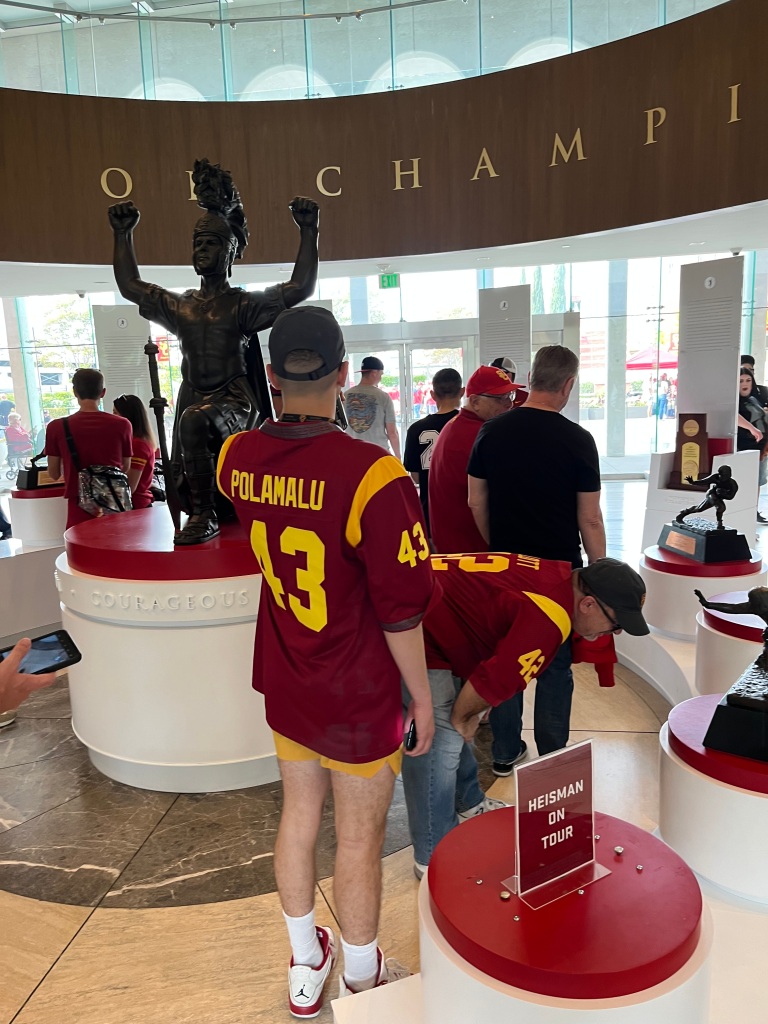
Along the way, we were fortunate to meet a USC alum and season ticket holder named Jeff. He suggested we stop by the “Tommy Trojan” statue and Heritage Hall, a monument to USC’s storied football program. Trojan fans line up to have their picture taken in front of the statue. We were in line with another couple wearing Husky gear. We took turns taking each other’s picture.
Vicki and I posing for a photo in front of the “Tommy Trojan” statue. I don’t think we’re doing the “Dubs Up” correctly.
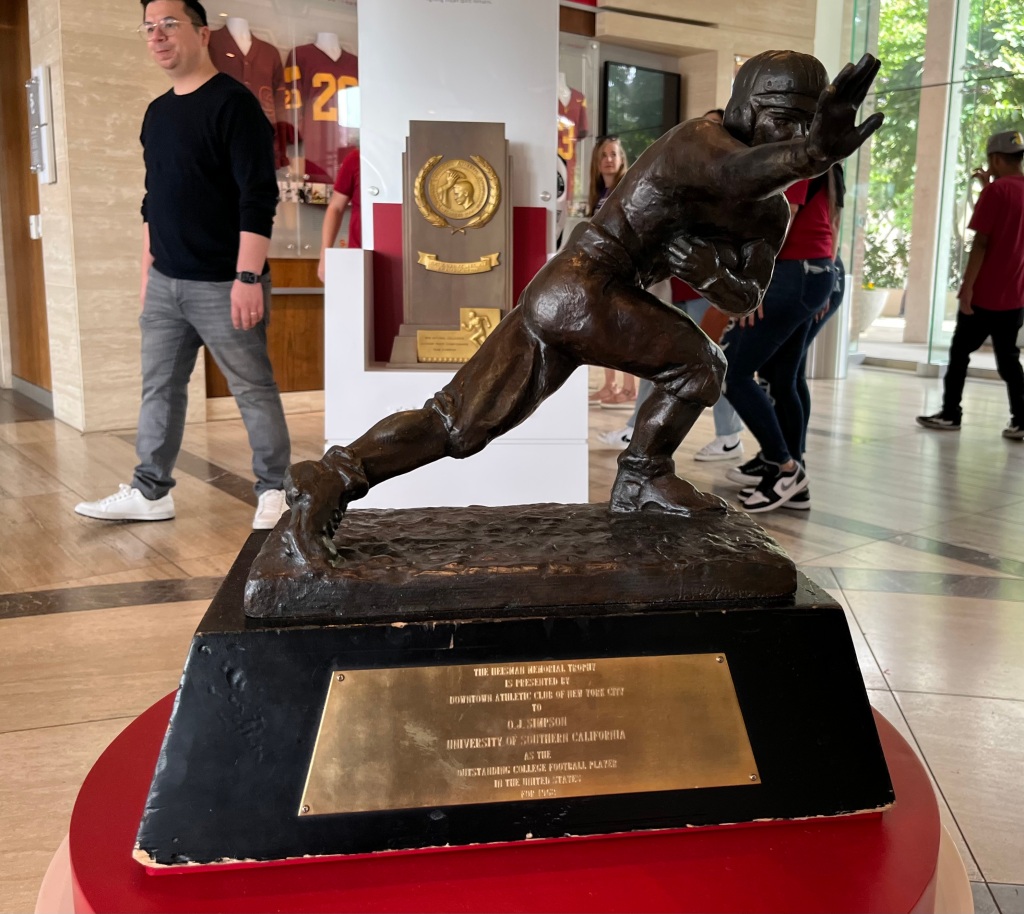
Heritage Hall houses all the national-champion trophies and jerseys from SC’s glory years. USC has won 11 national championships and produced 14 pro football hall-of-famers. Its most prized treasures, however, are the school’s eight Heisman Trophies, the most prestigious award in college football. That’s eight more than UW has. But as a SC fan pointed out to me as I snapped pictures of each one: “You could have your first this year.” That would be UW’s record-setting quarterback, Michael Penix, Jr.
Heritage Hall is open to the public. Many USC fans visit before the game to take the “Heisman Tour.” I really enjoyed walking down memory lane here, looking at memorabilia from USC greats I grew up watching as a kid.Eight Heisman Trophies are housed in Heritage Hall. This one belongs to O.J. Simpson, who played at SC in 1967 and 1968. That was long before his success was overshadowed by his trial and controversial acquittal for the murders of his former wife Nicole Brown and her friend Ron Goldman.Vicki talking smack to “Tommy Trojan” before the game. Well, that’s actually not true. She asked him if I could pose for a photo with him. He said “no.” I guess he was in a hurry to get to the stadium to watch his team lose.
Southern Cal is a private school It has a reputation for a being a little uppity. I was once told USC stands for the “University of Spoiled Children.” I also have imagined that grown-up USC fans have been spoiled over the years by their football team’s success. The USC teams I knew as a kid largely dominated the old Pac-8, and steamrolled their Pacific Northwest foes. But championships have eluded the Trojans since Pete Carroll left the school in 2009 to take the Seattle Seahawks coaching job. Stepping into the void have been Oregon and Washington, and more recently Utah, in the soon-to-be-defunct Pac-12.
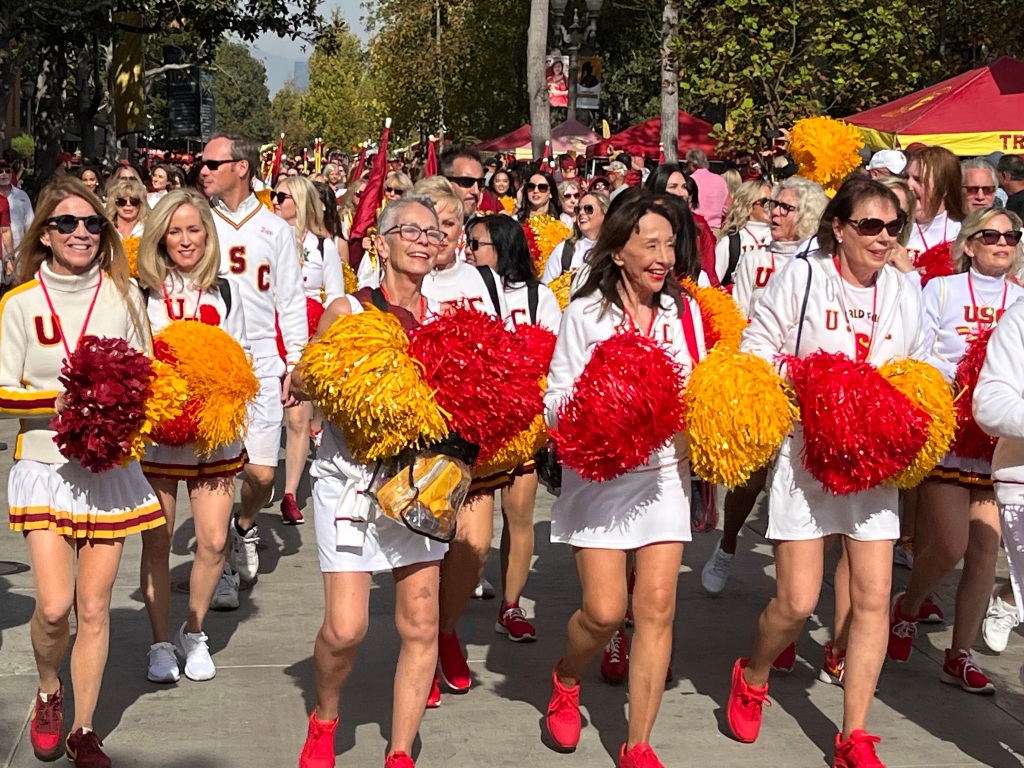
USC’s alumni cheerleaders and band on their way to the game. They would be followed by the school’s marching band an hour later.We dropped in a Husky tailgate party sponsored by the UW Alumni Association in Exposition Park, between the USC campus and the stadium.
USC fans were welcoming and hospitable. Let’s just say you wouldn’t get this kind of reception from the Yucks in Eugene. Some, however, need to get outside their SoCal bubble. One asked: “So where is UW? In Spokane?” The game-day experience here was big-time, a far cry from what we’ve experienced in recent years at Stanford, Cal, Arizona State and Arizona, where the football program is almost an afterthought.
We arrived to the stadium shortly after the gates opened at 3 p.m. (my mantra, “arrive early, stay. late”). And it was a good thing we did. We walked into a monumental, if not an unprecedented, ticket snafu.
UW fans were not happy to be sent to a “ticket resolution services” gate to have their tickets printed because their digital tickets wouldn’t scan for entry into the stadium. Perhaps Jen Cohen (former UW AD, not at USC) was behind this?
We were one of the first UW ticket holders to find out that our “digital tickets” were not scanning for entry into the stadium. We were re-routed to a “ticket resolution services” gate to try and get the problem solved. Soon after we got there, many UW ticket holders joined us. They were having the same problem. It turned out that all the digital tickets that USC sent to UW for distribution were not working with USC’s scanners. Our digital tickets, as well as thousands of others, had to be converted to printed tickets on site. I’m sure many Husky fans who arrived closer to game time missed kickoff.
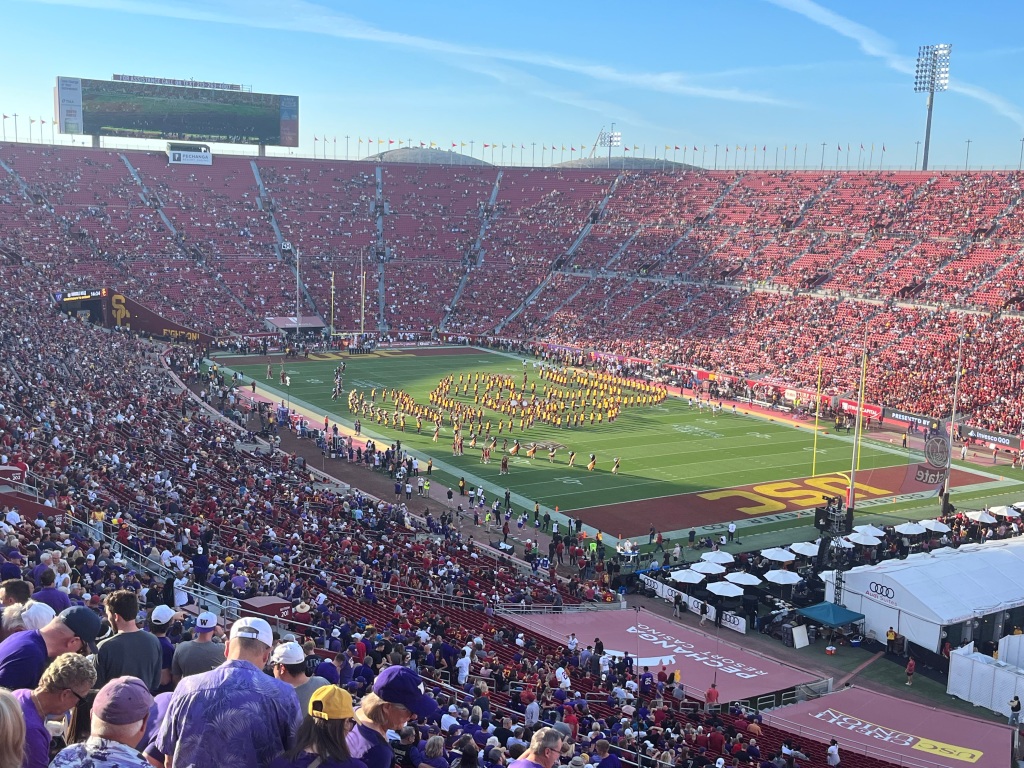
Known as “the greatest stadium in the world,” the Coliseum was completed in 1923, with a capacity of 75,000. It has been the site of two Olympic Games, two Super Bowls, one World Series, as well as many other significant events. It was for decades also the home field for the Los Angles Rams, until 2020, when ScoFi Stadium opened. USC and UCLA shared this field for many years until the early 1980s. That’s when UCLA began playing home games in the Rose Bowl in Pasadena. UW fans and Husky band for this game were seated in the corner behind the far end zone, just to the right of the “SC” logo on the canvas covering a large section of seats.
USC, like most schools, places visiting fans in the least desired section of the stadium. Our seats were in the corner of the expansive Coliseum, well beyond the end zone. Leading up to kickoff, USC’s large marching band played “Conquest” over and over again. That is an earworm I wouldn’t wish on anyone. “Tommy Trojan” rode his white horse around the field. Then it was game time.
The USC marching band forming the script “USC” in pregame.It was a balmy 76 degrees at kickoff.
Washington takes the field to begin the game.
Both teams’ high-powered offenses didn’t disappoint. The UW defense made just enough plays in the fourth quarter to get the 52-42 win. It was easily the most points UW had ever put up on USC, and just the 13th Washington win in 44 games against the Trojans in the Coliseum. Penix threw for 256 yards and two touchdowns. But the star of the game for UW was running back Dillon Johnson, who rushed for 256 yards, fifth highest in school history.
The outcome, obviously, could have gone the other way. A UW loss, for me anyway, wouldn’t have spoiled the day.
A big-time college football game in a big-time setting was an experience I’ll never forget.
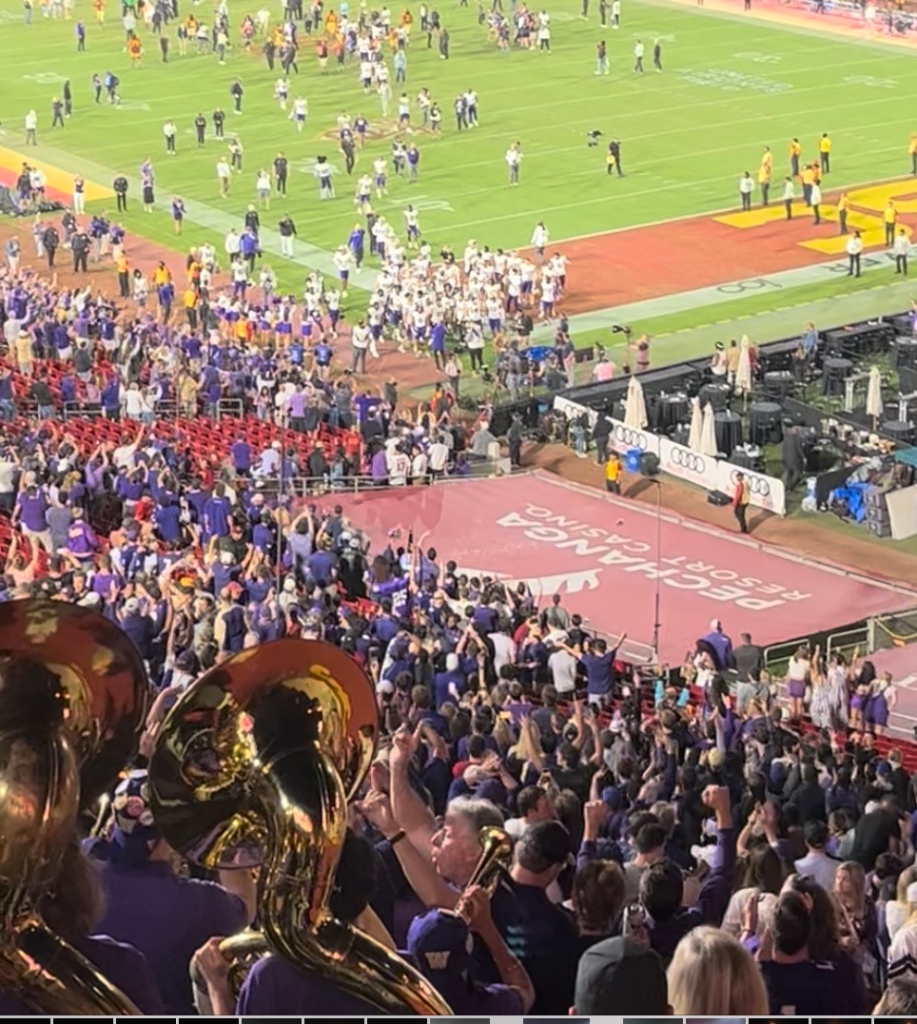
The stadium lights were dimmed at the end of the third quarter, and people turned on their smartphone flashlights. This is also done for night games at Husky Stadium.After the game, the players came over to the area of the stadium where UW fans were seated to sing together “Bow Down to Washington.” This is a tradition after every UW victory.Good night, Memorial Coliseum.
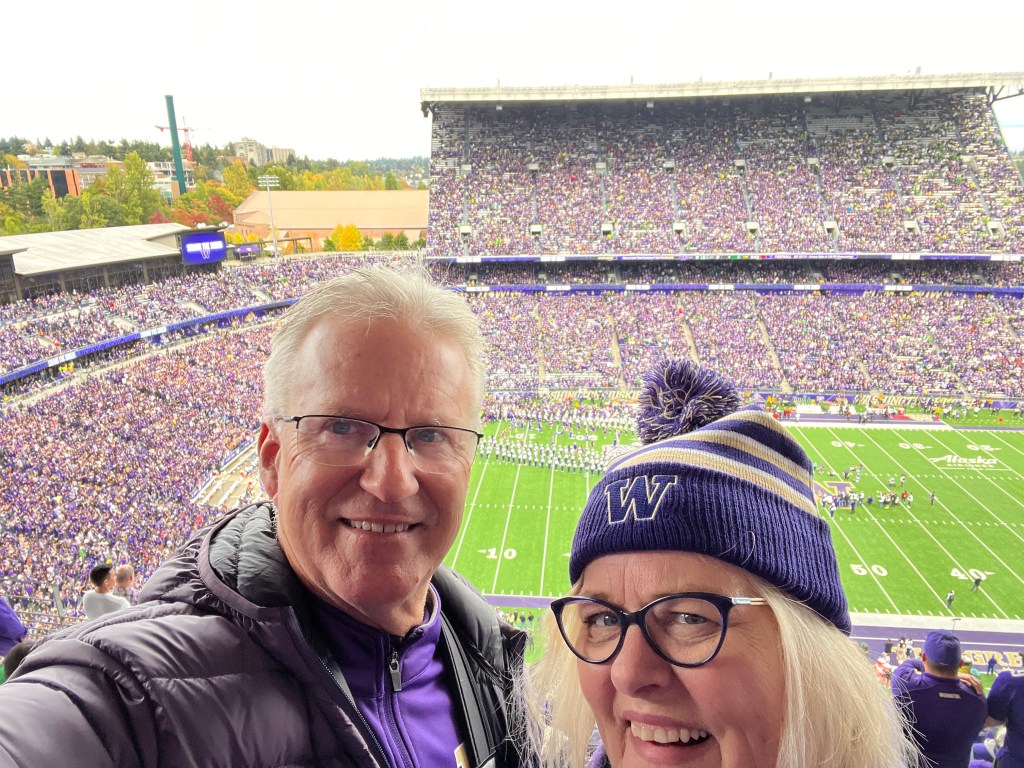
Vicki and I at the UW-Oregon game earlier this season in Husky Stadium. That was a good day, by the way.
Vicki teaches a Bible study on Friday mornings. Last week, she told her group she couldn’t be there tomorrow because she’ d be in California.
“Oh, you’re going to see your sister?” one of the women asks Vicki, who grew up in California and two of her sisters still live there.
“No, we’re going to LA to see the Washington-USC football game,” Vicki replied.
She’s a real Dawg. I mean that in a complimentary way. Vicki, like me, has become quite a fan of college football.
Looks of disbelief ensued.
Some people are surprised Vicki goes to more sporting events in a year than many women attend in a lifetime. It’s really not her fault. That’s what she signed up for when she married me.
We hadn’t been married two years when I was hired as a public relations intern for the Seattle Mariners. I had to be in the press box for all 82 games of that 1979 season. She watched several games in box seats in the Kingdome that year, but regretably spent many more evenings alone in our Capitol Hill apartment.
When we moved to Roseburg, Oregon later that year for my first full-time sportswriter job, she accompanied me to countless high-school games. She also occasionally tagged along when I made the hour-drive north to Eugene to cover University of Oregon basketball games. She sat under the basket and took pictures. There, she experienced first-hand the crazy Oregon fans that former UCLA Coach Gene Bartow once called “deranged idiots.” Some of her photos were published with my stories the next day in The News-Review.
Vicki did not grow up in a sports-minded family. Yet, she realized early in our marriage that if she wanted to spend more time with me, she had to embrace my passion for sports..
We’ve had season tickets for UW football games for 11 years. We usually go to one road game every year. We’ve been to nearly every football stadium in the soon-to-be-gone Pac-12. Last November, while spending the month in Tucson, we took in the Territorial Cup between Arizona and Arizona State. The storied Memorial Coliseum –which has hosted two Super Bowls, two Summer Olympic Games, and has been the home to the Trojans since 1923 – has long been on my bucket list.
Full disclosure here: I’m a college sports guy. My favorite day is any Saturday during the college football season. Thirty years in sports journalism soured me a bit on pro sports. I love the college, game-day atmosphere: The buildup to the game, the marching bands, the sense of excitement in the air, the rowdy student sections.
This photo I’m guessing was taken in 1968, just after the installation of artificial turf. This is the Husky Stadium I knew as a kid. The bleachers behind the east end zone are not shown here, so I’m thinking they were added shortly after. The upper south deck was built in the 1950s. The north upper deck wouldn’t be built until 1987. Everything you see here was demolished — except for the newer north upper deck — when Husky Stadium was remodeled and completed for the 2013 season.
It’s in my DNA. My dad took my brother and I to about one Husky game a year when we were young. It was a different era. Older men wearing fedora hats. The pungent scent of cigar smoke in the air. We couldn’t afford to sit in the covered upper deck. That’s where my Uncle Paul had season tickets. If you sat with him, you were obligated to sing “Bow Down to Washington” at halftime. He couldn’t carry a tune in a bucket. But he didn’t care.
My dad, brother and I sat in the cheap seats, the bleachers behind the east end zone. I still have memories of watching the backs of the USC players in front of us, and O.J. Simpson taking the pitch in the backfield, waiting patiently behind his wall of blockers, then darting to daylight for a long touchdown run. Behind the same goal post we saw the debut of legendary Husky quarterback Sonny Sixkiller, who would fire tight spirals all over the field in the Huskies’ stunning upset of heavily-favored Michigan State.
I bought these tickets last June, figuring it would be the last time UW would play in the Memorial Coliseum, hence my last chance to see a game there. Two months later, UW joined the Big Ten and will now play there every other year.
Although I’m a lifelong Husky fan, I would describe myself as a college football – and for that matter college basketball as well – purist. I follow college sports on a national scale. I’m interested in every region, every conference (even if the schools keep changing) and every team at every level. I would pay to watch a Big Sky game between Idaho and Montana. If there was a game show on the naming of college sports mascots, I swear, I would win it, hands down.
I listen to several national college football podcasts during the season. One of them is aptly named “Until Saturday.” As a follower of Jesus, I honor Sundays. “Until Saturday,” for the college football fan, means that during the week we live in this land of waiting .. of expectation … of anticipation .. for the full day of games.
I’ve never seen a college football game in Los Angeles … that is, “Until Saturday.”
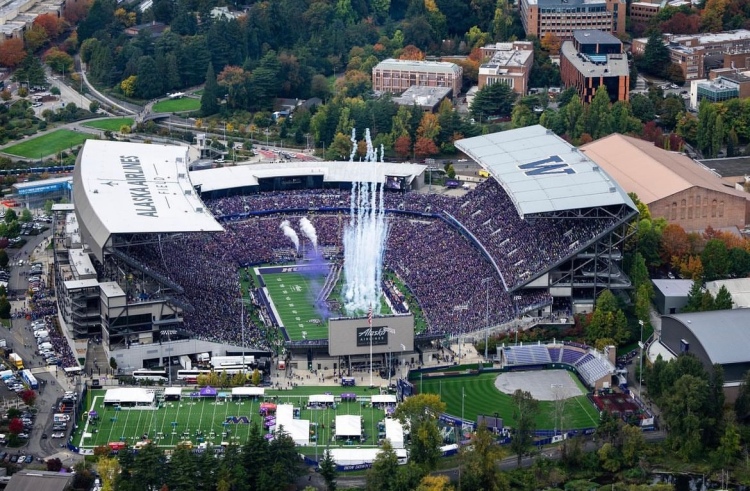
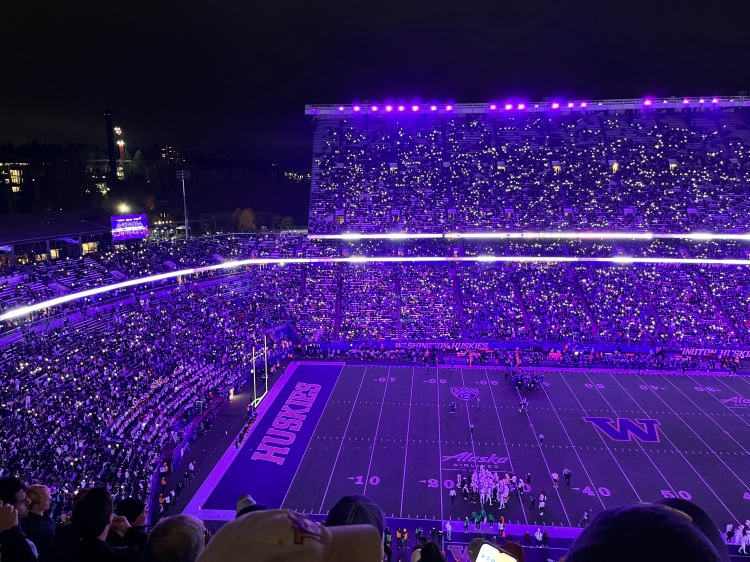
Husky Stadium on the shores of Lake Washinton has been called “The Greatest Setting in College Football.”Fireworks go off and purple smoke fills the air when the Huskies take the field.Night games aren’t popular with many fans, especially those of us who come from long distance. But they have a special aura to them, including when the stadium lights are dimmed during a timeout and everyone turns on their smartphone flashlights.
Peter snaps a photo near the summit of Easy Pass (Photo by Bob Swenson)
EASY PASS – Before we get started, let’s just make one thing clear: There’s nothing “easy” about the hike to Easy Pass.
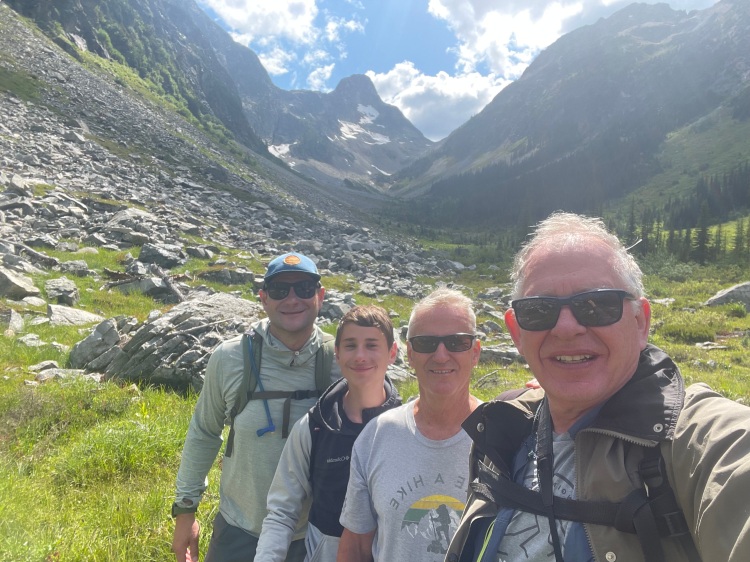
From left, the Fab Four: Peter Richardson, Isaac Richardson, Rick Lund and Bob Swenson.
Sure, the clearly-marked sign off Highway 20 is easy to spot. The trailhead, unlike many starting points for hikes, is easily accessible, just a short, paved road from the highway.
After that? Easy doesn’t do it.
It’s a 3,000-foot climb to the pass. That’s a tough slog for even the hardiest of day hikers. Our group of four – which included my son-in-law Peter, his 11-year-old son Isaac and longtime friend and hiking fanatic Bob “Next Ridge” Swenson – would carry weighty overnight packs up to the summit and down 1,275 feet to our camp at Fisher Creek. With the return trip, that’s a minimum elevation gain of nearly 4,300 feet.
Why Easy Pass? Believe it or not, our original plan was even a more difficult hike to Lake Byrne. That trail along picturesque Lost Creek Ridge in the shadow of Glacier Peak has long been on my bucket list. But Bob, after looking at the topographical map, convinced me to pull the plug on that one.
Even so, this hike would be our group’s most challenging. To paraphrase the title of a popular Eagles song, I had a peaceful, yet uneasy feeling.
Who named this pass? And what were they thinking?
After crossing Easy Pass Creek, the trail to Easy Pass breaks out from the forest and follows an exposed, talus slope up to the 6,525-foot summit. (Photo by Rick Lund)Wildflowers along the trail to Easy Pass. (Photo by Bob Swenson)
Apparently, someone was trying to be funny. According to historical accounts, the trail was a prospecting route to mines. It was a sarcastic name because there was no “easy route” across the ridge.
No one in our group was laughing when Mother Nature threw us a curve ball on this 27th day nof July on the steepest part of the trail. Just as we were making our way up the final set of exposed switchbacks to the summit, an unexpected thunderstorm rolled through. What started as a drizzle, eventually turned into a driving hailstorm. Even though no rain had been in the forecast, we were caught off-guard. We had not packed rain ponchos.
As we hauled our wet gear to the top and found what little shelter there was under scruffy, wind-whipped trees, Peter, a strong hiker and fearless in many ways, had a look of horror on his face.
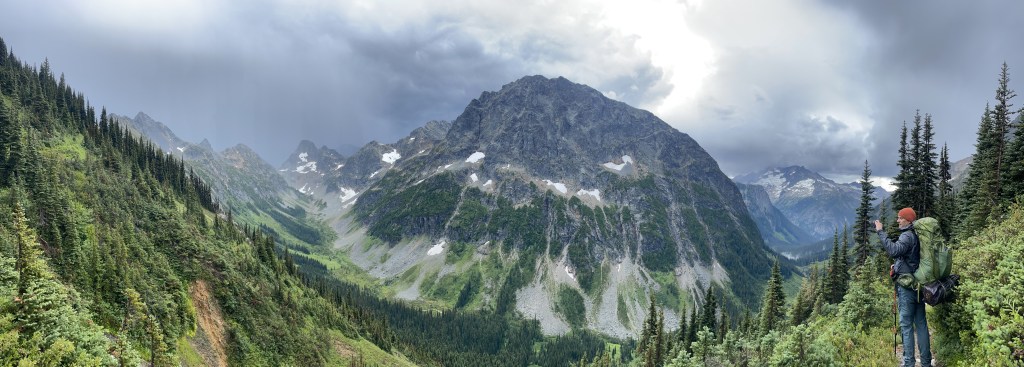
Looking at Fisher Peak and the Fisher Creek basin from the summit of Easy Pass shortly after a thunderstorm passed through. (Photo by Bob Swenson)
“I was not prepared for this,” he said, as he nervously rubbed Isaac’s hands, which had gone numb from the sudden drop in temperature.
Even with dark clouds overhead, however, the views were amazing. Standing at the 6,525-foot summit, you’re reminded why you hike in the first place. Your feet have taken you where few people go.
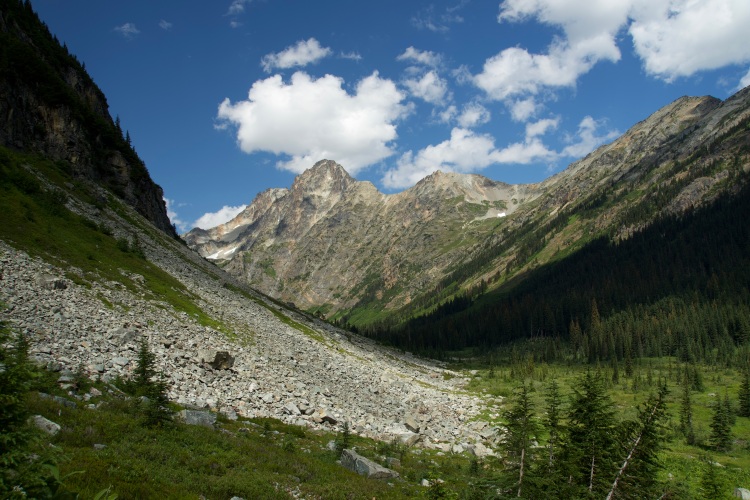
The view to the west, into the heart of North Cascades National Park, is absolutely stunning. With glaciated Mount Logan in the distance, the lush-green valley below runs as far as the eye can see. Looking south, a stream-carved basin leads to snow-topped Fisher Peak. To the east are Golden Horn and Mount Henry, two peaks that straddle the Pacific Crest National Scenic Trail.
Most hikers at this point take their time savoring the views, have lunch, and then make their way back to the trailhead for what amounts to a seven-mile, round trip. The outliers here, we continued down the other side – frozen fingers, soaked backpacks and all – to Fisher Creek Camp, where we had reserved one of three campsites for two nights.
Peter and Isaac forge Fisher Creek to explore the meadow. (Photo by Rick Lund)
A day of exploring
We woke up to sun on Day 2. Hanging our wet clothes out to dry, we donned light day packs to explore nearby Fisher Creek basin.
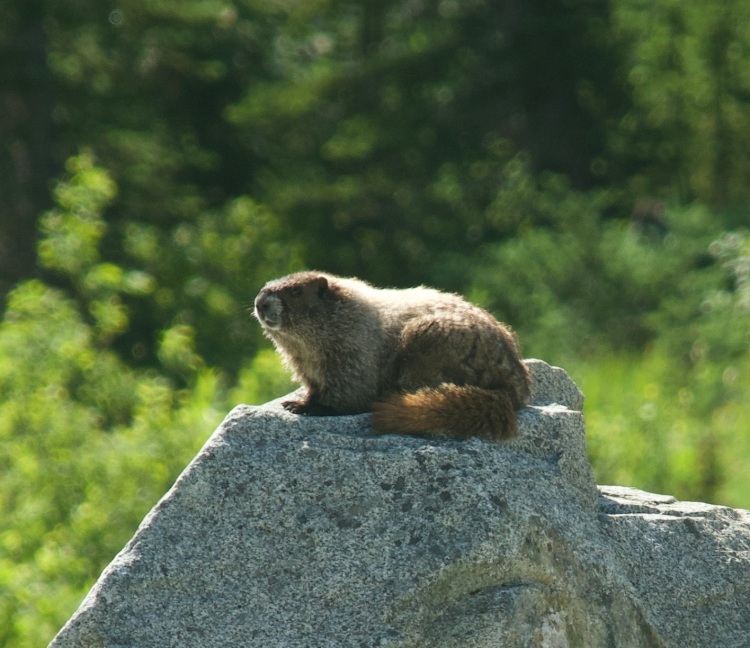
A marmot basks in the sun on a boulder in the Fisher Creek basin. (Photo by Bob Swenson)
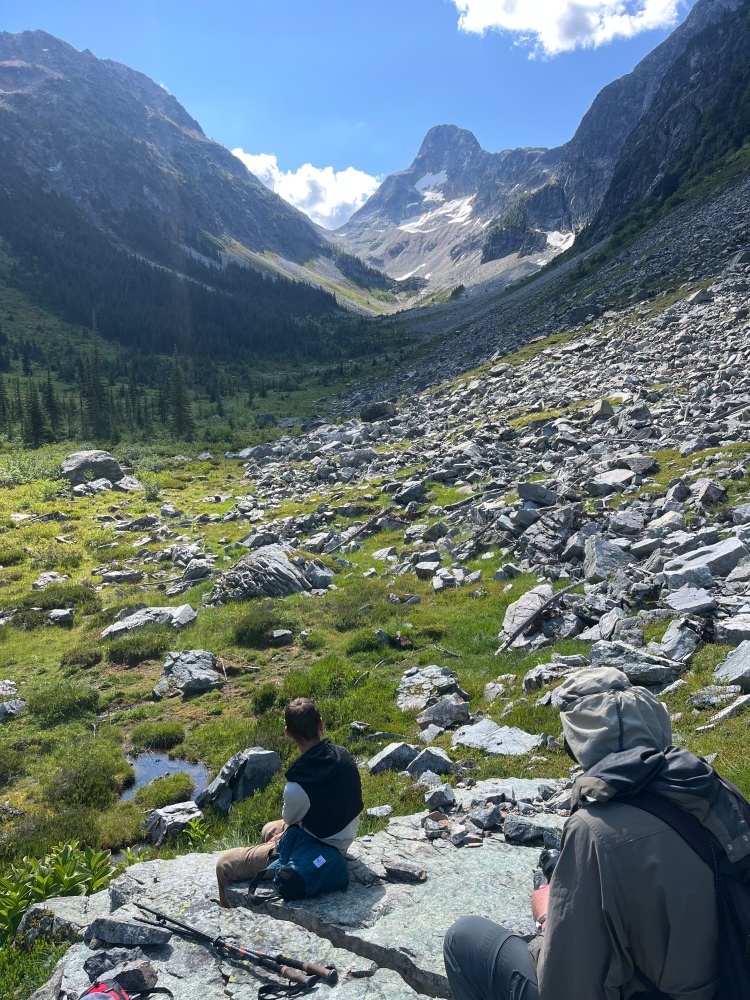
The more lightly-traveled trail from the junction just east of camp hugs the forest for a few hundred yards, before breaking out into a vast Alpine meadow that is nothing short of spectacular. We took pictures of wildflowers, took selfies and lounged on giant-sized boulders and ate our lunch as marmots scurried nearby.
Towering high above the meadow that ends in a mountain version of a cul-de-sac is 8,060-foot Fisher Peak. Looking back to where we came from, the sun glistened off 8,795-foot Mesahchie Peak. We could also see the switchbacks of the trail that would take us up and over Easy Pass the next morning.
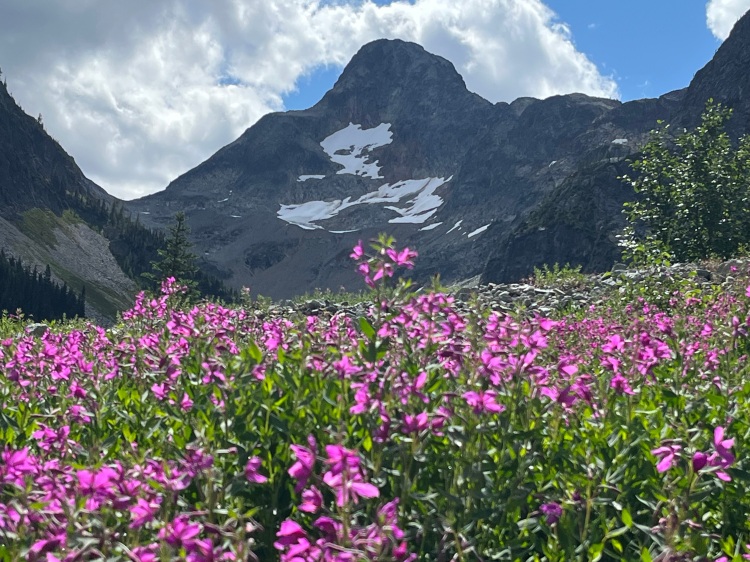
Wildflowers in the Fisher Creek basin frame 8,060-foot Fisher Peak in the background. (Photo by Rick Lund)Looking down the Fisher Creek basin to 8,795-foot Mesahchie Peak. (Photo by Bob Swenson)Fisher Creek meanders through the beautiful Alpine meadow that is Fisher Creek basin. (Photo by Bob Swenson)Having a lunch on a table-topped boulder in Fisher Creek basin, with 8,060-foot Fisher Peak in the background. (Photo by Rick Lund)
We also met backpackers on this side of Easy Pass who, like us, were here for extended stays. A few were headed farther up the Fisher Creek basin to Silent Lakes. Others were even more ambitious. We met backpackers who had dropped cars off on two locations, so as to make the trip one-way. A wilderness ranger checking overnight permits had started at Colonial Creek and was headed to the Easy Pass trailhead, for a total trip of 24 miles. Another group had started at the Panther Creek trailhead. Their final destination at the trailhead off Highway 20 completed a 33-mile journey.
One step at a time
I had struggled two days earlier ascending Easy Pass, having to stop frequently to catch my breath. The return trip over the pass was also challenging. About halfway up, Bob gave made some good advice.
“Try setting step goals,” he said. “For example, tell yourself you’re going to take 25 steps before resting. That way, you’re counting steps and not thinking about how far you have to go.”
On Day 3 we make our way back up to Easy Pass. (Photo by Bob Swenson)
I started out at 25 steps, then 35, before working my way to 50. Eventually, I was counting 100 steps before resting. Before I knew it, I was making great progress. Like Bob said, it took my focus off of looking at the summit and realizing how far I had to go.
Isn’t that how life is? The older I get, the more I understand that growth is incremental. The key is discipline. This can be true of an exercise regiment or a diet plan. You cannot meet your weight goal or get fit overnight. As a Christian, I have found that daily time spent in God’s Word and prayer has a stacking-bricks effect. It’s the accumulation of days that ultimately stimulates lasting growth and liberates potential. There are no short cuts.
Rick makes his way down the Easy Pass trail on talus slopes on the way back to the trailhead. (Photo by Bob Swenson)
There were certainly no quick fixes or short cuts back to the trailhead. It took us about seven hours from the Fisher Creek Camp to make our way back. In the parking lot, I had a conversation with a couple younger day hikers from Oregon we had met earlier in the day at the Easy Pass summit.
As I removed my overnight pack, one of the women exclaimed, “That was a tough day hike, one of the tougher ones I’ve done. I can’t imagine hauling a backpack up there.”
Easy? No. Worth it? Definitely.
A Buck we named “Velvet” was a frequent visitor at the Fisher Creek Camp. Here, Isaac offers him some “leafy greens.” (Photo by Rick Lund)