Tag: cancer

  • A rare, lazy (like me?) form of kidney cancer

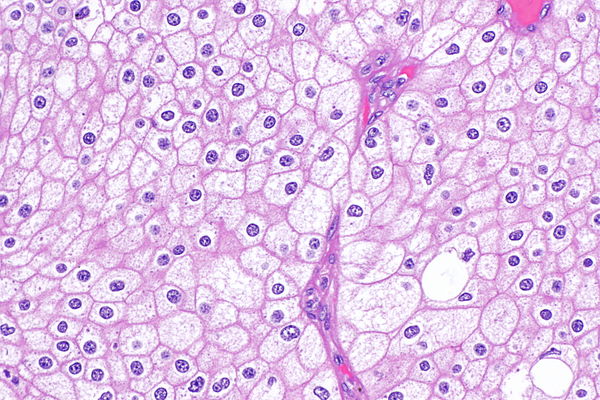
    What Chromofobe Renal Cell Carcinoma looks like under the microscope. The subtype of renal cancer only appears in 3-5% of kidney cancer patients.

    On the morning of May 20, I was wheeled into one of the 24 operating rooms at the University of Washington Hospital.

    I was greeted at the operating table by a host of doctors, anesthesiologists and nurses. Knowing they were working for the “UW brand,” I borrowed a line from “Bow Down to Washington,” the school’s fight song, to give them a little pre-surgery pep talk. They smiled, acknowledging my nervous attempt at last-minute, gallows humor.

    The words that followed – and frankly the last ones I remember before waking up seven hours later in the recovery room – were grounded in hope and the significance of the task at hand.

    “Today’s going to be a good day, Rick,” said my renowned, gifted surgeon, Dr. Sarah Psutka, before I nodded off into la-la land.

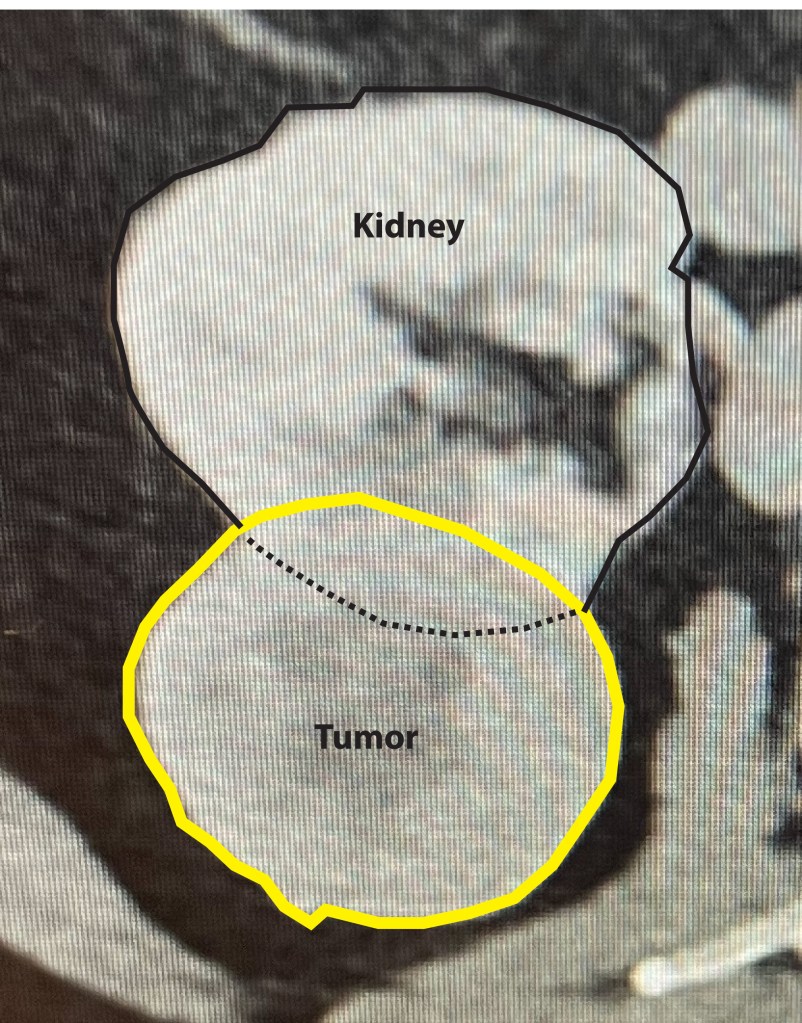
    It would be a good day, despite all the pain I had in my abdomen that evening and the days to follow. Dr. Psutka, and her assistant, Dr. Carson, told me they had accomplished what they set out to do. Dr. Psutka had successfully removed the cancerous tumor on my right kidney – which apparently was no small feat – while preserving 85 percent of the otherwise-healthy kidney. Because the mostly-exterior, 6-centimeter tumor was behind the kidney, Dr. Psutka said she had to “flip the kidney over” with her hands to cut the tumor.

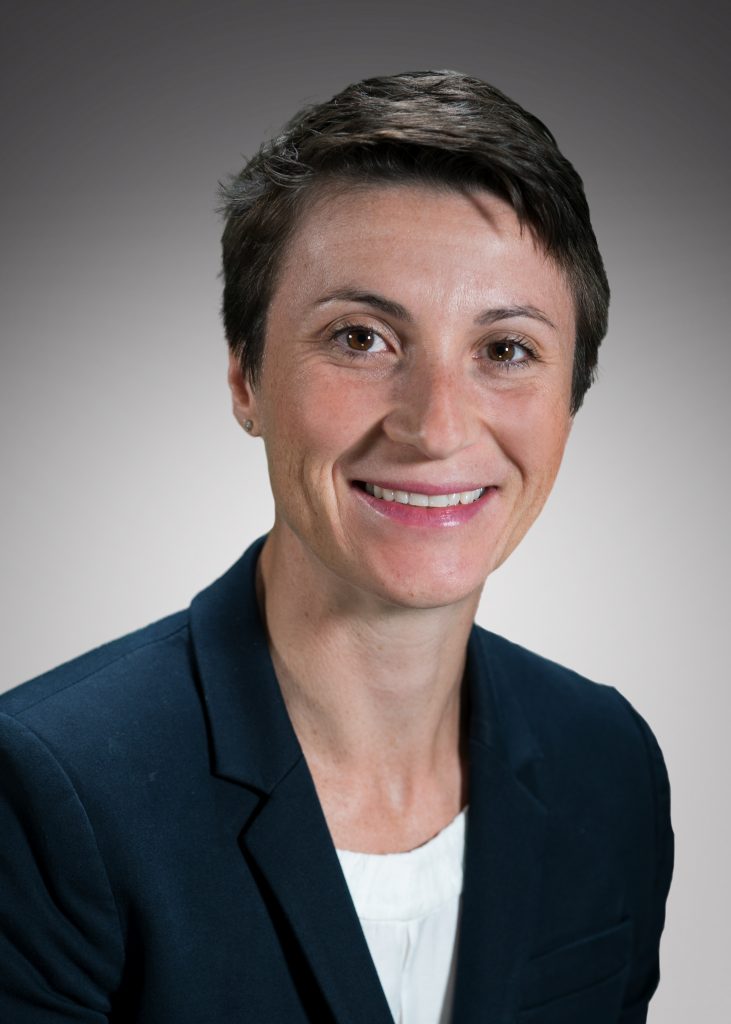
    Dr. Sarah Psutka is one of the leading kidney cancer surgeons in the U.S. She’s in demand, so it took awhile to get an opening for surgery. She was worth the wait.Fortunately, “Chromofobe” cancer was willing to wait as well.

    That image didn’t ease my pain. Only a favorable pathology report would ease the discomfort emanating from the 8 1/2-inch-long incision just below my right rib cage.

    Dr. Carson, in his check-in with me on day 3 of my stay at UW, hinted he and Dr. Ptsuka were expecting good news.

    “We feel very good about what we did,” he told me. “And we’re expecting a good report card from pathology.”

    An “A+” report card, as it turned out. No cancer was found “on the margins,” or in other words, healthy tissue beyond the tissue with cancer cells. No cancer in the surrounding “fatty tissue,” which I imagine after consuming a lot of pizza and IPA beers over the years was considerable.

    The shocker in the pathology report was this: The cancer was found to be “Chromofobe Renal Cell Carcinoma,” a rare but less aggressive than the cancer that afflicts most kidneys, “Clear Renal Cell Carcinoma.”

    “This is a rarer cancer of the kidney that generally has a more indolent behavior,” Dr. Psutka told me.

    “Indolent” is a fancy term for “habitually lazy, or disinclined to exert oneself.” Which I found interesting. Perhaps fitting. When I was little, my parents and aunt and uncle from Minnesota would occasionally refer to my cousin and myself, in a half-kidding sort of way, as “Lazy Ole Me.” I guess we were slackers back in the day. That label must have drove me to prove them wrong, because I think I’m anything but lazy now.

    “Chromofobe Renal Cell Carcinoma” was content to just sit there, not socialize with nearby organs, such as the lungs and liver, where more aggressive forms of kidney cancer tend to dangerously wander. I guess I can be an introvert and anti-social at times.

    Truth is, the tumor was large enough it would eventually mix it up with nearby organs, I’m told. I am so thankful this was caught early.

    Most common types of kidney cancer

    Renal cancerPercentage in patients
    Clear Cell Carcinoma70-80 percent
    Papillary Cell Carcinoma10-15 percent
    Chromofobe Cell Carcinima3-5 percent

    I will not need follow-up treatment for cancer. The surgical removal of the cancerous tumor was the treatment. I will require annual screenings for at least five years going forward.

    Thank you God, for knitting me together, for knowing my innermost thoughts, as well as my innermost organs. And thank you that the pesky tumor that threatened to cut my life short was actually the real “Lazy Ole Me” in this scenario.

  • Hearing the dreaded “C Word”

    I drove to Cascade Valley Hospital in Arlington on the morning of February 12 for what appeared to a routine ultrasound test. My doctor wanted a look at my bladder, and since the scan would be “in the neighborhood,” he made a last-minute decision to include pictures of my two kidneys.

    When the ultrasound was finished, I asked the technician if he saw “anything interesting.” He said my bladder was functioning normal. And my kidneys? He declined to answer, saying something to the effect that he wasn’t at liberty to discuss results, which sounded ominous. That was the radiologist’s job, he said.

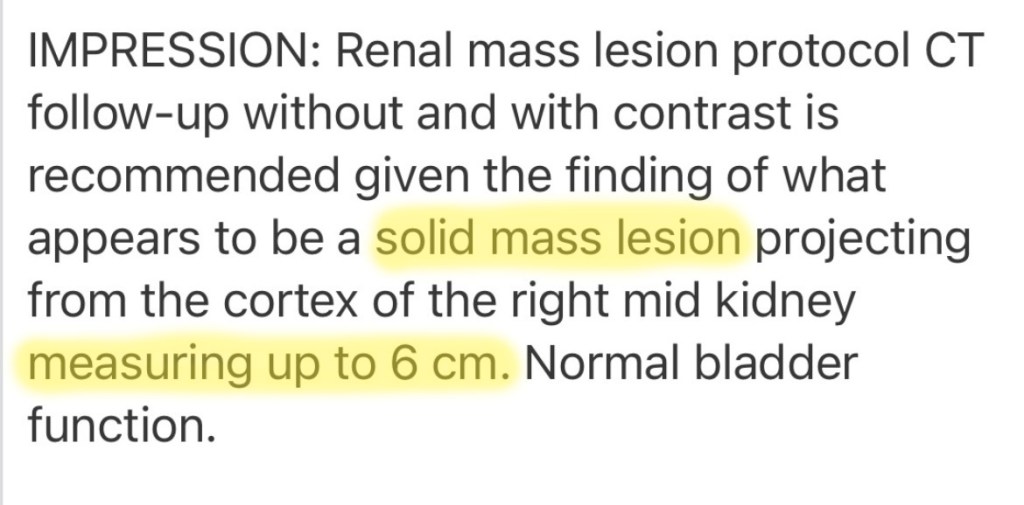
    The radiologist didn’t take long to release his findings. I hadn’t even finished the 25-minute drive back home when I got a “ping” on my email that I had a new test result in “MyChart.” I was stopped at a red light on Highway 532 just west of I-5, so I instinctively opened the message. My eyes fixated on the words “solid mass lesion.”

    Results from my ultrasound test at a hospital in Arlington on Feburary 12, which so happens to be our oldest daughter’s birthday.

    I’m no medical expert, but those words were unsettling. I had left my home two hours earlier a healthy man – at least as far as I knew. I returned home acutely aware I had a mass half the size of my right kidney. I had no symptoms. The results, of course, also went to my primary care physician, Dr. Alden Campbell. A few days later, he called me.

    “This looks concerning,” he said. “I’m ordering a CT scan.”

    The CT scan would confirm or deny my doctor’s suspicions it was cancer. If it were cancer, the CT would also show if it had spread to nearby organs. The CT scan was scheduled for the following week, also at the Arlington hospital. Once again, the results came back quickly.

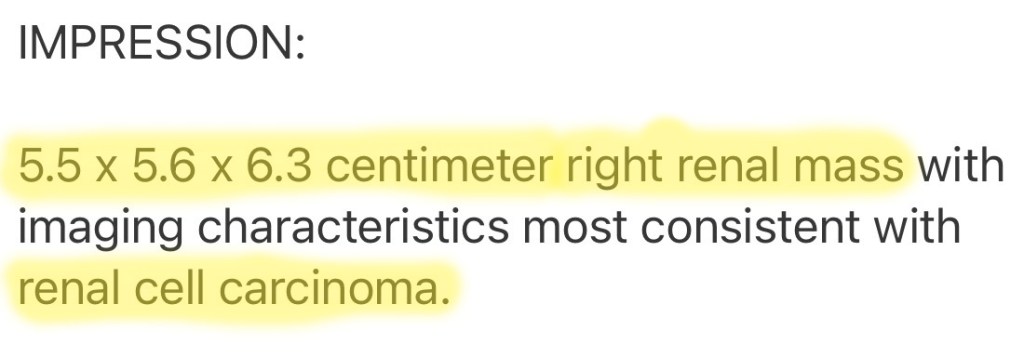
    The radiologist’s report from my initial CT scan on my right kidney.

    I didn’t immediately think the term “renal cell carcinoma” was cancer. I’m new to this world. I thought, or hoped, it might mean “pre-cancer.” But Dr. Campbell called me and told me it was indeed cancer. The good news, he said, is it appeared the cancer was contained to the kidney, and had not “metastasized.” That assessment would later be confirmed by my urologist and my surgeon.

    “I think we caught this early,” Dr. Campbell told me. “You might have dodged a bullet.”

    If I did steer clear of advanced cancer, I owe Dr. Campbell a debt of gratitude. To borrow a catch phrase from COVID, he ordered the kidney scan out of “an abundance of caution.” He had noticed my kidney function bloodwork tests were trending slightly downward.

    “I just want to make sure,” he said before the ultrasound.

    My good friend and retired cardiologist, Bob Swenson, thinks most doctors wouldn’t have ordered the ultrasound, electing to instead “watch the numbers” going forward. My next appointment with Dr. Campbell wouldn’t have been until September.

    Over the course of my life I have occasionally wondered what it would be like to receive news you had cancer. Dr. Campbell’s words were so “matter of fact,” as if I’d been told I had the flu, or bronchitis. Not that I knew it should be dramatic, like “My God, you have cancer!” Or, “I’m very sorry to tell you that you have cancer.” I guess I just didn’t know what to expect.

    A few weeks later, I spoke with a friend of mine who is currently in remission from colon cancer. In her case, it was diagnosed late. The cancer had already invaded her liver. It was termed Stage 4 cancer. She has undergone “immunotherapy.” The cancer, for the time being, has been kept at bay.

    “You’re entering a new world,” she told me. “You will never be the same.”

    That’s for sure. Once word spread, I received phone calls and text messages from people I hadn’t heard from in years. With my cancer diagnosis, I had crossed a line.

    Dr. Campbell immediately referred me to a urologist at Skagit Valley Hospital. Dr. Kyle Schuyler showed me the images from the CT scan. It was his opinion the tumor was slow-growing, and could have been there “for years.” He said he could remove my kidney – otherwise known as a “nephrectomy” – at SV Hospital, but thought the rest of my kidney looked healthy and could be saved. He said the best option would be what is termed a “partial nephrectomy.” That procedure, he said, is more complex and would be best performed by a surgeon at University of Washington Medical Center in Seattle. He put in the referral while I was still in the room.

    That surgeon would be Dr. Sarah Psutka. It took awhile for the UW and my insurance to approve the referral. But once that happened, we were told we had a “pre-op” appointment on March 30 with Dr. Psukta.

    I had done a little research on Dr. Psutka beforehand. It was obvious she had impeccable credentials. She is an Associate Professor of Urology in the Department of Urology at the University of Washington and Fred Hutchinson Cancer Center. She received her undergraduate and medical degrees from Harvard University, and completed urology residency training at the Massachusetts General Hospital. She completed a Society of Urologic Oncology Fellowship in Urologic Oncology at the Mayo Clinic, and concurrently obtained her Masters’ in Clinical and Translational Science. In our one-hour sit down with her, she was as advertised. She was knowledgeable, professional and kind.

    “You’ll be well cared for here,” she told me.

    She noticed my UW shirt. I told her we were Husky football season ticket holders. A native of Toronto, Canada, she said she was a hockey fan, and pulled out her phone to proudly show us photos of her two girls who are members of the Seattle Kraken “junior” hockey team.

    But I digress. Back to the surgery. She concurred much of the kidney looked healthy and could be saved. But because of the size of the tumor, she would have to do an “open surgery,” as opposed to the less invasive laparoscopic/robotic procedure. That meant a large incision, a minimum three-night stay in the hospital and a longer recovery. She said, if during the three-to-four-hour procedure it’s deemed unsafe to do the partial nephrectomy, she will remove the entire kidney. She termed my cancer “Stage 1B.”

    A CT scan of my right kidney and tumor, which at 6 cm (or 2 1/2 inches) in diameter is considered large. The tumor is described as “exophytic,” meaning most of it is outside the kidney.

    We then found out there’s a price to pay for a world-class surgeon. She’s in demand. She told us we were likely looking at surgery in “June or July.” Fortunately, we received a call the next day that the surgery will actually be May 20.

    The delay does allow us to travel on May 8 to our niece’s wedding near Santa Cruz, California. I can also attend a speaker event at my church (a former UW football player and chaplain) on April 18 that I am in charge of. I had this crazy idea surgery was imminent after our March 30 meeting with Dr. Psutka.

    Funny how “life happens when you’re making plans. ” I’ll be relieved when the cancer mass is removed as I continue along this uncertain journey that began the day I heard the “C Word.” I’m hopeful for another “C Word” – the one that stands for “Cured.”