Author: scoopricklund

  • I have a shallow interest in the Kraken’s deep dive into the postseason

    I have a shallow interest in the Kraken’s deep dive into the postseason

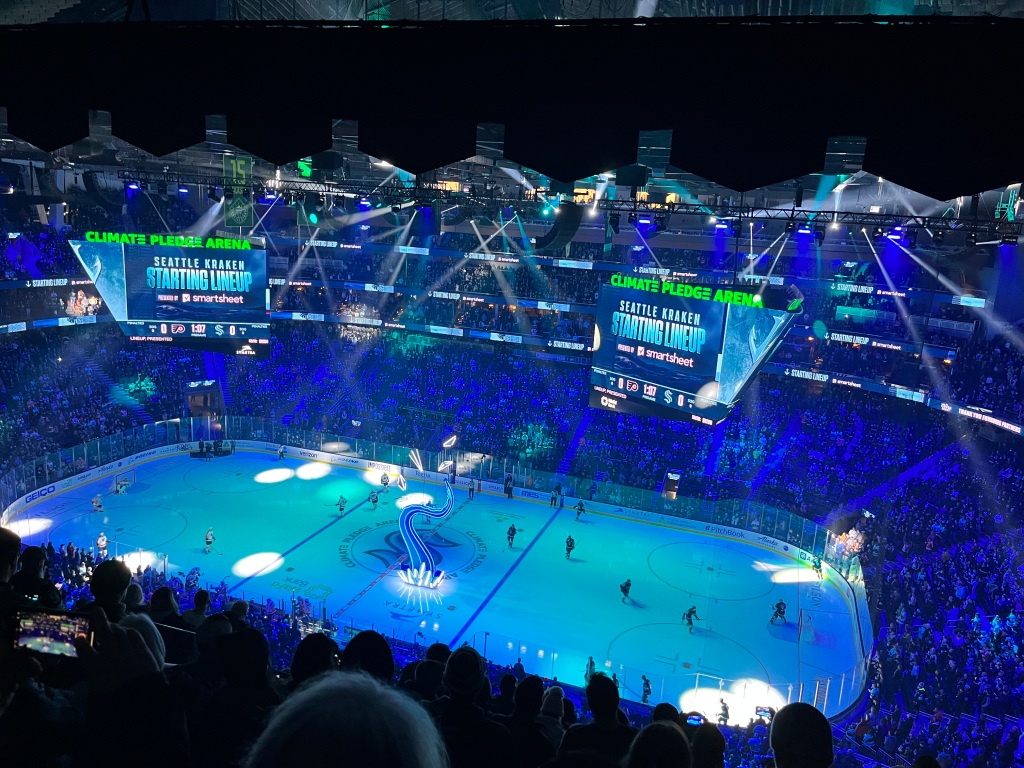
    The Kraken warm up before a game with the Philadelphia Flyers in February at Climage Pledge Arena. This view is from our seats, close to the top of the arena. Great overhead view of how plays develop, but hard to see the puck at times because you’re so far away.

    The Seattle Kraken are in the Stanley Cup playoffs. Whoop-dee-freakin-doo.

    Please excuse my sarcasm. I’m trying – I really am – to embrace hockey. I should be over the moon that the Kraken, in just their second season in the NHL, are in the postseason. I may watch tonight’s Game 1 against the Colorado Avalanche. On the other hand, I may not.

    Yes, I’ve been to Climate Pledge Arena to watch a game. Vicki and I were there in early February to see the Kraken maul the Philadelphia Flyers, 6-2. We went more out of curiosity to see the new arena – which I might add is world-class – than anything else. It was a fun evening. The home team was dominating. The video graphics, lighting and sound system were second to none. It had a rock-concert feel to it. But the seats, three rows from the top of the arena, were $127 apiece. I had little desire to go back to another game this season.

    Vicki and I at “The Wall” before a Kraken game. We spent more than an hour before the game exploring Climate Pledge Arena.

    Granted, the Kraken consistently draw capacity crowds to Climate Pledge. But in my opinion, it’s a niche audience. Like soccer fans, the majority of Kraken fans are in the stadium. TV ratings for Kraken games and newspaper readership for their stories are not impressive. I’m apparently not alone in my tepid interest in the team.

    I recently finished a three-month temp stint in the Sports department of The Seattle Times, a paper I retired at in 2020. Each day in our daily front-page, lineup meetings on Zoom, an online editor would review the day’s “digital traffic.” That’s a fancy phrase for a rundown on how many readers were engaging with our stories online. It’s a way for editors at the paper to see what readers like.

    In my early days in Sports, my way of gauging reader interest was very primitive. It went something like this. I watched the guy in the seat in front of me on the bus flip through the Sports section to see which pages and stories he spent the most time with.

    The analytics newspapers and web sites use today, suffice it to say, are much more sophisticated. For example, a software program reveals not only which stories are most read, but how many readers are reading a story at a given time, whether they are subscribers or visitors, how much time he or she is spending with a given story, and what type of device they’re reading it on (smart phone, tablet or computer).

    The analytics during my recent stint in Sports revealed this: Kraken stories consistently lagged behind the “Big Three” drivers of Sports online traffic: Husky football, the Seahawks and the Mariners., in that order. And this was during the peak of the Kraken’s historic season, which was the offseason for the aforementioned other sports. In other words, a story on projected two-deeps for next fall’s UW football team attracted more eyeballs than a Kraken story. Yes, this is the much-improved hockey team, that after winning just 27 of 82 games in its expansion season, put together an 8-game winning streak in January en route to an impressive 46-28 regular-season record and a third-place finish in the tough Pacific Division.

    “We saw a pretty big spike initially when the team arrived,” one of The Times Sports editors told me. “But there was a huge drop-off when the team fell flat in year 1, and we haven’t seen folks return in full.

    “It’s a bit of a head-scratcher considering they’re about to face the defending champs in the playoffs, but we’re still not seeing a ton of interest in our playoff preview stories.”

    Furthermore, the Kraken’s stellar on-ice performance in Season 2 also didn’t transfer to good TV ratings. A Nielsen Media report in January revealed broadcast ratings for the Kraken were among the bottom third of U.S.-based NHL teams. The rating was virtually no different than the ratings from the previous year, when the expansion team had one of the worst records in the NHL.

    Unlike Midwest and Eastern U.S. cities, we have a small sample size of major-league hockey in the Pacific Northwest. We grew up with minor-league hockey. Maybe we don’t understand the nuances of the game, or appreciate how skilled hockey players are, though it’s pretty obvious to me they are very athletic, in great shape and very good ice skaters.

    Two years into this Kraken thing, I still couldn’t rattle off the names of more than four players on the roster. I don’t completely understand what “offsides” or “icing” is. They’re apparently egregious hockey violations that stop play. But that’s as much as I can tell you. The problem is, I don’t want to know.

    Maybe postseason hockey is a different deal. Maybe if the Kraken start out hot, beat some teams they have no business beating, I’ll change my thinking. We’ll see.


    The pregame is pretty cool. The serpent-looking logo you see at center ice is lowered from the rafters. The rink goes from blue-green to red and the place goes crazy.


    More of Climage Pledge Arena. I think from this vantage point I’d get a better sense for the fast-paced game. A lot easier to see the puck and feel the energy.


  • Duel in the Desert

    Duel in the Desert

    I am a huge Washington Husky fan. That’s not a surprise to anyone. I can thank my dear dad for that. It’s in my DNA. My earliest childhood memories of Saturday afternoons in the fall were listening to Husky football on the radio with my dad, watching the rare televised game together (on black-and-white TV), and of course the once-every-year-or-so trip to Husky Stadium to see our beloved Huskies in person.

    The underpinnings for my passion for the purple and gold, however, run much deeper: I love college sports, football and basketball in particular. Vicki knows it. Our daughters know it. On one family road trip to southern California, I pulled off I-5 in Fresno so I could see the football stadium of Fresno State. During a spring break trip to Phoenix, we found our way into an empty Arizona State basketball arena, and on the same trip, I coaxed them to attend an ASU spring (intersquad) football game.

    On a road trip to Indiana two years ago to visit Greta and her family, I dragged Vicki to eight college football stadiums along the way. That’s right, eight, including Notre Dame, which was more than an hour’s drive east of Greta and Karl’s home in Valparaiso.

    Thirty-plus years in sports journalism sucked the life of the pro sports fan out of me. For whatever reason, my time in journalism only increased my appetite for college sports.

    With that backdrop in mind, Vicki and I are nearing the end of a month-long stay in Tucson, Arizona, our favorite destination city in the southwest. Oh, and Tucson just so happens to be the home of the University of Arizona.

    First, we attended an Arizona basketball game in hallowed McKale Center, which seats 14,545 and is one of the more raucous college basketball venues in the nation. The Wildcats, a perennial national power and ranked No. 14 on this night, destroyed lowly Utah Tech by more than 30 points before a crowd of more than 12,000. I’m sure a game against a Pac-12 opponent, or a big name, non-conference foe, would have been a much tougher ticket.

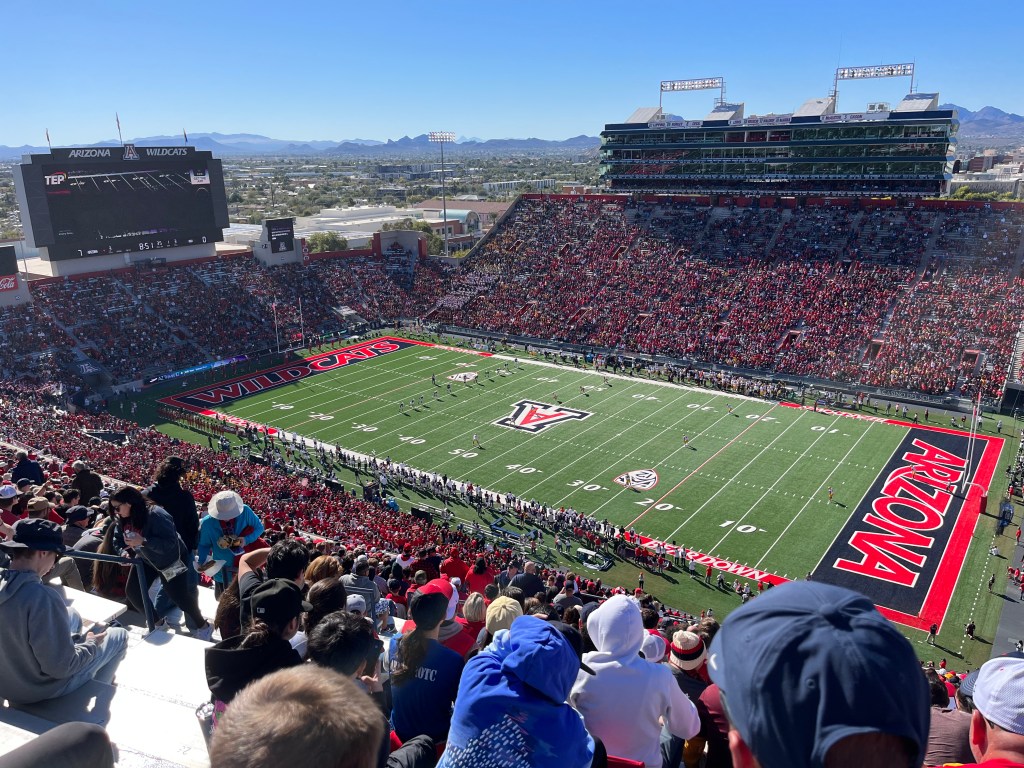
    The highlight would be a day-after-Thanksgiving football game between Arizona and Arizona State. It’s called the Territorial Cup, Arizona’s version of our Apple Cup. Which made this rivalry game all so surreal. Apple Cup games, whether in Seattle or Pullman, are almost always played in frigid temperatures. The temperature at the 1 p.m. kickoff in this southernmost city in the Pac-12 was just under 70 degrees, with a slight breeze. Anything warmer, you could see yourself baking in the desert heat. Arizona Stadium has no roof that offers shade. Walking to the stadium alongside UA and ASU fans wearing short-sleeved shirts in November was new to me.

    What a magnificent setting for college football in this desert city ringed by mountains. While Husky Stadium offers great views of Lake Washington and Mount Rainier, you’re in close proximity to hills, feeling a little boxed in. The upper reaches of Arizona Stadium, where we sat, rises high above the desert like a Saguaro cactus on steroids. You see the vastness of the Sonoran Desert. To the west are the Tucson Mountains, to the east the Rincon Mountains, to the north the Santa Catalina Mountains, and to the south, the Huachuca Mountains. The sunset behind the Tucson Mountains is nothing short of spectacular.

    We were entertained in the pregame by UA’s marching band called “The Pride of Arizona.” If you attend a UA football or basketball game, be prepared to hear “Bear Down Arizona” many times. It is the unofficial but more popular fight song that in recent decades has essentially replaced the official school fight song “Fight! Wildcats! Fight!”

    The roots of “Bear Down Arizona” go back nearly 100 years. And it has nothing to do with bears. Arizona’s quarterback and student body president, John Salmon, suffered a severe spinal cord injury in an automobile accident the day after the first game of the 1926 season. On his death bed, in one of those “win-one-for-the-gipper” moments, Salmon told football coach Pop McKale to tell the team “to bear down.”

    While “Bear Down” immediately became a rally cry for the school it didn’t become a fight song until the 1950s. The band director of the University of Michigan was in Tucson to interview for the same position at Arizona. As he flew out over the city, he noticed the words “Bear Down” painted on the roof of the school gymnasium. He then wrote the lyrics to “Bear Down Arizona” on a napkin on the return flight to Michigan.

    The chorus to the song he would eventually lead goes like this:

    Bear down, Arizona!
    Bear down, red and blue!
    Bear down, Arizona!
    Hit ’em hard let ’em know who’s who!
    Bear down, Arizona!
    Bear down, red and blue!
    Go, go, Wildcats go!
    Arizona, bear down!

    “The Pride of Arizona” performing “Bear Down Arizona.”

    The words “Bear Down” were included on the field turf in 2015. It’s said that whenever a Wildcat fans sees another wearing the familiar “Block A” around the world he or she yells “Bear Down.”

    The game we saw will probably go down in history as one of the more exciting in the rivalry. Neither team could stop the other in the wild affair that featured more than 1,000 combined yards. The lead changed hands five times. Had Arizona State not turned the ball over five times, I’m convinced the Sun Devils would have won. But the Wildcats prevailed, 38-35, snapping a streak of five losses in the series with their hated rivals, including a 70-7 drubbing to ASU on this same field in 2020.

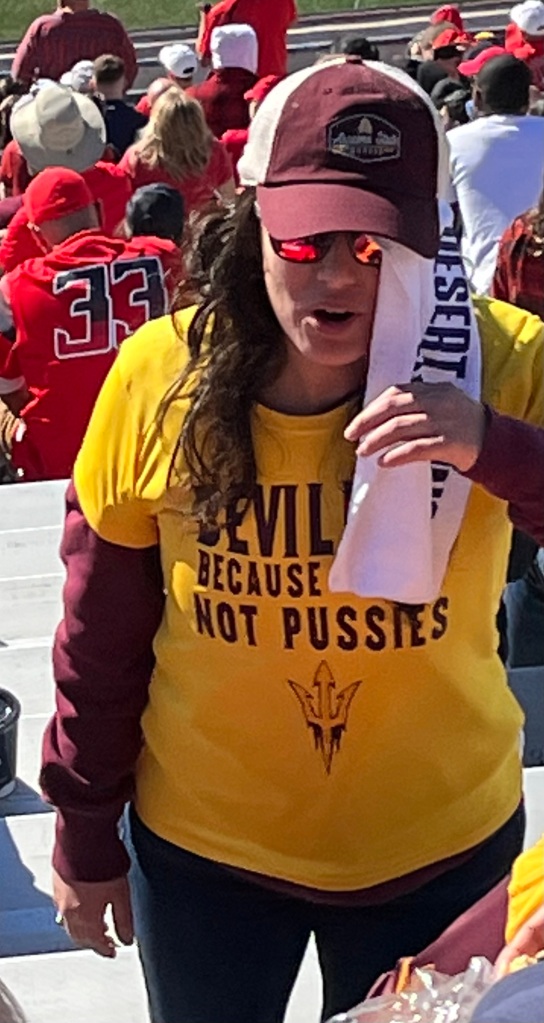
    And it is a bitter rivalry. It was chippy. Several scuffles broke out throughout the game. After ASU’s last game-clinching interception with about a minute to go, an all-out melee between the two teams ensued on the field. Three Wildcats and two Sun Devils were thrown out of the game and escorted out of the stadium. As the game ended, the PA announcer instructed the ASU team to leave the field, as not to start another brawl.

    The game symbolized two programs going in opposite directions. ASU fired its coach, Herm Edwards, just a few games into the season in the wake of NCAA recruiting violations. Meanwhile, second-year UA Coach Jedd Fisch has gotten Arizona turned around. Its freshman recruiting class was ranked in the Top 25 nationally. The young Wildcats won five games this season, its most since 2017, and is poised for even greater things ahead.

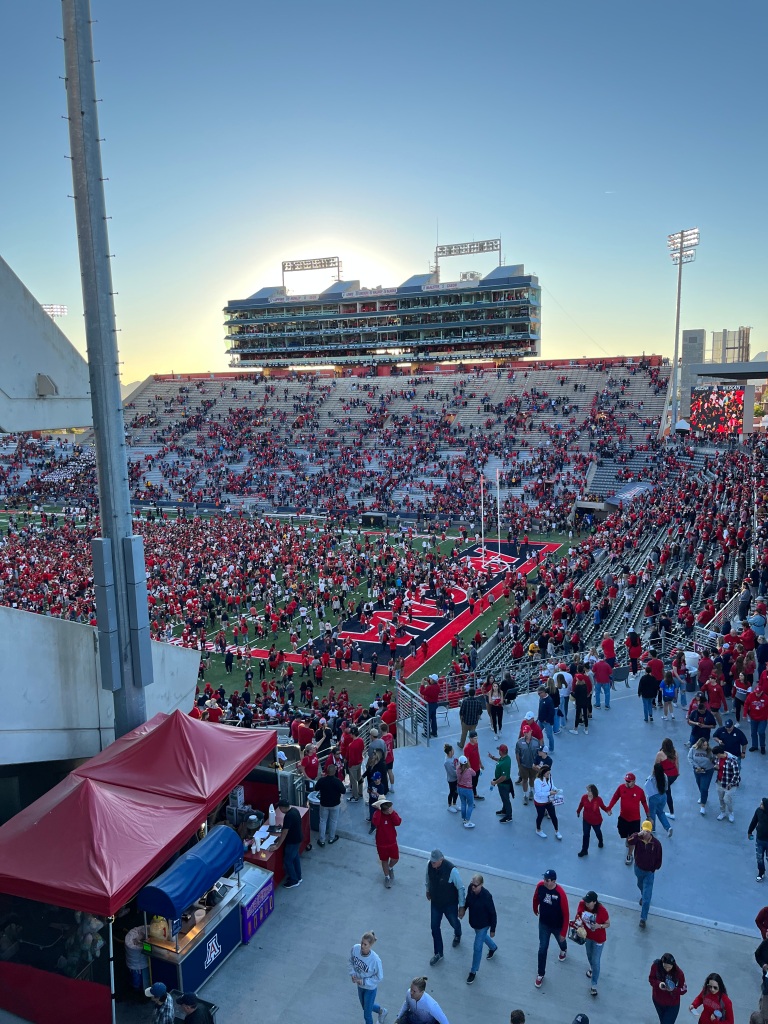
    A football power is rising in the desert. At game’s end, red-clad Wildcat fans stormed the field as the sun slid behind the press box and prepared to set behind the Tucson Mountains.

    I said it before, and I’ll say it again. I love college football.

  • The tale of Two Queens

    We mourn the loss of Queen Elizabeth. Her magnificent 70-year reign is over.

    Just two days after her passing, we celebrate “Queen Victoria,” who turns 66 today. I only mention the two in the same paragraph because they’re connected … at the neck.

    When Vicki turned 60, I planned a birthday party fit for a queen. I photoshoped her head on Queen Elizabeth’s body (see above). The photo I used was the same photo that ran on the front page of Friday’s Seattle Times (seen here below).

    The black and white photo of Queen Elizabeth was taken in 1969. She would have been 53. The photo of Vicki was taken in 1979. She would have turned 23 that year. It was a rare black and white photograph I had of Vicki that was needed to match the black and white photo of Queen Elizabeth. I colored her eyes blue — which they are — and did a lot of the photoshop work. A former Seattle Times colleague of mine, however, helped me fine-tune it. Fitting QV’s head under QE’s tiarra was particularly challenging. He did a pretty good job.

    Vicki’s head (she was always “a head” of the game) and Elizabeth’s body. At this point, I could say something snarky and it would be very complimentary to Vicki, but I’ll refrain.

    God Rest Queen Elizabeth! God Bless Queen Victoria! Long live the Queen!

  • Eyes in the sky

    Veteran fire lookout watchman Jim Henterly looks through the “Osborne Fire Finder” in the iconic Desolation Peak fire lookout in North Cascades National Park (Photo courtesy of Jim Henterly)

    Doing a story on a fire lookout watchman has long been on my bucket list. I can now check that box.

    I have to say, though, this was not an easy story to do. First of all, only about a third of the state’s remaining 93 fire lookouts are staffed. I talked to several rangers with the U.S. Forest Service. No dice. Finally, one ranger suggested I contact North Cascades National Park. A spokesperson with the park directed me to the guy who mans the famous Desolation Peak fire lookout, which also happens to be the only one in the park that is staffed.

    My intent was to hike to the lookout for the story. But I soon discovered that was going to be challenging. It’s roughly 50 miles round trip from the Ross Lake east bank trailhead off Highway 20. An easier option is to take a water taxi from Ross Lake Resort to Lightning Creek Campground. That puts you at the trailhead to Desolation Peak, a 4,400-foot climb in elevation over 4.7 miles. But the water taxi option comes at a price — $145 each way — thereby gobbling up much of the money I was to be paid for this story.

    So I reached out to Desolation’s watchman, Jim Henterly, by phone. At first he was reluctant to be interviewed. He thought other reporters from various media had misrepresented him. He gradually warmed up to me. He was a wealth of information and a great quote.

    Oh, and Desolation Peak isn’t just any fire lookout.

    Here’s my story in The Seattle Times:

    https://www.seattletimes.com/life/outdoors/93-fire-lookout-towers-remain-in-wa-heres-what-its-like-working-and-living-in-one/

  • Visiting the mecca of auto racing

    It’s tradition at the Indianapolis Motor Speedway for the winning race driver to kiss the bricks at the conclusion of the race. I think it’s almost sacrilegious for a non-auto racing fan for me to do that. But I do have the utmost respect for this race track in a city that is known as the “Racing Capital of the World.”

    To paraphrase the most interesting man in the Dos Equis beer commercial, “I don’t visit race tracks very often. But when I do, I kiss the bricks at the finish line of the Indy 500.”

    Full disclosure here. I’m not into motorsports. The last time I stepped near a racing oval was Skagit Speedway, in like 1962. I have watched only small portions of auto races on TV in my lifetime.

    Winners of each race since 1911 are displayed on a wall in the Indy 500 Museum.

    I am, however, familiar, with the drivers who made names for themselves in a city they call “The Racing Capital of the World:” A.J. Foyt. Mario Andretti. Al Unser. Bobby Unser. Johnny Rutherford. Rick Mears. Helio Castroneves. Emerson Fittipaldi. Arie Lurendyk.

    One can’t follow sports for as long as I have and be oblivious to these auto-racing icons.

    The enormity of this race and the venue aren’t lost on me. The track seats 350,000, which makes the Indy 500 the largest single sporting event in the world. The buildup to race time, I’m told is memorable, culminating with the song “Back Home Again in Indiana, ” sung for many years by Indiana native Jim Nabors (aka Gomer Pyle). Our tour guide said most people are in their seats three hours before the race. An Indianapolis native, the tour guide was my age and said he’s been to every race since he was 8 years old. He’s also a longtime track employee, and while being at the track has become ordinary, he said the excitement of “race day” never gets old.

    Layer No. 8 is the bricks, only to be covered later by seven layers of asphalt.

    I won’t bore you with too many facts and figures about the Indy 500. But here’s a few to chew on.

    The track is 2.5 miles long, which means it takes 200 laps to complete the race. The average speed is 230-240 miles per hour. At those speeds, it takes about 40 seconds to complete one lap. Our trip in a small shuttle bus around the track at an average speed of 20 mph took us considerably longer. More than 70 drivers have been killed on this oval. Ticket prices ranges from $100 to $250. Compared to ticket prices for NFL, NHL and NBA games, that seemed reasonable to me.

    Where did the brick theme come from? 3.2 million paving bricks, each weighing 9.5 pounds, were laid on top of the original surface of crushed rock and tar over a span of 63 days when the track was constructed in 1909. Seven layers of asphalt have since been paved over that brick layers. The brick-lined starting and finish line consists of some of those original bricks, which are changed out when they are damaged.

    We’re in Indiana to visit our daughter, Greta, and her family, Karl, Svea, Ida and Aksel. They live in Valparaiso, located in the northwest corner of the state, about a 2 1/2-hour drive from Indianapolis. Son-in-law Karl, his brother Eric and I talked this weekend about attending the Indy 500 (always held on Sunday of Memorial Day weekend) as early as next year.

    Looking from the starting line to Turn No. 1, arguably the most dangerous turn in racing as the field of 33 cars traveling in excess of 200 mph vie for the early lead.
    The crow’s nest at the start/finish line where someone waves the starting and checkered flags.
    Vicki and I standing at the Terrace Tower at the start/finish line, This fairly new addition to the track is where the scoring happens and includes the most expensive corporate suites and seating. The track was purchased by Roger Penske in 2020. He’s already making improvements to make the race more attractive to younger fans.
    I shot this photo of the Indy 500 Motor Speedway from our plane as we prepared to land at the airport in Indianapolis.
    One of the older Indy 500 cars on display in the museum. I believe this was 1950s-1960s vintage.

    Boiler up!

    Truth be told, however, I’d just as soon attend a Purdue University football or basketball game. We stopped in West Lafayette on our way to Valparaiso to check out the Big Ten campus and athletic facilities. Here’s some photos from the home of the Boilermakers.

    Outside the main entrance to Ross-Ade Stadium, home of the Purdue Boilermakers.
    A peak inside the football stadium. Note the painted train tracks leading to the field (where the Boilermaker train runs).
    Legendary UCLA basketball coach John Wooden was an All-American at Purdue. His statue is outside Mackey Arena. Behind him is displayed Wooden’s famous “pyramid of success.”
    Purdue has a long tradition of championship-caliber basketball teams.
  • Remembering you dad – on this day, and every day

    My brother John and I with our dad at a Father’s Day gathering at our home in Conway in 2014. My dad was a good man – the best of the best.

    As a college student in 1975 I once mailed a birthday card to my dad that he was to open on March 29, his birthday. There was just one problem. His birthday was a month later, on April 29.

    Years later, we joked about that. Better early than late, right dad?

    On this 29th day of April, 2022, my dad would have been 90. And rather than being early to the party – as I was 47 years ago – I feel like I was a little late.

    I always envisioned I would spend more time with my dad after I retired. But time would not wait for dad. My retirement at age 65 in 2020 would come nearly three years after his death. My dad had Multiple Sclerosis for more than 50 years. I thought he would experience a slow decline from that disease, not the catastrophic pulmonary embolism that abruptly took his life on August 10, 2017.

    Time. It’s our most precious commodity. Your time is your life. I know this to be true as a parent. You can always give your kids money or gifts. When you give them your time – look them in the eye, be fully present in the moment – you’re giving them a slice of your life you’ll never get back. You are telling that person that he or she matters.

    Dad and our three girls in the early 1990s.

    Did I give my dad enough of my time? I’m probably a little hard on myself, but I still wrestle with that today. Did I have too many things going on in my life to give him my undivided attention?

    I recall one incident a couple years before his death where I clearly had not shared enough of my time.

    It was just dad and I at my parents’ condo in Burlington. Mom was gone, and after a hour-long visit, dad suggested we go out and grab a burger for lunch. I had a project at the lake cabin I wanted to attend to, and said I’d take a pass.

    He looked at me and said: “You’re a workaholic.”

    Me with my parents on August 13, 1977, the day Vicki and I got married. Though dad isn’t smiling here, I think he was very pleased with what was about to happen.

    Whoa. That was NOT like my dad. For him to confront me like that must have taken considerable courage. I can count on one hand the times in my life he ever gave me advice, much less admonish me. I stayed and we grabbed a burger.

    Dad was, let’s say “the less forceful” disciplinarian in our home. But he was no slouch, and when he reached a boiling point you knew you had crossed a line. Yet, he never laid a hand on me. He never uttered a curse word. There were certainly many times I frustrated him, disappointed him. When he got really mad, he’d say – and my brother, John, will chuckle at this because he got the same treatment – “Gee, you gripe me!” The punishment was the look of disappointment in his eyes. You didn’t want to receive “that look.”

    Dad at his 60th birthday party at our home.

    My dad was not flashy, was never one to draw attention to himself. He was soft-spoken. He could get lost in a crowd. He would never have a Facebook or Twitter account today. He was a successful banker, but wasn’t eager to climb the corporate ladder. He didn’t equate net worth with self worth. As a lifelong Christian, he really understood that God is not interested in what we accomplish on this earth, but rather who we become. You don’t bring your career or your bank account to heaven. You bring your character. He was known for his kind and gentle spirit. That warmth and ready smile was evident to all he met, a living testimonial to the God he served.

    Dad also had what I would describe as a “non-anxious spirit.” Nothing ever seem to rattle him, though he had reasons to live in fear. MS was his constant companion, and he shared privately with me in later years his declining ability to move his legs. He was discouraged, which was unlike him. Yet, he drew assurance from his favorite verse in the Bible, Isaiah 30:15. “In quietness and confidence is my strength.”

    When I addressed the crowd at my dad’s memorial service more than four years ago, I said “I know why you’re here. Because you saw in my dad characteristics that are rare in our self-absorbed, me-first culture: Kindness. Gentleness. Giving.”

    People who knew my dad made a point to be at that service in Sedro-Woolley. One of my cousins drove from Idaho. I didn’t know he was even that close to my dad. But as one who himself had an angry, abusive father, my dad over the years had obviously made an impression on him. My sister-in-law and her husband made the trip from Leavenworth. I saw the two of them recently and thanked them once again for making the effort to attend my dad’s funeral. Suzann’s response: “Your dad was probably the kindest man I’ve ever met.”

    I guess I shouldn’t have been surprised to hear that. To me, that was normal .. that was just “dad.” My cousin Terry undoubtedly wished his dad was more like my dad. We don’t choose our parents. I was fortunate.

    So here I am, marking what would have been my dad’s 90th birthday. Although his earthly life is over, his story, his legacy, lives in me. I continue to discover things about my dad since his death that challenge me, that continue to shape me – attributes about him I hadn’t totally grasped before. I am intentional in my retirement to offer myself – my time – to my mom, who will turn 89 in July and suffers from dementia. It is a slice of my life I am glad to give, thanks in no small part to the man who gave so much of himself to me.

    Mom and dad were a good team. Mom was a faithful caregiver in my dad’s later years as he struggled with MS.

    I’ll close with a Father’s Day card I wrote for for my dad a couple years before he died. It’s titled “To a good dad. From a fortunate son.”

    Happy Father’s Day, dad; my how the years have flown; my childhood is a fading memory, heck, now my girls are grown.

    What I’ll never forget, though, is that you were always there; guiding me, prodding me, and yes your occasional rant about my long hair.

    I remember you driving me on my Sunday morning paper route, even watching John and I mow the grass; whether it was going to our games, or our piano recitals – you always put your family first, never last.

    You and mom worked hard so I could go to North Park; met a pretty blonde there, asked her to marry me on a lark.

    So now I’m a little bit like you, slowing down, getting more gray; I don’t like watching the Mariners as much as you, I will have to say.

    But we’re alike in many ways, the apple doesn’t fall far from the tree; I’m a fortunate son to have been raised by you. Lucky me.

  • A trip to ‘the end of the world’

    The snarling, snow-covered Cougar outside Martin Stadium

    Until yesterday (March 9, 2022), I had never been to Pullman, Washington.

    I’m almost embarrassed to admit that. I’m 67 years old. I’m a native Washingtonian. My brother went to Washington State University, for crying out loud. My beloved Husky football team plays there every two years.

    It’s just that, for me, it was never on the way to anywhere. When we went to Montana, or points beyond, we always drove through Spokane. What’s Pullman on the way to? Moscow or Lewiston, Idaho?

    Heck, even George Raveling, the Cougars’ great basketball coach who worked the sidelines there from 1972-1983, once said this of Pullman:

    “It’s not the end of the world. But you can see it from there.”

    One season, when Raveling was preparing to bring his team to a preseason tournament in Anchorage, Alaska, he said: “When you live in Pullman, you’re just happy to go anywhere.”

    I don’t know who “Gesa is.” I believe it’s named after a credit union in Richland, but your Gesa is as good as mine.

    And yet …. I have talked to so many devoted Cougar alums over the years who have this great, great love for their school and the town of Pullman. Former Seattle Times sportswriter Craig Smith, who covered WSU football for several years, once described this allure as “Mother Pullman,” the nurturing place this cozy campus nestled in the rolling hills of the Palouse is for its students. They study together, play together, root together – and undoubtedly drink (a lot!) together.

    Martin Stadium’s seating capacity of 32,952 is the smallest in the Pac-12.

    So Vicki and I just this past week made a quick road trip to Bozeman, Montana to attend a memorial service for Vicki’s uncle. We drove there in one day – through Spokane of course. But because of a morning commitment with her uncle’s family in Big Sky, Montana on the day of our departure, we needed to split the return trip over two days. I suggested, instead of spending the night in Spokane, we drive to out-of-the-way Pullman.

    We explored “downtown Pullman” Saturday evening, ending up at “The Porchlight” for artesian pizza. What a quaint town. The backdrop of the rolling hills of the Palouse is stunningly beautiful.

    The University of Idaho is eight miles to the east in Moscow. The old saying is “Pullman is a campus with a town. Moscow is a town with a campus.” Having driven through Moscow to reach Pullman, I believe that to be true.

    The plan was to explore the WSU campus the next morning. What we woke up to was 4-5 inches of snow. Sort of put a damper on things. You see, this is why I never went to the Apple Cup in Pullman, which is always held in late November, and is usually played in snow or at least frigid temperatures. So here we are in Pullman in April, and the weather is very November-like.

    Still, we were able to drive through this cozy, friendly campus. And yes, I got out of the car to snap the obligatory pictures of Martin Stadium. Unlike Husky Stadium, the Cougs’ stadium is carved into the campus. I like that. I can see why students embrace “Mother Pullman,” love their school and their COUGS! I can sense their “us against the world” mentality. I can even imagine why they hate the city slickers from the other side of the state. That would be the arrogant and entitled Husky fans (of course, I’m not one of them).

    I’m ready to come back to “Wazzu,” but preferably under more favorable weather conditions. I’d like to spend some more time there.

    Having said that, there’s nothing quite like that stadium by the lake. Purple is, after all, the color of royalty. And the Alaskan Malamute is a beautiful animal.

    A peak inside snow-covered Martin Stadium, which unlike Husky Stadium, is carved into the campus.

  • Remembering a life well-lived

    Early Bethany Covenanter Alice Van Liew Anderson had a story to tell – of God’s faithfulness and goodness, through the joys and tragedies of her long and full life

    Running a farm at Baker Heights and raising two small children (Alice and Johnny) was a challenging job for Otto and Jennie Johnson. But through hard work and prayer, the farm provided a good life.

    Sometimes you meet people that just stand out. Alice Van Liew Anderson, to me, was one of those persons. Just a year before she died – during the depths of the pandemic – she wrote her life story in a book titled “Looking West: Remembering a Life Well-Lived.” Raised by Swedish immigrant parents, on a stump farm at Baker Heights just east of Mount Vernon, she tells her story. I was captivated by this book. March 12 would have been her 98th birthday. Here is my story on her, and the book, that was published in a new newsletter I’ve put together called “The Bethany Beacon.”

    By Rick Lund

    Storytelling has long been a characteristic of the Swedish culture. It’s been said the long, dark days prompted people to gather, to share, to talk and to say “tell me a story.”

           Former Bethany Covenant member Alice Van Liew Anderson has done just that. She has told “her story” – all 97 years of it – in a book titled “Looking West: Remembering a Life Well-Lived.” The 336-page, paperback book is available on Amazon for $8.90.

    Alice Van Liew Anderson’s book is available on Amazon for a bargain: $8.90

          The book offers a poignant glimpse of what life was like during the Great Depression for Alice as the daughter of Swedish immigrants who was raised on a stump ranch in Baker Heights just east of Mount Vernon. 

           Summing up her book, Alice writes she “learned to treasure life and the people who impacted her. Embracing a deep love of God and the joys and tragedies of life, she reached out to welcome her present and future, always looking West and striving to be the best she could be!”

          Longtime Bethany Covenanters will remember Alice’s parents, Otto and Jennie Johnson. Faithful attenders for many years, Otto and Jennie became members in Year 3 of our 100-year history. That would be 1924, when the church was known as the Swedish Tabernacle of Mount Vernon. Alice joined the church in 1941, and as a young woman would become a fixture in the life of Bethany Covenant, especially when it came to teaching children’s Sunday School and Daily Vacation Bible School. I know I have vivid memories of her as a leader of VBS. She was a gifted communicator and an energizer-bunny-like, dynamo. 

          “Alice always loved children,” recalled Doris (Bergman) Oliver, who grew up at Bethany Covenant and is Alice’s second cousin.

          The book talks of Otto teaching his daughter to speak his native tongue, Swedish, which would come in handy in the early years of the church. Sunday morning worship services at Bethany were in Swedish-only until 1938. Doris recalls that in those early days of Swedish services a young child from a Swedish-speaking home would recite a Swedish Christmas poem or reading.

         “I think she started this as a pre-schooler,” Doris said. “Her father (Otto) would begin months before working with her so it would be perfect, both in pronunciation, but also never missing a word.

         “As time passed, and the church switched to English services, she did the Christmas recitations in English. I think she did these until she graduated from high school. A gentleman in church was so taken by how well these were done, from the very first one, he gave Alice 50 cents each year in appreciation for her great work. That was a lot of money for a little girl during the Depression.”

    At Sedro-Woolley High School, Alice Van Liew distinguished herself as an eager learner and an oustanding student.

         The book is filled with interesting tales about quirky neighbors, the family pets on the farm, a memorable Christmas Eve gathering with said quirky neighbors, dinners after church with visiting pastors from Covenant headquarters in Chicago and the challenges of making ends meet during tough times.

          It harkens back to a slower, simpler time, when the mail lady would stop by for a cup of coffee and honk her horn at the mailbox when the Johnsons had received a letter from a relative in their homeland of Sweden.

         Alice writes about visits with their favorite church family in Conway, the Torseths – that would include Arnold, Mel, Gudrun (Hanstad) and Louise (Bottles) – and a risky purchase of three dairy cows from an unnamed church member (I know it to be Swan Hammer). Otto would nearly lose the cows because the loan came due shortly after he lost his job during the Great Depression.

         Alice and her husband, Jud, were active members of Bethany while Jud worked for Skagit Steel in Sedro-Woolley. Their adopted children – daughter Sally and son Garrit – attended the church in their early years. The closure of Skagit Steel forced the Van Liews to move to Seattle, where Jud found other work in his field of engineering. But Bethany Covenant remained a central point of reference over the years. 

           Alice wrote and delivered a poem at the church’s 50th anniversary celebration, and “came home” often to visit her brother, Johnny, who remained on the family farm in Baker Heights until his death. Johnny worked as an excavator for many years for Melvin Nilson, also a former Bethany Covenant member. Johnny and Melvin donated their labor for the excavation work at the church’s present site on 18th Street.

          The Van Liews lived for many years at Covenant Beach – the Pacific Northwest Conference’s former camping center – and attended Midway Covenant in Des Moines. 

    Alice Van Liew Anderson at a book-signing gathering in Silverdale on Aug. 28, 2021. She passed away a couple months later at the age of 97.

         Alice was also in demand as a speaker at women’s retreats, and an avid writer whose stories were published in The Seattle Times.

           Jud passed away of cancer in 1986. In 1995 Alice married Harold Anderson, who had lost his first wife. They met while they were both attending Kent Covenant. Harold passed away in 2002.

           Alice spent her final years at Crista Shores, an assisted living facility in Silverdale, Washington. She wrote the book “Looking West” during the lockdown, first year of the global COVID-19 pandemic. She wanted to attend Bethany’s 100th anniversary celebration last October, but was unable to because of declining health.

           Alice Van Liew was a bright light for Jesus who gave her all for His Kingdom. She truly was “the best she could be!”

            Alice passed away November 1, 2021 at the age of 97. Fittingly, it was All Saints Day.

         (EDITOR’S NOTE: This story hits close to home. Otto and Jennie are the reason I exist. My mother, Sally, is the daughter of Morris and Sylvia Davidson. The Davidson family lived near the Johnsons in Baker Heights. But my grandparents, at least at that time, were not church-goers. Otto and Jennie invited my mother and her sisters, Shirley and Sheila, to come to Bethany. All three girls became very involved in Sunday School and youth group. And at some point during those high-school, youth-group days, my mom began dating some guy named “Skip” Lund, whose family went back to the church’s beginnings. I think you can figure out the story from there.)

  • Here today, gone to Maui

    Vicki surprises Rick in the Sports department of The Seattle Times as Alex MacLeod, the newspaper’s managing editor, looks on.

    Vicki and I recently returned from a trip to Maui. We figured it was our sixth trip to the Hawaiian island. We took note of the new, much-improved rental car center upon our arrival at the airport in Kahului that wasn’t there when we last visited in 2019. That prompted me to exclaim: “I guess we haven’t been here in three years.”

    Vicki and Rick in 1994 at Ioa Valley State Park near Wailuki on the island of Maui. Yes, we were younger then.

    Pandemic travel restrictions aside, it struck me how odd that statement was. Some members of our family have never been to Hawaii. I had equated a visit to Hawaii as if it were as commonplace as a trip to Eastern Washington or Canada. Spending any time at this tropical paradise should never be taken for granted.

    Now fast forward, 27 years later. Vicki and Rick in Maui in February 2022. Yes, we are (much) older now.

    Especially the first one. Let me explain.

    I was nearly a decade into my job as a lead Sports designer at The Seattle Times and about to turn 40. I had no idea how I was to turn 40.

    But one November morning in 1994, Vicki walked into the newspaper office wearing a grass skirt, sunglasses, a straw hat and puka shells and a Hawaiian lei around her neck. After much fanfare with others in the newsroom, she whisked me to Sea-Tac Airport for a flight to Maui.

    Was I surprised? As cousin Eddie of National Lampoon’s Christmas Vacation once famously said: “If I woke up tomorrow morning with my head sewn to the carpet, I wouldn’t be more surprised than I am right now.”

    I have been known to be clueless. So it goes without saying I had no clue what Vicki had up her sleeve – or in this case her grass skirt. In late summer of that year she had conspired with Seattle Times sports editor Cathy Henkel to kidnap me at the office. Vicki had arranged for our three girls to stay with friends during our five-day trip to Maui, packed up our suitcases, which would even include frozen steaks to be barbecued (we were on a budget!).

    I was in charge of the Sunday Sports section at the time, and was in the early stages of setting up our Apple Cup presentation plan that week. So my first question to Cathy was “who’s taking my place on Saturday?” Not to worry. She had long ago scheduled my replacement, even though the posted work schedule said otherwise, contributing to the element surprise.

    Two days into our Hawaiian vacation, I recall stepping into our hotel room after yet another snorkeling adventure to turn on the TV and get a glimpse of the aforementioned Apple Cup. To my astonishment, the UW-WSU game in Pullman was being played in a snowstorm. The juxtaposition of the snow globe on the TV screen and the view of the ocean and cloudless sky outside was very surreal. I didn’t waste much time heading back to the 85-degree temps and the beach.

    That Vicki wanted to do this for me in the first place – not to mention the fact she was able to pull it off – made me the envy of many in The Seattle Times newsroom. A couple of editors – male and female – later told me “I wish I were married to your wife.” You have to remember this was 1994.

    We stayed in the Kaanapali area just north Lahaina. In subsequent years we seemed to gravitate to the Kihei region of Maui. A little less-crowded than Maui’s west side, Kihei – or Low-Kihei as I call it– is a little more relaxed and less touristy in my opinion. I believe it also has better beaches for boogie-boarding and snorkeling.

    So if you’re going to the Kihei region anytime soon, here are my five favorite beaches (although I’m sure there are others I don’t know about):


  • The story behind ‘the backstory’: Remembering David Virta

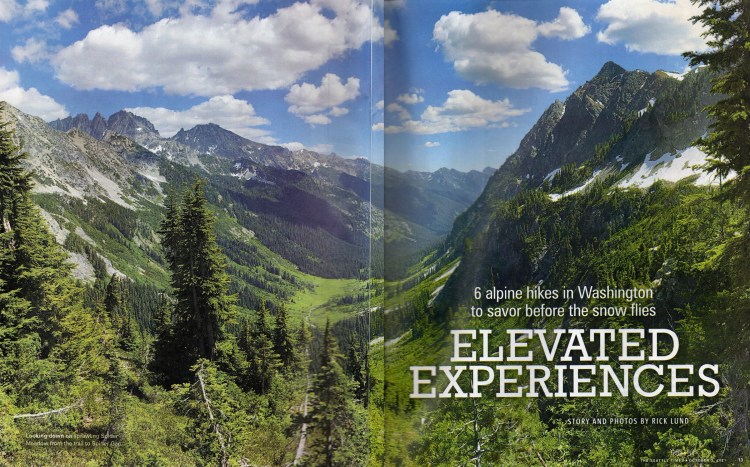
    The opening inside spread of my hiking piece for Pacific NW magazine.

    The Seattle Times’ Pacific NW magazine in October published my story on a collection of fall hikes. It was a nice, 12-page spread designed by the magazine’s art director, David Miller and edited by Bill Reader, the mag’s editor. “D-Mill” and I worked together at The Times for more than 30 years, Bill and I for about 20 years.

    The cover. That’s my brother-in-law, Kent Oldenburger, making his way on the Maple Pass Loop trail.

    In assigning this story, Bill also asked me to write a “backstory,” a short page 2 piece that usually accompanies the front-page story. It’s supposed to offer some insight about the author and the “story behind the story.” Well, here’s a backstory to the backstory.

    In the backstory for The Times, I wrote about my introduction to backpacking that we remember several decades ago as “The Starvation Hike,” a 55-mile slog through Olympic National Park that unexpectedly whetted my appetite for a lifetime of hiking. The unnamed family in the article was the Virtas, who became lifelong friends with my family beginning in the 1960s. The “other family” in the story responsible for food planning? They will remain nameless.

    My dad was a banker for Seattle First National Bank. In 1963 he was transferred from the Mount Vernon branch to Monroe. We met the Virta family at the church we began attending. I instantly became best buds with the Virtas’ oldest son, David. We shared a love of sports – first and foremost – and just seemed to bond on every level.

    But our time in Monroe was short-lived. In 1966 my dad was transferred, yet again, this time to the Sea-First branch in Sedro-Woolley. The day my dad broke the news at the dinner table we were moving from Monroe I broke down and cried. I had just finished the fourth grade. David was my best friend.

    Despite being separated by an hour’s drive, our families remained good friends. In high school, David was quite the football player at Monroe, while my basketball-playing career was more modest at Sedro. We would occasionally hook up in Seattle to watch our beloved SuperSonics, or attend a UW game.

    When it came time for college, David went to Seattle Pacific, I to North Park College in Chicago. Still, we managed to find time to get together. He was always kind and gentle, and loved to laugh. When Vicki and I were married in 1977, David was one of my groomsmen. We saw each other as often as we could in our adult years, even though we sometimes lived in different states.

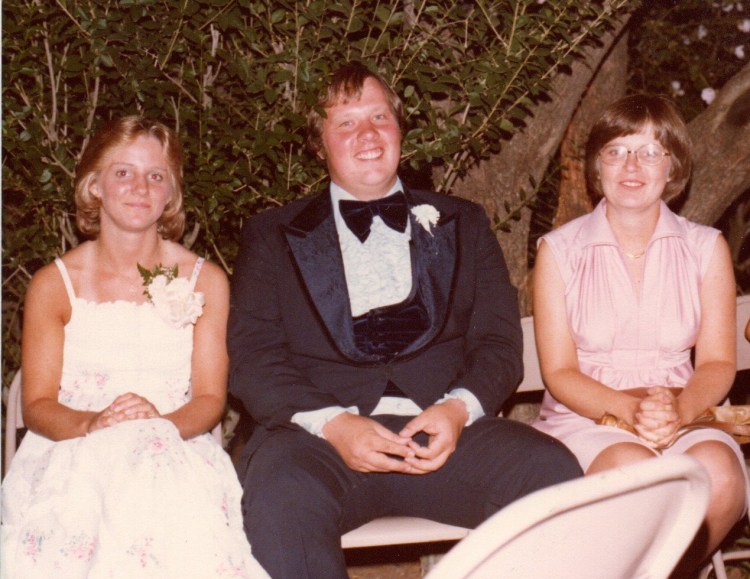
    David Virta, pictured here in his groomsman attire at in our wedding in 1977. He is flanked by my sister, Cindy, on the left, and David’s sister, Kerry, on the right.

    Then in the mid-1980s, David was admitted to UW Hospital. Surgeons removed a suspicious-looking mole on his back. He was diagnosed with melanoma. I visited him at the hospital. Still, everything seemed to be fine.

    Several years later, I got a call from his parents. The melanoma cancer had spread to other parts of his body. December of 1997 was the last time I saw him. I visited him at his folks’ Monroe home, where he was in hospice care. Hooked up with tubes, and struggling to breath, he couldn’t really communicate with me. But he was fully aware of my presence and what I was saying to him. I don’t remember everything I said to him on that day. But I did tell him I loved him, and that he was the best friend I ever had. It was emotional.

    David would pass away a couple weeks later, 24 years ago this month (December). He was just 44 years old. I spoke at his funeral. Sadly, not even three years later, David’s dad, Bob, died from the same aggressive cancer.

    So as I wrote the “backstory” piece for the hiking story, not only was I thankful for the lifelong friendship with the Virta family that introduced me to backpacking, I was also thankful for the big, gentle man in the family who would become my best friend. I still miss him to this day.

    Here is a link to the “backstory”: https://www.seattletimes.com/pacific-nw-magazine/those-first-meals-on-the-trail-were-mighty-skimpy-but-backpacking-feeds-the-soul-for-a-lifetime/