

I am a huge Washington Husky fan. That’s not a surprise to anyone. I can thank my dear dad for that. It’s in my DNA. My earliest childhood memories of Saturday afternoons in the fall were listening to Husky football on the radio with my dad, watching the rare televised game together (on black-and-white TV), and of course the once-every-year-or-so trip to Husky Stadium to see our beloved Huskies in person.
The underpinnings for my passion for the purple and gold, however, run much deeper: I love college sports, football and basketball in particular. Vicki knows it. Our daughters know it. On one family road trip to southern California, I pulled off I-5 in Fresno so I could see the football stadium of Fresno State. During a spring break trip to Phoenix, we found our way into an empty Arizona State basketball arena, and on the same trip, I coaxed them to attend an ASU spring (intersquad) football game.
On a road trip to Indiana two years ago to visit Greta and her family, I dragged Vicki to eight college football stadiums along the way. That’s right, eight, including Notre Dame, which was more than an hour’s drive east of Greta and Karl’s home in Valparaiso.
Thirty-plus years in sports journalism sucked the life of the pro sports fan out of me. For whatever reason, my time in journalism only increased my appetite for college sports.
With that backdrop in mind, Vicki and I are nearing the end of a month-long stay in Tucson, Arizona, our favorite destination city in the southwest. Oh, and Tucson just so happens to be the home of the University of Arizona.
First, we attended an Arizona basketball game in hallowed McKale Center, which seats 14,545 and is one of the more raucous college basketball venues in the nation. The Wildcats, a perennial national power and ranked No. 14 on this night, destroyed lowly Utah Tech by more than 30 points before a crowd of more than 12,000. I’m sure a game against a Pac-12 opponent, or a big name, non-conference foe, would have been a much tougher ticket.
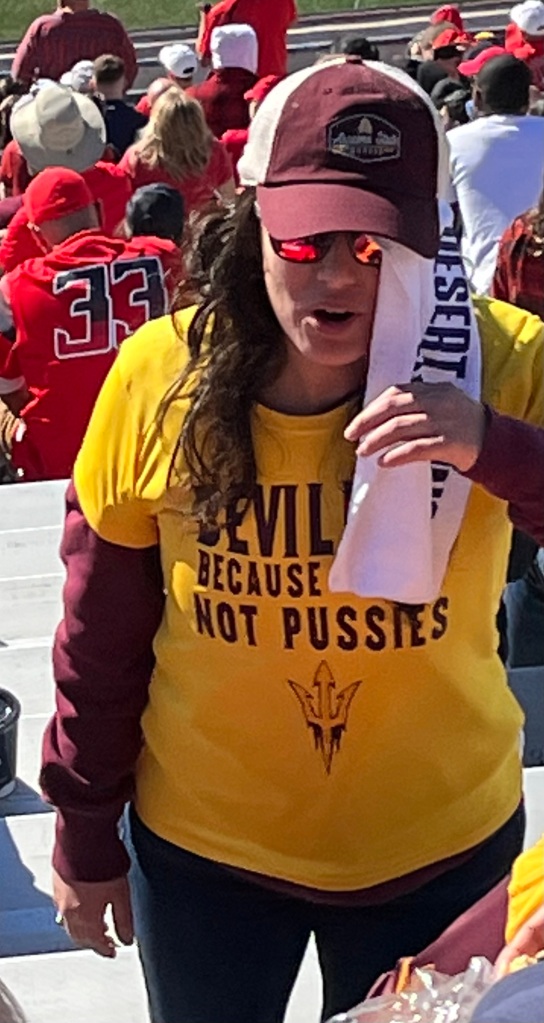
The highlight would be a day-after-Thanksgiving football game between Arizona and Arizona State. It’s called the Territorial Cup, Arizona’s version of our Apple Cup. Which made this rivalry game all so surreal. Apple Cup games, whether in Seattle or Pullman, are almost always played in frigid temperatures. The temperature at the 1 p.m. kickoff in this southernmost city in the Pac-12 was just under 70 degrees, with a slight breeze. Anything warmer, you could see yourself baking in the desert heat. Arizona Stadium has no roof that offers shade. Walking to the stadium alongside UA and ASU fans wearing short-sleeved shirts in November was new to me.

What a magnificent setting for college football in this desert city ringed by mountains. While Husky Stadium offers great views of Lake Washington and Mount Rainier, you’re in close proximity to hills, feeling a little boxed in. The upper reaches of Arizona Stadium, where we sat, rises high above the desert like a Saguaro cactus on steroids. You see the vastness of the Sonoran Desert. To the west are the Tucson Mountains, to the east the Rincon Mountains, to the north the Santa Catalina Mountains, and to the south, the Huachuca Mountains. The sunset behind the Tucson Mountains is nothing short of spectacular.
We were entertained in the pregame by UA’s marching band called “The Pride of Arizona.” If you attend a UA football or basketball game, be prepared to hear “Bear Down Arizona” many times. It is the unofficial but more popular fight song that in recent decades has essentially replaced the official school fight song “Fight! Wildcats! Fight!”

The roots of “Bear Down Arizona” go back nearly 100 years. And it has nothing to do with bears. Arizona’s quarterback and student body president, John Salmon, suffered a severe spinal cord injury in an automobile accident the day after the first game of the 1926 season. On his death bed, in one of those “win-one-for-the-gipper” moments, Salmon told football coach Pop McKale to tell the team “to bear down.”
While “Bear Down” immediately became a rally cry for the school it didn’t become a fight song until the 1950s. The band director of the University of Michigan was in Tucson to interview for the same position at Arizona. As he flew out over the city, he noticed the words “Bear Down” painted on the roof of the school gymnasium. He then wrote the lyrics to “Bear Down Arizona” on a napkin on the return flight to Michigan.
The chorus to the song he would eventually lead goes like this:
Bear down, Arizona!
Bear down, red and blue!
Bear down, Arizona!
Hit ’em hard let ’em know who’s who!
Bear down, Arizona!
Bear down, red and blue!
Go, go, Wildcats go!
Arizona, bear down!
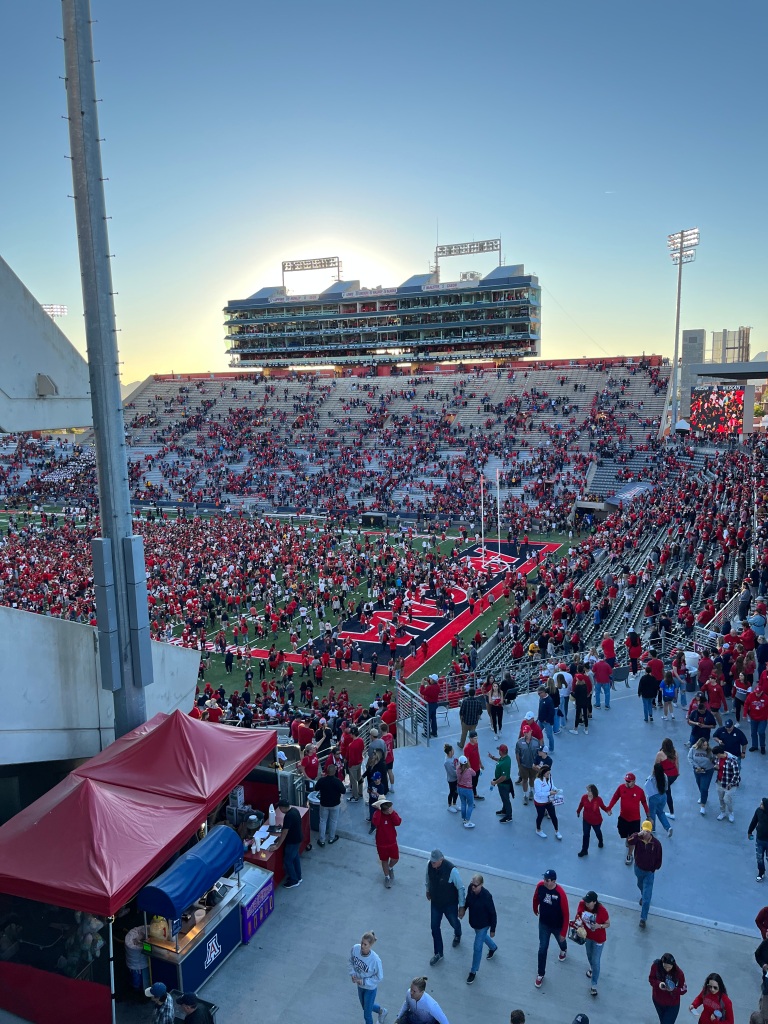
The words “Bear Down” were included on the field turf in 2015. It’s said that whenever a Wildcat fans sees another wearing the familiar “Block A” around the world he or she yells “Bear Down.”
The game we saw will probably go down in history as one of the more exciting in the rivalry. Neither team could stop the other in the wild affair that featured more than 1,000 combined yards. The lead changed hands five times. Had Arizona State not turned the ball over five times, I’m convinced the Sun Devils would have won. But the Wildcats prevailed, 38-35, snapping a streak of five losses in the series with their hated rivals, including a 70-7 drubbing to ASU on this same field in 2020.

And it is a bitter rivalry. It was chippy. Several scuffles broke out throughout the game. After ASU’s last game-clinching interception with about a minute to go, an all-out melee between the two teams ensued on the field. Three Wildcats and two Sun Devils were thrown out of the game and escorted out of the stadium. As the game ended, the PA announcer instructed the ASU team to leave the field, as not to start another brawl.
The game symbolized two programs going in opposite directions. ASU fired its coach, Herm Edwards, just a few games into the season in the wake of NCAA recruiting violations. Meanwhile, second-year UA Coach Jedd Fisch has gotten Arizona turned around. Its freshman recruiting class was ranked in the Top 25 nationally. The young Wildcats won five games this season, its most since 2017, and is poised for even greater things ahead.
A football power is rising in the desert. At game’s end, red-clad Wildcat fans stormed the field as the sun slid behind the press box and prepared to set behind the Tucson Mountains.
I said it before, and I’ll say it again. I love college football.


Leave a comment