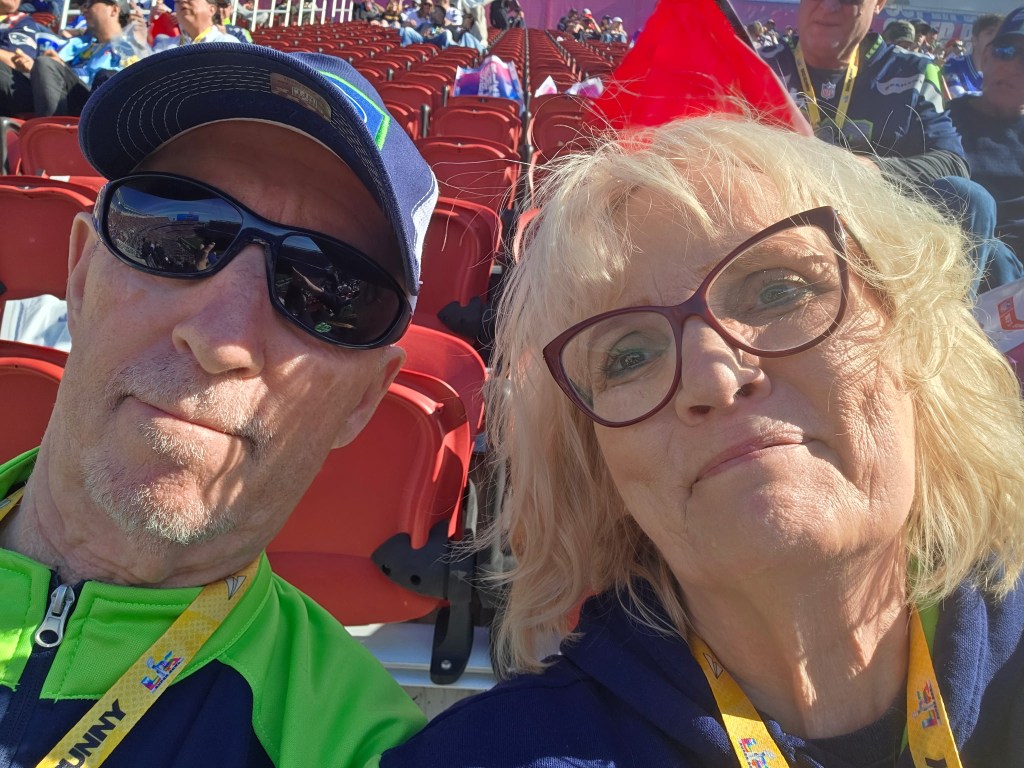
My brother, John, with his wife, Brenda, at Super Bowl LX in Santa Clara, California. I’m a sports fan, but John is probably an even bigger fan – and that’s saying something.
Buy or sell? That’s the question my brother and sister-in-law faced.
John and Brenda have been loyal Seahawk season ticket holders for 23 years. Sunday’s Super Bowl game in Santa Clara, California was the fourth in franchise history. But until this year, going to this annual, mega-sporting event was never an option.That changed in 2026.
After the Seahawks defeated the LA Rams in the NFC Championship game, John and Brenda learned they had won for the first time a “lottery” for season-ticket holders. That meant they could purchase Super Bowl tickets at reasonable, season-ticket prices. “Reasonable,” in this case, was $1,000 per ticket. That’s a bargain compared to what the general public paid, where the cheapest ticket was $6,000.
John told me the other day they probably could have sold their tickets for $7,000 apiece. But what price do you place on making a memory? John and Brenda decided to make it a road trip. They drove, spending time in Oregon and northern California on the way to Santa Clara and back.
“It was the experience of a lifetime,” he told me as they passed Centralia on their way home, five days after the game.
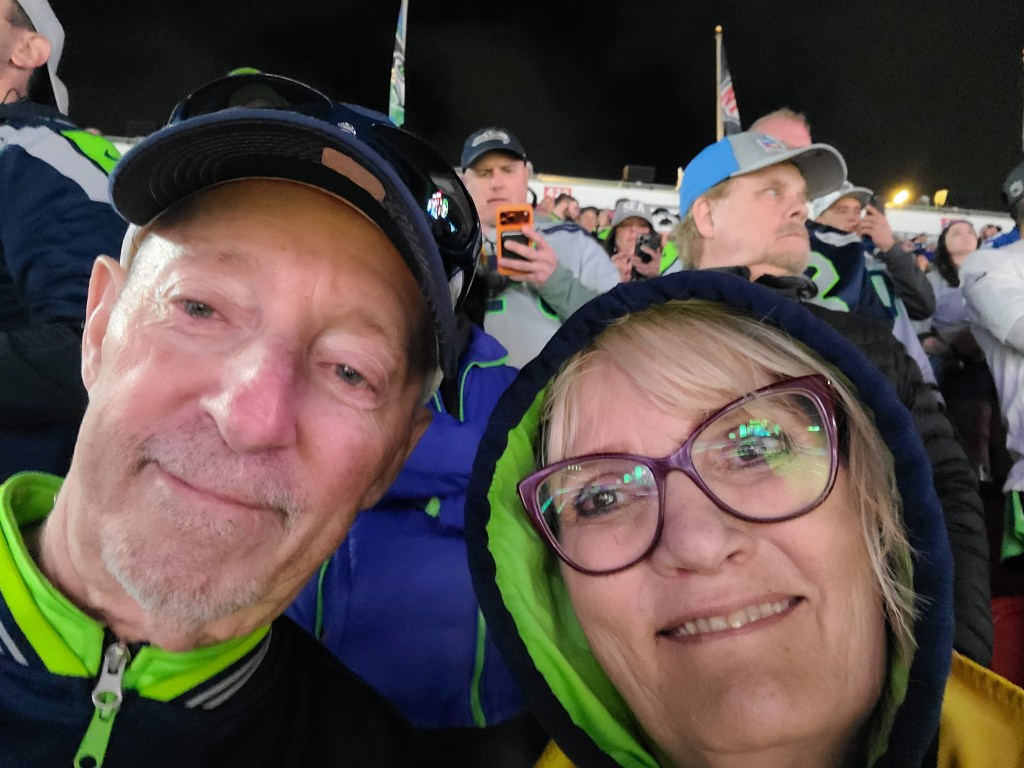
Sure, there were blips along the way. John said he only packed a light coat for the game. While the temperature hovered around 70 degrees at the start of the game, he discovered it gets cold in the Bay Area in February at night. It took them more than two hours after the game to get from the stadium to their hotel, only three miles away. And that hotel cost $500 per night.
Expensive? Yes. The memories? Priceless.
John and Brenda picked a good one. The Seahawks destroyed the New England Patriots, 29-13, for their second Super Bowl title.
“A night we’ll never forget,” John said after the game.
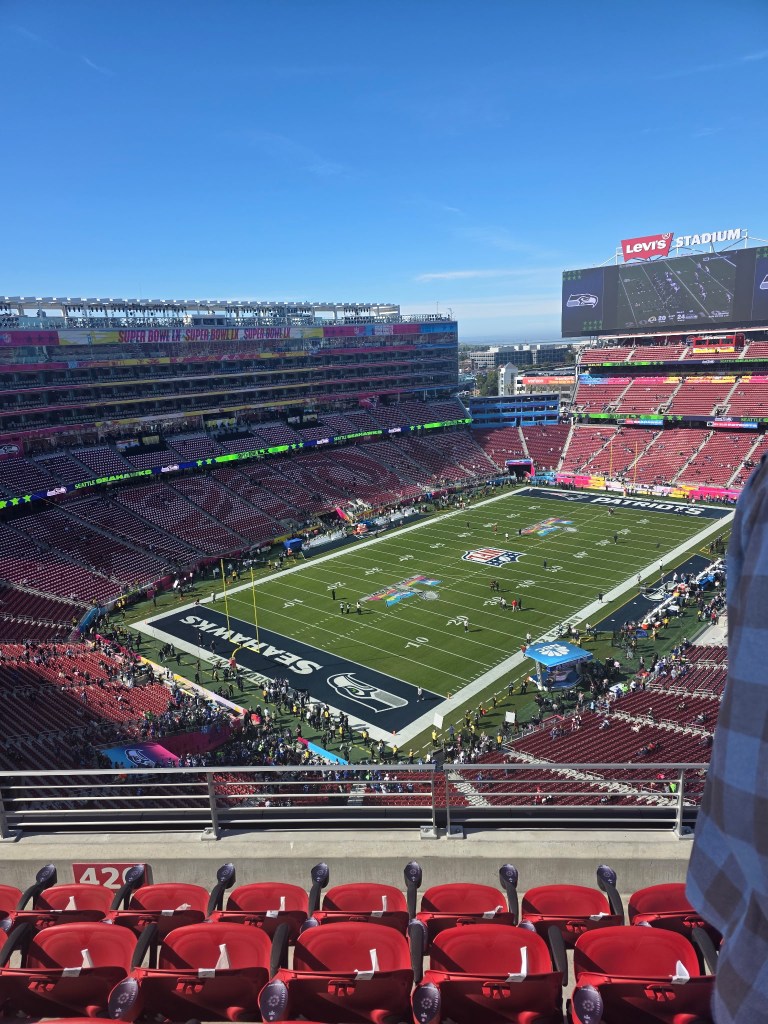
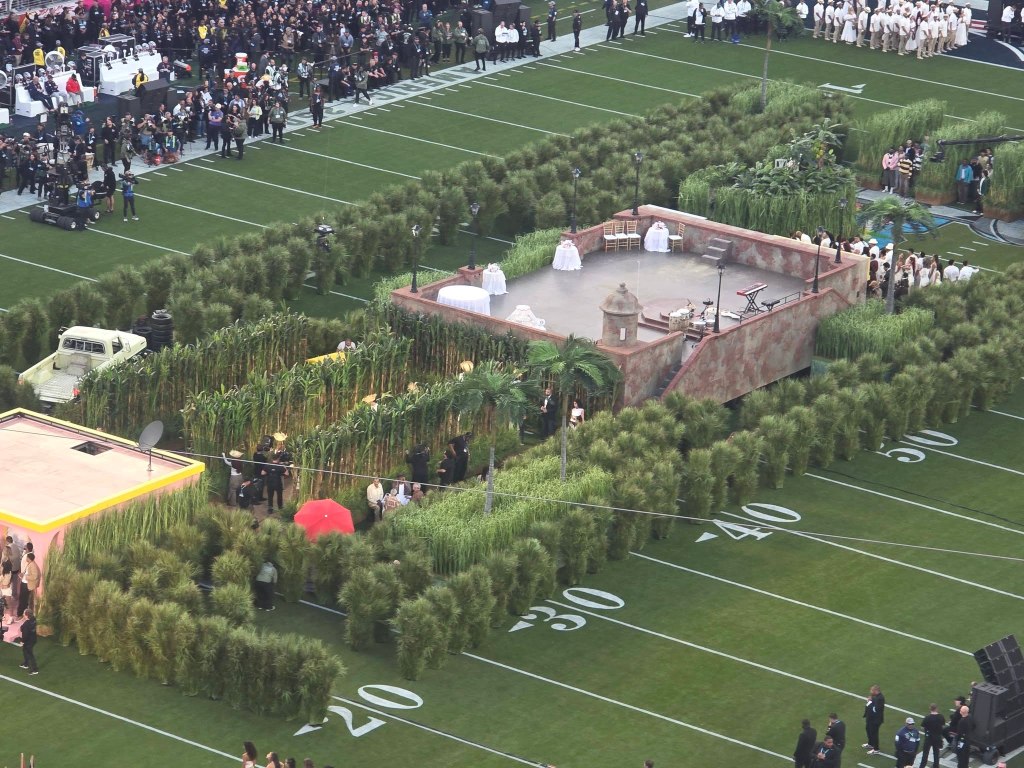
The view of the field from John and Brenda’s seats, several hours before Kickoff. .The temperature dropped dramatically once the sun set at Levi’s Stadium in Santa Clara. Brenda was better prepared for the cooler temps.The set up for the “Bad Bunny” performance at halftime, which Brenda said was probably a lot easier to follow on TV.
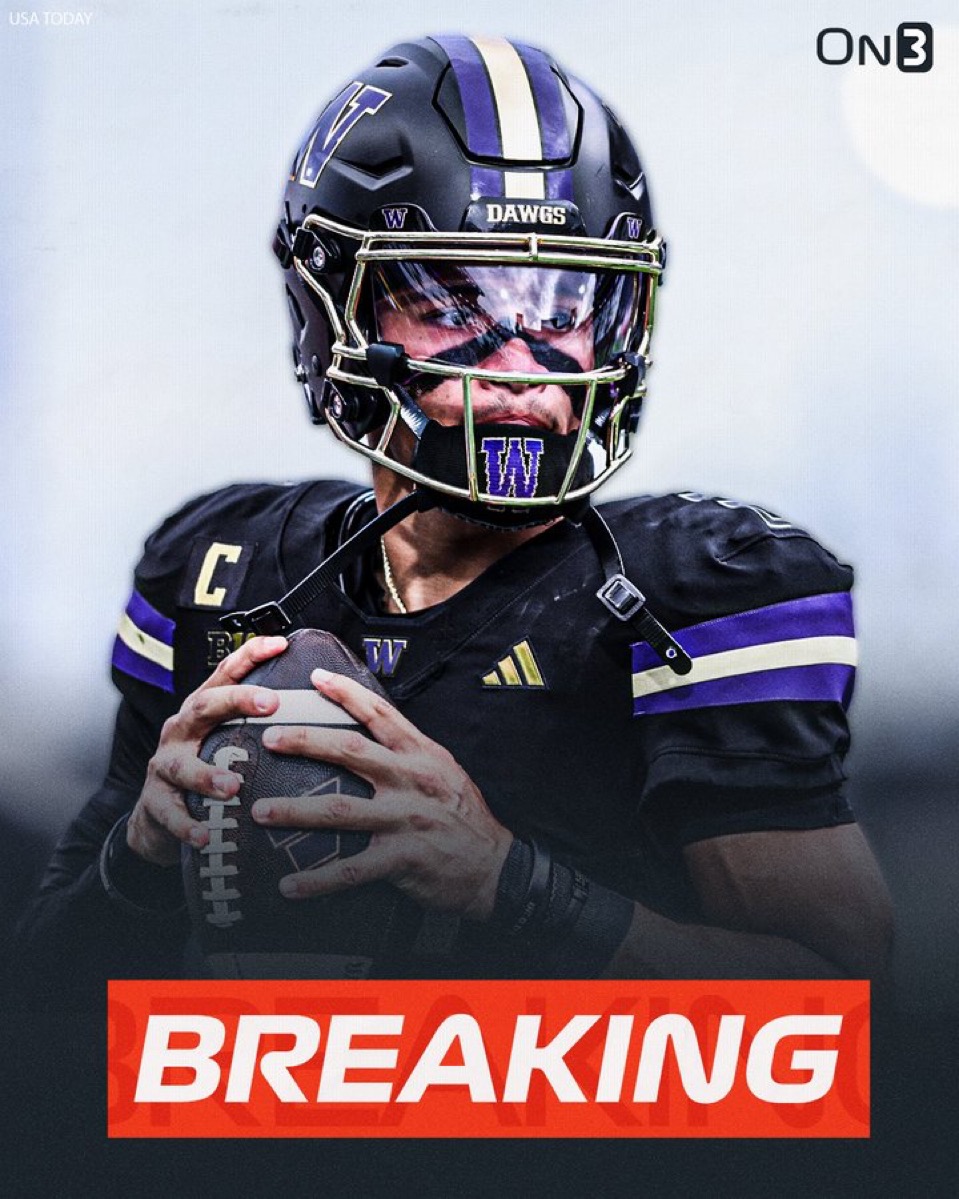
Social media platforms X (formerly Twitter) and Instagram blew up the evening of January 6 when Washington quarterback Demond Williams dropped the bombshell he was entering the transfer portal. The star signal caller just four days earlier had signed a new NIL deal with the school, which many assumed to be binding.
Growing up in western Washington, I naturally gravitated to being a fan of the Seattle SuperSonics, Seahawks, Mariners, and yes, University of Washington football and basketball.
As I grew older, however, my passion for the three professional sports teams waned. A big piece of that disenchantment I attribute to my career in sports journalism. As a newspaper insider, I guess I knew too much about “how the sausage was made.” Highly-paid pro athletes seem entitled. Some were hard to talk to. Reporters often had to grovel for interviews. I experienced that first-hand. Too many prima donnas. Too many meaningless games.
But UW? I’ll have to admit purple and gold runs in my veins. It’s in my DNA. That passion had never wavered. My earliest memories of sports are listening to UW football games on the radio on Saturday afternoons with my dad. Seattle’s first pro sports team, the Sonics, didn’t arrive until 1967, when I was 13. My dad took me to my first UW football game when I was 9. I was hooked that day in 1963. I loved the pageantry of college football. The marching bands. The buildup to kickoff. The raucous student section. Media access to players was no problem. We knew their names. They spent four seasons at a school, sometimes five with a redshirt. They played for the love of the game. They weren’t paid.
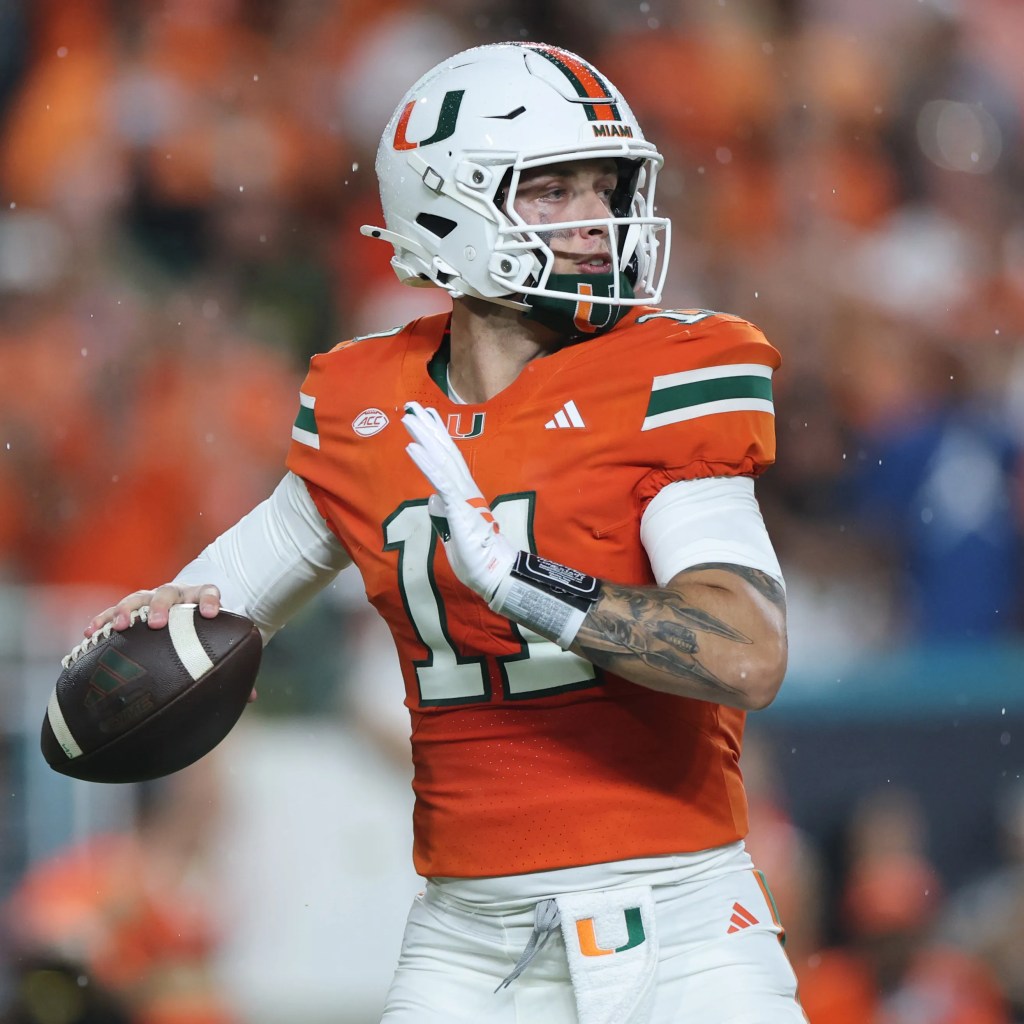
Of course that was so Don James-era. It’s all changed now. College football in 2026 is broken. It’s NFL free agency without binding contracts and guardrails. Washington quarterback Demond Williams shocked the college football world when he announced last evening (January 6) he was entering the transfer portal for a better deal, just four days after he had signed a one-year, near top-of-the-market NIL deal with UW for $4 million, according to The Seattle Times.
I was perplexed, but at least tried to understand, why frontline players Adam Mohammad and Raiden Vines-Bright transferred to California and Arizona State, respectively. But Demond? Or should we call him “Demand?” That was shocking. To quote Chevy Chase in National Lampoon’s Christmas Vacation, “if I woke up tomorrow with my head sewn into the carpet I wouldn’t be more surprised than I am right now.”
That’s because Demond Williams was the face of UW football. Coach Jedd Fisch made him so. He brought Demond with him from Basha High School in Chandler, Arizona. He played him his freshman season, many times in odd situations over the more experienced Will Rogers, just to get his feet wet. Fisch generated significant hype for his dual-threat quarterback by making bold predictions about him becoming a first-round NFL draft pick and a Heisman finalist. When Demond struggled against Ohio State, Michigan, Wisconsin and Oregon this past season Jedd was quick to defend him. “He’s just 18 years old,” he said. Next year’s team, built around Demond, was expected to be College Football Playoff-caliber. The three-year plan was on schedule. The coach and quarterback seemed joined at the hip.
Sources say that relationship went south in a hurry yesterday afternoon (January 6). Someone had apparently reached out to Demond. The quarterback told his coach he could get more money elsewhere. The exchange got heated. Since bringing Demond to UW, Jedd has seemingly bent over backwards to accommodate him. Now it seems Demond has stabbed his coach in the back.
The timing of Demond’s next step that day, his announcement on Instagram, may haunt him for awhile. He announced his intentions during the memorial service for a fellow UW soccer player who died of cancer. This is bad optics. A large contingent of UW football players and coaches were at that memorial service for Mia Hamant, and learned of Demond’s farewell on social media. Demond was not at the service.
Jedd wasn’t the only Fisch who felt betrayed. His wife, Amber, posted this on Instagram: “Announces during a funeral of an athlete at University of Washington how disgusting! While all of his other teammates were at the funeral!”
Oh, the drama. And frankly it’s been building since July 1, 2021, when “Name, Image and Likeness” (NIL) was adopted by the NCAA. It essentially allowed student athletes to be paid for promoting products or services. Then along came revenue sharing. On July 1, 2025, an NCAA antitrust settlement allowed Division 1 schools to share up to $20.5 million of their athletics revenue to pay players. But that doesn’t include money from unlimited “NIL collectives,” or third-party organizations funded by donors, boosters, businesses and fans. Football programs like Ohio State, Oregon, Texas Tech, Texas A&M, Michigan and Texas are believed to have rosters in the neighborhood of $35-$40 million. There was supposed to be tighter regulation of NIL deals. There was supposed to be “a salary cap.” It hasn’t happened.
The promise of a huge payday has fueled high-priced quarterbacks in the transfer portal. It’s no coincidence that the “Final Four” of the College Football Playoffs are led by transfer quarterbacks in their first season as starters with their respective teams.
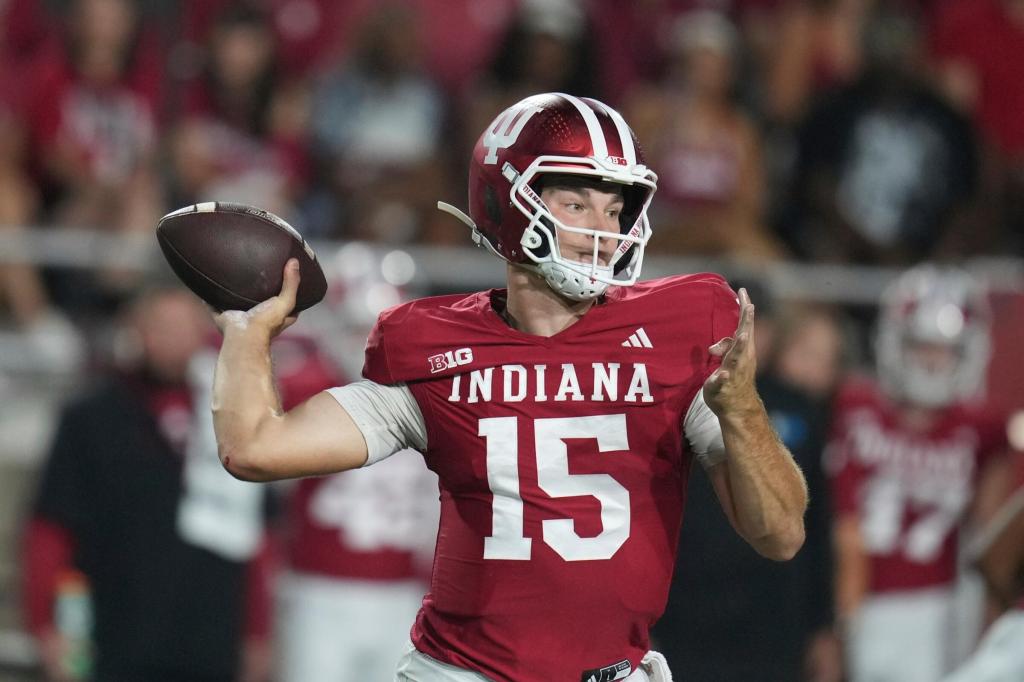
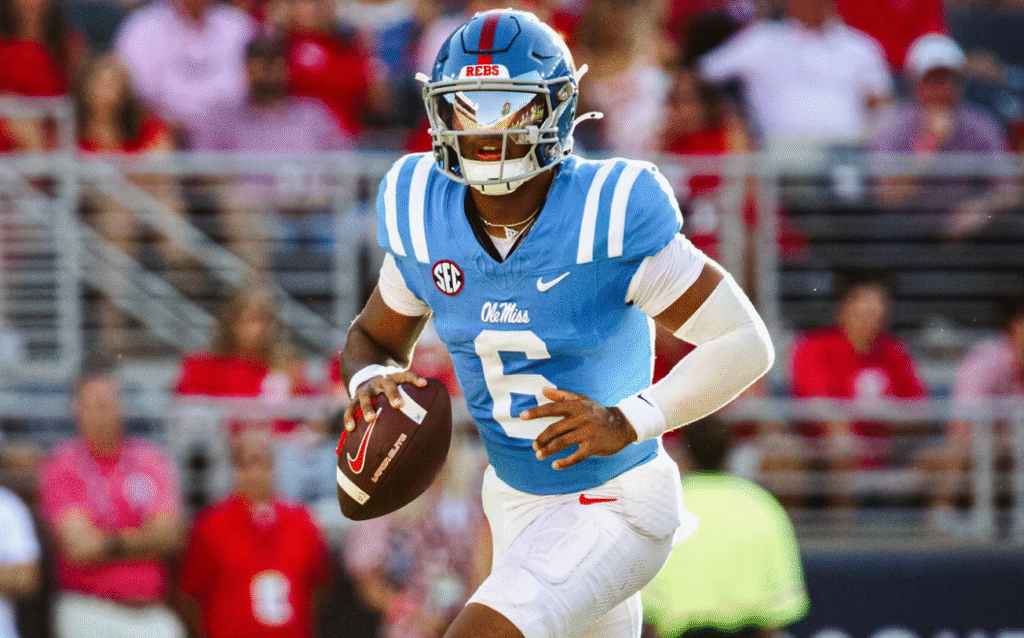
The four remaining teams in the college football playoffs were all fueled by transfer quarterbacks. Clockwise, from upper left: Indiana’s Fernando Mendoza (transfer from California); Oregon’s Dante Moore (UCLA); Miami’s Carson Beck (Georgia) and Ole Miss’ Trinidad Chambliss (Ferris State).
More than 4,500 Division 1 players have entered the transfer portal in 2026. The winter portal window officially opened on January 2, and runs through January 16. Quarterbacks usually command the highest prices. CBS Sports recently did a position-by-position salary price range (see below). The survey, done before the portal opening, now actually seems a little low as Texas Tech last week signed Cincinnati quarterback Brendan Sorsby to a $5 million deal. It’s been reported Demond is getting up to $6 million at his next stop. LSU and Miami have been mentioned as schools to watch.
For whatever it’s worth, I met Demond’s parents before the Michigan game in Ann Arbor. I told them “you must be proud of your son. We’re glad he’s a Husky.”
Less than three months later, he’s a Husky no more.
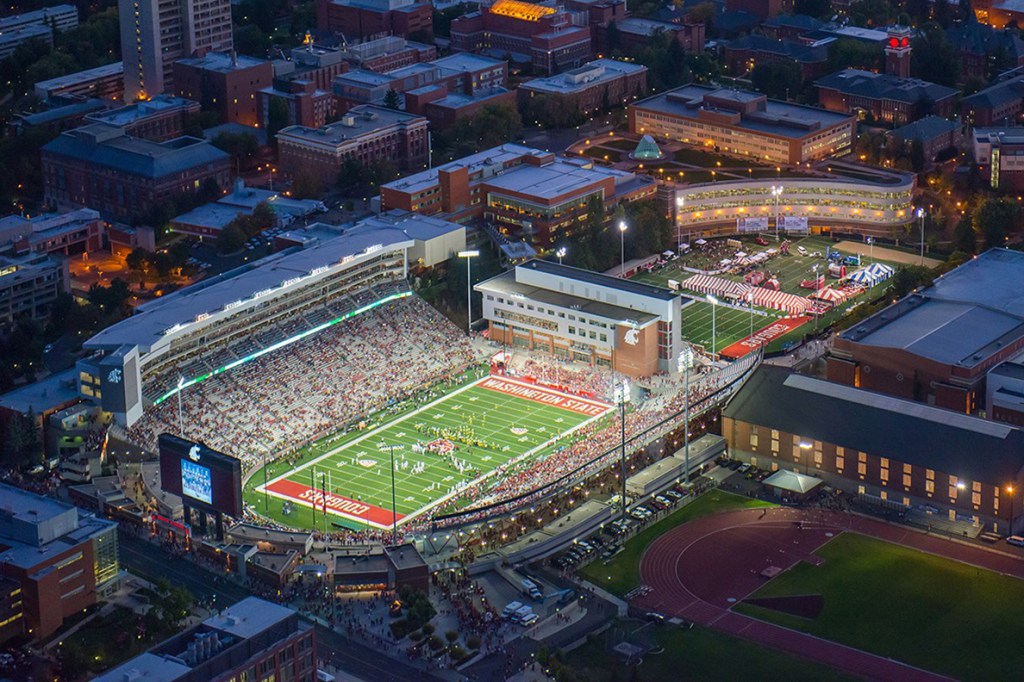
An aerial photo of cozy Martin Stadium, home of the Washington State Cougars, in Pullman. The Compton Union Building is just beyond the Cougar Football Complex behind the west end zone, and the Terrell Library behind that.
I don’t know why it took me so long. I was born in Washington, have lived all but nine of my 70-plus years in this state, yet until recently had never set foot on the campus of Washington State University in Pullman.
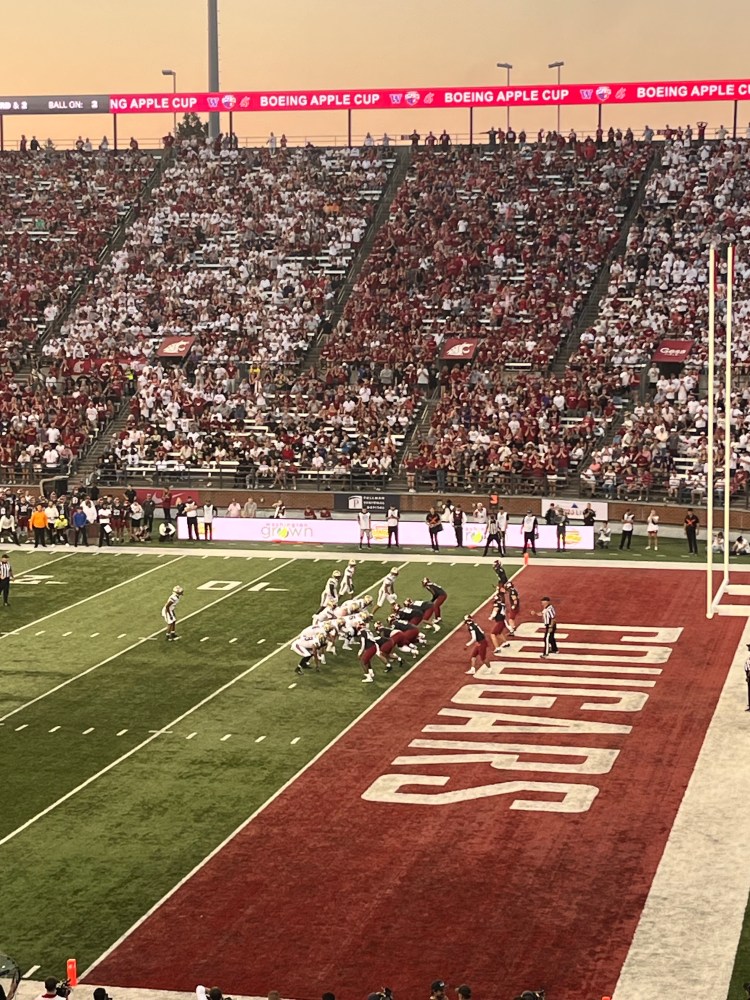
But there we were, in quaint Martin Stadium, surrounded by Cougar fans, on a sun-splashed, late September afternoon in the Palouse, to watch WSU and UW play in the Apple Cup. It was glorious.
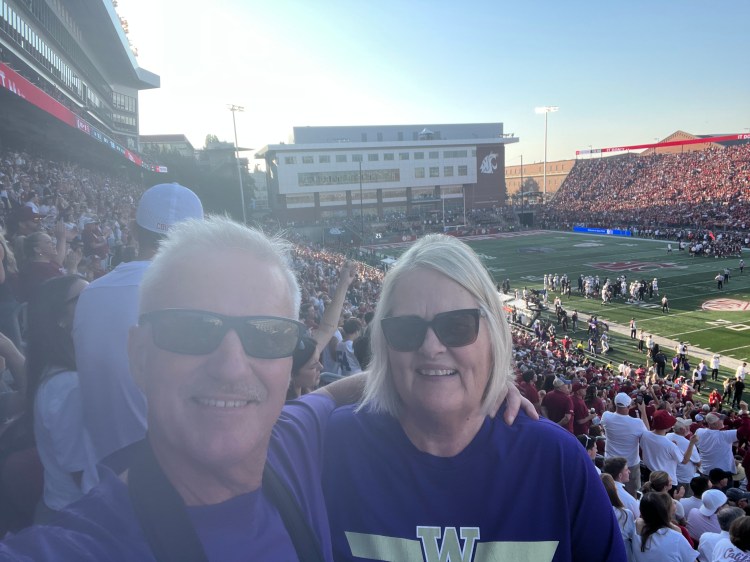
Vicki and I at the September 20 Apple Cup in Martin Stadium. That’s the Cougar Football Complex in the background. We were surrounded by Cougar fans, who were absolutely giddy that on this day beer was sold for the first time in the stadium (how ironic!). I asked the beer-drinking guy next to me if this was his first beer in the stadium. “No, it’s my fourth,” he replied. He was on beer No. 4 for the game.
I’m sorry I was late to the party. And having had many conversations with Coug alums over the years, I understand life at Wazzu was one big party!
I had always wanted to watch an Apple Cup in Pullman. But I could never summon the courage to make the trip over the mountains in late November, when the contest was traditionally played. I preferred to watch those games –usually played in sub-freezing temperatures, and occasionally in howling snow storms – from the comfort of my family-room couch.
That all changed when the Huskies left the Pac-12 for the promise of a more lucrative future in the Big Ten, leaving the Cougars to fend for themselves. The bold move – which WSU fans will never forgive UW for – relegated the Apple Cup to a non-conference matchup in September.
I, for one, certainly wasn’t complaining when the 117th Apple Cup kicked off at 4:40 p.m. amid 80-degree temperatures and a slight breeze. UW won the game decisively, 59-24, though for three quarters it was much closer than that. The game was okay, not great. It was the experience I won’t forget.
The Huskies drive for yet another touchdown in their 59-24 victory over the Cougars, a game that was more competitive than the final score indicated.
My perception of Pullman had always been colored by Apple Cup humor. You know, the back-and-forth jokes between the two schools in the days leading up to the rivalry game, including the one about directions to Pullman: “Go east until you smell it. Then go south until you step in it.”
Many WSU fans perceive UW fans as “arrogant,” and chafe at Huskies referring to Cougars as their “little brother.” Or, perceiving Cougars as country bumpkins, “Cousin Clem.”
Even legendary UW Coach Don James, who was usually understated and not one to take shots at an opponent, could talk some smack. Once speaking at a spring coaches tour in Portland, James referenced Pullman.
“A tornado went through there,” he said, “and did a million dollars worth of improvements.”
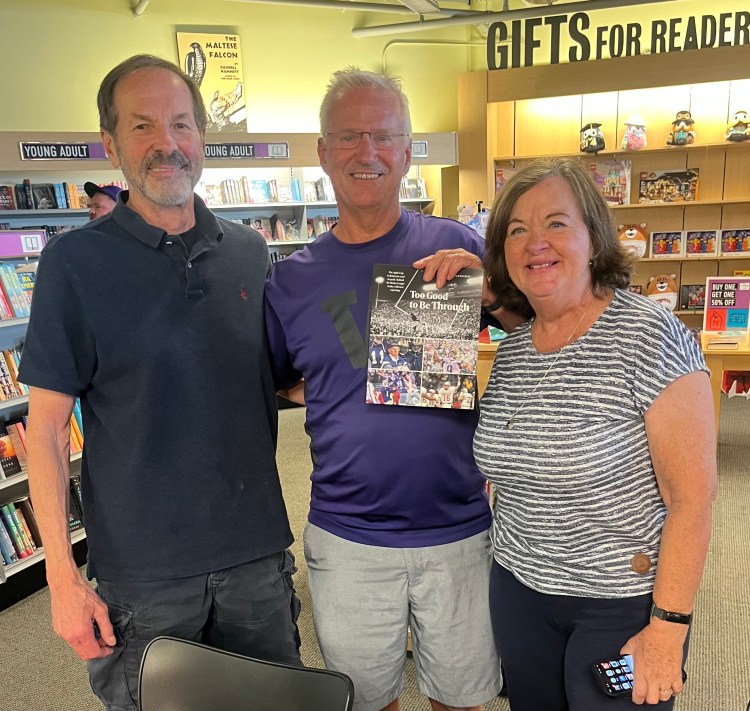
Myself with Bud Withers, and his wife, Velvet, in the WSU Bookstore before the Apple Cup. I’m holding Bud’s book “Too Good to be Through.” It’s the first book written on the Apple Cup, and one I highly recommend. Bud is an award-winning sports writer. We worked together for several years at The Seattle Times.
Husky and Cougar players were also known to talk a little trash. Before the 1987 Apple Cup in Seattle, UW quarterback Chris Chandler said this of the Cougs:
“No matter what happens, they have to go back to Pullman. And I feel sorry for them.”
Shed no tears for the Cougs. They love Pullman – and are fiercely loyal and true to their school.
The Cougar Band plays the school’s fight song before the teams take the field. That’s the student section on the left side of the grandstands across the field. Alcohol wasn’t allowed to be served there, but of course we all know alcohol has been consumed in that section for many decades, as is the case with most schools.
My friend and former colleague, Craig Smith, covered WSU football for The Seattle Times in the 1980s and 1990s. Because the team was his beat, Craig spent a lot of time in Pullman. I remember him telling me he was struck by the tight-knit, bond WSU students seem to have – the sense of family, an “us against the world” mentality while isolated together in the remote town in the northeast corner of the state. Years after graduation, Cougars are drawn “home” to the familiar haunts of ole Wazzu. Craig called this sense of community “Mother Pullman.”
Driving east from the Columbia River on Highway 26, and passing the rolling wheat fields of the Palouse, is the only way to run to the warm embrace of “Mother Pullman.” Can’t say there’s anything memorable between the river and Othello. But once you hit Washtucna, you see the familiar “quilting effect” of the rolling hills, which change from vibrant green in spring to golden brown in the summer. Giant grain elevators proudly proclaim “GO COUGS” in bold letters the closer you get to Pullman.
Finally, NW Davis Way leads you down the hill to the edge of downtown Pullman. Except there’s nothing really special about the downtown. Instead, your eyes are fixed on the big hill behind downtown, and the towering brick buildings that adorn this picturesque, 620-acre campus. Pullman IS Washington State University.
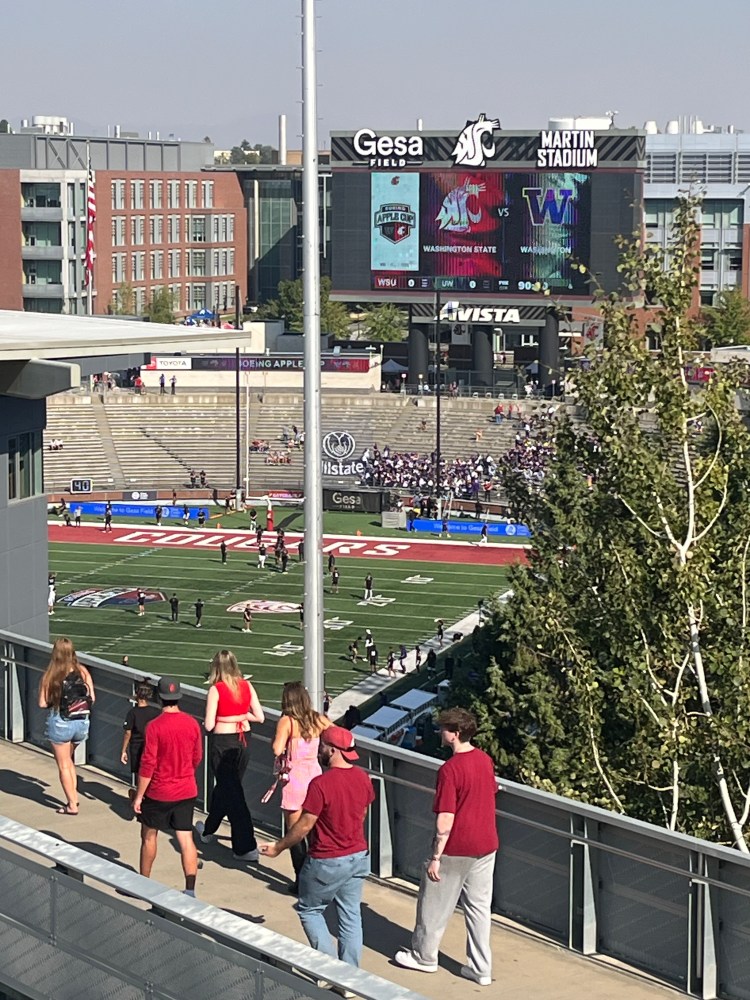
Martin Stadium is not separate from campus, as Husky Stadium is at UW, and Autzen Stadium at the University of Oregon. The stadium is carved into the campus. The Compton Union Building (bookstore) and Terrell and Holland libraries are a couple minutes walk from the stadium, as are several other classroom buildings.
Down Colorado Street, near the frat houses, is the historic “Coug” restaurant and bar, where former WSU coaches Jim Sweeney, Walden, Dennis Erickson, Mike Price and Mike Leach were known to drown their sorrows after a tough loss, or celebrate a big victory. Just east of the stadium, near the indoor practice facility is Ferdinand’s Ice Cream Shoppe and WSU Creamery, which Cougs claim serves the best ice cream on the planet. You can also purchase popular “Cougar Gold” cheese there.
It is here, on this quaint, walkable campus, where memories are made, and lifelong bonds are formed. My friend Dave Harrison, who played football for Jim Walden and remains a die-hard Coug, met his wife at Wazzu.
The terrace along Terrell Library offers great views of the stadium.
“It’s (WSU) a pretty special place for Ann and me,” he said wistfully.
Even Huskies acknowledge this. Perhaps Joe Steele, a star running back for UW in the 1970s, said it best.
“Washington State’s a beautiful place,” Steele told Bud Withers in his recently-released book “Too Good to be Through,” a historical account of the Apple Cup. “The campus, where it sits, the stadium. The Washington experience is one thing – it’s inner-city, it’s got its challenges … one thing about the Cougars, you go to Washington State, you’re Cougars for life.”
1982: When the rivalry got serious
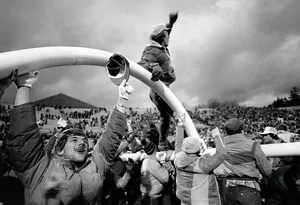
Cougar fans tear down the goal post after WSU stunned heavily-favored UW in the 1982 Apple Cup. The students eventually carried the goal post out of Martin Stadium and dumped it into the Palouse River.
I was a young sportswriter in Oregon working in the office one Saturday afternoon when the Associated Press teletype machine spit out the shocking final score: Washington State 24, Washington 20. It was one of those “I-remember-where-I-was-when-I-heard” moments.
The Huskies entered the game 10-1 and ranked No. 5 in the nation, and only needed to defeat the 2-7-1 Cougars to return to the Rose Bowl for the third consecutive year. UW was behind 21-20 in the waning minutes of the game, but seemed destined to break the hearts of the Cougar faithful when usually-reliable kicker Chuck Nelson lined up for what appeared to be a 33-yard, game-winning field goal. But the referees ruled Nelson’s kick sailed inches wide right, ending his streak of a then NCAA-record 30th consecutive made field goals. It was WSU’s first win over UW in nine years. Instead of a trip to Pasadena, the loss sent the Huskies to the Aloha Bowl.
As a follower of UW sports since my earliest memories (thanks dad!), I had always viewed the Apple Cup as a nice, intrastate rivalry. Back then, in most years neither the Huskies nor the Cougars were very good. Hence, there wasn’t much on the line. But by the late ’70s, the UW football program had become a player on the national stage under James. There was this aura of invincibility under the legendary coach. Not only had James proven he could win big games, his teams usually won when they were supposed to. How could UW lose to such an inferior opponent?
The game in 1982 was also the first Apple Cup played in Pullman in 28 years. Prior to that, WSU’s home games in the rivalry were played in Joe Albi Stadium in Spokane. Bringing the game back to Pullman gave the Cougars more of a – and frankly overdue – home-field advantage. Cougar fans were so excited to beat the Huskies they tore down a goal post, carried it out of the stadium and dumped it in the Palouse River.
My friend Dave was a backup center and special teams player on that ’82 team. He said the Cougs were still smarting from the previous year’s game, in Seattle, when the Huskies won 23-10 in a winner-to-the-Rose Bowl game.
“After watching my high-school teammate (UW receiver and future Seattle Seahawk) Paul Skansi catch a touchdown pass, and the very long bus ride back to Pullman after the 1981 game, I just remember how painful that was for all us,” recalled Dave. “After a miserable season in 1982, returning the favor was pretty big for us Cougs.”
The ’82 game would not be a fluke. The following season in Seattle, the unranked Cougs knocked the Huskies out of the Rose Bowl once again. This time, with a big, physical defensive front, they completely shut down No. 15 Washington, 17-6. Just as the ’81 game stung the Cougs, the back-to-back losses to WSU had to be galling for UW fans.
Although the Huskies have had the upper hand for the most part since, I believe that game 43 years ago was a turning point for the rivalry. That’s when the Apple Cup became more competitive – and jokes and the trash talk began.
Below are the Apple Cup scores from 1974-1985. The 1982 season marked the return of the game to Pullman, andstarted a run where WSU won three games in a four-year span.
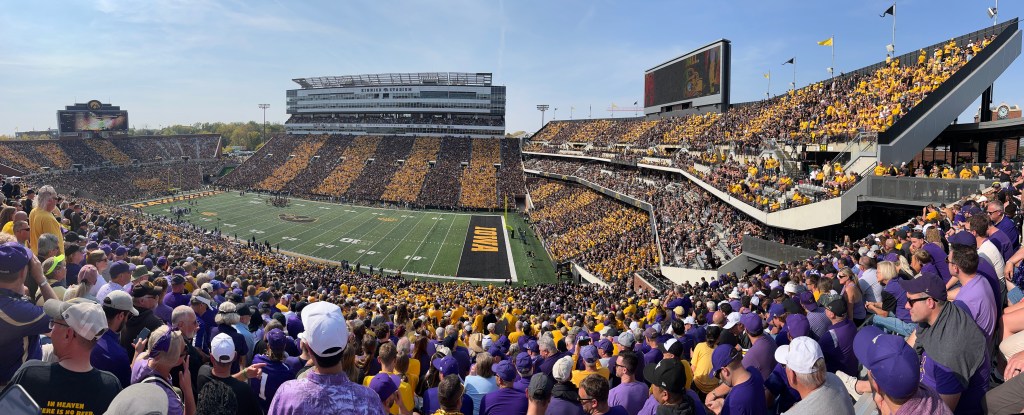
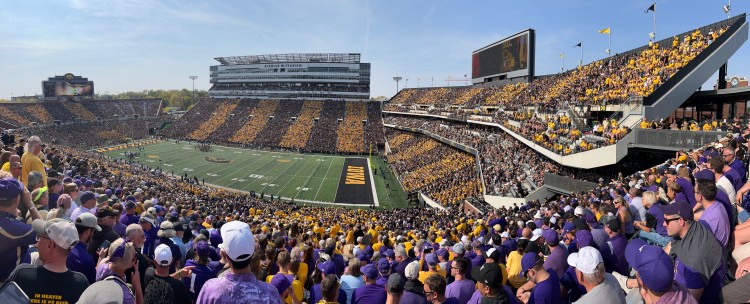
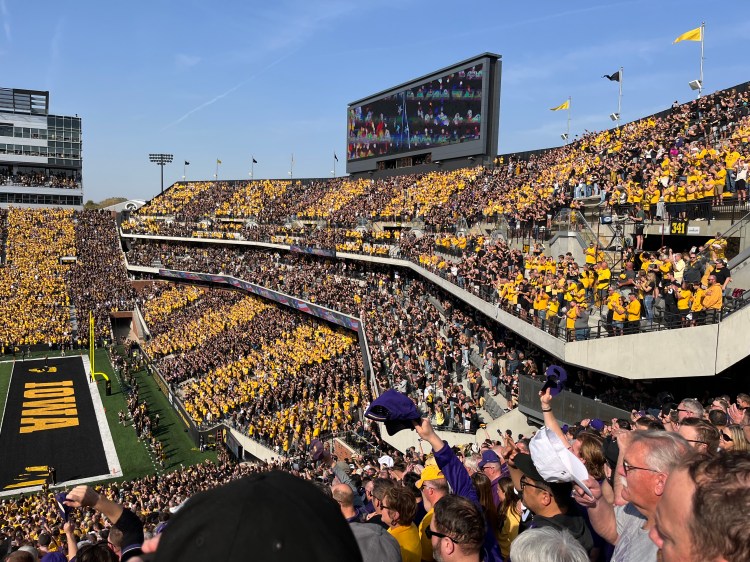
Sold-out Kinnick Stadium for the October 12 game between Iowa and Washington in Iowa City.
“Thanks for coming,” said an Iowa fan, as Vicki and I walked out of Kinnick Stadium near the end of Iowa’s 40-16 dismantling of Washington on Saturday. “I hope our fans here treated you well.”
They certainly did. Better than the visiting team was treated, for sure. We came a long way to watch the visitors from the Pacific Northwest bullied by the always-physical, corn-fed team in America’s Heartland. But while I was expecting the Huskies to be more competitive against slightly-favored Iowa, I’d have to characterize our experience on an unseasonably warm, mid-October afternoon in Iowa City to be a worthwhile experience.
The primary reason for the trip was to visit our daughter Greta and family in their new home in the Chicago suburb of Wheaton, Illinois. But I also am keenly aware that there are eight Big Ten schools within a four-hour drive of Chicago.
I’d circled the UW-Iowa game on October 12 to visit historic Kinnick Stadium before the temperatures dropped too low for comfort. We made the three-hour drive on Friday to Davenport, Iowa, putting us within an hour’s drive of Iowa City for the 11 a.m. local time kickoff the following day.
This quaint college town off Interstate-80 in eastern Iowa was a paradigm shift for me. I was expecting a non-descript town surrounded by corn fields and flat plains. To my surprise, Iowa City is nestled amidst rolling hills. The Iowa River runs through campus.
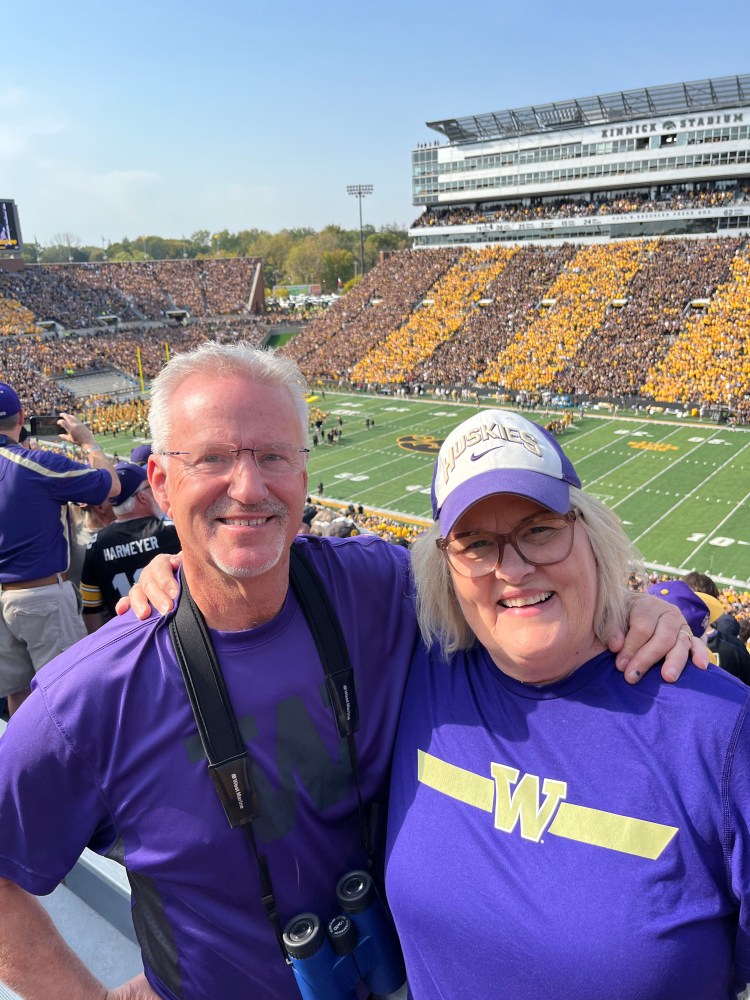
Vicki and I at the game.
The smell of barbecue and big-time college football were in the Midwest air as we walked past Hawkeye tailgaters toward the stadium, named after the school’s lone Heisman Trophy winner, Nile Kinnick. A 20-foot-tall bronze statue of Kinnick resides outside one end of that stadium. The stadium, built in 1929, is wedged between Carver-Hawkeye basketball arena, the university’s children’s hospital and other campus buildings.
The concourse at Kinnick Stadium. Banners of Iowa’s bowl-game appearances are on display, including the 1995 Sun Bowl game between the Hawkeyes and Washington.
Seating capacity is 69,250, slightly smaller than Husky Stadium. Walking down the concourses under the grandstands on each side of the field, the stadium shows its age. It’s obvious the original stadium was much smaller until the first of two major renovations, beginning in 2004, brought the capacity to its current 10th largest in the 18-team, Big Ten.
Some thoughts on the Iowa football experience:
“The Hawkeye Wave” to pediatric patients and their families in a children’s hospital takes place at the end of the first quarter of each Iowa football game.
The Hawkeye Wave: A few Iowa fans told me it’s the best tradition in college football. Not sure I can argue. It does tug on the heart strings. Started in 2017, when the clock hits zero at the end of the first quarter, fans, players and even the game officials turn their attention to the children’s hospital just behind the east grandstand. In unison, they wave to the pediatric patients and their families watching the game.
The game was a “Black and Gold Stripeout” day at Kinnick Stadium.
Striping Kinnick black and gold: The “Stripeout,” as they call it, was on display for this particular game. Fans in alternating sections wore black and gold. Not sure UW fans – perhaps more independent and less inclined to cooperate? – would comply to stripe Husky Stadium purple and gold.
Back in Black: The AC/DC song is blared in the stadium as the black-clad Hawkeyes in their Pittsburgh Steeler-look-alike jerseys make their way out of the locker room toward the tunnel. Not sure if this is a tradition, but on this day anyway, the team formed a large “V formation” and trotted out together holding hands as the band played “Fight, Fight, Fight for Iowa!”
The Iowa Hawkeyes take the field.
I-O-W-A Kinnick chant: A flag for each letter is placed in each corner of the field. In wave-like fashion, fans in each corner of the stadium stand up and yell as that flag is raised for those fans. It goes around the stadium several times. Ironically, the “W” flag happened to be in the corner of the stadium where most UW fans were, so we were happy to stand and salute the “W.”
“Iowa Nice:” This is not a tradition, just my observation of Hawkeye football fans in general. I’ve heard of “Minnesota Nice,” not necessarily the Iowa version. But I actually saw an Iowa fan wearing those words on his shirt. It’s true. From the tailgaters in pregame who offered Vicki and I food, to the Iowa fan seated next to me who handed me some me peanuts – well, at least that was after the Hawkeyes had built a comfortable lead – they couldn’t have been more friendly and welcoming.
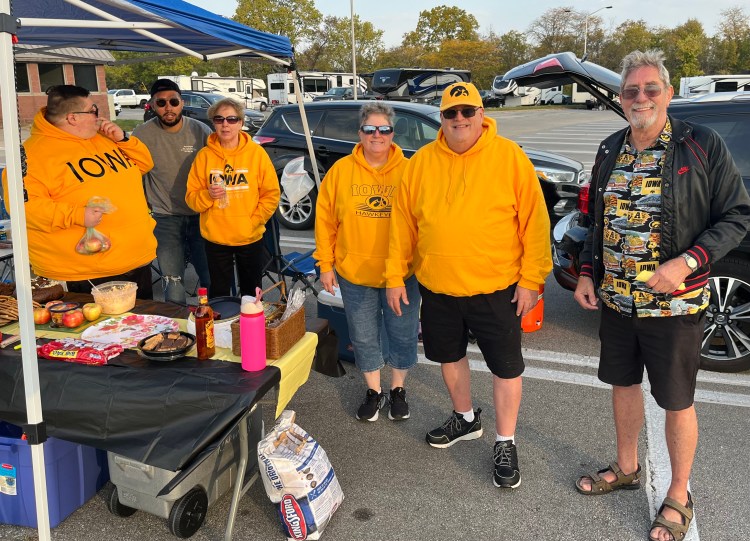
Struck up a conversation with these Iowa fans in the parking lot before the game. They offered me food.The most recent addition to Kinnick Stadium, the north end zone, completed in 2019.
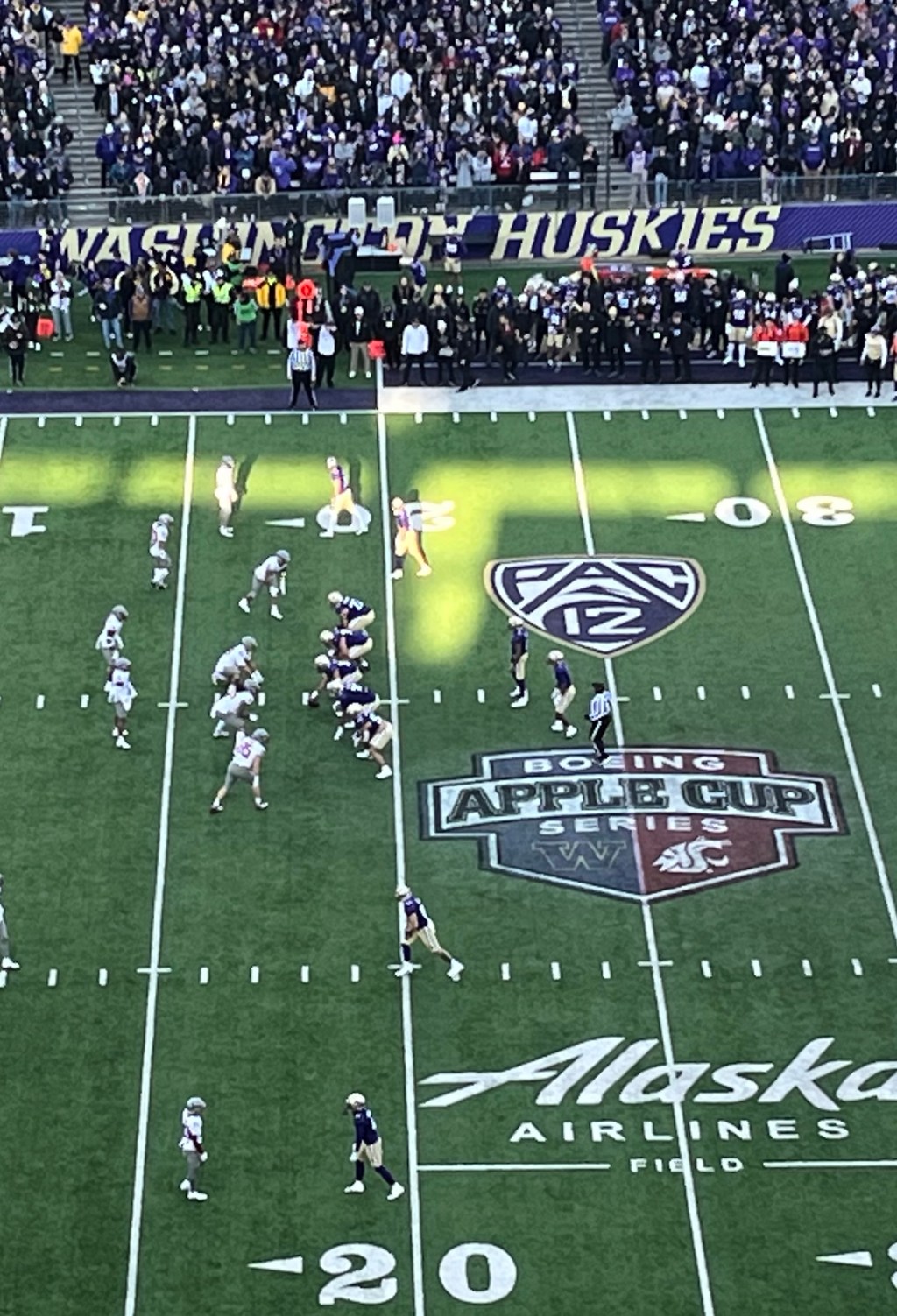
The last Pac-12 Apple Cup game between Washington and Washington State, played November 25, 2023 at Husky Stadium (Photo by Rick Lund)
The 2024 Apple Cup by all accounts appeared to be one of the more anticipated matchups of the season. The rivalry game between Washington and Washington State that at one point was in danger of being another realignment casualty, was salvaged among the scraps from the wrecking ball that destroyed the Pac-12, sending UW to the Big Ten and its in-state foe with only Oregon State as a conference partner.
But as UW football season ticket holders this past week were invited to an “exclusive pre-sale” of tickets for the Sept. 14 game at neutral-site, Luman Field, the response has been tepid at best.
Dawgman.com, a website for the most rabid of Husky fans, published results of a poll that asked its readers if they were planning to attend the Apple Cup. Only half of the responders said they were going. For a game played in Seattle, that is almost unheard of in the 115-year history of the rivalry, one of the oldest in college athletics.
The Apple Cup may be running out of juice.
Much of the sentiment seems to be that since UW and WSU are no longer in the same conference, the rivalry no longer means as much. The Apple Cup has traditionally been the last game of the regular season, where in many years there was much on the line.
But there’s also the ticket prices. I am one of those season-ticket holders, and I’m still recovering from sticker shock. The cheapest ticket is $94, which gets you in the corners of the 300 level. Most of the seats in the 69,000-seat stadium are more than $200 apiece, and top out at $424.
Because the game will not be played in Husky Stadium, it is not a part of our seven-game, season-ticket package, which is expensive enough. Vicki and I are retired. We had a discussion the other day about the Apple Cup. It was short. We’re gonna pass.
I’m also not sure Cougar fans are chomping at the Apple Cup. The neighbor at our lake cabin is a resident of Sammamish and a longtime Wazzu season-ticket holder. The trip to Luman Field is a 30-minute drive. But he told me the other day that he and his wife aren’t going.
Ticket prices and a less-important, non-conference matchup may have something to do with that. More likely, however, the core of Apple Cup apathy for WSU is hard feelings. Not sure Cougar fans will ever forgive UW for jumping ship to a more lucrative future in the Big Ten, leaving the Cougs to fend for themselves with a conference-replacement schedule of Mountain West schools for at least the next two seasons.
And in this new era of college sports, where geography and tradition no longer seem to matter, that is a darn shame.