Hoosier Hysteria

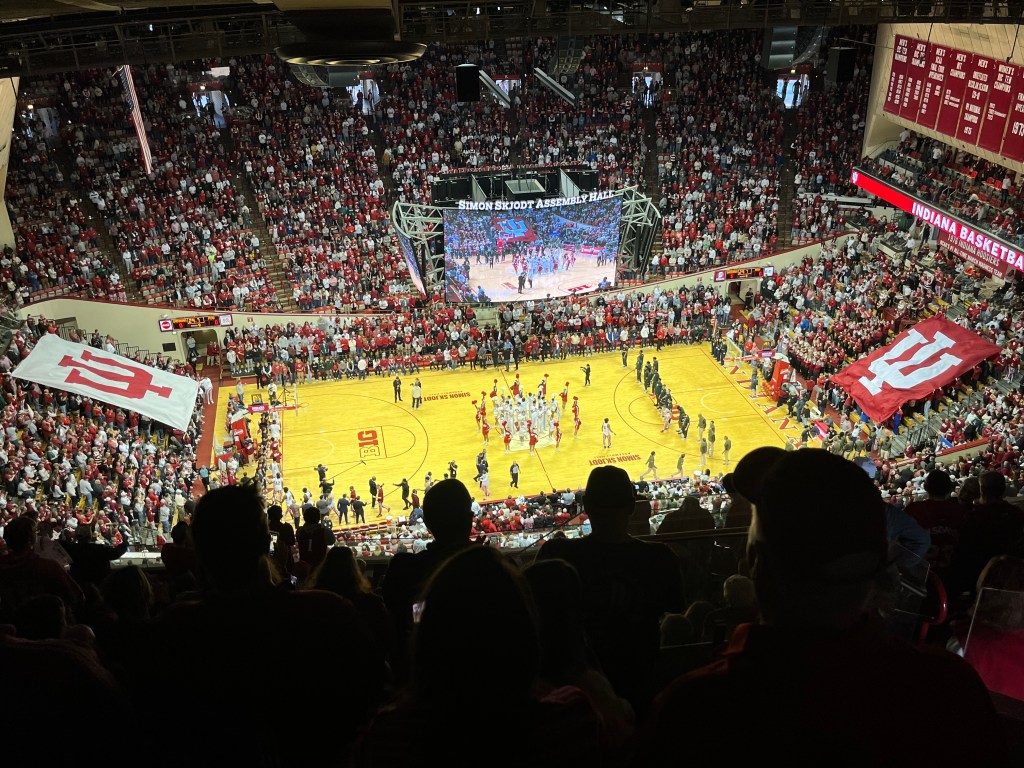
Indiana prepares to face Michigan State March 10 in Simon Skjodt Assembly Hall in Bloomington, Indiana. Built in 1971, this iconic basketball arena holds 17,222 fans. Basketball is more than a game in Indiana. It’s a way of life.

Never daunted, we cannot falter

In the battle, we’re tried and true

Indiana, our Indiana

Indiana we’re all for you! I-U!

BLOOMINGTON, Indiana – Most of the 16,000-plus fans were clearly all for Indiana on a crisp, sunny Sunday afternoon here in the heart of the Hoosier State.

That would include myself, admittedly a college sports nut, and wife Vicki, who has become a fan of college athletics largely through osmosis , i.e. married to me for nearly 47 years. I’ve had a long fascination with college football stadiums and college basketball arenas. Iconic Assembly Hall, if not the Holy Grail, was as least toward the top of my bucket list.

I had seen countless televised games from venerable Assembly Hall. To finally step inside the 53-year-old arena was a thrill (I know, I’m easily entertained). My eyes immediately went to the familiar outline of the state of Indiana at half court, and the iconic steep wall behind one basket. The majority of the 17,222 seats are along the sideline. Only a limited number of seats are behind the two baskets. Assembly Hall is known for its unique design of steep sides, which combined with capacity crowds, makes it one of the loudest venues in college basketball. A 2012 poll of four ESPN pundits ranked it third in terms of best home-court advantage in the country.

It’s more than steep sides and big crowds, however, that has made this place a living hell for opponents. More often, it’s been the home team wearing crimson and cream. Assembly Hall has been the home to three national championships, 32 straight winning teams, 14 conference champions and home winning streaks of 50 and 35 games.

Before the game, Vicki and I toured the massive lobby leading to the arena, which proudly displays the school’s championship banners, trophies and sculptures of Indiana greats. We had our picture taken in front of the sculptures of Indiana’s unbeaten, national championship team from the 1975-76 season.

Posing for a picture in front of sculptures of the starting and senior players from Indiana’s historic 1975-76 team that went 32-0 and claimed the school’s third national championship. The players are Bobby Wilkerson, Kent Benson, Scott May, Quinn Buckner, Jim Crews and Tom Abernathy. Its coach, Bob Knight, requested he not be dipicted in this sculpture. This team remains the last undefeated NCAA men’s basketball champion.

The Hoosier team we saw play Michigan State isn’t one of those great teams. These days, Indiana is middle-of-the-pack in the Big Ten, a far cry from the perennial national championship contenders under legendary Coach Bob Knight, whose 29-year reign abruptly ended with his controversial firing in 2000.

Twenty-four years later, however, the coach they called “The General” still casts a long shadow. Alhough you won’t find a statue of Knight in or outside the building (Knight’s choice), his image popped up frequently on the video screen overhead the court. Perched in our balcony seats high above the Indiana bench, I could only imagine what it was like that day in 1985 when Knight, in a fit of rage, famously threw a chair across the court after being assessed a technical. You can watch it here:

https://www.youtube.com/watch?v=ukpekodCQ-U

The Knight-Indiana divorce was messy. The bitter coach for many years refused to show his face at Assembly Hall, even though he had moved back to Bloomington after retiring from coaching at Texas Tech in 2008. He finally relented in 2020 to attend a game along with many of his former players, about 20 years after his ouster. The Hoosier crowd roared. Less than three years later, he passed away at the age of 83.

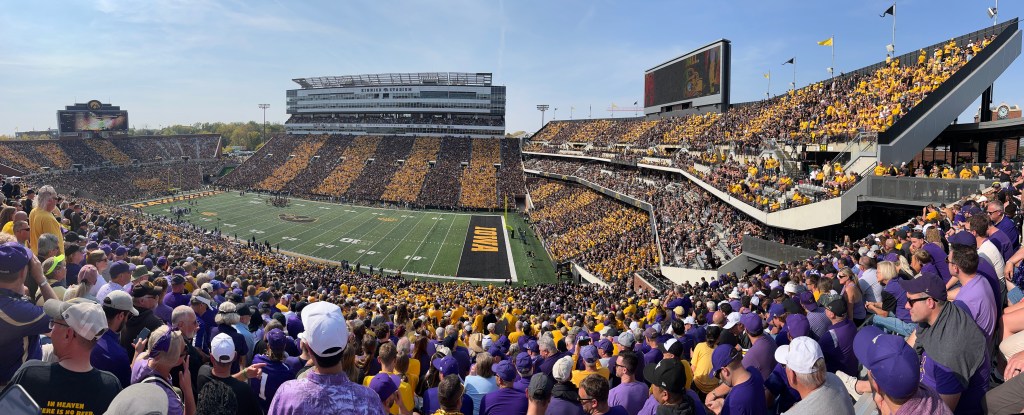
Despite the program’s downturn after the Knight era, you’d think this last game of the regular season had conference title implications. The near-capacity, Hoosier faithful were on their feet for much of the game, clapping in unison whenever the pep band played the school’s fight song “Indiana, Our Indiana,” during timeouts, and roaring with approval when the home team went on a scoring run.

Fans are on their feet during a break in the action, singing along to the school fight song played by the IU pep band.

The University of Washington needs to work on its game-day experience once it enters the Big Ten next fall. Basketball is more than just a game here in the Heartland. In Indiana, it’s a way of life. The Huskies will not only face good basketball teams in their new conference, but big-time venues fueled by large, passionate crowds.

On this second Sunday in March, the hot-shooting Hoosiers jumped out to a 20-5 lead, only to fall behind in the second half before rallying at the end for a nail-biting, 65-64 victory.

Before the game, we took a walk through the old part of IU’s beautiful campus. Most or all of the buildings are built from Indiana limestone mined from the famous quarries south of Bloomington, also known as “B-Town.” We also stopped in at the Student Union Building, which houses the bookstore and a massive selection of IU shirts, hats and other gear. The Journalism School is next door, named after its most famous alum, Pulitzer Prize-winning journalist and World War II correspondent Ernie Pyle.

All of these tour tips came from my former boss, Bob Silver, who served as sports editor at The Seattle Times early in my tenure there. Bob is an IU alum, and was a member of the school’s swim team. Bob now lives in Walla Walla, Washington, and is retired, but says he if were to ever live in the Midwest again, he’d choose Bloomington.

The old part of Indiana’s University’s campus. Most of the buildings were built from Indiana limestone.

French Lick? Hick, yes!

We flew to Indiana to visit our daughter, Greta, and family, who live in Valparaiso. In previous visits we had never ventured south of Indianapolis. But this time, after three days in Louisville, Kentucky, we took some back roads to French Lick, the home of Boston Celtic legend Larry Bird, on our way to Bloomington.

I will have to say this stop off the beaten path took some convincing. Vicki was not a fan of the extra 45 minutes it would add to the drive to B-Town and the Indiana-Michigan State basketball game later that afternoon. But this wide spot in the road in southwest Indiana was also on my bucket list.

Tiny Springs Valley High School is just off State Route 145 on Larry Bird Boulevard.

We drove down Larry Bird Boulevard to his old stomping grounds, Springs Valley High School and the teen center and outdoor court where he used to play. A bust of Larry Bird resides outside the teen center.

The bust of Larry Bird, known as “The Hick from French Lick,” at the teen center next to Springs Valley High School.

Larry Bird, if you haven’t heard of him, is widely regarded as one of the greatest basketball players of all time. That he played ball at tiny Springs Valley High School in one of the poorest regions of the state is even more remarkable.

Larry’s father, Joe Bird, struggled to hold a job. A veteran of the Korean War, he suffered from what we know now as post traumatic stress disorder. He was a heavy drinker. He often threatened to kill himself. Finally, he delivered on that promise, taking his life at age 48. The financial burden in the family fell to Bird’s mother, Georgia. As a waitress at a restaurant, she barely made enough to put food on the table.

Years later, Bird would say, “growing up we didn’t have much. I just spent all my time playing basketball.”

Even so, Bird was not an instant sensation. He barely made the varsity team as a 6-foot-1 sophomore. As a junior he had grown two more inches, but was known more as a defensive specialist. But by his senior year, he put it all together. He had grown to six-foot-seven-inches. As he perfected his offensive game, he began to dominate high-school competition.

Inside the Springs Valley High gym, where Larry Bird dominated play, averaging more than 30 points and 20 rebounds per game his senior season.

Playing in front of a a packed house in his home gym for every game, Bird averaged 30.6 points and 20.5 rebounds his senior season, making the all-state team. He was offered scholarships to Kentucky and Indiana, among others, choosing to sign with Bob Knight’s Hoosiers. But whether it was living in the bigger city of Bloomington, or he got cold feet at the prospect of playing for the demanding and volatile Knight, one month into his freshman year Bird walked away. He returned to French Lick, enrolled in a local school, Northwood Institute, and went to work as a garbage man to help pay for tuition. He would eventually leave that school as well. Indiana State Coach Bill Hodges, however, didn’t give up on Bird and convinced him to join the Sycamores in Terre Haute the following season.

Bird would soon become among the leading scorers in the nation. After being drafted by the Boston Celtics after his junior season, Bird elected to return to college for the 1978-79 season. He would lead Indiana State to an undefeated regular season, and finished the season with a national championship game matchup with future NBA great Magic Johnson and Michigan State. The Spartans won in one of the most-watched title games in history, a game which elevated college basketball to another level.

Eventually, the “Hick from French Lick” would be known around the world as “Larry Legend.” Bird would play all 13 of his NBA seasons with Boston, leading them to three NBA championships. He was a 12-time NBA All-Star, won two NBA Finals MVP awards and received the NBA Most Valuable Player award three consecutive times (1984-86).

Not bad for a Hick from French Lick.

Bucket list checked.

A cold, devastating blow on the eve of Christmas Eve

    On a dark, frigid afternoon in the Pacific Northwest just two days before Christmas, the email from The Seattle Times that popped up on my phone took my breath away.

   “Passing along sad news from Beth,” wrote Angela Lo, my former colleague, referencing the Metro editor working the news desk that day. ”Bill Kossen died of a heart attach today. He collapsed after a running event.”

Bill’s online obituary.

I stopped in my tracks on our walk with a couple of our friends. I couldn’t believe what I was reading. Not Bill, I thought. Not one of the good guys.

   Bill was only 68 when he collapsed and could not be revived during a Holiday Fun Run at Magnuson Park in Seattle. The news sent shock waves through The Times. That would include not only people who work there now, but many more people no longer with the paper.

  Even though Bill retired in 2015, ending a 25-year run at The Times, Bill’s death was felt deeply by all who knew him. Bill was selfless. He retired, in part, to spare a younger journalist from being laid off at a time when the paper was cutting staff. In his retirement, he volunteered many hours at Garfield High School.

   Bill was a dear friend. I got to know him in 2006, when he embraced me during my awkward landing in News and Business from Sports. Bill was bright, informed about all things Seattle, and hilariously funny. We were both members of the “Northwest Basketball Legends.” I last saw him in May at our annual luncheon.

You think I’m a punster? Bill was the “Pontiff of Puns.” But Bill begged to differ.

  When I retired in 2020, he wrote on my farewell page: “It was the best of puns. It was the worst of puns. It is a tale of two guys, Rick and Bill, the so-called Punzi-scheme brothers. So called because that’s what Rick called us. He was the kingpun. No one could top Rick’s wayward way with words. I tried.”

A mock Business cover front I did a few years back. Rick and Bill were known to “pun-tificate” at Business meetings at The Times.

  We quickly became “Partners in Pun” as we worked together on the Business section, turning what should have been 10-minute, weekend planning meetings into 30-minute sessions as we rifted back and forth.

   Bill was one of several of my Times colleagues who attended my 60th birthday party in Skagit County in 2014. In fact, he was one of the speakers, sharing the page you see above, as well as a box of “Lund’s Swedish Puncakes” he had given me as a present.

    When it came time for me to speak, I mentioned that although I never made a lot of money as a journalist, as I stood surrounded by my family and friends, I considered myself that day “a rich man.” That line seemed to resonate with Bill. When I saw him in the office the next week, he said “hey, it’s filthy-rich Rick!”

   While Bill was popular at The Times, and one who was great up front as a comical emcee at “Times farewell-to-employee gatherings,” he also had a serious side.

He was a big fan of Rev. Dale Turner, who served for 24 years as senior pastor of University Congregational Church in Seattle, and wrote a religion column for The Seattle Times for 21 years. He had all of Rev. Turner’s devotional booklets. We talked about our faith journeys. Bill was moved by the story I wrote for The Times in 2006 about my church-sponsored, multiracial bus tour of the Deep South called “The Sankofa Journey.” The two of us attended the funeral of our beloved colleague at The Times, Charles Brown, at Mount Zion Baptist Church in Seattle, where Charles was a member. Charles was one of the first African-American reporters at The Times.

We usually don’t give much display to staffers who pass away. I was steering the bus this day. I threw that unwritten rule out the window.

I was working under contract with The Times on a part-time basis when Bill passed away. And I was working the night his obituary was to be published. Coincidence? No. It was surreal, and with a heavy heart, that I designed the story on the local “Northwest” section cover print edition. I gave him extra treatment and space, did my best for him, and yet I didn’t, couldn’t, do him justice.

He is deeply missed.


A spectacular day at USC

The sun sets behind historic LA Memorial Coliseum at halftime of Saturday’s game between Washington and USC.

What a day in LA LA land.

The University of Southern California has a rich football tradition. All that history, SC’s game-day traditions and the pageantry of the great game of college football were on full display on a beautiful, sunny day in Los Angeles.

We flew into Santa Ana on Friday, and made the hour or so drive to the USC campus Saturday morning, long before the 4:30 p.m. kickoff. The LA Memorial Coliseum, the home of the Trojans since 1923, is adjacent to USC. So most people park in designated parking lots around campus and walk to the stadium, which is about a mile away. And that’s what makes this experience unique.

Tailgating tents line the wide, brick-pathed walk through the beautiful campus. It was homecoming for USC, so there was even more alums on campus than usual. They were in a party mood. We enjoyed our time just walking around campus and milling with USC fans.

Fans walking to the stadium along Trousdale Parkway.

Along the way, we were fortunate to meet a USC alum and season ticket holder named Jeff. He suggested we stop by the “Tommy Trojan” statue and Heritage Hall, a monument to USC’s storied football program. Trojan fans line up to have their picture taken in front of the statue. We were in line with another couple wearing Husky gear. We took turns taking each other’s picture.

Vicki and I posing for a photo in front of the “Tommy Trojan” statue. I don’t think we’re doing the “Dubs Up” correctly.

Heritage Hall houses all the national-champion trophies and jerseys from SC’s glory years. USC has won 11 national championships and produced 14 pro football hall-of-famers. Its most prized treasures, however, are the school’s eight Heisman Trophies, the most prestigious award in college football. That’s eight more than UW has. But as a SC fan pointed out to me as I snapped pictures of each one: “You could have your first this year.” That would be UW’s record-setting quarterback, Michael Penix, Jr.

Heritage Hall is open to the public. Many USC fans visit before the game to take the “Heisman Tour.” I really enjoyed walking down memory lane here, looking at memorabilia from USC greats I grew up watching as a kid.
Eight Heisman Trophies are housed in Heritage Hall. This one belongs to O.J. Simpson, who played at SC in 1967 and 1968. That was long before his success was overshadowed by his trial and controversial acquittal for the murders of his former wife Nicole Brown and her friend Ron Goldman.
Vicki talking smack to “Tommy Trojan” before the game. Well, that’s actually not true. She asked him if I could pose for a photo with him. He said “no.” I guess he was in a hurry to get to the stadium to watch his team lose.

Southern Cal is a private school It has a reputation for a being a little uppity. I was once told USC stands for the “University of Spoiled Children.” I also have imagined that grown-up USC fans have been spoiled over the years by their football team’s success. The USC teams I knew as a kid largely dominated the old Pac-8, and steamrolled their Pacific Northwest foes. But championships have eluded the Trojans since Pete Carroll left the school in 2009 to take the Seattle Seahawks coaching job. Stepping into the void have been Oregon and Washington, and more recently Utah, in the soon-to-be-defunct Pac-12.

USC’s alumni cheerleaders and band on their way to the game. They would be followed by the school’s marching band an hour later.
We dropped in a Husky tailgate party sponsored by the UW Alumni Association in Exposition Park, between the USC campus and the stadium.

USC fans were welcoming and hospitable. Let’s just say you wouldn’t get this kind of reception from the Yucks in Eugene. Some, however, need to get outside their SoCal bubble. One asked: “So where is UW? In Spokane?” The game-day experience here was big-time, a far cry from what we’ve experienced in recent years at Stanford, Cal, Arizona State and Arizona, where the football program is almost an afterthought.

We arrived to the stadium shortly after the gates opened at 3 p.m. (my mantra, “arrive early, stay. late”). And it was a good thing we did. We walked into a monumental, if not an unprecedented, ticket snafu.

UW fans were not happy to be sent to a “ticket resolution services” gate to have their tickets printed because their digital tickets wouldn’t scan for entry into the stadium. Perhaps Jen Cohen (former UW AD, not at USC) was behind this?

We were one of the first UW ticket holders to find out that our “digital tickets” were not scanning for entry into the stadium. We were re-routed to a “ticket resolution services” gate to try and get the problem solved. Soon after we got there, many UW ticket holders joined us. They were having the same problem. It turned out that all the digital tickets that USC sent to UW for distribution were not working with USC’s scanners. Our digital tickets, as well as thousands of others, had to be converted to printed tickets on site. I’m sure many Husky fans who arrived closer to game time missed kickoff.

Known as “the greatest stadium in the world,” the Coliseum was completed in 1923, with a capacity of 75,000. It has been the site of two Olympic Games, two Super Bowls, one World Series, as well as many other significant events. It was for decades also the home field for the Los Angles Rams, until 2020, when ScoFi Stadium opened. USC and UCLA shared this field for many years until the early 1980s. That’s when UCLA began playing home games in the Rose Bowl in Pasadena. UW fans and Husky band for this game were seated in the corner behind the far end zone, just to the right of the “SC” logo on the canvas covering a large section of seats.

USC, like most schools, places visiting fans in the least desired section of the stadium. Our seats were in the corner of the expansive Coliseum, well beyond the end zone. Leading up to kickoff, USC’s large marching band played “Conquest” over and over again. That is an earworm I wouldn’t wish on anyone. “Tommy Trojan” rode his white horse around the field. Then it was game time.

The USC marching band forming the script “USC” in pregame.It was a balmy 76 degrees at kickoff.
Washington takes the field to begin the game.

Both teams’ high-powered offenses didn’t disappoint. The UW defense made just enough plays in the fourth quarter to get the 52-42 win. It was easily the most points UW had ever put up on USC, and just the 13th Washington win in 44 games against the Trojans in the Coliseum. Penix threw for 256 yards and two touchdowns. But the star of the game for UW was running back Dillon Johnson, who rushed for 256 yards, fifth highest in school history.

The outcome, obviously, could have gone the other way. A UW loss, for me anyway, wouldn’t have spoiled the day.

A big-time college football game in a big-time setting was an experience I’ll never forget.

The stadium lights were dimmed at the end of the third quarter, and people turned on their smartphone flashlights. This is also done for night games at Husky Stadium.
After the game, the players came over to the area of the stadium where UW fans were seated to sing together “Bow Down to Washington.” This is a tradition after every UW victory.
Good night, Memorial Coliseum.

I brainwashed her, and I’m truly sorry … sort of

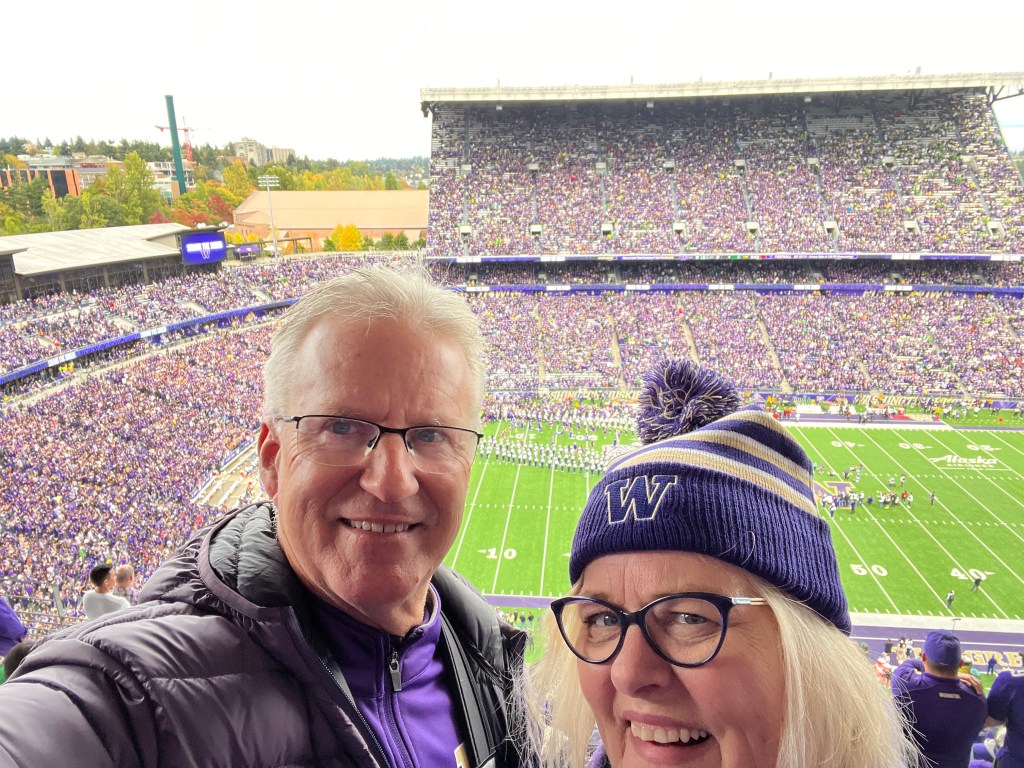
Vicki and I at the UW-Oregon game earlier this season in Husky Stadium. That was a good day, by the way.

Vicki teaches a Bible study on Friday mornings. Last week, she told her group she couldn’t be there tomorrow because she’ d be in California.

“Oh, you’re going to see your sister?” one of the women asks Vicki, who grew up in California and two of her sisters still live there.

“No, we’re going to LA to see the Washington-USC football game,” Vicki replied.

She’s a real Dawg. I mean that in a complimentary way. Vicki, like me, has become quite a fan of college football.

Looks of disbelief ensued.

Some people are surprised Vicki goes to more sporting events in a year than many women attend in a lifetime. It’s really not her fault. That’s what she signed up for when she married me.

We hadn’t been married two years when I was hired as a public relations intern for the Seattle Mariners. I had to be in the press box for all 82 games of that 1979 season. She watched several games in box seats in the Kingdome that year, but regretably spent many more evenings alone in our Capitol Hill apartment.

When we moved to Roseburg, Oregon later that year for my first full-time sportswriter job, she accompanied me to countless high-school games. She also occasionally tagged along when I made the hour-drive north to Eugene to cover University of Oregon basketball games. She sat under the basket and took pictures. There, she experienced first-hand the crazy Oregon fans that former UCLA Coach Gene Bartow once called “deranged idiots.” Some of her photos were published with my stories the next day in The News-Review.

Vicki did not grow up in a sports-minded family. Yet, she realized early in our marriage that if she wanted to spend more time with me, she had to embrace my passion for sports..

We’ve had season tickets for UW football games for 11 years. We usually go to one road game every year. We’ve been to nearly every football stadium in the soon-to-be-gone Pac-12. Last November, while spending the month in Tucson, we took in the Territorial Cup between Arizona and Arizona State. The storied Memorial Coliseum –which has hosted two Super Bowls, two Summer Olympic Games, and has been the home to the Trojans since 1923 – has long been on my bucket list.

Full disclosure here: I’m a college sports guy. My favorite day is any Saturday during the college football season. Thirty years in sports journalism soured me a bit on pro sports. I love the college, game-day atmosphere: The buildup to the game, the marching bands, the sense of excitement in the air, the rowdy student sections.

This photo I’m guessing was taken in 1968, just after the installation of artificial turf. This is the Husky Stadium I knew as a kid. The bleachers behind the east end zone are not shown here, so I’m thinking they were added shortly after. The upper south deck was built in the 1950s. The north upper deck wouldn’t be built until 1987. Everything you see here was demolished — except for the newer north upper deck — when Husky Stadium was remodeled and completed for the 2013 season.

It’s in my DNA. My dad took my brother and I to about one Husky game a year when we were young. It was a different era. Older men wearing fedora hats. The pungent scent of cigar smoke in the air. We couldn’t afford to sit in the covered upper deck. That’s where my Uncle Paul had season tickets. If you sat with him, you were obligated to sing “Bow Down to Washington” at halftime. He couldn’t carry a tune in a bucket. But he didn’t care.

My dad, brother and I sat in the cheap seats, the bleachers behind the east end zone. I still have memories of watching the backs of the USC players in front of us, and O.J. Simpson taking the pitch in the backfield, waiting patiently behind his wall of blockers, then darting to daylight for a long touchdown run. Behind the same goal post we saw the debut of legendary Husky quarterback Sonny Sixkiller, who would fire tight spirals all over the field in the Huskies’ stunning upset of heavily-favored Michigan State.

I bought these tickets last June, figuring it would be the last time UW would play in the Memorial Coliseum, hence my last chance to see a game there. Two months later, UW joined the Big Ten and will now play there every other year.

Although I’m a lifelong Husky fan, I would describe myself as a college football – and for that matter college basketball as well – purist. I follow college sports on a national scale. I’m interested in every region, every conference (even if the schools keep changing) and every team at every level. I would pay to watch a Big Sky game between Idaho and Montana. If there was a game show on the naming of college sports mascots, I swear, I would win it, hands down.

I listen to several national college football podcasts during the season. One of them is aptly named “Until Saturday.” As a follower of Jesus, I honor Sundays. “Until Saturday,” for the college football fan, means that during the week we live in this land of waiting .. of expectation … of anticipation .. for the full day of games.

I’ve never seen a college football game in Los Angeles … that is, “Until Saturday.”

Husky Stadium on the shores of Lake Washinton has been called “The Greatest Setting in College Football.”
Fireworks go off and purple smoke fills the air when the Huskies take the field.
Night games aren’t popular with many fans, especially those of us who come from long distance. But they have a special aura to them, including when the stadium lights are dimmed during a timeout and everyone turns on their smartphone flashlights.

Hiking (not so) Easy Pass, step by step

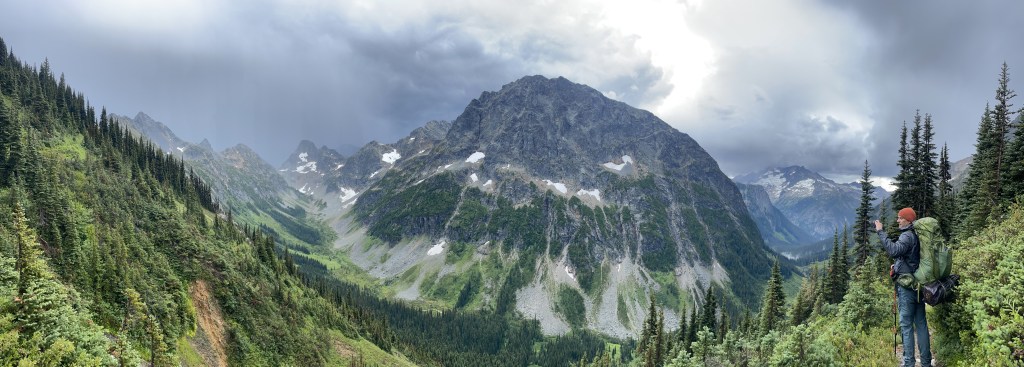
Peter snaps a photo near the summit of Easy Pass (Photo by Bob Swenson)

EASY PASS – Before we get started, let’s just make one thing clear: There’s nothing “easy” about the hike to Easy Pass.

From left, the Fab Four: Peter Richardson, Isaac Richardson, Rick Lund and Bob Swenson.

Sure, the clearly-marked sign off Highway 20 is easy to spot. The trailhead, unlike many starting points for hikes, is easily accessible, just a short, paved road from the highway.

       After that? Easy doesn’t do it.

       It’s a 3,000-foot climb to the pass. That’s a tough slog for even the hardiest of day hikers. Our group of four – which included my son-in-law Peter, his 11-year-old son Isaac and longtime friend and hiking fanatic Bob “Next Ridge” Swenson – would carry weighty overnight packs up to the summit and down 1,275 feet to our camp at Fisher Creek. With the return trip, that’s a minimum elevation gain of nearly 4,300 feet.

      Why Easy Pass? Believe it or not, our original plan was even a more difficult hike to Lake Byrne. That trail along picturesque Lost Creek Ridge in the shadow of Glacier Peak has long been on my bucket list. But Bob, after looking at the topographical map, convinced me to pull the plug on that one.

      Even so, this hike would be our group’s most challenging. To paraphrase the title of a popular Eagles song, I had a peaceful, yet uneasy feeling.

       Who named this pass? And what were they thinking?

After crossing Easy Pass Creek, the trail to Easy Pass breaks out from the forest and follows an exposed, talus slope up to the 6,525-foot summit. (Photo by Rick Lund)
Wildflowers along the trail to Easy Pass. (Photo by Bob Swenson)

       Apparently, someone was trying to be funny. According to historical accounts, the trail was a prospecting route to mines. It was a sarcastic name because there was no “easy route” across the ridge.

       No one in our group was laughing when Mother Nature threw us a curve ball on this 27th day nof July on the steepest part of the trail. Just as we were making our way up the final set of exposed switchbacks to the summit, an unexpected thunderstorm rolled through. What started as a drizzle, eventually turned into a driving hailstorm. Even though no rain had been in the forecast, we were caught off-guard. We had not packed rain ponchos.

      As we hauled our wet gear to the top and found what little shelter there was under scruffy, wind-whipped trees, Peter, a strong hiker and fearless in many ways, had a look of horror on his face.

Looking at Fisher Peak and the Fisher Creek basin from the summit of Easy Pass shortly after a thunderstorm passed through. (Photo by Bob Swenson)

       “I was not prepared for this,” he said, as he nervously rubbed Isaac’s hands, which had gone numb from the sudden drop in temperature.

        Even with dark clouds overhead, however, the views were amazing. Standing at the 6,525-foot summit, you’re reminded why you hike in the first place. Your feet have taken you where few people go.

       The view to the west, into the heart of North Cascades National Park, is absolutely stunning. With glaciated Mount Logan in the distance, the lush-green valley below runs as far as the eye can see. Looking south, a stream-carved basin leads to snow-topped Fisher Peak. To the east are Golden Horn and Mount Henry, two peaks that straddle the Pacific Crest National Scenic Trail.

        Most hikers at this point take their time savoring the views, have lunch, and then make their way back to the trailhead for what amounts to a seven-mile, round trip. The outliers here, we continued down the other side – frozen fingers, soaked backpacks and all ­– to Fisher Creek Camp, where we had reserved one of three campsites for two nights.

Peter and Isaac forge Fisher Creek to explore the meadow. (Photo by Rick Lund)

A day of exploring

      We woke up to sun on Day 2. Hanging our wet clothes out to dry, we donned light day packs  to explore nearby Fisher Creek basin.

A marmot basks in the sun on a boulder in the Fisher Creek basin. (Photo by Bob Swenson)

      The more lightly-traveled trail from the junction just east of camp hugs the forest for a few hundred yards, before breaking out into a vast Alpine meadow that is nothing short of spectacular. We took pictures of wildflowers, took selfies and lounged on giant-sized boulders and ate our lunch as marmots scurried nearby.

      Towering high above the meadow that ends in a mountain version of a cul-de-sac is 8,060-foot Fisher Peak. Looking back to where we came from, the sun glistened off 8,795-foot Mesahchie Peak. We could also see the switchbacks of the trail that would take us up and over Easy Pass the next morning.

Wildflowers in the Fisher Creek basin frame 8,060-foot Fisher Peak in the background. (Photo by Rick Lund)
Looking down the Fisher Creek basin to 8,795-foot Mesahchie Peak. (Photo by Bob Swenson)
Fisher Creek meanders through the beautiful Alpine meadow that is Fisher Creek basin. (Photo by Bob Swenson)
Having a lunch on a table-topped boulder in Fisher Creek basin, with 8,060-foot Fisher Peak in the background. (Photo by Rick Lund)

      We also met backpackers on this side of Easy Pass who, like us, were here for extended stays. A few were headed farther up the Fisher Creek basin to Silent Lakes. Others were even more ambitious. We met backpackers who had dropped cars off on two locations, so as to make the trip one-way. A wilderness ranger checking overnight permits had started at Colonial Creek and was headed to the Easy Pass trailhead, for a total trip of 24 miles. Another group had started at the Panther Creek trailhead. Their final destination at the trailhead off Highway 20 completed a 33-mile journey.

One step at a time

     I had struggled two days earlier ascending Easy Pass, having to stop frequently to catch my breath. The return trip over the pass was also challenging. About halfway up, Bob gave made some good advice.

     “Try setting step goals,” he said. “For example, tell yourself you’re going to take 25 steps before resting. That way, you’re counting steps and not thinking about how far you have to go.”

On Day 3 we make our way back up to Easy Pass. (Photo by Bob Swenson)

      I started out at 25 steps, then 35, before working my way to 50. Eventually, I was counting 100 steps before resting. Before I knew it, I was making great progress. Like Bob said, it took my focus off of looking at the summit and realizing how far I had to go.

       Isn’t that how life is? The older I get, the more I understand that growth is incremental. The key is discipline. This can be true of an exercise regiment or a diet plan. You cannot meet your weight goal or get fit overnight. As a Christian, I have found that daily time spent in God’s Word and prayer has a stacking-bricks effect. It’s the accumulation of days that ultimately stimulates lasting growth and liberates potential. There are no short cuts.

Rick makes his way down the Easy Pass trail on talus slopes on the way back to the trailhead. (Photo by Bob Swenson)

        There were certainly no quick fixes or short cuts back to the trailhead. It took us about seven hours from the Fisher Creek Camp to make our way back. In the parking lot, I had a conversation with a couple younger day hikers from Oregon we had met earlier in the day at the Easy Pass summit.

       As I removed my overnight pack, one of the women exclaimed, “That was a tough day hike, one of the tougher ones I’ve done. I can’t imagine hauling a backpack up there.”

      Easy? No. Worth it? Definitely.

A Buck we named “Velvet” was a frequent visitor at the Fisher Creek Camp. Here, Isaac offers him some “leafy greens.” (Photo by Rick Lund)

The tall and short of it

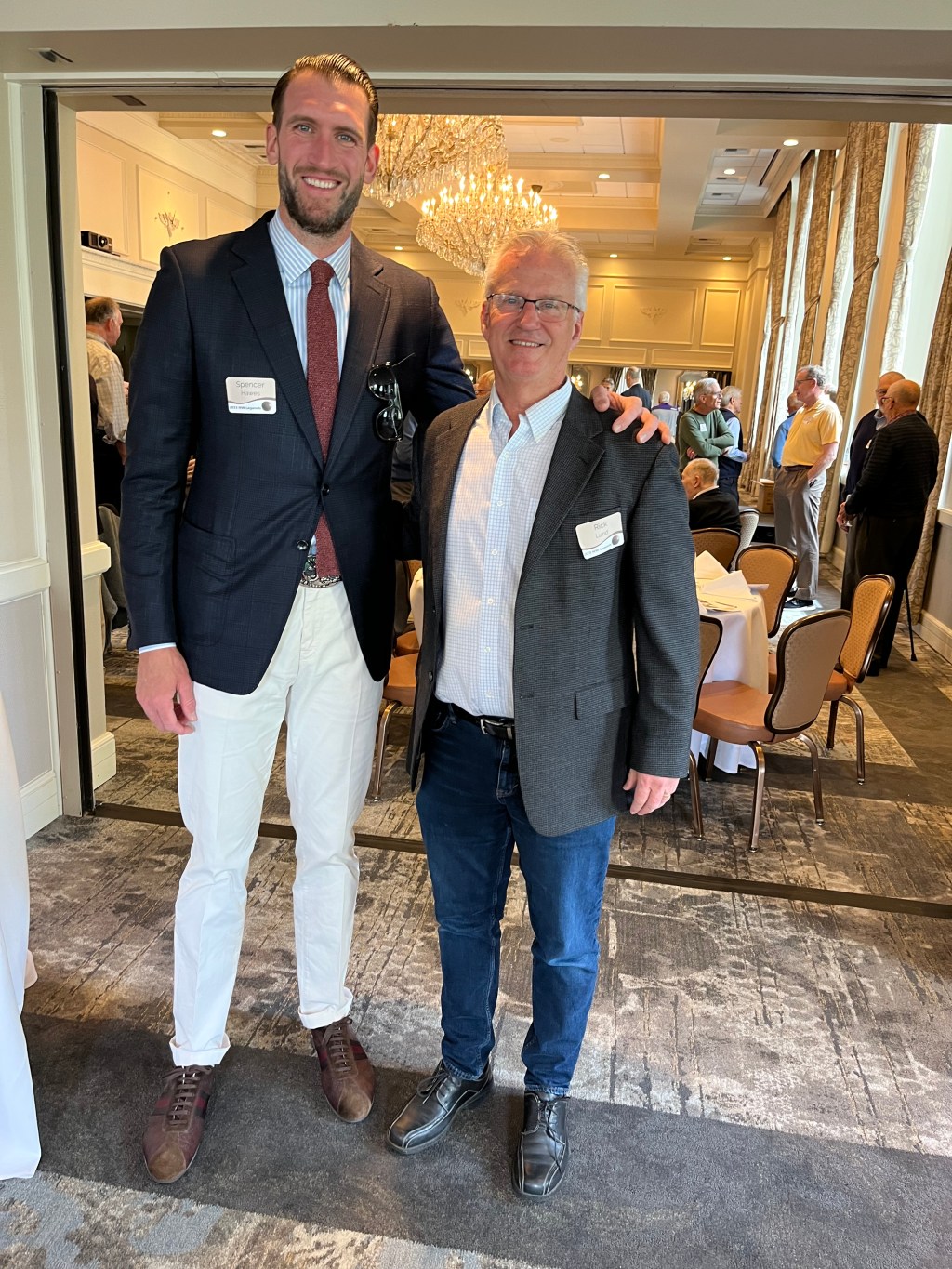
Spencer Hawes – all 7 feet 1 inches of him – with me at the Northwest Basketball Legends at the Washington Athletic Club in Seattle on May 6.

I entered the Land of the Giants recently – literally and figuratively.

It was the 68th gathering of the Northwest Basketball Legends in Seattle. Seven-foot-1 Spencer Hawes was there. His uncle, Steve Hawes, a mere 6-foot-10, received a Merit of Excellence award at the banquet. Steve was an All-American at the UW and also played 10 seasons in the NBA, including two for the hometown Seattle SuperSonics. He was introduced by his brother, Jeff, a relative shrimp at 6-foot-7 inches who played alongside Steve at UW.

Also in attendance were other former college basketball giants in our state: Jim McKean (6-9, Washington State), Jay Bond (6-9, Washington), Tom Workman (6-7, Seattle U.) and Eddie Miles (6-4, Seattle U.), one of the few black players in the room of 100 or so.

Spencer Hawes and and I formally entered the “Legends” group together. The similarities end there. He played one season at the University of Washington, before bolting for the NBA, where he spent 10 productive seasons in the NBA. I spent two largely unproductive seasons at Sedro-Woolley High School as a reserve guard.

Talk about an unlikely pair. The organization is made up of former players, coaches and assorted media-types. I fall into the latter group. It was great to reunite with my former Seattle Times colleagues Craig Smith, Dwight Perry, Scott Hanson, Bill Kossen, Mike Lindblom and current Times Sports Editor Paul Barrett. Sportswriter extraordinaire Bud Withers was unable to make it.

What a wonderful afternoon at the Washington Athletic Club in downtown Seattle. Keynote speaker Johnny O’Brien, former Seattle U. All-American and major-league baseball player, regaled us with his humor and story-telling.

Already looking forward to next year’s gathering, which hopefully will be younger and less “white.”

It’s time for me to get Kraken

They said playoff hockey will hook you. Consider me hooked.

I tried to be disinterested. But how can you not be caught up in this team and this game of skill played at lightning speed?

Greta and Karl, wearing a Chicago Blackhawks shirt.

I credit my Chicago-raised, son-in-law, Karl, for sparking our interest in hockey. Karl is a big Chicago Blackhawks fan and a hockey player himself. Vicki and I usually visit Karl and Greta in May, and our visits between 2010-2015 invariably overlapped with playoff hockey in Chicago. The Blackhawks made deep runs in the NHL playoffs during that five-year span, including two Stanley Cup titles. We spent many evenings watching those playoff games together. During that time, Karl taught us some of the nuances of the game of hockey.

So when Seattle landed a NHL team, perhaps no one was happier in our family than Karl. While the Blackhawks are in rebuilding mode, Karl’s jumped on the Kraken bandwagon.

It’s time for me to jump on board as well.

I have a shallow interest in the Kraken’s deep dive into the postseason

The Kraken warm up before a game with the Philadelphia Flyers in February at Climage Pledge Arena. This view is from our seats, close to the top of the arena. Great overhead view of how plays develop, but hard to see the puck at times because you’re so far away.

The Seattle Kraken are in the Stanley Cup playoffs. Whoop-dee-freakin-doo.

Please excuse my sarcasm. I’m trying – I really am – to embrace hockey. I should be over the moon that the Kraken, in just their second season in the NHL, are in the postseason. I may watch tonight’s Game 1 against the Colorado Avalanche. On the other hand, I may not.

Yes, I’ve been to Climate Pledge Arena to watch a game. Vicki and I were there in early February to see the Kraken maul the Philadelphia Flyers, 6-2. We went more out of curiosity to see the new arena – which I might add is world-class – than anything else. It was a fun evening. The home team was dominating. The video graphics, lighting and sound system were second to none. It had a rock-concert feel to it. But the seats, three rows from the top of the arena, were $127 apiece. I had little desire to go back to another game this season.

Vicki and I at “The Wall” before a Kraken game. We spent more than an hour before the game exploring Climate Pledge Arena.

Granted, the Kraken consistently draw capacity crowds to Climate Pledge. But in my opinion, it’s a niche audience. Like soccer fans, the majority of Kraken fans are in the stadium. TV ratings for Kraken games and newspaper readership for their stories are not impressive. I’m apparently not alone in my tepid interest in the team.

I recently finished a three-month temp stint in the Sports department of The Seattle Times, a paper I retired at in 2020. Each day in our daily front-page, lineup meetings on Zoom, an online editor would review the day’s “digital traffic.” That’s a fancy phrase for a rundown on how many readers were engaging with our stories online. It’s a way for editors at the paper to see what readers like.

In my early days in Sports, my way of gauging reader interest was very primitive. It went something like this. I watched the guy in the seat in front of me on the bus flip through the Sports section to see which pages and stories he spent the most time with.

The analytics newspapers and web sites use today, suffice it to say, are much more sophisticated. For example, a software program reveals not only which stories are most read, but how many readers are reading a story at a given time, whether they are subscribers or visitors, how much time he or she is spending with a given story, and what type of device they’re reading it on (smart phone, tablet or computer).

The analytics during my recent stint in Sports revealed this: Kraken stories consistently lagged behind the “Big Three” drivers of Sports online traffic: Husky football, the Seahawks and the Mariners., in that order. And this was during the peak of the Kraken’s historic season, which was the offseason for the aforementioned other sports. In other words, a story on projected two-deeps for next fall’s UW football team attracted more eyeballs than a Kraken story. Yes, this is the much-improved hockey team, that after winning just 27 of 82 games in its expansion season, put together an 8-game winning streak in January en route to an impressive 46-28 regular-season record and a third-place finish in the tough Pacific Division.

“We saw a pretty big spike initially when the team arrived,” one of The Times Sports editors told me. “But there was a huge drop-off when the team fell flat in year 1, and we haven’t seen folks return in full.

“It’s a bit of a head-scratcher considering they’re about to face the defending champs in the playoffs, but we’re still not seeing a ton of interest in our playoff preview stories.”

Furthermore, the Kraken’s stellar on-ice performance in Season 2 also didn’t transfer to good TV ratings. A Nielsen Media report in January revealed broadcast ratings for the Kraken were among the bottom third of U.S.-based NHL teams. The rating was virtually no different than the ratings from the previous year, when the expansion team had one of the worst records in the NHL.

Unlike Midwest and Eastern U.S. cities, we have a small sample size of major-league hockey in the Pacific Northwest. We grew up with minor-league hockey. Maybe we don’t understand the nuances of the game, or appreciate how skilled hockey players are, though it’s pretty obvious to me they are very athletic, in great shape and very good ice skaters.

Two years into this Kraken thing, I still couldn’t rattle off the names of more than four players on the roster. I don’t completely understand what “offsides” or “icing” is. They’re apparently egregious hockey violations that stop play. But that’s as much as I can tell you. The problem is, I don’t want to know.

Maybe postseason hockey is a different deal. Maybe if the Kraken start out hot, beat some teams they have no business beating, I’ll change my thinking. We’ll see.


The pregame is pretty cool. The serpent-looking logo you see at center ice is lowered from the rafters. The rink goes from blue-green to red and the place goes crazy.


More of Climage Pledge Arena. I think from this vantage point I’d get a better sense for the fast-paced game. A lot easier to see the puck and feel the energy.


Duel in the Desert

I am a huge Washington Husky fan. That’s not a surprise to anyone. I can thank my dear dad for that. It’s in my DNA. My earliest childhood memories of Saturday afternoons in the fall were listening to Husky football on the radio with my dad, watching the rare televised game together (on black-and-white TV), and of course the once-every-year-or-so trip to Husky Stadium to see our beloved Huskies in person.

The underpinnings for my passion for the purple and gold, however, run much deeper: I love college sports, football and basketball in particular. Vicki knows it. Our daughters know it. On one family road trip to southern California, I pulled off I-5 in Fresno so I could see the football stadium of Fresno State. During a spring break trip to Phoenix, we found our way into an empty Arizona State basketball arena, and on the same trip, I coaxed them to attend an ASU spring (intersquad) football game.

On a road trip to Indiana two years ago to visit Greta and her family, I dragged Vicki to eight college football stadiums along the way. That’s right, eight, including Notre Dame, which was more than an hour’s drive east of Greta and Karl’s home in Valparaiso.

Thirty-plus years in sports journalism sucked the life of the pro sports fan out of me. For whatever reason, my time in journalism only increased my appetite for college sports.

With that backdrop in mind, Vicki and I are nearing the end of a month-long stay in Tucson, Arizona, our favorite destination city in the southwest. Oh, and Tucson just so happens to be the home of the University of Arizona.

First, we attended an Arizona basketball game in hallowed McKale Center, which seats 14,545 and is one of the more raucous college basketball venues in the nation. The Wildcats, a perennial national power and ranked No. 14 on this night, destroyed lowly Utah Tech by more than 30 points before a crowd of more than 12,000. I’m sure a game against a Pac-12 opponent, or a big name, non-conference foe, would have been a much tougher ticket.

The highlight would be a day-after-Thanksgiving football game between Arizona and Arizona State. It’s called the Territorial Cup, Arizona’s version of our Apple Cup. Which made this rivalry game all so surreal. Apple Cup games, whether in Seattle or Pullman, are almost always played in frigid temperatures. The temperature at the 1 p.m. kickoff in this southernmost city in the Pac-12 was just under 70 degrees, with a slight breeze. Anything warmer, you could see yourself baking in the desert heat. Arizona Stadium has no roof that offers shade. Walking to the stadium alongside UA and ASU fans wearing short-sleeved shirts in November was new to me.

What a magnificent setting for college football in this desert city ringed by mountains. While Husky Stadium offers great views of Lake Washington and Mount Rainier, you’re in close proximity to hills, feeling a little boxed in. The upper reaches of Arizona Stadium, where we sat, rises high above the desert like a Saguaro cactus on steroids. You see the vastness of the Sonoran Desert. To the west are the Tucson Mountains, to the east the Rincon Mountains, to the north the Santa Catalina Mountains, and to the south, the Huachuca Mountains. The sunset behind the Tucson Mountains is nothing short of spectacular.

We were entertained in the pregame by UA’s marching band called “The Pride of Arizona.” If you attend a UA football or basketball game, be prepared to hear “Bear Down Arizona” many times. It is the unofficial but more popular fight song that in recent decades has essentially replaced the official school fight song “Fight! Wildcats! Fight!”

The roots of “Bear Down Arizona” go back nearly 100 years. And it has nothing to do with bears. Arizona’s quarterback and student body president, John Salmon, suffered a severe spinal cord injury in an automobile accident the day after the first game of the 1926 season. On his death bed, in one of those “win-one-for-the-gipper” moments, Salmon told football coach Pop McKale to tell the team “to bear down.”

While “Bear Down” immediately became a rally cry for the school it didn’t become a fight song until the 1950s. The band director of the University of Michigan was in Tucson to interview for the same position at Arizona. As he flew out over the city, he noticed the words “Bear Down” painted on the roof of the school gymnasium. He then wrote the lyrics to “Bear Down Arizona” on a napkin on the return flight to Michigan.

The chorus to the song he would eventually lead goes like this:

Bear down, Arizona!
Bear down, red and blue!
Bear down, Arizona!
Hit ’em hard let ’em know who’s who!
Bear down, Arizona!
Bear down, red and blue!
Go, go, Wildcats go!
Arizona, bear down!

“The Pride of Arizona” performing “Bear Down Arizona.”

The words “Bear Down” were included on the field turf in 2015. It’s said that whenever a Wildcat fans sees another wearing the familiar “Block A” around the world he or she yells “Bear Down.”

The game we saw will probably go down in history as one of the more exciting in the rivalry. Neither team could stop the other in the wild affair that featured more than 1,000 combined yards. The lead changed hands five times. Had Arizona State not turned the ball over five times, I’m convinced the Sun Devils would have won. But the Wildcats prevailed, 38-35, snapping a streak of five losses in the series with their hated rivals, including a 70-7 drubbing to ASU on this same field in 2020.

And it is a bitter rivalry. It was chippy. Several scuffles broke out throughout the game. After ASU’s last game-clinching interception with about a minute to go, an all-out melee between the two teams ensued on the field. Three Wildcats and two Sun Devils were thrown out of the game and escorted out of the stadium. As the game ended, the PA announcer instructed the ASU team to leave the field, as not to start another brawl.

The game symbolized two programs going in opposite directions. ASU fired its coach, Herm Edwards, just a few games into the season in the wake of NCAA recruiting violations. Meanwhile, second-year UA Coach Jedd Fisch has gotten Arizona turned around. Its freshman recruiting class was ranked in the Top 25 nationally. The young Wildcats won five games this season, its most since 2017, and is poised for even greater things ahead.

A football power is rising in the desert. At game’s end, red-clad Wildcat fans stormed the field as the sun slid behind the press box and prepared to set behind the Tucson Mountains.

I said it before, and I’ll say it again. I love college football.

The tale of Two Queens

We mourn the loss of Queen Elizabeth. Her magnificent 70-year reign is over.

Just two days after her passing, we celebrate “Queen Victoria,” who turns 66 today. I only mention the two in the same paragraph because they’re connected … at the neck.

When Vicki turned 60, I planned a birthday party fit for a queen. I photoshoped her head on Queen Elizabeth’s body (see above). The photo I used was the same photo that ran on the front page of Friday’s Seattle Times (seen here below).

The black and white photo of Queen Elizabeth was taken in 1969. She would have been 53. The photo of Vicki was taken in 1979. She would have turned 23 that year. It was a rare black and white photograph I had of Vicki that was needed to match the black and white photo of Queen Elizabeth. I colored her eyes blue — which they are — and did a lot of the photoshop work. A former Seattle Times colleague of mine, however, helped me fine-tune it. Fitting QV’s head under QE’s tiarra was particularly challenging. He did a pretty good job.

Vicki’s head (she was always “a head” of the game) and Elizabeth’s body. At this point, I could say something snarky and it would be very complimentary to Vicki, but I’ll refrain.

God Rest Queen Elizabeth! God Bless Queen Victoria! Long live the Queen!